



Avibactam free acid (Standard)
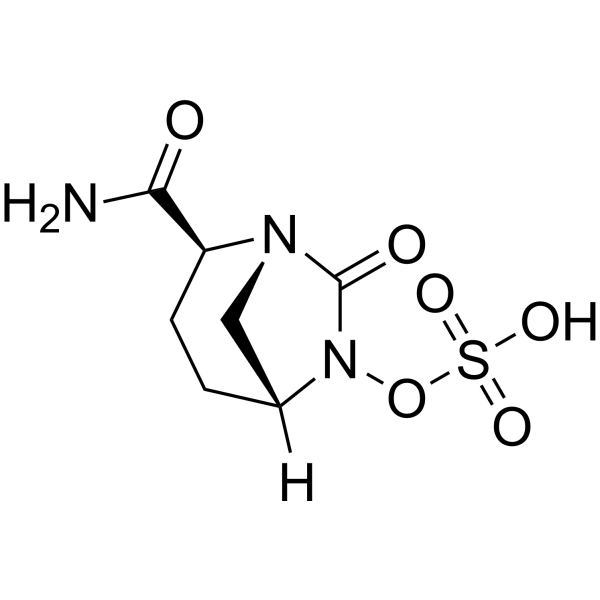
Avibactam (free acid) (Standard) is the analytical standard of Avibactam (free acid). This product is intended for research and analytical applications. Avibactam (NXL-104) free acid is a covalent and reversible non-β-lactam β-lactamase inhibitor which inhibits β-lactamase TEM-1 and CTX-M-15 with IC50s of 8 nM and 5 nM, respectively[1].
For research use only. We do not sell to patients.
- CAS No.: 1192500-31-4
- Formula: C7H11N3O6S
- Molecular Weight:265.24
-
Storage:
Please store the product under the recommended conditions in the Certificate of Analysis.


To place orders, for customer services and technical support, please contact: MedChemExpress USA
Tel: 609-228-6898 E-mail: [email protected] [email protected]


-
 Product Information
-
Chemical Information
- Purity & Documentation
-
 Help & FAQs




Product Information
Information
Application
The compound is the grade of analytical standard, which is the reference standard supplied assay. It is commonly used in qualitative, quantitative and methodological research experiments in HPLC, GC and MS.


Chemical Information
-
CAS No. 1192500-31-4
-
Molecular Weight 265.24
-
Formula C7H11N3O6S
-
SMILES
O=S(ON1[C@]2([H])CC[C@@H](C(N)=O)[N@@](C2)C1=O)(O)=O
-
Synonyms
NXL-104 free acid (Standard)
-
Shipping
Room temperature in continental US; may vary elsewhere.
-
Storage
Please store the product under the recommended conditions in the Certificate of Analysis.


Purity & Documentation
References
[1]. Ehmann DE, et al. Avibactam is a covalent, reversible, non-β-lactam β-lactamase inhibitor. Proc Natl Acad Sci U S A. 2012 Jul 17;109(29):11663-8. [Content Brief]
[2]. Livermore DM, et al. Characterization of β-lactamase and porin mutants of Enterobacteriaceae selected with ceftaroline + avibactam (NXL104). J Antimicrob Chemother. 2012 Jun;67(6):1354-8. [Content Brief]
[3]. Berkhout J, et al. Pharmacokinetics and penetration of ceftazidime and avibactam into epithelial lining fluid in thigh- and lung-infected mice. Antimicrob Agents Chemother. 2015 Apr;59(4):2299-304. [Content Brief]
[4]. Zhang W, et al. In vitro and in vivo bactericidal activity of ceftazidime-avibactam against Carbapenemase-producing Klebsiella pneumoniae. Antimicrob Resist Infect Control. 2018 Nov 21;7:142. [Content Brief]

Calculators
Concentration (start) × Volume (start) = Concentration (final) × Volume (final)


Avibactam free acid (Standard) Related Classifications
HY-14879R Related Classifications
 Powered by Bioz