



PACAP Receptor
Pituitary adenylyl cyclase activating polypeptide receptor
Pituitary adenylate cyclase-activating polypeptide (PACAP) is a 38-amino acid, C-terminally alpha-amidated peptide that can be isolated from an ovine hypothalamic extract based on its ability to stimulate cAMP formation in anterior pituitary cells. PACAP belongs to the vasoactive intestinal polypeptide (VIP)-secretin-growth hormone-releasing hormone-glucagon superfamily. The sequence of PACAP has been remarkably well conserved during evolution, from protochordates to mammals. PACAP is widely distributed in the brain and peripheral organs, notably in the endocrine pancreas, gonads, and the respiratory and urogenital tracts. Two types of PACAP binding sites have been characterized: type I binding sites exhibit a high affinity for PACAP and a much lower affinity for VIP, whereas type II binding sites have a similar affinity for both PACAP and VIP.
Molecular cloning of PACAP receptors has shown the existence of three distinct receptor subtypes: the PACAP-specific PAC1-R, which is coupled to several transduction systems, and the PACAP/VIP-indifferent VPAC1-R and VPAC2-R, which are primarily coupled to adenylyl cyclase. PAC1-Rs are particularly abundant in the brain, pituitary, and adrenal gland, whereas VPAC receptors are expressed mainly in the lung, liver, and testis[1].
Molecular cloning of PACAP receptors has shown the existence of three distinct receptor subtypes: the PACAP-specific PAC1-R, which is coupled to several transduction systems, and the PACAP/VIP-indifferent VPAC1-R and VPAC2-R, which are primarily coupled to adenylyl cyclase. PAC1-Rs are particularly abundant in the brain, pituitary, and adrenal gland, whereas VPAC receptors are expressed mainly in the lung, liver, and testis[1].
PACAP Receptor Isoform Specific Products
All Product Categories
-
PACAP Receptor Related Products (34)
Related Products (34)

-
Antibodies (2)
-
PACAP Receptor Isoform Comparison
- 1
- 2
-
KS-133
 0 ImagesKS-133 is a bicyclic peptide with VIPR2 antagonistic activity that can cross the blood-brain barrier. KS-133 selectively blocks VIPR2-mediated Gq/Ca, Gs/cAMP, cAMP/PKA/ERK and PI3K/AKT/GSK3β signaling pathways. KS-133 inhibits VIPR2 agonist-induced CREB phosphorylation in the prefrontal cortex of mice. KS-133 shifts the polarization direction of macrophages toward M1. KS-133 attenuates cancer cell proliferation and reduces the cell cycle distribution level at the S-M phase. KS-133 exerts antitumor effects in a mouse model of colorectal cancer. KS-133 reverses cognitive decline in mouse models of psychiatric disorders. KS-133 can be used for research related to schizophrenia, colorectal cancer and breast cancer.
-
Anti-PACAP38 Antibody
 0 ImagesCat. No.: HY-P990481Anti-PACAP38 Antibody is a human antibody expressed in CHO cells, targeting PACAP38. The Anti-PACAP38 Antibody has a huIgG4SP type heavy chain and a huκ type light chain, with a predicted molecular weight (MW) of 150 kDa. The isotype control for Anti-PACAP38 Antibody can refer to Human IgG4 kappa, Isotype Control (HY-P99003).
-
Maxadilan
 0 ImagesCat. No.: HY-P3483CAS No.: 135374-80-0Maxadilan is a specific irreversible PAC1 receptor agonist and a potent vasodilator peptide present in the salivary glands of sand flies. Maxadilan exhibits anti-apoptotic activity in hADSCs. Maxadilan inhibits pro-inflammatory cytokines (TNF-α) and enhances anti-inflammatory mediators (IL-10). Maxadilan can activate leukocytes and inhibit vascular permeability through PAC1 receptors. Maxadilan promotes neural differentiation of human adipose-derived stem cells. Maxadilan can be used to study endotoxin shock, atherosclerosis, and neurodegenerative diseases[1][2][3][4][5].
-
PACAP (1-38), human, ovine, rat TFA
 0 ImagesCat. No.: HY-P0221ASynonyms: Pituitary Adenylate Cyclase Activating Polypeptide 38 TFAPACAP (1-38), human, ovine, rat TFA is a PAC1 receptor agonist. PACAP (1-38), human, ovine, rat TFA binds to PACAP type I receptor, PACAP type II receptor VIP1, and PACAP type II receptor VIP2 with IC50s of 4 nM, 2 nM, and 1 nM, respectively. PACAP (1-38), human, ovine, rat TFA increases the α-secretase activity. PACAP (1-38), human, ovine, rat TFA elevates cytosolic Ca2+, increases proliferation and increases phosphorylation of extracellular regulates kinase (ERK) and the epidermal growth factor receptor (EGFR). PACAP (1-38), human, ovine, rat TFA demonstrates potent, efficacious, and sustained stimulatory effects on sympathetic neuronal NPY and catecholamine production. PACAP (1-38), human, ovine, rat TFA can be used for neurotrophic and neuroprotective research.
-
PACAP-38 (16-38), human, mouse, rat
 0 ImagesCat. No.: HY-P1817CAS No.: 144025-82-1PACAP-38 (16-38), human, mouse, rat is a peptide fragment encompassing the C-terminal 16-38 segment of PACAP (1-38), human, ovine, rat (HY-P0221). PACAP-38 (16-38), human, mouse, rat lacks the N-terminal 1-15 receptor activation core, but retains the ability to bind to the PAC/VPAC receptor family (PAC1/VPAC1/VPAC2 receptor). PACAP-38 (16-38), human, mouse, rat promotes histamine release and exerts a certain degree of hypotensive effect.
-
VIP(Guinea pig) TFA
 0 ImagesCat. No.: HY-P1015ASynonyms: Vasoactive Intestinal Peptide, guinea pig TFAVIP Guinea pig TFA (Vasoactive intestinal peptide), a trophic and mitogenic factor, stimulates growth in whole cultured embryos. VIP Guinea pig functions as a simple gastrointestinal hormone and suggest a possible neurotransmitter function.
-
PACAP (1-38) free acid TFA
 0 ImagesCat. No.: HY-P0221BPACAP (1-38) free acid TFA is an endogenous neuropeptide. PACAP (1-38) free acid TFA potently stimulates antral motility and somatostatin secretion, inhibits the secretion of gastrin and stimulates the release of vasoactive intestinal polypeptide, gastrin releasing peptide and substance P. PACAP (1-38) free acid TFA also enhances N-methyl-D-aspartate receptor function and expression of brain-derived neurotrophic factor through RACK1.

-
Ro 25-1553
 0 ImagesCat. No.: HY-P10768CAS No.: 159427-08-4Ro 25-1553 is a selective VIP2 receptor (VPAC2 receptor) agonist. Ro 25-1553 exhibits bronchodilatory effects on tracheal smooth muscle contractions induced by nerve stimulation or Carbachol (HY-B1208). Ro 25-1553 produces a superimposed effect when combined with Formoterol and Salmeterol (HY-14302). Ro 25-1553 can be used for the study of bronchoconstriction.
-
[Arg-15,20,21,Leu17]-PACAP-Gly-Lys-Arg-NH2
![[Arg-15,20,21,Leu17]-PACAP-Gly-Lys-Arg-NH2](https://file.medchemexpress.com/product_pic/hy-p3875.gif "Click to View [Arg-15,20,21,Leu17]-PACAP-Gly-Lys-Arg-NH2 Product Detail") 0 ImagesCat. No.: HY-P3875CAS No.: 176785-25-4Synonyms: BM-PACAP[Arg-15,-20,-21,Leu17]-PACAP-Gly-Lys-Arg-NH2 (BM-PACAP) is a synthetic PACAP 1-27 (HY-P0176) analogue with relaxant effect.
0 ImagesCat. No.: HY-P3875CAS No.: 176785-25-4Synonyms: BM-PACAP[Arg-15,-20,-21,Leu17]-PACAP-Gly-Lys-Arg-NH2 (BM-PACAP) is a synthetic PACAP 1-27 (HY-P0176) analogue with relaxant effect.
-
ANT308
 0 ImagesCat. No.: HY-P11288CAS No.: 2871680-36-1ANT308 is a vasoactive intestinal polypeptide (VIP receptor) antagonist. ANT308 significantly enhances the activation and proliferation of T cells. ANT308 inhibits the migration and metastasis, induces apoptosis of melanoma tumor cells by inhibiting VIP-VPAC2 signaling and reducing the expression of MCAM and N-cadherin. ANT308 can be used for the studies of acute myeloid leukemia (AML) and uveal melanoma (UVM).
-
Prepro VIP (81-122), human
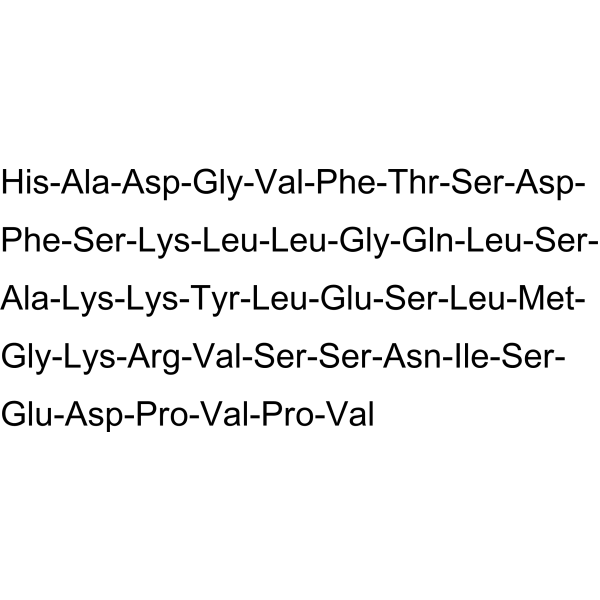 0 ImagesCat. No.: HY-P1767CAS No.: 111366-38-2Prepro VIP (81-122), human is a prepro-vasoactive intestinal polypeptide (VIP) derived peptide, corresponding to residues 81-122. Peptide histidine valine 42 (PHV-42) has been designated to correspond exactly to Prepro VIP (81-122), which reduces both the force and frequency of spontaneous contractions of isolated rat uterus.
-
[D-p-Cl-Phe6,Leu17]-VIP
![[D-p-Cl-Phe6,Leu17]-VIP](https://file.medchemexpress.com/product_pic/hy-p1159.gif "Click to View [D-p-Cl-Phe6,Leu17]-VIP Product Detail") 0 ImagesCat. No.: HY-P1159CAS No.: 102805-45-8[D-p-Cl-Phe6,Leu17]-VIP is a competitive and selective antagonist of vasoactive intestinal peptide (VIP) receptor, with the IC50 of 125.8 nM. [D-p-Cl-Phe6,Leu17]-VIP has no activity on glucagon, secretin or GRF receptors.
0 ImagesCat. No.: HY-P1159CAS No.: 102805-45-8[D-p-Cl-Phe6,Leu17]-VIP is a competitive and selective antagonist of vasoactive intestinal peptide (VIP) receptor, with the IC50 of 125.8 nM. [D-p-Cl-Phe6,Leu17]-VIP has no activity on glucagon, secretin or GRF receptors.
-
Thielocin B1
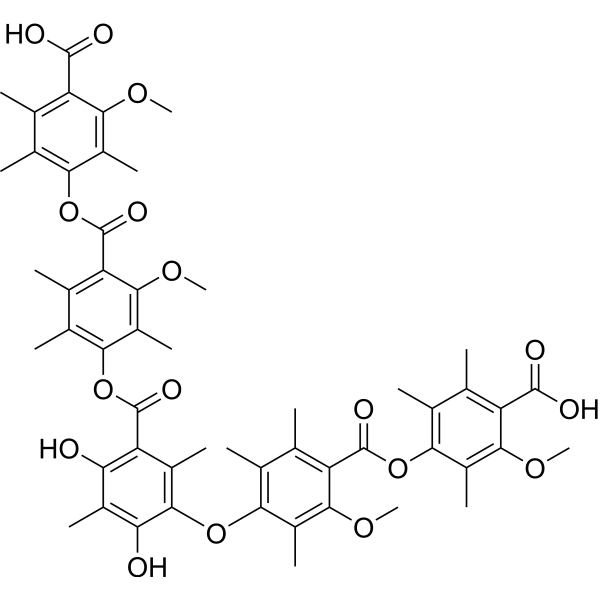 0 ImagesCat. No.: HY-125690CAS No.: 144118-26-3Thielocin B1 is a protein-protein interaction inhibitor of PAC3 homodimer.
- 1
- 2




