1. Others
  2. Drug Derivative Environmental Pollutants
  3. Gibberellic acid

Gibberellic acid  (Synonyms: Gibberellin A3)

Cat. No.: HY-N1964 Purity: 99.26%
Handling Instructions Technical Support

Gibberellic acid (GA3) is a natural plant growth regulator with oral bioactivity. Gibberellic acid governs multiple plant developmental events, including seed germination, cell elongation, floral organ formation, and rice spikelet fertility. Gibberellic acid optimizes root morphology and secondary metabolite production in Echinacea purpurea hairy roots, and serves as a bioactive seed priming agent to improve chilling stress tolerance in chickpea. Gibberellic acid mediates modulation of enzyme activity and secondary metabolism in plants and exerts tissue-specific regulatory effects on antioxidant systems and lipid peroxidation in rats. Gibberellic acid can be used in studies of plant growth, metabolism, and abiotic stress responses.

For research use only. We do not sell to patients.

Gibberellic acid

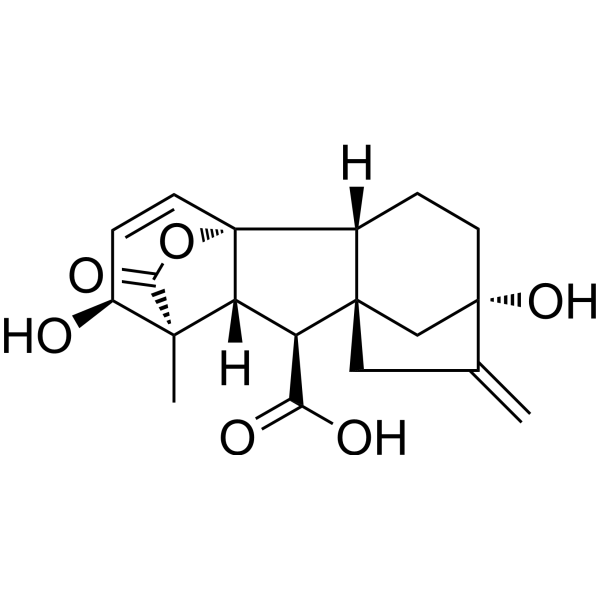
Gibberellic acid Chemical Structure

CAS No. : 77-06-5

Size Price Stock Quantity
Solid + Solvent (Highly Recommended)
10 mM * 1 mL in DMSO
ready for reconstitution
In-stock
Solution
10 mM * 1 mL in DMSO In-stock
Solid
500 mg In-stock
1 g In-stock
5 g In-stock
10 g   Get quote  
50 g   Get quote  

* Please select Quantity before adding items.

This product is a controlled substance and not for sale in your territory.

Customer Review

Based on 1 publication(s) in Google Scholar

Top Publications Citing Use of Products

1 Publications Citing Use of MCE Gibberellic acid

  • Biological Activity

  • Purity & Documentation

  • References

  • Customer Review

Description

Gibberellic acid (GA3) is a natural plant growth regulator with oral bioactivity. Gibberellic acid governs multiple plant developmental events, including seed germination, cell elongation, floral organ formation, and rice spikelet fertility. Gibberellic acid optimizes root morphology and secondary metabolite production in Echinacea purpurea hairy roots, and serves as a bioactive seed priming agent to improve chilling stress tolerance in chickpea. Gibberellic acid mediates modulation of enzyme activity and secondary metabolism in plants and exerts tissue-specific regulatory effects on antioxidant systems and lipid peroxidation in rats. Gibberellic acid can be used in studies of plant growth, metabolism, and abiotic stress responses[1][2][3][4].

Cellular Effect
Cell Line Type Value Description References
CA46 IC50
> 10000 nM
Compound: JRA-001
Cytotoxicity against human CA46 cells assessed as reduction in cell viability measured after 24 hrs by CellTiter-Glo luminescent assay
[PMID: 33062173]
HCC1599 IC50
> 10000 nM
Compound: JRA-001
Cytotoxicity against human HCC1599 cells assessed as reduction in cell viability measured after 24 hrs by CellTiter-Glo luminescent assay
[PMID: 33062173]
HEK-293T IC50
> 10000 nM
Compound: JRA-001
Cytotoxicity against human HEK293T cells assessed as reduction in cell viability measured after 24 hrs by CellTiter-Glo luminescent assay
[PMID: 33062173]
Hs-578T IC50
> 10000 nM
Compound: JRA-001
Cytotoxicity against human Hs-578T cells assessed as reduction in cell viability measured after 24 hrs by CellTiter-Glo luminescent assay
[PMID: 33062173]
NCI-H446 IC50
> 10000 nM
Compound: JRA-001
Cytotoxicity against human NCI-H446 cells assessed as reduction in cell viability measured after 24 hrs by CellTiter-Glo luminescent assay
[PMID: 33062173]
PSN1 IC50
> 10000 nM
Compound: JRA-001
Cytotoxicity against human PSN1 cells assessed as reduction in cell viability measured after 24 hrs by CellTiter-Glo luminescent assay
[PMID: 33062173]
RCK8 IC50
> 10000 nM
Compound: JRA-001
Cytotoxicity against human RC-K8 cells assessed as reduction in cell viability measured after 24 hrs by CellTiter-Glo luminescent assay
[PMID: 33062173]
SUD4 IC50
> 10000 nM
Compound: JRA-001
Cytotoxicity against human SU-DHL-4 cells assessed as reduction in cell viability measured after 24 hrs by CellTiter-Glo luminescent assay
[PMID: 33062173]
In Vitro

Gibberellic acid (GA3) (0.005-1.0 μM; 50 days) maximally enhances biomass, cell viability, secondary metabolite production (cichoric acid, caftaric acid, chlorogenic acid, lignin, anthocyanins), PAL activity, and free radical scavenging activity in light-grown Echinacea purpurea hairy root cultures, while 0.005 μM and 1.0 μM reduce these parameters relative to the 0.025 μM group[2].
Gibberellic acid maintains rice spikelet fertility and anther/pollen development by mediating SLR1 repressor degradation to activate GAMYB and downstream male reproductive genes, while GA deficiency induced by low temperature or GA signaling mutation impairs pollen development and results in male sterility and reduced spikelet fertility in rice[3].
Gibberellic acid (5-20 μM; continuous low-temperature stress treatment) improves stand establishment, shoot/root growth, relative water content, chlorophyll retention, and flower/branch formation, and reduces electrolyte leakage in both chilling-tolerant Çağatay and chilling-sensitive Akçin chickpea cultivars under low-temperature stress[4].

MedChemExpress (MCE) has not independently confirmed the accuracy of these methods. They are for reference only.

Cell Viability Assay[2]

Cell Line: Echinacea purpurea hairy root cells
Concentration: 0.005 μM, 0.025 μM, 1.0 μM
Incubation Time: 0-50 days continuous incubation
Result: Moderate 0.025 μM gibberellic acid significantly enhanced hairy root cell viability; low (0.005 μM) and high (1.0 μM) concentrations exhibited inhibitory effects on cell viability versus control group.
In Vivo

Gibberellic acid (75 ppm; p.o.; ad libitum; 25 days) increases lipid peroxidation in spleen and lung tissues, and alters antioxidant enzyme activities in spleen, kidney, lung, and heart tissues in male Sprague-Dawley rats[1].

MedChemExpress (MCE) has not independently confirmed the accuracy of these methods. They are for reference only.

Animal Model: Sprague-Dawley albino (male, 4 months old, 250-300 g average weight)[1]
Dosage: 75 ppm (equivalent to ~2 mg/day per rat)
Administration: p.o.; 25 days
Result: Significantly increased malondialdehyde (MDA) content in spleen and lung tissues compared to controls.
Significantly increased superoxide dismutase (SOD) activity in spleen and kidney tissues compared to controls.
Significantly decreased glutathione reductase (GR) activity in spleen tissue and significantly increased in kidney tissue compared to controls.
Significantly increased glutathione-S-transferase (GST) activity in spleen and lung tissues, and significantly decreased in heart tissue compared to controls.
Molecular Weight

346.37

Formula

C19H22O6

CAS No.
Appearance

Solid

Color

White to off-white

SMILES

OC([C@H]1[C@@]([C@]23C)([H])[C@@](OC2=O)(C=C[C@@H]3O)[C@@](CC4)([H])[C@]1(C5)C[C@]4(O)C5=C)=O

Initial Source
Shipping

Room temperature in continental US; may vary elsewhere.

Storage

4°C, protect from light

*In solvent : -80°C, 6 months; -20°C, 1 month (protect from light)

Solvent & Solubility
In Vitro: 

DMSO : 100 mg/mL (288.71 mM; Need ultrasonic; Hygroscopic DMSO has a significant impact on the solubility of product, please use newly opened DMSO)

H2O : 4 mg/mL (11.55 mM; ultrasonic and warming and heat to 60°C)

Preparing
Stock Solutions
Concentration Solvent Mass 1 mg 5 mg 10 mg
1 mM 2.8871 mL 14.4354 mL 28.8709 mL
5 mM 0.5774 mL 2.8871 mL 5.7742 mL
View the Complete Stock Solution Preparation Table

* Please refer to the solubility information to select the appropriate solvent. Once prepared, please aliquot and store the solution to prevent product inactivation from repeated freeze-thaw cycles.
Storage method and period of stock solution: -80°C, 6 months; -20°C, 1 month (protect from light). When stored at -80°C, please use it within 6 months. When stored at -20°C, please use it within 1 month.

* Note: If you choose water as the stock solution, please dilute it to the working solution, then filter and sterilize it with a 0.22 μm filter before use.

  • Molarity Calculator

  • Dilution Calculator

Mass (g) = Concentration (mol/L) × Volume (L) × Molecular Weight (g/mol)

Mass
=
Concentration
×
Volume
×
Molecular Weight *

Concentration (start) × Volume (start) = Concentration (final) × Volume (final)

This equation is commonly abbreviated as: C1V1 = C2V2

Concentration (start)

C1

×
Volume (start)

V1

=
Concentration (final)

C2

×
Volume (final)

V2

In Vivo:

Select the appropriate dissolution method based on your experimental animal and administration route.

For the following dissolution methods, please ensure to first prepare a clear stock solution using an In Vitro approach and then sequentially add co-solvents:
To ensure reliable experimental results, the clarified stock solution can be appropriately stored based on storage conditions. As for the working solution for in vivo experiments, it is recommended to prepare freshly and use it on the same day.
The percentages shown for the solvents indicate their volumetric ratio in the final prepared solution. If precipitation or phase separation occurs during preparation, heat and/or sonication can be used to aid dissolution.

  • Protocol 1

    Add each solvent one by one:  10% DMSO    40% PEG300    5% Tween-80    45% Saline

    Solubility: ≥ 2.08 mg/mL (6.01 mM); Clear solution

    This protocol yields a clear solution of ≥ 2.08 mg/mL (saturation unknown).

    Taking 1 mL working solution as an example, add 100 μL DMSO stock solution (20.8 mg/mL) to 400 μL PEG300, and mix evenly; then add 50 μL Tween-80 and mix evenly; then add 450 μL Saline to adjust the volume to 1 mL.

    Preparation of Saline: Dissolve 0.9 g sodium chloride in ddH₂O and dilute to 100 mL to obtain a clear Saline solution.
  • Protocol 2

    Add each solvent one by one:  10% DMSO    90% (20% SBE-β-CD in Saline)

    Solubility: ≥ 2.08 mg/mL (6.01 mM); Clear solution

    This protocol yields a clear solution of ≥ 2.08 mg/mL (saturation unknown).

    Taking 1 mL working solution as an example, add 100 μL DMSO stock solution (20.8 mg/mL) to 900 μL 20% SBE-β-CD in Saline, and mix evenly.

    Preparation of 20% SBE-β-CD in Saline (4°C, storage for one week): 2 g SBE-β-CD powder is dissolved in 10 mL Saline, completely dissolve until clear.
In Vivo Dissolution Calculator
Please enter the basic information of animal experiments:

Dosage

mg/kg

Animal weight
(per animal)

g

Dosing volume
(per animal)

μL

Number of animals

Recommended: Prepare an additional quantity of animals to account for potential losses during experiments.
Please enter your animal formula composition:
%
DMSO +
+
%
Tween-80 +
%
Saline
Recommended: Keep the proportion of DMSO in working solution below 2% if your animal is weak.
The co-solvents required include: DMSO, . All of co-solvents are available by MedChemExpress (MCE). , Tween 80. All of co-solvents are available by MedChemExpress (MCE).
Calculation results:
Working solution concentration: mg/mL
Method for preparing stock solution: mg drug dissolved in μL  DMSO (Stock solution concentration: mg/mL).

*In solvent : -80°C, 6 months; -20°C, 1 month (protect from light)

The concentration of the stock solution you require exceeds the measured solubility. The following solution is for reference only. If necessary, please contact MedChemExpress (MCE).
Method for preparing in vivo working solution for animal experiments: Take μL DMSO stock solution, add μL . μL , mix evenly, next add μL Tween 80, mix evenly, then add μL Saline.
 If the continuous dosing period exceeds half a month, please choose this protocol carefully.
Please ensure that the stock solution in the first step is dissolved to a clear state, and add co-solvents in sequence. You can use ultrasonic heating (ultrasonic cleaner, recommended frequency 20-40 kHz), vortexing, etc. to assist dissolution.
Purity & Documentation

Purity: 99.26%

References

Complete Stock Solution Preparation Table

* Please refer to the solubility information to select the appropriate solvent. Once prepared, please aliquot and store the solution to prevent product inactivation from repeated freeze-thaw cycles.
Storage method and period of stock solution: -80°C, 6 months; -20°C, 1 month (protect from light). When stored at -80°C, please use it within 6 months. When stored at -20°C, please use it within 1 month.

Optional Solvent Concentration Solvent Mass 1 mg 5 mg 10 mg 25 mg
H2O / DMSO 1 mM 2.8871 mL 14.4354 mL 28.8709 mL 72.1772 mL
5 mM 0.5774 mL 2.8871 mL 5.7742 mL 14.4354 mL
10 mM 0.2887 mL 1.4435 mL 2.8871 mL 7.2177 mL
DMSO 15 mM 0.1925 mL 0.9624 mL 1.9247 mL 4.8118 mL
20 mM 0.1444 mL 0.7218 mL 1.4435 mL 3.6089 mL
25 mM 0.1155 mL 0.5774 mL 1.1548 mL 2.8871 mL
30 mM 0.0962 mL 0.4812 mL 0.9624 mL 2.4059 mL
40 mM 0.0722 mL 0.3609 mL 0.7218 mL 1.8044 mL
50 mM 0.0577 mL 0.2887 mL 0.5774 mL 1.4435 mL
60 mM 0.0481 mL 0.2406 mL 0.4812 mL 1.2030 mL
80 mM 0.0361 mL 0.1804 mL 0.3609 mL 0.9022 mL
100 mM 0.0289 mL 0.1444 mL 0.2887 mL 0.7218 mL

* Note: If you choose water as the stock solution, please dilute it to the working solution, then filter and sterilize it with a 0.22 μm filter before use.

  • No file chosen (Maximum size is: 1024 Kb)
  • If you have published this work, please enter the PubMed ID.
  • Your name will appear on the site.
Help & FAQs
  • Do most proteins show cross-species activity?

    Species cross-reactivity must be investigated individually for each product. Many human cytokines will produce a nice response in mouse cell lines, and many mouse proteins will show activity on human cells. Other proteins may have a lower specific activity when used in the opposite species.

Your Recently Viewed Products:

Inquiry Online

Your information is safe with us. * Required Fields.

Product Name


Requested Quantity *

Applicant Name *


Salutation

Email Address *


Phone Number *

Department


Organization Name *

City

State

Country or Region *


Remarks

Bulk Inquiry

Inquiry Information

Product Name:
Gibberellic acid
Cat. No.:
HY-N1964
Quantity:
MCE Japan Authorized Agent: