



Ras
Ras is the name given to a family of related proteins which is ubiquitously expressed in all cell lineages and organs. All Ras protein family members belong to a class of protein called small GTPase, and are involved in transmitting signals within cells. Ras is the prototypical member of the Ras superfamily of proteins, which are all related in 3D structure and regulate diverse cell behaviours. When Ras is 'switched on' by incoming signals, it subsequently switches on other proteins, which ultimately turn on genes involved in cell growth, differentiation and survival. As a result, mutations in ras genes can lead to the production of permanently activated Ras proteins. This can cause unintended and overactive signalling inside the cell, even in the absence of incoming signals. Because these signals result in cell growth and division, overactive Ras signaling can ultimately lead to cancer. The 3 Ras genes in humans (HRAS,KRAS, and NRAS) are the most common oncogenes in human cancer; Ras inhibitors are being studied as a treatment for cancer, and other diseases with Ras overexpression.
Ras Isoform Specific Products
All Product Categories
-
Ras Related Products (719)
Related Products (719)

-
Antibodies (36)
-
Ras Isoform Comparison
-
pan-KRAS-IN-20
 0 ImagesCat. No.: HY-182994CAS No.: 3111803-46-1pan-KRAS-IN-20 is a pan-KRAS inhibitor. pan-KRAS-IN-20 can be used for the researches of cancer, tumors, inflammatory diseases, autoimmune diseases or immune-mediated diseases.
-
KRAS G12D inhibitor 19
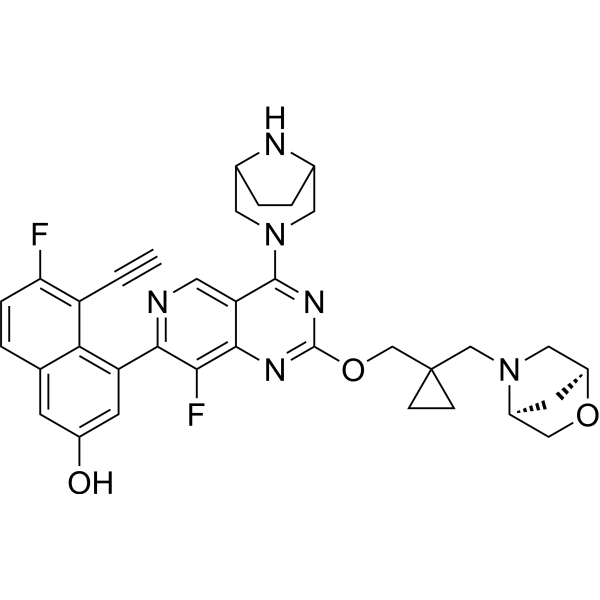 0 ImagesCat. No.: HY-160445CAS No.: 2833695-47-7KRAS G12D inhibitor 19 (Compound 7) is a KRAS G12D inhibitor. KRAS G12D inhibitor 19 can be used for the research of cancer.
-
Myr-Arf1(2–17)
 0 ImagesCat. No.: HY-P10594CAS No.: 143244-89-7Myr-Arf1(2–17) is a sarcosinated peptide that mimics the localization and function of Arf1 protein on the cell membrane. Myr-Arf1(2–17) can be used to study the desensitization mechanism of luteinizing hormone/chorionic gonadotropin receptor (LH/CGR).
-
KRAS G12D-IN-35
 0 ImagesCat. No.: HY-180885SKRAS G12D-IN-35 (example 7) is a potent and orally active KRAS G12D inhibitor. KRAS G12D-IN-35 suppresses p-ERK in AGS cells and potently inhibits the proliferation of various KRAS G12D-mutant cancer cell lines. KRAS G12D-IN-35 inhibits tumor growth in HPAC and GP2D mouse models. KRAS G12D-IN-35 can be used for cancer research, such as pancreatic and colorectal cancer.
-
A-176120
 0 ImagesCat. No.: HY-117807CAS No.: 185049-54-1A-176120 is a selective inhibitor of farnesyl transferase (IC50=1.2 nM) based on a farnesyl pyrophosphate (FPP) analog, with superior selectivity against GGTaseI (IC50=423 nM), GGTaseII (IC50=3000 nM), and SSase (IC50>10 μM). A-176120 inhibits ras processing in H-ras transformed NIH3T3 cells and HCT116 K-ras mutant cells (ED50=1.6 and 0.5 μM, respectively). A-176120 has antiangiogenic and antitumor activities in vivo and reduces capillary structure formation and VEGF secretion.


-
Rho GTPase inhibitor 1
 0 ImagesCat. No.: HY-172917CAS No.: 1309252-99-0Rho GTPase inhibitor 1 (compound 7) is a potent Rho GTPase inhibitor. Rho GTPase inhibitor 1 exhibits high affinity on Cdc42, Rac1 and RhoA with KDs of 151, 352, and 232 μM, respectively. Rho GTPase inhibitor 1 reduces cell migration on glioma cell line.
-
NSC-658497
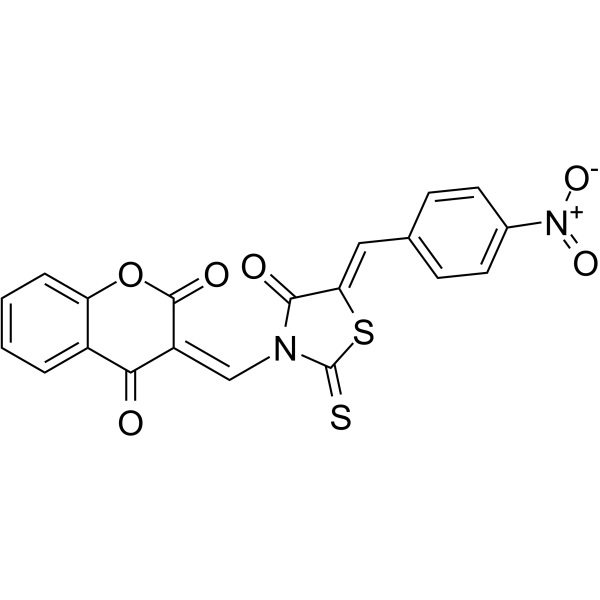 0 ImagesCat. No.: HY-19539CAS No.: 909197-38-2NSC-658497 is an effective inhibitor of Ras-GEF, SOS1. NSC-658497 binds to SOS1, competitively suppresses SOS1-Ras interaction, and dose-dependently inhibits SOS1 GEF activity. NSC-658497 showed dose-dependent efficacy in inhibiting Ras, downstream signaling activities, and associated cell proliferation.
-
PCA-IN-1
 0 ImagesCat. No.: HY-183625PCA-IN-1 is a polyisoprenylated cysteinyl amide (PCA) inhibitor that acts on multiple KRAS mutant subtypes. PCA-IN-1 dissociates KRAS4B from its transport chaperones, prevents its localization to the plasma membrane, and blocks downstream oncogenic signaling pathways. PCA-IN-1 inhibits colony formation of KRAS-mutant lung cancer cells, induces sustained long-term growth inhibition, and suppresses cell migration. PCA-IN-1 is applicable to the research of KRAS-mutant lung cancer.
-
Tubulin-IN-64
 0 ImagesCat. No.: HY-181491Tubulin-IN-64 is a sulfonated styrylquinazoline derivative with high selectivity antitumor activity. Tubulin-IN-64 targets tubulin, inhibits the EGFR/Akt/mTOR and EGFR/Ras signaling pathways, induces cell cycle arrest, apoptosis and autophagy. Tubulin-IN-64 exhibits significant antitumor efficacy in the zebrafish GBM xenograft model. Tubulin-IN-64 can be used for the research on glioblastoma and leukemia.
-
Anticancer agent 207
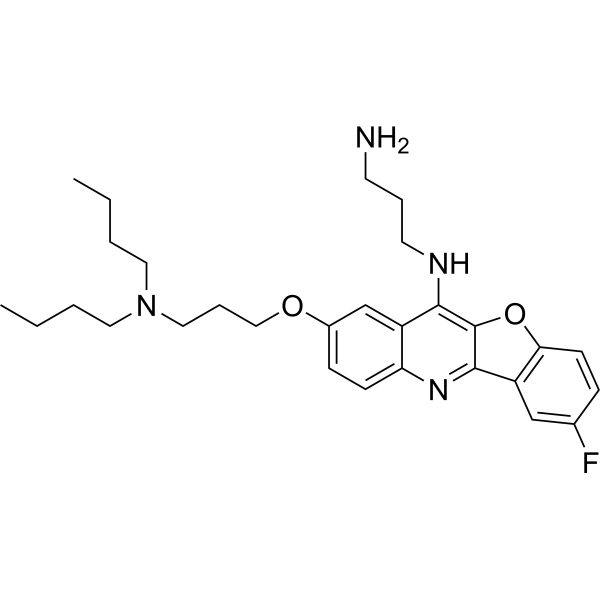 0 ImagesCat. No.: HY-163515Anticancer agent 207 (compound 10b) is a potent anticancer agent. Anticancer agent 207 bounds to the NRAS rG4 with a KD value of 2.31 µM. Anticancer agent 207 shows cytotoxicity and decreases the expression of NRAS protein. Anticancer agent 207 shows antitumor activity.
-
SOS1-IN-20
 0 ImagesCat. No.: HY-175244SOS1-IN-20 (Compound 12f) is an orally active SOS1 inhibitor with an IC50 of 5.11 nM against KRASG12C::SOS1. By disrupting the interaction between KRAS and SOS1, SOS1-IN-20 inhibits KRAS activation and downstream signal transduction. SOS1-IN-20 has an IC50 of 253 nM for p-ERK in PC-9 cells and 16.71 μM for hERG channel . SOS1-IN-20 can inhibit the proliferation of tumor cells and has antitumor activity.
-
KRAS-IN-48
 0 ImagesCat. No.: HY-179300ACAS No.: 3074833-87-4KRAS-IN-48 (Compound 1-01) is a KRAS mutant inhibitor, with Kd values of 2.58 nM and 5.49 μM for KRAS-G12D and KRAS-G12V, respectively. KRAS-IN-48 can be used in the research of cancer.
-
L-744832
 0 ImagesCat. No.: HY-116428CAS No.: 160141-09-3L-744832 is a farnesyl transferase inhibitor. L-744832 effectively inhibits the farnesylation of H-Ras and N-Ras, but has little effect on K-Ras treatment. L-744832 not only directly targets the oncogenic pathway by inhibiting Ras farnesylation, but also enhances radiosensitivity by restoring TGF-β signaling through epigenetic reprogramming. L-744832 can induce cell cycle arrest and apoptosis. L-744832 can be used in combination therapy studies for Ras-driven tumors such as pancreatic cancer.
-
KRAS G12C inhibitor 57
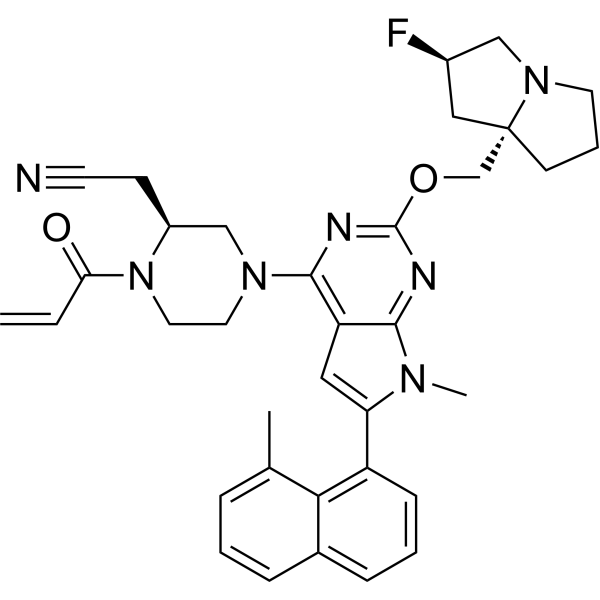 0 ImagesCat. No.: HY-151968CAS No.: 2821863-70-9
-
KRAS G12D inhibitor 6
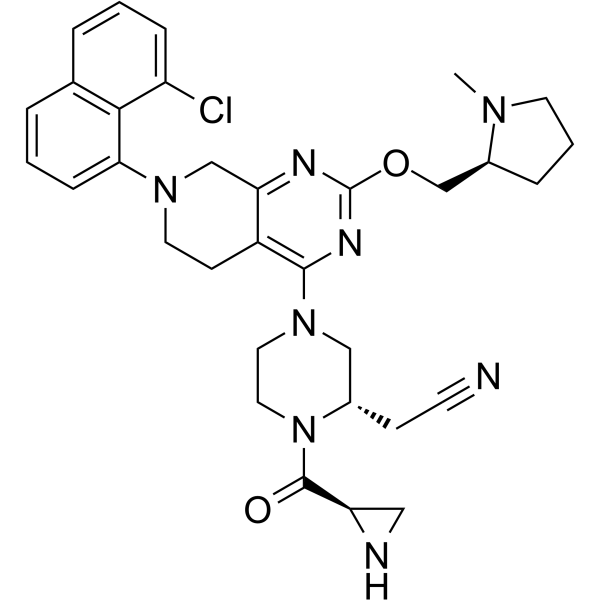 0 ImagesCat. No.: HY-139910CAS No.: 2648552-32-1KRAS G12D inhibitor 6 is a potent inhibitor of KRAS G12D (extracted from patent WO2021108683A1, compound 112) .
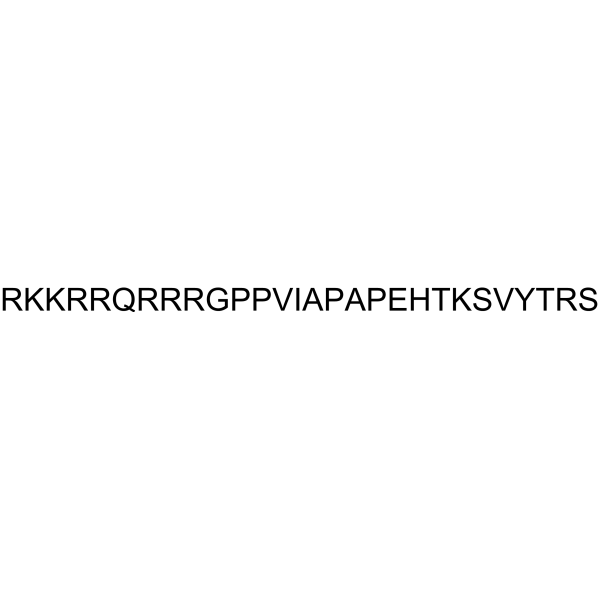
-
KRASG12C IN-20
 0 ImagesCat. No.: HY-182883KRASG12C IN-20 is an orally potent KRASG12C inhibitor with an EC50 of 3.9 nM. KRASG12C IN-20 covalently modifies KRASG12C in its inactive GDP-bound state and locks it to block oncogenic signal transduction. KRASG12C IN-20 exhibits significant activity in lung adenocarcinoma xenograft models. KRASG12C IN-20 can be used for research related to lung adenocarcinoma.




