



N-Ras
N-Ras is a small GTPase that controls cell proliferation, differentiation, and survival through GDP/GTP-regulated signaling[1]. Mechanistically, Ras proteins cycle between ON and OFF states and signal through effector pathways including RAF-MEK-ERK and PI3K[2][3]. In disease models, NRAS has strong relevance in melanoma and acute myelogenous leukemia, and NRAS-mutant melanoma depends on MAPK and PI3K/mTOR signaling[4][5]. Compared with related isoforms, N-Ras, K-Ras, and H-Ras share high G-domain conservation, but biochemical studies show distinct catalytic and signaling properties, so H-Ras data should not be treated as fully representative of N-Ras[1][6]. Isoform distinction also matters experimentally because KRAS is usually more abundant than NRAS in cell-line panels, whereas NRAS often exceeds HRAS in those models[7]. For applications, MEK inhibition with binimetinib improved progression-free survival versus dacarbazine in advanced NRAS-mutant melanoma, while combined MEK and PI3K/mTOR targeting showed antitumor activity in NRAS-mutant melanoma models[8][5]. Recent NRAS-directed monobody work further supports direct inhibition and degradation strategies for NRAS-focused research tools[9].
Verweise:
- [1]. Johnson CW, et al. The small GTPases K-Ras, N-Ras, and H-Ras have distinct biochemical properties determined by allosteric effects. J Biol Chem. 2017 Aug 4;292(31):12981-12993. [Content Brief]
- [2]. Simanshu DK, et al. RAS Proteins and Their Regulators in Human Disease. Cell. 2017 Jun 29;170(1):17-33. [Content Brief]
- [3]. Castellano E, et al. RAS Interaction with PI3K: More Than Just Another Effector Pathway. Genes Cancer. 2011 Mar;2(3):261-74. [Content Brief]
- [4]. Johnson DB, et al. Molecular pathways: targeting NRAS in melanoma and acute myelogenous leukemia. Clin Cancer Res. 2014 Aug 15;20(16):4186-92. [Content Brief]
- [5]. Posch C, et al. Combined targeting of MEK and PI3K/mTOR effector pathways is necessary to effectively inhibit NRAS mutant melanoma in vitro and in vivo. Proc Natl Acad Sci U S A. 2013 Mar 5;110(10):4015-20. [Content Brief]
- [6]. Castellano E, et al. Functional specificity of ras isoforms: so similar but so different. Genes Cancer. 2011 Mar;2(3):216-31. [Content Brief]
- [7]. Hood FE, et al. Ras protein abundance correlates with Ras isoform mutation patterns in cancer. Oncogene. 2023 Apr;42(15):1224-1232. [Content Brief]
- [8]. Dummer R, et al. Binimetinib versus dacarbazine in patients with advanced NRAS-mutant melanoma (NEMO): a multicentre, open-label, randomised, phase 3 trial. Lancet Oncol. 2017 Apr;18(4):435-445. [Content Brief]
- [9]. Whaby M, et al. Inhibition and degradation of NRAS with a pan-NRAS monobody. Oncogene. 2024 Nov;43(48):3489-3497. [Content Brief]
All Product Categories
-
N-Ras Verwandte Produkte (4)
Verwandte Produkte (4)

-
RMC-7977
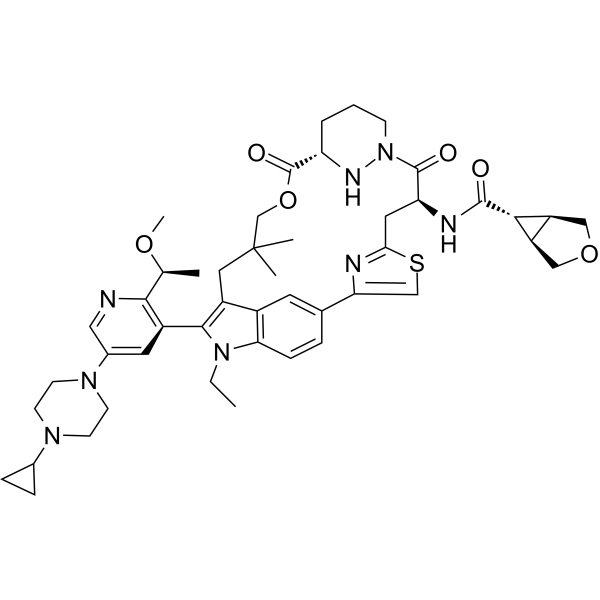 0 ImagesRMC-7977 is an orally active triple-complex RAS inhibitor that can simultaneously bind to cyclophilin A (CYPA) (Kd = 195 nM) and KRAS (G12V) (Kd = 292 μM). It exhibits broad-spectrum inhibitory activity against KRAS, NRAS, and HRAS proteins and their various wild-type and mutant variants. RMC-7977 induces apoptosis by inhibiting the phosphorylation of ERK, CRAF, and RSK, as well as increasing PARP cleavage. This leads to tumor regression, reduces resistance in KRASG12C cancer models, and demonstrates good tolerability across various RAS cancer models.
-
SHOC2-RAS PPI-IN-1
 0 ImagesArt. -Nr.: HY-202699Reinheit: 99.90%SHOC2-RAS PPI-IN-1 is a SHOC2-NRAS interaction inhibitor with IC50 of 0.048 μM and a Kd of 0.065 μM for SHOC2. SHOC2-RAS PPI-IN-1 inhibits RAS/MAPK signalling and downregulates MEK and ERK phosphorylation. SHOC2-RAS PPI-IN-1 can inhibit cells proliferation in RAS-mutant cancer models. SHOC2-RAS PPI-IN-1 can be used for the research of RAS-mutant cancers.
-
Anticancer agent 207
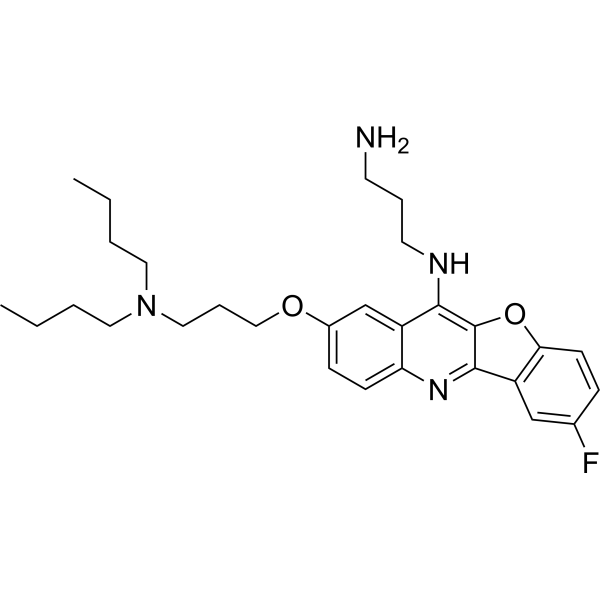 0 ImagesArt. -Nr.: HY-163515Anticancer agent 207 (compound 10b) is a potent anticancer agent. Anticancer agent 207 bounds to the NRAS rG4 with a KD value of 2.31 µM. Anticancer agent 207 shows cytotoxicity and decreases the expression of NRAS protein. Anticancer agent 207 shows antitumor activity.
-
L-744832
 0 ImagesArt. -Nr.: HY-116428CAS. Nr.: 160141-09-3L-744832 is a farnesyl transferase inhibitor. L-744832 effectively inhibits the farnesylation of H-Ras and N-Ras, but has little effect on K-Ras treatment. L-744832 not only directly targets the oncogenic pathway by inhibiting Ras farnesylation, but also enhances radiosensitivity by restoring TGF-β signaling through epigenetic reprogramming. L-744832 can induce cell cycle arrest and apoptosis. L-744832 can be used in combination therapy studies for Ras-driven tumors such as pancreatic cancer.



