Search Result
Results for "
HAMA/MMP13sp/Lipo@celecoxib microspheres
" in MedChemExpress (MCE) Product Catalog:
25
Biochemical Assay Reagents
| Cat. No. |
Product Name |
Target |
Research Areas |
Chemical Structure |
-
- HY-B0340
-
|
DM9384; DZL-221
|
nAChR
iGluR
mGluR
PKC
GABA Receptor
Calcium Channel
|
Neurological Disease
|
|
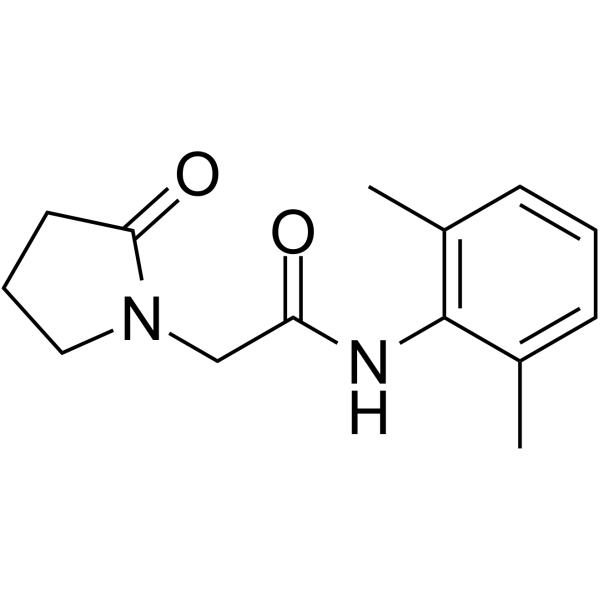
Nefiracetam is a cognition-enhancing agent. Nefiracetam is an activator of nAChR, N-methyl-D-aspartate receptor (NMDAR), mGluR5, PKC, gamma-aminobutyric acid (GABA), and N/L-type Ca 2+ channels. Nefiracetam promotes neuroplasticity and enhances neuroprotection. Nefiracetam can be used in Alzheimer's disease, epilepsy, and cerebral ischemia research .
|
-
-
- HY-126213
-
|
18:1 Lyso-PS
|
NADPH Oxidase
Interleukin Related
Apoptosis
|
Inflammation/Immunology
|
|
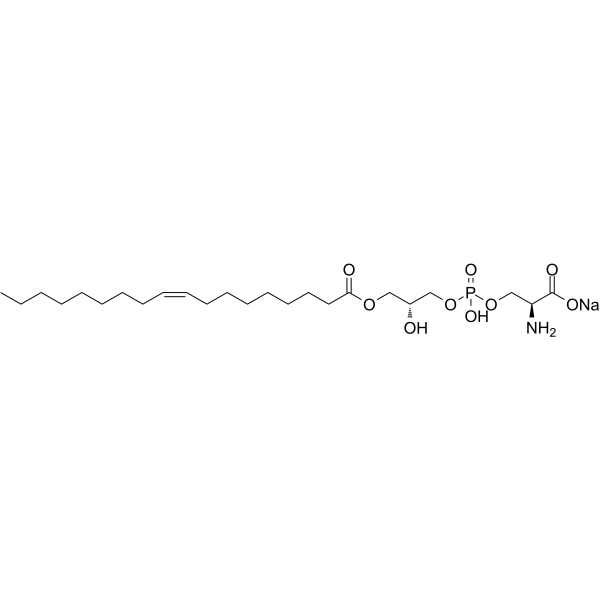
Oleoyl-2-hydroxy-sn-glycero-3-phospho-L-serine sodium (18:1 Lyso-PS) is a modified PS product generated following NADPH oxidase activation and Lyso-PS signal transduction. 1-Oleoyl-2-hydroxy-sn-glycero-3-phospho-L-serine sodium signals through macrophage G2A to enhance the phagocytic uptake of PS-dependent apoptotic (apoptosis) neutrophils and PS-exposed activated neutrophils. 1-Oleoyl-2-hydroxy-sn-glycero-3-phospho-L-serine sodium enhances macrophage phagocytic uptake of apoptotic cells, carboxylate-modified microspheres, and PS-exposed non-apoptotic activated neutrophils. 1-Oleoyl-2-hydroxy-sn-glycero-3-phospho-L-serine sodium serves as an acyl acceptor substrate for the lysophosphatidyltransferase At1g78690p to generate diacylphosphatidylserine. 1-Oleoyl-2-hydroxy-sn-glycero-3-phospho-L-serine sodium reduces the secretion of IL-8 and decreases the proportion of viable colon cancer cells. 1-Oleoyl-2-hydroxy-sn-glycero-3-phospho-L-serine sodium is applicable to studies on peritonitis and inflammatory bowel disease .
|
-
-
- HY-W134328
-
|
Dextran blue (MW 2000000)
|
Biochemical Assay Reagents
|
Others
|
|
Blue dextran (Dextran blue) (MW 2000000) is a high-molecular-weight long-chain polymer of D-glucose. Blue dextran (MW 2000000) serves as an important model macromolecular drug and molecular weight estimation marker, and can be used as a standard for gel permeation chromatography. The release of Blue dextran (MW 2000000) from alginate microspheres is regulated by preparation conditions; its release rate in a pH 6.8 environment is significantly faster than that in pH 1.2, and it exhibits release characteristics close to zero-order kinetics under this condition .
|
-

-
- HY-W020249
-
|
|
Biochemical Assay Reagents
|
Others
|
|
Sodium ionophore X is a neutral ionophore that binds highly selectively to sodium ions (Na +) to form stable complexes. Sodium ionophore X can be used to construct ion-selective chemical sensors (including optical sensors and electrochemical sensors) .
|
-

-
- HY-D2401F
-
|
|
Fluorescent Dye
|
Others
|
|
Cy5-Polystyrene microsphere (100 nm) is a Cy5 (HY-D0821)-labeled microsphere that can be used for bioimaging and drug delivery .
|
-

-
- HY-158220
-
|
HAMA (MW 400 kDa)
|
Biochemical Assay Reagents
|
Others
|
|
Hyaluronic acid Methacryloyl (HAMA) is methacrylated hyaluronic acid that is biocompatible. Hyaluronic acid Methacryloyl is also used as a 3D printing hydrogel ink, which has the characteristics of fast photosensitive response, fast gelation speed and stable hydrogel performance. Hyaluronic acid Methacryloyl can quickly induce gelation with lithium phenyl-2,4,6-trimethylbenzoylphosphinate (LAP) under UV irradiation. The combination of Hyaluronic acid Methacryloyl and tissue-specific extracellular matrix (ECM) materials (such as pancreatic extracellular matrix (pECM)) will become an important source material for organoid culture .
|
-

-
- HY-158220A
-
|
HAMA (MW 150 kDa)
|
Biochemical Assay Reagents
|
Others
|
|
Hyaluronic acid Methacryloyl (HAMA) MW 150 kDa is methacrylated hyaluronic acid that is biocompatible. Hyaluronic acid Methacryloyl is also used as a 3D printing hydrogel ink, which has the characteristics of fast photosensitive response, fast gelation speed and stable hydrogel performance. Hyaluronic acid Methacryloyl can quickly induce gelation with lithium phenyl-2,4,6-trimethylbenzoylphosphinate (LAP) under UV irradiation. The combination of Hyaluronic acid Methacryloyl and tissue-specific extracellular matrix (ECM) materials (such as pancreatic extracellular matrix (pECM)) will become an important source material for organoid culture .
|
-

-
- HY-D2401F1
-
|
|
Fluorescent Dye
|
Others
|
|
Cy5-Polystyrene microsphere (20um) is a Cy5 (HY-D0821)-labeled microsphere that can be used for bioimaging and drug delivery .
|
-

-
- HY-148140B
-
-

-
- HY-148140A
-
-

-
- HY-148140C
-
-

-
- HY-158221
-
|
CSMA
|
Biochemical Assay Reagents
|
Others
|
Chondroitin Sulfate Methacryloyl (CSMA) is methacrylated chondroitin sulfate and is biocompatible. Chondroitin Sulfate Methacryloyl has a higher degree of methacrylation than HAMA (HY-158220), and the degree of methacrylation is closely related to customizable mechanical properties, swelling properties and enzymatic degradability. Chondroitin Sulfate Methacryloyl is a versatile biomaterial suitable for biomimetic hydrogel scaffolds and an ideal 3D printing hydrogel ink . Chondroitin Sulfate Methacryloyl needs to self-assemble into fibrous hydrogel under the action of photoinitiator LAP (HY-44076), and target bioactive adhesion sites, play an inherent supporting role for tissue cells and biodegradable activity.
Application: cell culture, biological 3D printing, tissue engineering, etc.
|
-

-
- HY-158220C
-
|
HAMA (MW 50000)
|
Biochemical Assay Reagents
|
Others
|
|
Hyaluronic acid methacryloyl (HAMA) (MW 50000) is a methacrylate-modified hyaluronic acid that serves as a hydrogel former, hydrolysis-resistant material, photocrosslinkable hydrogel scaffold, and drug delivery carrier for tissue engineering. Hyaluronic acid methacryloyl (MW 50000) forms hydrogels via photocrosslinking; when combined with AuMA NPs through a one-step photocrosslinking method, its effective swelling ratio increases, and the mechanical reinforcement effect of Au NPs compensates for the impact caused by reduced crosslinking density. Hyaluronic acid methacryloyl (MW 50000) can be combined with AuMA NPs via a one-step photocrosslinking method, enabling non-invasive monitoring of hydrogel degradation with contrast-enhanced micro-CT .
|
-

-
- HY-141522A
-
-

-
- HY-148139A
-
-

-
- HY-138560A
-
|
|
Biochemical Assay Reagents
|
Others
|
|
Cross-linked dextran G 50, medium is a gel filtration medium. Cross-linked dextran G 50, medium can be used in gel permeation chromatography for fractionation of the glycopeptide mixture (Sphere protein separation range: 1.5K-30K Da; Polysaccharide separation range: 500-10K Da). Cross-linked dextran G 50, medium are microspheres with an average particle size of D50 = 220-250 μm .
|
-

-
- HY-138560B
-
|
|
Biochemical Assay Reagents
|
Others
|
|
Cross-linked dextran G 50, fine is a gel filtration medium. Cross-linked dextran G 50, fine can be used in gel permeation chromatography for fractionation of the glycopeptide mixture (Sphere protein separation range: 1.5K-30K Da; Polysaccharide separation range: 500-10K Da). Cross-linked dextran G 50, fineThe average particle size is D50=110-130 μmof microspheres .
|
-

-
- HY-158220B
-
|
HAMA (MW 10000)
|
Biochemical Assay Reagents
|
Others
|
|
Hyaluronic acid methacryloyl (MW 10000) (HAMA (MW 10000)) is a Hyaluronic acid (HY-B0633A) derivative. Hyaluronic acid methacryloyl-based material system has been applied in many biomedical research fields .
|
-

-
- HY-158220D
-
|
HAMA (MW 300000)
|
Biochemical Assay Reagents
|
Inflammation/Immunology
|
|
Hyaluronic acid methacryloyl (MW 300000) (HAMA (MW 300000)), a natural extracellular matrix (ECM) with anti-inflammatory effects, promoting cell adhesion and proliferation. Hyaluronic acid methacryloyl (MW 300000) can be widely used in tissue engineering and regenerative medicine. Hyaluronic acid methacryloyl (MW 300000) can rapidly form a hydrogel after exposure to UV light .
|
-

-
- HY-106868
-
|
Isocarbacyclin methyl ester; TEI 9090; TTC 909
|
Drug Derivative
|
Cardiovascular Disease
Neurological Disease
|
|
Clinprost (Isocarbacyclin methyl ester; TEI 9090; TTC 909) is a drug preparation of the stable prostaglandin I(2) analogue clinprost incorporated into lipid microspheres. Clinprost can reduce infarct volume in stroke rats .
|
-

-
- HY-179073A
-
|
|
Fluorescent Dye
|
Others
|
|
TRITC-Polysucrose 40 is TRITC-labeled Polysucrose 40 (HY-131960C). Polysucrose 40 is a copolymer of sucrose and epichlorohydrin. Polysucrose 40 can be used to prepare cross-linked polysucrose microspheres. TRITC-Polysucrose 40 is mainly used for permeability and microcirculation studies (Ex/Em = 544/570 nm) .
|
-

-
- HY-B0746
-
|
dl-Flurbiprofen sodium
|
Endogenous Metabolite
|
Inflammation/Immunology
|
|
Flurbiprofen sodium (dl-Flurbiprofen sodium) is a nonsteroidal anti-inflammatory agent (NSAID) with anti-inflammatory and analgesic activities. Flurbiprofen sodium is used to reduce bone resorption in periodontal disease, and it works by inhibiting carbonic anhydrase. Flurbiprofen sodium is formulated as biodegradable microspheres for use as a compound delivery system, particularly within the periodontal pocket. The release rate of flurbiprofen sodium is related to the concentration of polymer and polyvinyl alcohol used in its preparation .
|
-

-
- HY-157232
-
|
|
Biochemical Assay Reagents
|
Others
|
AC Antibody purification resin 2 is based on spherical, highly cross-linked agarose beads with a narrow size distribution and high mechanical stability. Used for the separation and purification of complex antibodies such as monoclonal antibody, double antibody, multi-antibody and Fc fusion protein
.
Substrate: highly crosslinked agarose microspheres; Particle size: 65μm; Ligand: alkali-resistant recombinant Protein A; ADC purified resin.
|
-
-
- HY-164036R
-
|
|
Reference Standards
Antibiotic
Bacterial
|
Infection
|
|
Flurbiprofen (sodium) (Standard) is the analytical standard of Flurbiprofen (sodium). This product is intended for research and analytical applications. Flurbiprofen sodium (dl-Flurbiprofen sodium) is a nonsteroidal anti-inflammatory agent (NSAID) with anti-inflammatory and analgesic activities. Flurbiprofen sodium is used to reduce bone resorption in periodontal disease, and it works by inhibiting carbonic anhydrase. Flurbiprofen sodium is formulated as biodegradable microspheres for use as a compound delivery system, particularly within the periodontal pocket. The release rate of flurbiprofen sodium is related to the concentration of polymer and polyvinyl alcohol used in its preparation .
|
-

-
- HY-P11641
-
|
|
MMP
|
Inflammation/Immunology
|
|
GCRRGPLGLSLGKRRCG is an MMP13-specific substrate peptide cleaved by MMP13. GCRRGPLGLSLGKRRCG contributes to an MMP13-responsive hydrogel microsphere system that achieves intelligent and controllable drug release in osteoarthritis (OA), decelerates disease progression, and promotes articular cartilage repair. GCRRGPLGLSLGKRRCG can be used for the research of osteoarthritis .
|
-

-
- HY-131960B
-
|
|
Biochemical Assay Reagents
|
Others
|
|
Polysucrose 20 is a copolymer of sucrose and epichlorohydrin. Polysucrose 20 can be used to prepare crosslinked polysucrose microspheres .
|
-

-
- HY-131960C
-
|
|
Biochemical Assay Reagents
|
Others
|
|
Polysucrose 40 is a copolymer of sucrose and epichlorohydrin. Polysucrose 40 can be used to prepare crosslinked polysucrose microspheres .
|
-

-
- HY-131960D
-
|
|
Biochemical Assay Reagents
|
Others
|
|
Polysucrose 1000 is a copolymer of sucrose and epichlorohydrin. Polysucrose 1000 can be used to prepare crosslinked polysucrose microspheres .
|
-

-
- HY-179073
-
|
|
Fluorescent Dye
|
Others
|
|
TRITC-Polysucrose 20 is TRITC-labeled Polysucrose 20 (HY-131960B). Polysucrose 20 is a copolymer of sucrose and epichlorohydrin. Polysucrose 20 can be used to prepare cross-linked polysucrose microspheres. TRITC-Polysucrose 20 is mainly used for permeability and microcirculation studies (Ex/Em = 544/570 nm) .
|
-

-
- HY-179074
-
|
|
Fluorescent Dye
|
Others
|
|
FITC-Polysucrose 20 is FITC-labeled Polysucrose 20 (HY-131960B). Polysucrose 20 is a copolymer of sucrose and epichlorohydrin. Polysucrose 20 can be used to prepare cross-linked polysucrose microspheres. FITC-Polysucrose 20 is mainly used for permeability and microcirculation studies (Ex/Em = 488/525 nm) .
|
-

-
- HY-179074A
-
|
|
Fluorescent Dye
|
Others
|
|
FITC-Polysucrose 40 is FITC-labeled Polysucrose 40 (HY-131960C). Polysucrose 40 is a copolymer of sucrose and epichlorohydrin. Polysucrose 40 can be used to prepare cross-linked polysucrose microspheres. FITC-Polysucrose 40 is mainly used for permeability and microcirculation studies (Ex/Em = 488/525 nm) .
|
-

-
- HY-182094C
-
|
|
Liposome
|
Metabolic Disease
|
|
DSPE-PEG5000-KTP is a PEG compound which composed of DSPE and a Kidney-targeting peptide KTP (HY-P11069). KTP can interact with specific proteins on the surface of renal tubular epithelial cells or exhibit higher affinity in the specific renal microenvironment, tending to aggregate or be internalized within the renal tubular epithelium. DSPE-PEG5000-KTP can actively guide carriers such as nanomedicines, liposomes, and microspheres to the kidney .
|
-

-
- HY-182094
-
|
|
Liposome
|
Metabolic Disease
|
|
DSPE-PEG1000-KTP is a PEG compound which composed of DSPE and a Kidney-targeting peptide KTP (HY-P11069). KTP can interact with specific proteins on the surface of renal tubular epithelial cells or exhibit higher affinity in the specific renal microenvironment, tending to aggregate or be internalized within the renal tubular epithelium. DSPE-PEG1000-KTP can actively guide carriers such as nanomedicines, liposomes, and microspheres to the kidney .
|
-

-
- HY-182094A
-
|
|
Liposome
|
Metabolic Disease
|
|
DSPE-PEG2000-KTP is a PEG compound which composed of DSPE and a Kidney-targeting peptide KTP (HY-P11069). KTP can interact with specific proteins on the surface of renal tubular epithelial cells or exhibit higher affinity in the specific renal microenvironment, tending to aggregate or be internalized within the renal tubular epithelium. DSPE-PEG2000-KTP can actively guide carriers such as nanomedicines, liposomes, and microspheres to the kidney .
|
-

-
- HY-B0746R
-
|
dl-Flurbiprofen sodium (Standard)
|
Endogenous Metabolite
Reference Standards
|
Inflammation/Immunology
|
|
Flurbiprofen (sodium) (Standard) is the analytical standard of Flurbiprofen (sodium). This product is intended for research and analytical applications. Flurbiprofen sodium (dl-Flurbiprofen sodium) is a nonsteroidal anti-inflammatory agent (NSAID) with anti-inflammatory and analgesic activities. Flurbiprofen sodium is used to reduce bone resorption in periodontal disease, and it works by inhibiting carbonic anhydrase. Flurbiprofen sodium is formulated as biodegradable microspheres for use as a compound delivery system, particularly within the periodontal pocket. The release rate of flurbiprofen sodium is related to the concentration of polymer and polyvinyl alcohol used in its preparation .
|
-

-
- HY-182094B
-
|
|
Liposome
|
Metabolic Disease
|
|
DSPE-PEG3400-KTP is a PEG compound which composed of DSPE and a Kidney-targeting peptide KTP (HY-P11069). KTP can interact with specific proteins on the surface of renal tubular epithelial cells or exhibit higher affinity in the specific renal microenvironment, tending to aggregate or be internalized within the renal tubular epithelium. DSPE-PEG3400-KTP can actively guide carriers such as nanomedicines, liposomes, and microspheres to the kidney .
|
-

| Cat. No. |
Product Name |
Type |
-
- HY-D2401F
-
|
|
Fluorescent Dyes
|
|
Cy5-Polystyrene microsphere (100 nm) is a Cy5 (HY-D0821)-labeled microsphere that can be used for bioimaging and drug delivery .
|
-
- HY-D2401F1
-
|
|
Fluorescent Dyes
|
|
Cy5-Polystyrene microsphere (20um) is a Cy5 (HY-D0821)-labeled microsphere that can be used for bioimaging and drug delivery .
|
| Cat. No. |
Product Name |
Type |
-
- HY-W134328
-
|
Dextran blue (MW 2000000)
|
Biochemical Assay Reagents
|
|
Blue dextran (Dextran blue) (MW 2000000) is a high-molecular-weight long-chain polymer of D-glucose. Blue dextran (MW 2000000) serves as an important model macromolecular drug and molecular weight estimation marker, and can be used as a standard for gel permeation chromatography. The release of Blue dextran (MW 2000000) from alginate microspheres is regulated by preparation conditions; its release rate in a pH 6.8 environment is significantly faster than that in pH 1.2, and it exhibits release characteristics close to zero-order kinetics under this condition .
|
-
- HY-158220
-
|
HAMA (MW 400 kDa)
|
Biochemical Assay Reagents
|
|
Hyaluronic acid Methacryloyl (HAMA) is methacrylated hyaluronic acid that is biocompatible. Hyaluronic acid Methacryloyl is also used as a 3D printing hydrogel ink, which has the characteristics of fast photosensitive response, fast gelation speed and stable hydrogel performance. Hyaluronic acid Methacryloyl can quickly induce gelation with lithium phenyl-2,4,6-trimethylbenzoylphosphinate (LAP) under UV irradiation. The combination of Hyaluronic acid Methacryloyl and tissue-specific extracellular matrix (ECM) materials (such as pancreatic extracellular matrix (pECM)) will become an important source material for organoid culture .
|
-
- HY-158220A
-
|
HAMA (MW 150 kDa)
|
Biochemical Assay Reagents
|
|
Hyaluronic acid Methacryloyl (HAMA) MW 150 kDa is methacrylated hyaluronic acid that is biocompatible. Hyaluronic acid Methacryloyl is also used as a 3D printing hydrogel ink, which has the characteristics of fast photosensitive response, fast gelation speed and stable hydrogel performance. Hyaluronic acid Methacryloyl can quickly induce gelation with lithium phenyl-2,4,6-trimethylbenzoylphosphinate (LAP) under UV irradiation. The combination of Hyaluronic acid Methacryloyl and tissue-specific extracellular matrix (ECM) materials (such as pancreatic extracellular matrix (pECM)) will become an important source material for organoid culture .
|
-
- HY-148140B
-
-
- HY-148140A
-
-
- HY-148140C
-
-
- HY-158221
-
|
CSMA
|
Biochemical Assay Reagents
|
Chondroitin Sulfate Methacryloyl (CSMA) is methacrylated chondroitin sulfate and is biocompatible. Chondroitin Sulfate Methacryloyl has a higher degree of methacrylation than HAMA (HY-158220), and the degree of methacrylation is closely related to customizable mechanical properties, swelling properties and enzymatic degradability. Chondroitin Sulfate Methacryloyl is a versatile biomaterial suitable for biomimetic hydrogel scaffolds and an ideal 3D printing hydrogel ink . Chondroitin Sulfate Methacryloyl needs to self-assemble into fibrous hydrogel under the action of photoinitiator LAP (HY-44076), and target bioactive adhesion sites, play an inherent supporting role for tissue cells and biodegradable activity.
Application: cell culture, biological 3D printing, tissue engineering, etc.
|
-
- HY-158220C
-
|
HAMA (MW 50000)
|
Biochemical Assay Reagents
|
|
Hyaluronic acid methacryloyl (HAMA) (MW 50000) is a methacrylate-modified hyaluronic acid that serves as a hydrogel former, hydrolysis-resistant material, photocrosslinkable hydrogel scaffold, and drug delivery carrier for tissue engineering. Hyaluronic acid methacryloyl (MW 50000) forms hydrogels via photocrosslinking; when combined with AuMA NPs through a one-step photocrosslinking method, its effective swelling ratio increases, and the mechanical reinforcement effect of Au NPs compensates for the impact caused by reduced crosslinking density. Hyaluronic acid methacryloyl (MW 50000) can be combined with AuMA NPs via a one-step photocrosslinking method, enabling non-invasive monitoring of hydrogel degradation with contrast-enhanced micro-CT .
|
-
- HY-141522A
-
-
- HY-148139A
-
-
- HY-138560A
-
|
|
Biochemical Assay Reagents
|
|
Cross-linked dextran G 50, medium is a gel filtration medium. Cross-linked dextran G 50, medium can be used in gel permeation chromatography for fractionation of the glycopeptide mixture (Sphere protein separation range: 1.5K-30K Da; Polysaccharide separation range: 500-10K Da). Cross-linked dextran G 50, medium are microspheres with an average particle size of D50 = 220-250 μm .
|
-
- HY-138560B
-
|
|
Biochemical Assay Reagents
|
|
Cross-linked dextran G 50, fine is a gel filtration medium. Cross-linked dextran G 50, fine can be used in gel permeation chromatography for fractionation of the glycopeptide mixture (Sphere protein separation range: 1.5K-30K Da; Polysaccharide separation range: 500-10K Da). Cross-linked dextran G 50, fineThe average particle size is D50=110-130 μmof microspheres .
|
-
- HY-158220B
-
|
HAMA (MW 10000)
|
Biochemical Assay Reagents
|
|
Hyaluronic acid methacryloyl (MW 10000) (HAMA (MW 10000)) is a Hyaluronic acid (HY-B0633A) derivative. Hyaluronic acid methacryloyl-based material system has been applied in many biomedical research fields .
|
-
- HY-158220D
-
|
HAMA (MW 300000)
|
Biochemical Assay Reagents
|
|
Hyaluronic acid methacryloyl (MW 300000) (HAMA (MW 300000)), a natural extracellular matrix (ECM) with anti-inflammatory effects, promoting cell adhesion and proliferation. Hyaluronic acid methacryloyl (MW 300000) can be widely used in tissue engineering and regenerative medicine. Hyaluronic acid methacryloyl (MW 300000) can rapidly form a hydrogel after exposure to UV light .
|
-
- HY-179073A
-
|
|
Biochemical Assay Reagents
|
|
TRITC-Polysucrose 40 is TRITC-labeled Polysucrose 40 (HY-131960C). Polysucrose 40 is a copolymer of sucrose and epichlorohydrin. Polysucrose 40 can be used to prepare cross-linked polysucrose microspheres. TRITC-Polysucrose 40 is mainly used for permeability and microcirculation studies (Ex/Em = 544/570 nm) .
|
-
- HY-131960B
-
|
|
Biochemical Assay Reagents
|
|
Polysucrose 20 is a copolymer of sucrose and epichlorohydrin. Polysucrose 20 can be used to prepare crosslinked polysucrose microspheres .
|
-
- HY-131960C
-
|
|
Biochemical Assay Reagents
|
|
Polysucrose 40 is a copolymer of sucrose and epichlorohydrin. Polysucrose 40 can be used to prepare crosslinked polysucrose microspheres .
|
-
- HY-131960D
-
|
|
Biochemical Assay Reagents
|
|
Polysucrose 1000 is a copolymer of sucrose and epichlorohydrin. Polysucrose 1000 can be used to prepare crosslinked polysucrose microspheres .
|
-
- HY-179073
-
|
|
Biochemical Assay Reagents
|
|
TRITC-Polysucrose 20 is TRITC-labeled Polysucrose 20 (HY-131960B). Polysucrose 20 is a copolymer of sucrose and epichlorohydrin. Polysucrose 20 can be used to prepare cross-linked polysucrose microspheres. TRITC-Polysucrose 20 is mainly used for permeability and microcirculation studies (Ex/Em = 544/570 nm) .
|
-
- HY-179074
-
|
|
Biochemical Assay Reagents
|
|
FITC-Polysucrose 20 is FITC-labeled Polysucrose 20 (HY-131960B). Polysucrose 20 is a copolymer of sucrose and epichlorohydrin. Polysucrose 20 can be used to prepare cross-linked polysucrose microspheres. FITC-Polysucrose 20 is mainly used for permeability and microcirculation studies (Ex/Em = 488/525 nm) .
|
-
- HY-179074A
-
|
|
Biochemical Assay Reagents
|
|
FITC-Polysucrose 40 is FITC-labeled Polysucrose 40 (HY-131960C). Polysucrose 40 is a copolymer of sucrose and epichlorohydrin. Polysucrose 40 can be used to prepare cross-linked polysucrose microspheres. FITC-Polysucrose 40 is mainly used for permeability and microcirculation studies (Ex/Em = 488/525 nm) .
|
-
- HY-182094C
-
|
|
Biochemical Assay Reagents
|
|
DSPE-PEG5000-KTP is a PEG compound which composed of DSPE and a Kidney-targeting peptide KTP (HY-P11069). KTP can interact with specific proteins on the surface of renal tubular epithelial cells or exhibit higher affinity in the specific renal microenvironment, tending to aggregate or be internalized within the renal tubular epithelium. DSPE-PEG5000-KTP can actively guide carriers such as nanomedicines, liposomes, and microspheres to the kidney .
|
-
- HY-182094
-
|
|
Biochemical Assay Reagents
|
|
DSPE-PEG1000-KTP is a PEG compound which composed of DSPE and a Kidney-targeting peptide KTP (HY-P11069). KTP can interact with specific proteins on the surface of renal tubular epithelial cells or exhibit higher affinity in the specific renal microenvironment, tending to aggregate or be internalized within the renal tubular epithelium. DSPE-PEG1000-KTP can actively guide carriers such as nanomedicines, liposomes, and microspheres to the kidney .
|
-
- HY-182094A
-
|
|
Biochemical Assay Reagents
|
|
DSPE-PEG2000-KTP is a PEG compound which composed of DSPE and a Kidney-targeting peptide KTP (HY-P11069). KTP can interact with specific proteins on the surface of renal tubular epithelial cells or exhibit higher affinity in the specific renal microenvironment, tending to aggregate or be internalized within the renal tubular epithelium. DSPE-PEG2000-KTP can actively guide carriers such as nanomedicines, liposomes, and microspheres to the kidney .
|
-
- HY-182094B
-
|
|
Biochemical Assay Reagents
|
|
DSPE-PEG3400-KTP is a PEG compound which composed of DSPE and a Kidney-targeting peptide KTP (HY-P11069). KTP can interact with specific proteins on the surface of renal tubular epithelial cells or exhibit higher affinity in the specific renal microenvironment, tending to aggregate or be internalized within the renal tubular epithelium. DSPE-PEG3400-KTP can actively guide carriers such as nanomedicines, liposomes, and microspheres to the kidney .
|
| Cat. No. |
Product Name |
Target |
Research Area |
-
- HY-P11641
-
|
|
MMP
|
Inflammation/Immunology
|
|
GCRRGPLGLSLGKRRCG is an MMP13-specific substrate peptide cleaved by MMP13. GCRRGPLGLSLGKRRCG contributes to an MMP13-responsive hydrogel microsphere system that achieves intelligent and controllable drug release in osteoarthritis (OA), decelerates disease progression, and promotes articular cartilage repair. GCRRGPLGLSLGKRRCG can be used for the research of osteoarthritis .
|
-
- HY-K0257
-
|
|
|
MCE CM Agarose 6FF is a weak cation exchanger formed by covalently coupling carboxymethyl (CM) groups to agarose microspheres. It is suitable for both laboratory research and large-scale industrial purification processes.
|
-
- HY-K0258
-
|
|
|
MCE SP Agarose 6FF is a strong cation exchanger formed by covalently coupling sulfopropyl (SP) groups to agarose microspheres. It is suitable for both laboratory research and large-scale industrial purification processes.
|
-
- HY-K0259
-
|
|
|
MCE DEAE Agarose 6FF is a weak cation exchanger formed by covalently coupling diethylaminoethyl (DEAE) groups to agarose microspheres. It is suitable for both laboratory research and large-scale industrial purification processes.
|
-
- HY-K0225
-
2 Publications Verification
|
|
MCE Carboxyl Magnetic beads (200 nm, 10 mg/mL) are characterized by superparamagnetism, fast magnetic response, abundant carboxyl functional groups, monodispersity, and submicron scale particle size. Biological ligands (proteins, peptides, oligonucleotides, drug molecules, etc.) can be covalently coupled to the surface of microspheres under the action of special chemical reagents (such as EDC).
|
Your information is safe with us. * Required Fields.
Inquiry Information
- Product Name:
- Cat. No.:
- Quantity:
- MCE Japan Authorized Agent:








