1. Search Result
Search Result
Pathways Recommended: Stem Cell/Wnt Cell Cycle/DNA Damage
Results for "

PSMA-positive cells

" in MedChemExpress (MCE) Product Catalog:

15

Inhibitors & Agonists

1

Peptides

2

Inhibitory Antibodies

Cat. No. Product Name Target Research Areas Chemical Structure
  • HY-P9992

    BAY-2315497; PSMA-TTC

    PSMA Apoptosis Cancer
    Peligifatamab is a PSMA-targeted α-radioimmunoconjugate with an EC50 of 1.2 nM against human targets. Peligifatamab induces DNA damage, DNA double-strand breaks, cell cycle arrest and apoptosis (Apoptosis) in PSMA-positive prostate cancer cells. Peligifatamab reduces cell viability in a manner dependent on cellular PSMA expression levels. Peligifatamab inhibits tumor growth and tumor-induced abnormal bone growth in prostate cancer bone metastasis models. Peligifatamab exhibits antitumor efficacy in subcutaneous prostate cancer models and xenograft models. Peligifatamab can be used for the research of metastatic castration-resistant prostate cancer .
    Pelgifatamab
  • HY-117756

    DCFPYL

    PSMA Cancer
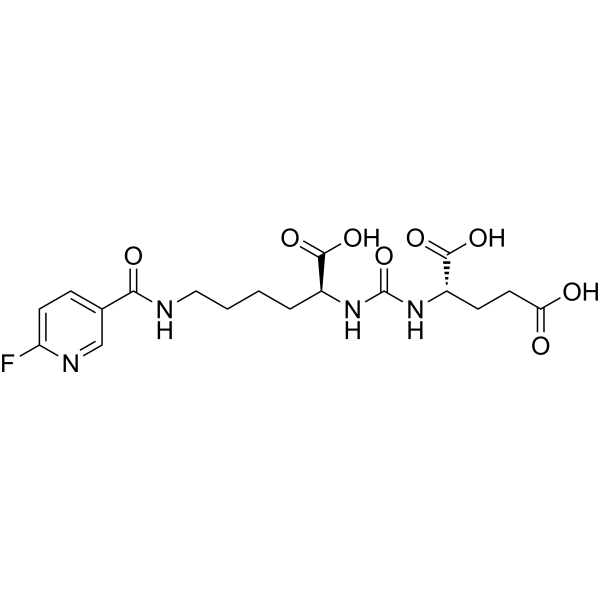
    Piflufolastat (DCFPYL) can be used for the preparation of piflufolastat F 18 (DCFPyL F-18). Piflufolastat F-18 (DCFPyL F-18) is an 18F-labeled imaging agent. Piflufolastat F-18 can be used for positron emission tomography (PET) targeting prostate-specific membrane antigen (PSMA). Piflufolastat can be used for imaging of prostate cancer .
    Piflufolastat
  • HY-159500

    OTL-0078; OTL78

    PSMA Cancer
    Zopocianine (OTL-0078; OTL78) is a near-infrared optical probe targeting PSMA. Zopocianine binds to PSMA on the surface of PSMA-expressing cells, enters cells via receptor-mediated endocytosis, and accumulates in acidic endosomes. Zopocianine selectively accumulates in PSMA-positive cancer tissues and enables the detection of small tumors, primary prostate tumors, and locoregional metastases. Zopocianine helps achieve negative tumor surgical margins during fluorescence-guided surgery. Zopocianine is applicable to research related to prostate cancer .
    Zopocianine
  • HY-114256

    PSMA Cancer
    EC1169 is a cytotoxic maytansinoid conjugate that specifically binds to prostate-specific membrane antigen (PSMA). EC1169 precisely delivers the maytansinoid B hydrazide payload to PSMA-positive cells to exert antitumor activity. EC1169 only inhibits the growth of PSMA-positive cells but has no effect on PSMA-negative cells, and enables complete recovery in mice bearing PSMA-positive tumors. EC1169 exhibits safety with no body weight loss or major organ damage induced. EC1169 is used in studies of prostate cancer and other PSMA-expressing malignancies .
    EC1169
  • HY-148152A

    PSMA Cancer
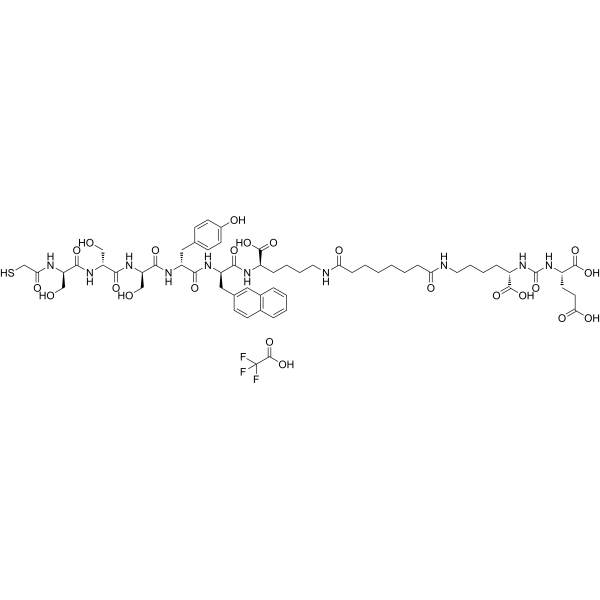
    PSMA I&S TFA is a PSMA-targeted imaging agent. PSMA I&S TFA undergoes PSMA-mediated internalization into PSMA-expressing cells, with uptake into PSMA-positive tissues competitively inhibited by a potent PSMA inhibitor. PSMA I&S TFA can be used for the research of prostate cancer .
    PSMA I&S TFA
  • HY-169336

    PARP PSMA Cancer
    CQ-16 is an orally active small molecule drug conjugate (SMDC) targeting prostate-specific membrane antigen (PSMA). CQ-16 exhibits highly selective antiproliferative activity between PSMA-positive and PSMA-negative prostate cells. In addition, CQ-16 also has PARP inhibitory activity (IC50=1 nM). (Pink: PSMA Ligand (HY-139840); Black: Linker (HY-W037980); Blue: PARP Inhibitor (HY-10162))
    CQ-16
  • HY-159500A

    OTL-0078 sodium; OTL78 sodium

    Biochemical Assay Reagents Cancer
    Zopocianine sodium (OTL-0078 sodium; OTL78 sodium) is a near-infrared optical probe targeting PSMA. Zopocianine sodium binds to PSMA on the surface of PSMA-expressing cells, enters cells via receptor-mediated endocytosis, and accumulates in acidic endosomes. Zopocianine sodium selectively accumulates in PSMA-positive cancer tissues and enables the detection of small tumors, primary prostate tumors, and locoregional metastases. Zopocianine sodium helps achieve negative tumor surgical margins during fluorescence-guided surgery. Zopocianine sodium is applicable to research related to prostate cancer .
    Zopocianine sodium
  • HY-181830

    PD-1/PD-L1 PSMA LYTACs Cancer
    Atz-L5 is a PD-L1 PTAC (PSMA-targeted chimera) degrader (DC50: 18 pM in PC3-PIP cells; 2 pM in LNCaP cells) and LYTAC. Atz-L5 promotes lysosomal degradation of PD-L1 in PSMA-positive prostate cancer cells. Atz-L5 is applicable to the research of prostate cancer .
    Atz-L5
  • HY-181829

    EGFR PSMA LYTACs Cancer
    Ctx-L3 is a selective EGFR PTAC (PSMA-targeted chimera) degrader (DC50: 4.3 pM in LNCaP cells) and LYTAC. Ctx-L3 recruits prostate-specific membrane antigen (PSMA) and mediates lysosomal degradation of EGFR in PSMA-positive prostate cancer cells. Ctx-L3 exhibits degrading activity against EGFR in prostate cancer cells. Ctx-L3 is applicable to related research on prostate cancer .
    Ctx-L3
  • HY-182240

    PSMA Cancer
    Cy5-ZW2-617 is a PSMA ligand with a IC50 of 4.39 nM. Cy5-ZW2-617 specifically binds to PSMA and is thereby internalized by PSMA-positive cells. Cy5-ZW2-617 shows uptake in PSMA-positive tumor cells and tumor xenografts in mice. Cy5-ZW2-617 can be used for the research of prostate cancer .
    Cy5-ZW2-617
  • HY-178248

    PSMA Cancer
    PSMA ligand 2 is a prostate specific membrane antigen (PSMA) ligand with a glutamate-urea-lysine (GUL) moiety. PSMA ligand 2 can be efficiently labeled with radioactive nuclides such as 68Ga and 177Lu and specifically binds to PSMA-positive tumor cells. PSMA ligand 2 can be used for imaging of PSMA-expressing tumors or cells via PET or SPECT imaging. PSMA ligand 2 can be used for the research of prostate cancer .
    PSMA-R2
  • HY-181853

    Radionuclide-Drug Conjugates (RDCs) PSMA Cancer
    NOTA-SP₂A-PSMAL is a ligand targeting prostate-specific membrane antigen (PSMA), which competitively binds to PSMA with high binding affinity and an IC50 value of 0.26 nM. 18F-labeled NOTA-SP2A-PSMAL can be used as a PET tracer for positron emission tomography imaging of prostate cancer. NOTA-SP2A-PSMAL can be used for the synthesis and research of radionuclide conjugates (RDCs) .
    NOTA-SP2A-PSMAL
  • HY-W1129940

    Radionuclide-Drug Conjugates (RDCs) Cancer
    p-SCN-Macropa is a bifunctional macrocyclic chelator featuring macrocyclic polyamine skeletons and thiocyanate (-SCN) reactive moieties. p-SCN-Macropa can conjugate with monoclonal antibodies including Nimotuzumab (HY-P9968), Rituximab (HY-P9913) and Trastuzumab (HY-P9907)-PEG6-DM1 for 225Ac radiolabeling to construct radioimmunoconjugates. p-SCN-Macropa is applicable for the research of colorectal cancer, HER2-positive breast cancer, TROP-2-positive cancers, and PSMA-positive cancers .
    p-SCN-Macropa
  • HY-P992094

    PSMA Cancer
    Capromab is an anti-human PSMA-targeting monoclonal antibody. Capromab binds specifically to the intracellular domain of PSMA, does not undergo internalization after binding, and targets necrotic cells with disrupted membranes. Capromab can be used for the research of prostate cancer .
    Capromab
  • HY-P11591

    PSMA-DOTA-PEI2

    Radionuclide-Drug Conjugates (RDCs) PSMA Cancer
    PDI2 (PSMA-DOTA-PEI2) is a prostate-specific membrane antigen (PSMA) ligand that acts as a tumor retention agent, renal uptake reducer, imaging agent and antitumor agent, applicable in SPECT diagnostic imaging and radiotheranostics. PDI2 specifically binds to PSMA on prostate cancer cells, enters cells via clathrin-dependent endocytosis, and exhibits higher tumor retention rate and lower renal uptake level. PDI2 is applicable in research related to prostate cancer and castration-resistant metastatic prostate cancer .
    PDI2

Inquiry Online

Your information is safe with us. * Required Fields.

Salutation


Country or Region *

Applicant Name *


Organization Name *

Department *


Email Address *


Product Name *

Cat. No.


Requested quantity *

Phone Number *


Remarks

Inquiry Online

Inquiry Information

Product Name:
Cat. No.:
Quantity:
MCE Japan Authorized Agent:

