

1. Search Result
Search Result
Results for "

micellar

" in MedChemExpress (MCE) Product Catalog:

14

Inhibitors & Agonists

1

Fluorescent Dyes

2

Biochemical Assay Reagents

6

Peptides

1

Natural
Products

1

Isotope-Labeled Compounds

1

Oligonucleotides

Cat. No. Product Name Target Research Areas Chemical Structure
  • HY-P2213

    MMP Apoptosis Cancer
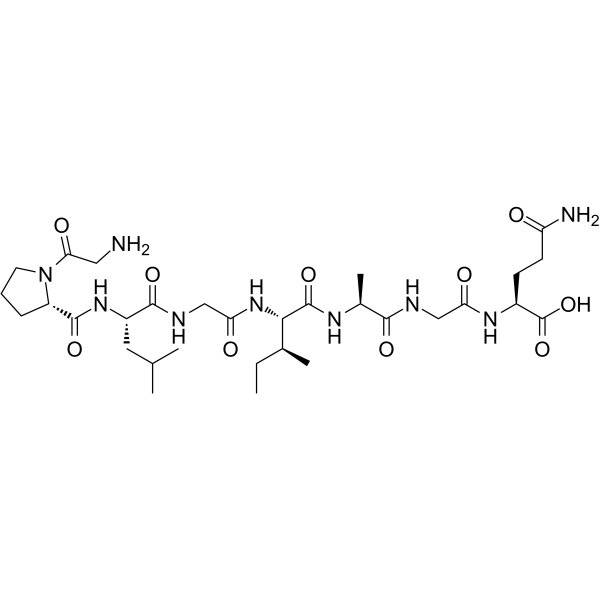
    GPLGIAGQ, a MMP2-cleavable polypeptide, is used as a stimulus-sensitive linker in both liposomal and micellar nanocarriers for MMP2-triggered tumor targeting. GPLGIAGQ can be used to synthesis unique MMP2-targeted photosensitizer in photodynamic therapy (PDT) .
    GPLGIAGQ
  • HY-172470

    Liposome EGFR Cancer
    DSPE-PEG2000-GE11 is a nanocarrier component composed of DSPE and the EGFR-targeting peptide (GE11). DSPE-PEG2000-GE11 specifically binds to EGFR and mediates receptor-mediated endocytosis of micellar drug carriers. DSPE-PEG2000-GE11 can be used for drug delivery .
    DSPE-PEG2000-GE11
  • HY-Y1309

    Furro ER; NSC 9586; Nako TRB

    Environmental Pollutants Endogenous Metabolite Others
    1-naphthol (Furro ER) is an excited state proton transfer (ESPT) fluorescent molecular probe. 1-naphthol can sense the hydrophobic domains in micellar aggregation and accurately sense the sol-gel transition. 1-naphthol can be used to study the thermally induced microenvironmental changes and hydration levels of Pluronic F127 (PF127) in different microenvironments in aqueous media .
    1-Naphthol
  • HY-117401

    Fluorescent Dye Others
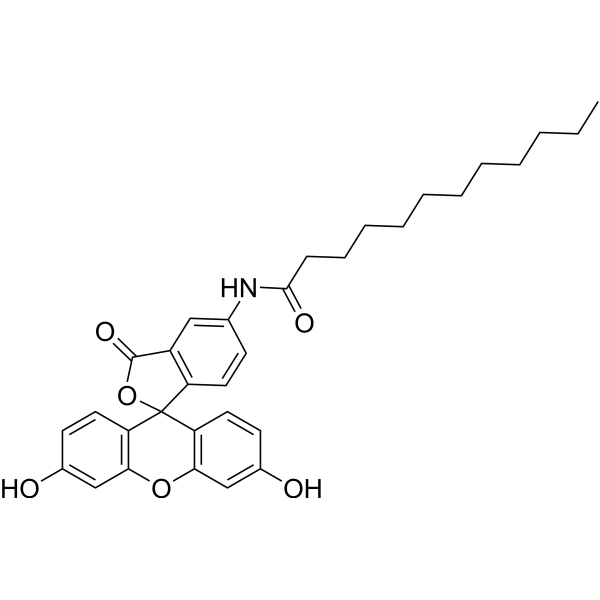
    5-Dodecanoylaminofluorescein is an amphipathic (amphoteric) fluorescent probe (Ex/Em = 485 nm/515-535 nm), which consists of a hydrophilic fluorescein core and a hydrophobic dodecanoyl group (C12 fatty acid chain) linked by an amide bond. 5-Dodecanoylaminofluorescein is mainly used as an interface-localized radical trapping/indicator probe. Dodecanoylaminofluorescein can be used for the determination of the antioxidant properties of emulsions, or can serve as a lipophilic drug model for the study of passive skin penetration when encapsulated in tyrosine-derived nanospheres .
    5-Dodecanoylaminofluorescein
  • HY-160113E

    Biochemical Assay Reagents Others
    Sodium phosphate buffer 0.1M, pH 8.0 is an aqueous sodium phosphate buffer with a concentration of 0.1M and a pH value of 8.0. Sodium phosphate buffer 0.1M, pH 8.0 can be used for the preparation of hydrated micellar membranes, the construction of pH-sensitive nanocarriers, and the maintenance of stable environmental conditions for pH-cleavable PEG-Hz-PE micelles. Sodium phosphate buffer 0.1M, pH 8.0 can also serve as a universal solvent, reaction medium and eluent, and is widely applied in experimental processes such as antibody thiolation, nanoparticle purification and cross-linking reactions .
    Sodium phosphate buffer 0.1M, pH 8.0
  • HY-21170E

    Zinc(II) Triflate

    Biochemical Assay Reagents Others
    Zinc trifluoromethanesulfonate (Zinc (II) Triflate) is a Zn 2+ salt commonly used in potentiometric titration to determine the stability constants of Zn 2+-quinoline sulfonamide complexes. Aqueous solutions of Zinc trifluoromethanesulfonate form micellar structures, which result in poor desolvation kinetics of Zn 2+ and induce dendrite growth on zinc anodes, failing to support long-term cycling of zinc anodes .
    Zinc trifluoromethanesulfonate
  • HY-P2213A

    MMP Apoptosis Cancer
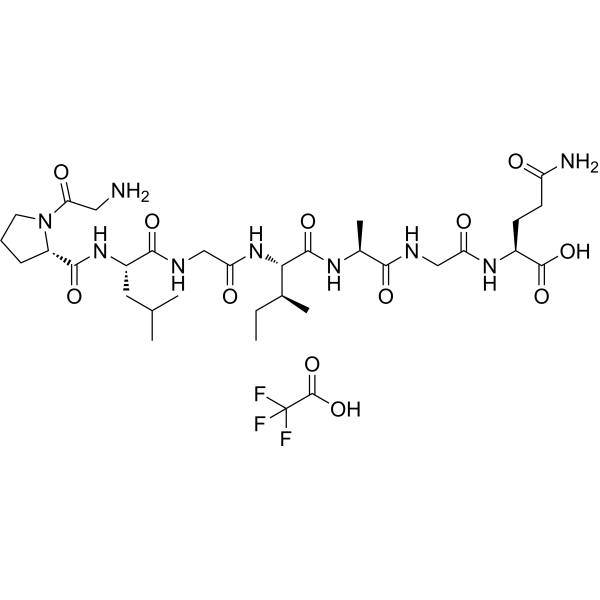
    GPLGIAGQ TFA, a MMP2-cleavable polypeptide, is used as a stimulus-sensitive linker in both liposomal and micellar nanocarriers for MMP2-triggered tumor targeting. GPLGIAGQ TFA can be used to synthesis unique MMP2-targeted photosensitizer in photodynamic therapy (PDT) .
    GPLGIAGQ TFA
  • HY-P1176

    Apoptosis Neurological Disease
    NTR 368 is a peptide derived from p75 neurotrophin receptor (p75NTR) corresponding to residues 368-381 of the human receptor. NTR 368 has helix forming propensity in the presence of micellar lipid. NTR 368 is a potent inducer of neural apoptosis .
    NTR 368
  • HY-P1176A

    Apoptosis Neurological Disease
    NTR 368 TFA is a peptide derived from p75 neurotrophin receptor (p75NTR) corresponding to residues 368-381 of the human receptor. NTR 368 TFA has helix forming propensity in the presence of micellar lipid. NTR 368 TFA is a potent inducer of neural apoptosis .
    NTR 368 TFA
  • HY-118311

    (Z)-Probilin; (Z)-Secrebil; (Z)-Piprozolin

    Others Metabolic Disease
    (Z)-W 3699 is a potential choleretic. (Z)-W 3699 can increase the solubility of cholesterol in the gallbladder by altering the secretion of micellar bile acids. (Z)-W 3699 can prevent the formation of cholesterol-containing gallstones in dogs.
    (Z)-W 3699
  • HY-Y1309S1

    Furro ER-d7; NSC 9586-d7; Nako TRB-d7

    Isotope-Labeled Compounds Endogenous Metabolite Others
    1-Naphthol-d7 (Furro ER-d7) is the deuterium labeled Naphthol (HY-Y1309). 1-Naphthol (Furro ER) is an excited state proton transfer (ESPT) fluorescent molecular probe. 1-naphthol can sense the hydrophobic domains in micellar aggregation and accurately sense the sol-gel transition. 1-naphthol can be used to study the thermally induced microenvironmental changes and hydration levels of Pluronic F127 (PF127) in different microenvironments in aqueous media .
    1-Naphthol-d7
  • HY-181817

    Reactive Oxygen Species (ROS) Apoptosis p38 MAPK PERK Cancer
    (S)-IP-DK143 is a polymeric micellar formulation. (S)-IP-DK143 inhibits the proliferation of cervical cancer cells, induces ROS-mediated apoptosis, and triggers mitochondrial dysfunction. (S)-IP-DK143 activates the p38 MAPK signaling pathway, increases the phosphorylation level of p38. (S)-IP-DK143 can be used for the research of cervical cancer .
    (S)-IP-DK143
  • HY-P11800

    MMP Inflammation/Immunology
    GPLGVRG is an MMP13-responsive linker peptide. GPLGVRG can be hydrolyzed by MMP13, which in turn triggers micellar disintegration, loss of amphipathicity, and increases the chondrocyte uptake rate of the related delivery system. GPLGVRG can be used in the research of osteoarthritis .
    GPLGVRG
  • HY-P11614

    Liposome Cancer
    LCA-H10 is a lithocholic acid-histidine decapeptide conjugate, a biocompatible lipid nanoparticle (LNP) additive that reduces ionizable lipid proportions, functions as an endosomal escape inducer, and enhances siRNA encapsulation. LCA-H10 increases hepatic accumulation of LNPs in mice after intravenous injection when incorporated into LiLNP-LH and reduces proinflammatory cytokines (IL-6, TNF, IL-1β) in mouse serum. LCA-H10 can be used for the research of prostate cancer .
    LCA-H10

Inquiry Online

Your information is safe with us. * Required Fields.

Salutation


Country or Region *

Applicant Name *


Organization Name *

Department *


Email Address *


Product Name *

Cat. No.


Requested quantity *

Phone Number *


Remarks

Inquiry Online

Inquiry Information

Product Name:
Cat. No.:
Quantity:
MCE Japan Authorized Agent:

