



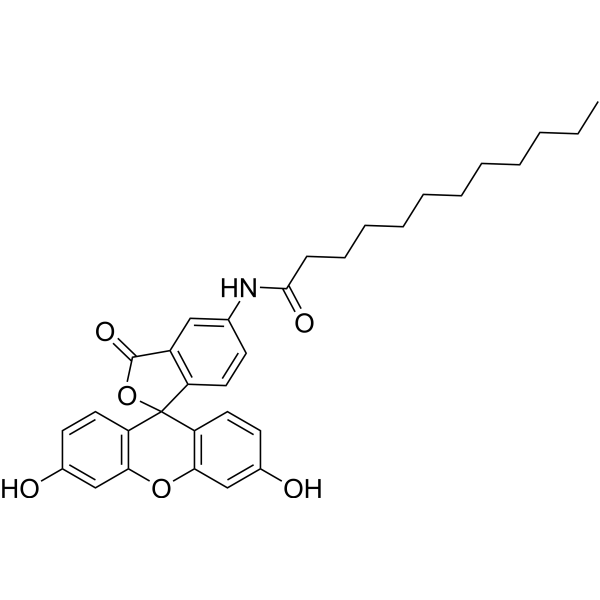
5-Dodecanoylaminofluorescein

Based on 1 Customer Validation
5-Dodecanoylaminofluorescein is an amphipathic (amphoteric) fluorescent probe (Ex/Em = 485 nm/515-535 nm), which consists of a hydrophilic fluorescein core and a hydrophobic dodecanoyl group (C12 fatty acid chain) linked by an amide bond. 5-Dodecanoylaminofluorescein is mainly used as an interface-localized radical trapping/indicator probe. Dodecanoylaminofluorescein can be used for the determination of the antioxidant properties of emulsions, or can serve as a lipophilic drug model for the study of passive skin penetration when encapsulated in tyrosine-derived nanospheres.
For research use only. We do not sell to patients.
- Purity : 98.96%
- CAS No.: 107827-77-0
- Formula: C32H35NO6
- Molecular Weight:529.62
-
Storage:
-20°C, protect from light
* In solvent : -80°C, 6 months; -20°C, 1 month (protect from light)

To place orders, for customer services and technical support, please contact: MedChemExpress USA
Tel: 609-228-6898 E-mail: [email protected] [email protected]


-
 Biological Activity
-
Chemical Information
-
Solvent & Solubility
- Purity & Documentation
- References
-
 Help & FAQs




Biological Activity
Description
In Vitro
5-Dodecanoylaminofluorescein (0.2-0.8 μM; 5 min-overnight) functions as a reliable, submicromolar-concentration fluorescent probe for detecting micelle formation via fluorescence anisotropy changes, enabling accurate critical micelle concentration measurements across nonionic, zwitterionic, anionic, and cationic detergents in varying buffer and ionic strength conditions, with consistent performance at concentrations from 0.2 μM to 0.8 μM[1].
5-Dodecanoylaminofluorescein (180 μg/mL; 24 h) delivered via tyrosine-derived nanospheres shows 2 times more delivery to the superficial dermis and 2.5 times more to the lower dermis of full-thickness human cadaver abdominal skin than a propylene glycol formulation after 24 hours of topical application, with no detectable transdermal permeation[2].
5-dodecanoylaminofluorescein (0.2 mg per 5 mL squalene; 1.5 h) serves as a valid probe for peroxyl radical activity in squalene W/O emulsions, showing that (+)-catechin-β-sitosterol preserves ~80% of its fluorescence intensity after 80 minutes at 60 °C, far outperforming control antioxidants and the no-antioxidant control[3].
Guide (Below is the recommended solution we suggest. This solution is merely a guideline and should be modified according to your specific needs.)
Take the evaluation of peroxide free radical scavenging/antioxidation of W/O emulsion as an example[3]
1. 5-Dodecanoylaminofluorescein stock solution: Weigh 5-Dodecanoylaminofluorescein, dissolve it with a small amount of methanol for assistance, then dry it with nitrogen gas, and dissolve it with an appropriate amount of anhydrous squalene to prepare the stock solution (~0.2 mg/mL), and store it in a dark place.
2. Oil phase: Take 5 mL of squalene and add 0.5 mL of the 5-Dodecanoylaminofluorescein stock solution. Mix well (final concentration ~ 20 mmol/kg of the oil phase, can be adjusted as needed).
3. Add antioxidants: Take 0.7 mL of the above oil phase, add the antioxidant to be tested (no addition for the control), and mix well.
4. Preparation of W/O emulsion: Take 20 µL of 200 mM AAPH (HY-Y0525) (dissolved in 25 mM phosphate buffer at pH 7.0), add it to 1.2 mL of the above oil phase, vortex for 30 seconds + ultrasonic for 2 minutes, to form a stable W/O emulsion.
5. Detection: Take 200 µL of the emulsion and place it in a 96-well plate on the blackboard. Use an enzyme reader with Ex/Em = 485/515 nm. Read the data every 1 minute at 60°C for approximately 90 minutes. Evaluate the antioxidant activity by observing the fluorescence decay curve (the fluorescence decay is slower when the antioxidant is present).
MedChemExpress (MCE) has not independently confirmed the accuracy of these methods. They are for reference only.
Emission (Em)
535
Excitation (Ex)
485


Chemical Information
-
CAS No. 107827-77-0
-
Appearance Solid
-
Molecular Weight 529.62
-
Formula C32H35NO6
-
Color Light yellow to yellow
-
SMILES
CCCCCCCCCCCC(NC1=CC2=C(C3(C4=C(OC5=C3C=CC(O)=C5)C=C(O)C=C4)OC2=O)C=C1)=O
-
Shipping
Room temperature in continental US; may vary elsewhere.
-
Storage
-20°C, protect from light
* In solvent : -80°C, 6 months; -20°C, 1 month (protect from light)


Solvent & Solubility
In Vitro:
DMSO : 125 mg/mL (236.02 mM; Need ultrasonic; Hygroscopic DMSO has a significant impact on the solubility of product, please use newly opened DMSO)
Please refer to the solubility information to select the appropriate solvent. Once prepared, please aliquot and store the solution to prevent product inactivation from repeated freeze-thaw cycles.
Storage method and period of stock solution: -80°C, 6 months; -20°C, 1 month (protect from light). When stored at -80°C, please use it within 6 months. When stored at -20°C, please use it within 1 month.
Please refer to the solubility information to select the appropriate solvent. Once prepared, please aliquot and store the solution to prevent product inactivation from repeated freeze-thaw cycles.
Storage method and period of stock solution: -80°C, 6 months; -20°C, 1 month (protect from light). When stored at -80°C, please use it within 6 months. When stored at -20°C, please use it within 1 month.
Concentration (start) × Volume (start) = Concentration (final) × Volume (final)


Purity & Documentation
-
Data Sheet (275 KB)
-
SDS (252 KB)
- English - EN (252 KB)
- Français - FR (252 KB)
- Deutsch - DE (252 KB)
- Norwegian - NO (252 KB)
- Español - ES (252 KB)
- Swedish - SV (252 KB)
- Italian - IT (252 KB)
- Korean - KR (252 KB)
- Portuguese - PT (252 KB)
-
Handling Instructions (2659 KB)
References
[1]. Thorsteinsson MV, et al. 5-Dodecanoylaminofluorescein as a probe for the determination of critical micelle concentration of detergents using fluorescence anisotropy. Anal Biochem. 2005;340(2):220-225. [Content Brief]
[2]. Sheihet L, et al. Tyrosine-derived nanospheres for enhanced topical skin penetration. Int J Pharm. 2008;350(1-2):312-319. [Content Brief]
[3]. Wang S, et al. Integration of (+)-catechin and β-sitosterol to achieve excellent radical-scavenging activity in emulsions. Food Chem. 2019;272:596-603. [Content Brief]


Complete Stock Solution Preparation Table
Please refer to the solubility information to select the appropriate solvent. Once prepared, please aliquot and store the solution to prevent product inactivation from repeated freeze-thaw cycles.
Storage method and period of stock solution: -80°C, 6 months; -20°C, 1 month (protect from light). When stored at -80°C, please use it within 6 months. When stored at -20°C, please use it within 1 month.
| Optional Solvent | Concentration Solvent Mass | 1 mg | 5 mg | 10 mg | 25 mg |
|---|---|---|---|---|---|
| DMSO | 1 mM | 1.8881 mL | 9.4407 mL | 18.8815 mL | 47.2037 mL |
| 5 mM | 0.3776 mL | 1.8881 mL | 3.7763 mL | 9.4407 mL | |
| 10 mM | 0.1888 mL | 0.9441 mL | 1.8881 mL | 4.7204 mL | |
| 15 mM | 0.1259 mL | 0.6294 mL | 1.2588 mL | 3.1469 mL | |
| 20 mM | 0.0944 mL | 0.4720 mL | 0.9441 mL | 2.3602 mL | |
| 25 mM | 0.0755 mL | 0.3776 mL | 0.7553 mL | 1.8881 mL | |
| 30 mM | 0.0629 mL | 0.3147 mL | 0.6294 mL | 1.5735 mL | |
| 40 mM | 0.0472 mL | 0.2360 mL | 0.4720 mL | 1.1801 mL | |
| 50 mM | 0.0378 mL | 0.1888 mL | 0.3776 mL | 0.9441 mL | |
| 60 mM | 0.0315 mL | 0.1573 mL | 0.3147 mL | 0.7867 mL | |
| 80 mM | 0.0236 mL | 0.1180 mL | 0.2360 mL | 0.5900 mL | |
| 100 mM | 0.0189 mL | 0.0944 mL | 0.1888 mL | 0.4720 mL |


5-Dodecanoylaminofluorescein Related Classifications
HY-117401 Related Classifications
 Powered by Bioz
Keywords
- 5-Dodecanoylaminofluorescein
- 107827-77-0
- Fluorescent Dye
- lipid bilayers
- critical micelle concentration
- peroxyl radical
- fluorescence anisotropy
- oil-water interfaces
- detergent micellar shells
- free radical detector
- tyrosine-derived nanospheres
- full-thickness human cadaver abdominal skin
- squalene W/O emulsions
- Inhibitor
- inhibitor
- inhibit