1. Search Result
Search Result
Results for "

microbial secondary metabolite

" in MedChemExpress (MCE) Product Catalog:

26

Inhibitors & Agonists

1

Biochemical Assay Reagents

1

Peptides

22

Natural
Products

1

Isotope-Labeled Compounds

Cat. No. 상품명 Target 연구분야 Chemical Structure
  • HY-48814

    Bacterial FXR Infection Inflammation/Immunology
    3-Epideoxycholic acid is a secondary bile acid and a microbial metabolite of Deoxycholic acid (HY-N0593). 3-Epideoxycholic acid targets FXR in dendritic cells, reduces their immunostimulatory properties, promotes the generation of Treg cells, and exerts anti-inflammatory activity. 3-Epideoxycholic acid can promote the growth of the bacterium Bacteroides. 3-Epideoxycholic acid can be used in research related to inflammatory and immune diseases as well as bacterial infections .
    3-Epideoxycholic acid
  • HY-N13292

    Antibiotic Bacterial Infection
    Actinorhodin is a blue-pigmented, redox-active microbial secondary metabolite. Actinorhodin is a potent, bacteriostatic, pH-responsive antibiotic. Actinorhodin exhibits antimicrobial activity against Gram-positive bacteria .
    Actinorhodin
  • HY-Y0669S

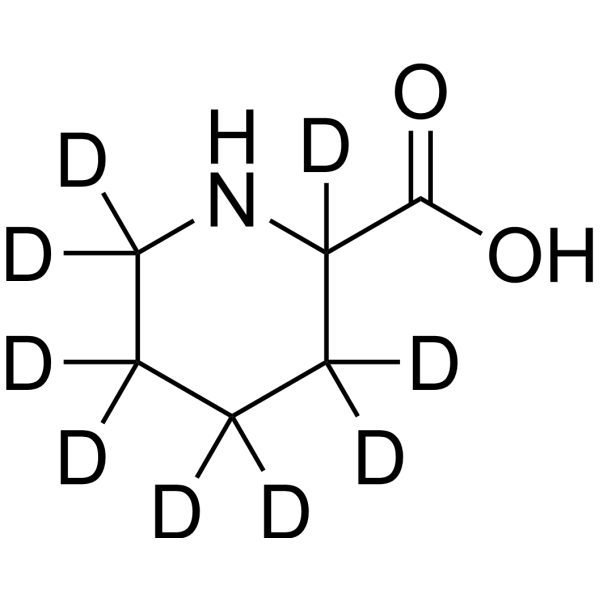
    Isotope-Labeled Compounds Endogenous Metabolite Ferroptosis YAP Glutathione Peroxidase Infection
    Pipecolic acid-d9 is the deuterium labeled Pipecolic acid. Pipecolic acid is a metabolite of lysine and an important precursor for many useful microbial secondary metabolites. Pipecolic acid slows ferroptosis in diabetic retinopathy by inhibiting the YAP-GPX4 signaling pathway. In addition, Pipecolic acid can be used as a diagnostic marker for pyridoxine-dependent epilepsy .
    Pipecolic acid-d9
  • HY-Y0669R

    Reference Standards Endogenous Metabolite YAP Glutathione Peroxidase Ferroptosis Neurological Disease Metabolic Disease Inflammation/Immunology
    Pipecolic acid (Standard) is the analytical standard of Pipecolic acid. This product is intended for research and analytical applications. Pipecolic acid is a metabolite of lysine and an important precursor for many useful microbial secondary metabolites. Pipecolic acid slows ferroptosis in diabetic retinopathy by inhibiting the YAP-GPX4 signaling pathway. In addition, Pipecolic acid can be used as a diagnostic marker for pyridoxine-dependent epilepsy .
    Pipecolic acid (Standard)
  • HY-W751002

    (+)-Orthosporin

    Endogenous Metabolite Bacterial HIV Reverse Transcriptase Infection
    Orthosporin ((+)-Orthosporin), a phytotoxic isocoumarin compound, is a microbial secondary metabolite. Orthosporin can be isolated from the endophytic fungus Lasiodiplodia tbeobromae. Orthosporin has potent antibacterial activity against B. subtilis, E. coli and P. aeruginosa. Orthosporin also has antioxidant activity against DPPH radical and antiviral activities with inhibition of HIV-1 reverse transcriptase activity .
    Orthosporin
  • HY-N16441

    Endogenous Metabolite Influenza Virus Infection
    Pulvic acid (Compound 3), a butenolide, is a microbial secondary metabolite. Pulvic acid can be isolated from the marine-derived fungus Aspergillus terreus Gwq-48. Pulvic acid has significant antiviral activity with an IC50 of 29.1 μg/mL for influenza A H1N1 virus. Pulvic acid can be used for influenza virus infections research .
    Pulvic acid
  • HY-158721

    Marinamide

    Endogenous Metabolite Parasite Infection Cancer
    Penicinoline (Marinamide) (Compound 1), a pyrrolyl 4-quinolinone alkaloid, is a microbial secondary metabolite. Penicinoline can be isolated from endophytic fungus Penicillium sp. Penicinoline has antimalarial activity against Chloroquine (HY-17589A) sensitive strain (pf3d7) and against Chloroquine resistant strain (pfDd2) of plasmodium falciparum. Penicinoline also has strong insecticidal activity against Aphis gossypii and selective anticancer effect with significant cytotoxicity for 95-D and HepG2 cells .
    Penicinoline
  • HY-N14927

    Proteasome Inflammation/Immunology
    Phepropeptin A, a microbial secondary metabolite, is a proteasome inhibitor with an IC50 of 21 μg/mL .
    Phepropeptin A
  • HY-N14928

    Proteasome Inflammation/Immunology
    Phepropeptin B, a microbial secondary metabolite, is a proteasome inhibitor with an IC50 of 11 μg/mL .
    Phepropeptin B
  • HY-N14940

    Proteasome Inflammation/Immunology
    Phepropeptin D, a microbial secondary metabolite, is a proteasome inhibitor with an IC50 of 7.8 μg/mL .
    Phepropeptin D
  • HY-N14929

    Proteasome Inflammation/Immunology
    Phepropeptin C, a microbial secondary metabolite, is a proteasome inhibitor with an IC50 of 12.5 μg/mL .
    Phepropeptin C
  • HY-N16394

    Endogenous Metabolite Cancer
    4-Hydroxyscytalone (Compound 3) is a microbial secondary metabolite. 4-Hydroxyscytalone can be isolated from the oak fungus Diplodia corticola. 4-Hydroxyscytalone has toxicity against Artemia salina with a LC50 of 90.6 μ/mL, but no significant antifungal activity. 4-Hydroxyscytalone can be used for cancer therapy research .
    4-Hydroxyscytalone
  • HY-N16445

    (-)-Strevertene A

    Endogenous Metabolite Antibiotic Fungal Infection
    Strevertene A ((-)-Strevertene A) (Compound 1), a pentaene macrolide, is a microbial secondary metabolite. Strevertene A is an antibiotic and has a potent antifungal activity. Strevertene A significantly inhibits the mycelial growth of phytopathogenic fungi (such as Alternaria mali, Aspergillus oryzae and Cylindrocarpon destructans) with IC50s of 4-16 μg/mL. Strevertenes A can strongly prevent Fusarium wilt development on tomato plants .
    Strevertene A
  • HY-N16457

    Endogenous Metabolite Influenza Virus Infection
    5,6-Dihydro-6-hydroxypenicillic acid (Compound 6) is a microbial secondary metabolite. 5,6-Dihydro-6-hydroxypenicillic acid can be isolated from the endophytic fungus Talaromyces sp. CPCC 400783 of Reynoutria japonica Houtt. 5,6-Dihydro-6-hydroxypenicillic acid has antiviral activity against influenza A virus with an IC50 of 65.45 μM .
    5,6-Dihydro-6-hydroxypenicillic acid
  • HY-N16442

    Endogenous Metabolite Prolyl Endopeptidase (PREP) Cancer
    Pyrrocidine B (Compound 6), an alkaloid, is a microbial secondary metabolite. Pyrrocidine B can be isolated from the endophytic fungus Neonectria ramulariae Wollenw KS-246. Pyrrocidine B has significant cytotoxicity against leukemia cells (IC50 of 4.6  μM for HL60 cells) with a weak Prolyl oligopeptidase (POP) inhibitory activity .
    Pyrrocidine B
  • HY-N12106

    Fumicycline

    Endogenous Metabolite Fungal Infection
    Neosartoricin (Fumicycline) (Compound 3), a prenylated anthracenone, is a microbial secondary metabolite. Neosartoricin can be isolated from Aspergillus fumigatus and Neosartorya fischeri. Neosartoricin has immunosuppressive activity, and significantly inhibits T-cell proliferative activity with an IC50 of 3 μM. Neosartoricin may be beneficial to fungal defense, facilitating infection through suppressing the host adaptive immunity without involvement of primary virulence .
    Neosartoricin
  • HY-119675

    Bacterial Infection Cancer
    Albonoursin, a microbial secondary metabolite, is an antibacterial peptide. Albonoursin displays antibacterial and antitumor activities .
    Albonoursin
  • HY-N5158B

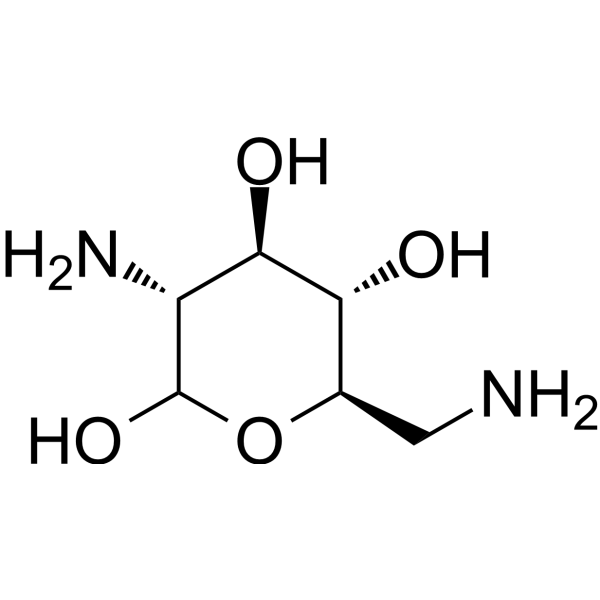
    Antibiotic Endogenous Metabolite Infection
    (5S)-Neosamine C is an aminocyclic alcohol antibiotic derived from microbial secondary metabolites. (5S)-Neosamine C has a cyclized structure and can be used for biosynthesis of Neomycins (HY-B0470).
    (5S)-Neosamine C
  • HY-N16423

    Endogenous Metabolite Others
    Metenaticin A (Compound 8), a polyketide, is a microbial secondary metabolite. Metenaticin A can be isolated from Streptomyces violaceoruber TU22 .
    Metenaticin A
  • HY-N13891

    Antibiotic Bacterial Apoptosis Infection Cancer
    Arisostatin A, a microbial secondary metabolite, is an antibiotic against Gram-positive bacteria and shown to possess potent anti-tumor properties. Arisostatin A induces apoptosis through the activation of caspase-3 and reactive oxygen species (ROS) generation in AMC-HN-4 cells .
    Arisostatin A
  • HY-N16443

    Endogenous Metabolite Fungal Bacterial Infection
    Sporminarin A (Compound 1), a polyketide, is a microbial secondary metabolite. Sporminarin A can be isolated from the Sporormiella minimoides. Sporminarin A has significant antifungal activity against Aspergillus flavus with an MIC50 of 25  μg/mL. Sporminarin A also has antibacterial activity against Staphylococcus aureus (ATCC 29213) and Candida albicans (ATCC 14053) .
    Sporminarin A
  • HY-N16429

    Endogenous Metabolite Others
    Neosartoricin D, a polyketide, is a microbial secondary metabolite. Neosartoricin D can be isolated from the cultural of Aspergillus nidulans. Neosartoricin D is an analog of Neosartoricin B (HY-N10311). Neosartoricin B is the secondary metabolite, which can be produced by Aspergillus nidulans. Neosartoricin B may regulate immunomodulatory effects with the host during infection and colonization by pathogenic fungi .
    Neosartoricin D
  • HY-N13886

    Endogenous Metabolite Cancer
    Anicequol, a microbial secondary metabolites, is an anchorage-independent growth of tumor cells inhibitor. Anicequol inhibits the anchorage-independent growth of human colon cancer DLD-1 cells with the IC50 of 1.2 μM .
    Anicequol
  • HY-P11338

    Endogenous Metabolite Cancer
    Microcyclamide (Compound 1), a cytotoxic cyclic hexapeptide, is a microbial secondary metabolite. Microcyclamide can be isolated from the cyanobacterium Microcystis aeruginosa. Microcyclamide has moderate cytotoxicity against P388 murine leukemia cells with an IC50 of 1.2 μg/mL. Microcyclamide can be used for cancers research .
    Microcyclamide
  • HY-N12229

    Endogenous Metabolite Bacterial Infection
    Penipurdin A (Compound 1), an anthraquinone, is a microbial secondary metabolite. Penipurdin A can be isolated from the soil fungus Penicillium purpurogenum SC0070. Penipurdin A has no significant cytotoxicity against cancer cells, such as A549, HepG2 and Hela cells. Penipurdin A has antibacterial activity against Enterococcus faecalis and Staphylococcus aureus .
    Penipurdin A
  • HY-N16428

    NSC 356436

    Endogenous Metabolite Fungal Bacterial Infection Cancer
    Neoaspergillic acid (NSC 356436) (Compound 2) is a microbial secondary metabolite. Neoaspergillic acid can be isolated from the endophytic fungus Aspergillus sp. SPH2. Neoaspergillic acid has potent antifungal activity against Alternaria alternata, Botrytis cinerea and Fusarium oxysporum. Neoaspergillic acid appears during the exponential phase of fungal growth. Neoaspergillic acid also antitumor and antibacterial effects .
    Neoaspergillic acid

온라인 문의

Your information is safe with us. * Required Fields.

호칭


Country or Region *

고객명 *


회사명 *

Department *


메일주소 *


상품명 *

Cat. No.


Requested quantity *

전화번호 *


비고

온라인 문의

Inquiry Information

상품명:
Cat. No.:
수량:
MCE Japan Authorized Agent:

