





1. Search Result
Search Result
Results for "

solid tumour

" in MedChemExpress (MCE) Product Catalog:

32

Inhibitors & Agonists

1

Peptides

24

Inhibitory Antibodies

Cat. No. Product Name Target Research Areas Chemical Structure
  • HY-P99011
    Cibisatamab
    2 Publications Verification

    CD3 Cancer
    Cibisatamab, a T cell bispecific antibody, binds Carcino-Embryonic Antigen (CEA) on cancer cells and CD3 on T cells. Cibisatamab triggers T cell killing of cancer cell lines expressing moderate to high levels of CEA at the cell surface. Cibisatamab can be used for colorectal cancer research .
    Cibisatamab
  • HY-172320

    PD-1/PD-L1 Cancer
    BMS-986238 is an orally active macrocyclic peptide PD-L1 inhibitor. BMS-986238 can be used in the research of tumors such as solid tumors and lymphomas .
    BMS-986238
  • HY-150314

    Monocarboxylate Transporter Cancer
    MCT-IN-1 (Compound 2) is a potent MCT inhibitor, with IC50 values of 9 nM and 14 nM against MCT1 and MCT4, respectively. MCT-IN-1 can be used in research related to solid tumors .
    MCT-IN-1
  • HY-P99450

    IPH 5401; Anti-C5aR1 mAb

    Complement System Inflammation/Immunology Cancer
    Avdoralimab (IPH 5401) is a fully human IgGκ monoclonal antibody that targets the complement C5a receptor 1 (C5aR1) that prevents its binding to C5a. Avdoralimab can be used for complement-driven inflammatory diseases and solid tumours research .
    Avdoralimab
  • HY-13432
    Nanatinostat
    2 Publications Verification

    CHR-3996

    HDAC Apoptosis Cancer
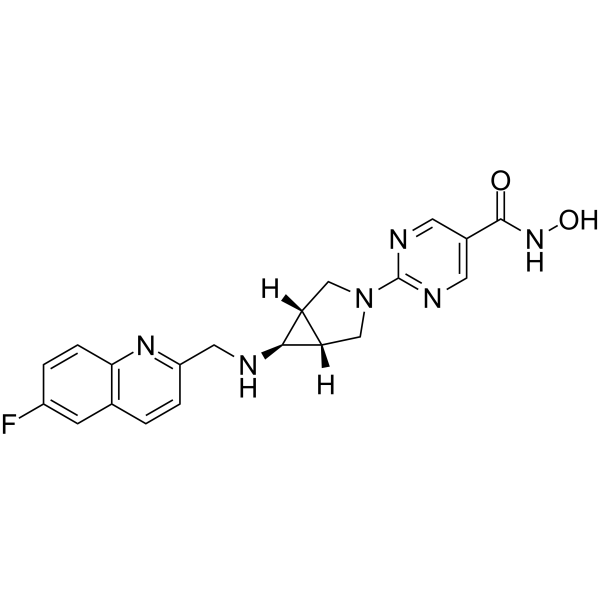
    Nanatinostat (CHR-3996) is a potent, class I selective and orally active HDAC inhibitor with IC50s of 3 nM, 4 nM, and 7 nM for HDAC1, HDAC2, and HDAC3, respectively. Nanatinostat has low activity against HDAC5 (IC50 of 200 nM) and HDAC6 (IC50 of 2100 nM). Nanatinostat induces apoptosis in myeloma cells. Nanatinostat has potent anticancer effects, such as myeloma, advanced solid tumours and colorectal cancer .
    Nanatinostat
  • HY-P99114

    PD-1/PD-L1 Cancer
    Sugemalimab is a fully human, full length, anti-programmed death ligand 1 (PD-L1) immunoglobulin G4 (IgG4) monoclonal antibody (mAb). Sugemalimab shows anticancer activities and can be used for non-small cell lung cancer research .
    Sugemalimab
  • HY-176761

    Apoptosis Autophagy Caspase mTOR Cancer
    NSC647889 is an apoptosis and autophagy inducer. NSC647889 induces apoptosis, inhibits mTOR pathway and abrogates DNA synthesis. NSC647889 triggers LC3-positive vesicle formation, modulates AKT and 4EBP1 phosphorylation and shows heightened caspase-3 activation in multicellular spheroids. NSC647889 can be used for the research of solid cancer tumour, head-neck carcinoma, and colorectal cancer .
    NSC647889
  • HY-139678

    FLAP Opioid Receptor Apoptosis STING Neurological Disease Cancer
    SC13 is an orally active, selective Flap structure-specific endonuclease 1 (FEN1) inhibitor and mu opioid receptor (MOR) activator. SC13 impairs DNA damage repair and induces apoptosis in cancer cells. SC13 activates cGAS-STING signaling, increases chemokine secretion, and promotes CAR-T cell infiltration at solid tumour sites. SC13 can be used for the research of solid tumours and pain .
    SC13
  • HY-P991455

    TNF Receptor Cancer
    PTX-35 is a human IgG monoclonal antibody (mAb) targeting TNFRSF25. PTX-35 reduces the suppressive activity of regulatory T cells and enhances CD4+ T cell effector responses in a mouse melanoma model. PTX-35 can be used in Islet cell transplant rejection and Solid tumours research. Recommended isotype control: Human IgG1 lambda2, Isotype Control (HY-P990096) .
    PTX-35
  • HY-P991469

    MEDI-565

    Transmembrane Glycoprotein Cancer
    AMG-211 (MEDI-565)i s a bispecific antibody targeting CD3E and CEACAM5/CEA/CD66e. AMG-211 can be used in Gastrointestinal cancer and Solid tumours research .
    AMG-211
  • HY-139453A

    DNA Alkylator/Crosslinker Cancer
    LP-284 is a potent DNA alkylating agent that kills solid tumours. LP-284 can be used in the studies of hematologic cancers with compromised DNA repair, such as mantle cell lymphoma (MCL) .
    LP-284
  • HY-111786

    Toll-like Receptor (TLR) Cancer
    LHC-165 is a TLR7 agonist. LHC-165 has potential to used in study of solid tumors .
    LHC-165
  • HY-148954

    Adenosine Receptor Phosphodiesterase (PDE) Cancer
    PBF-999 is a phosphodiesterase10A (PDE-10A) and adenosine A2A receptor (A2AR) dual antagonist.
    PBF-999
  • HY-P991348

    PD-1/PD-L1 Cancer
    BAT-1306 is a human monoclonal antibody (mAb) targeting PDCD1/PD-1/CD279. BAT-1306 can be used in Colorectal cancer and Solid tumours research .
    BAT-1306
  • HY-P991391

    Transmembrane Glycoprotein Cancer
    COM902 is a human IgG4 monoclonal antibody (mAb) targeting TIGIT. COM902 enhances anti-tumor immune responses. COM902 can be used in Multiple myeloma, Solid tumours and Colorectal cancer research. Recommended isotype control: IgG4-lambda .
    COM902
  • HY-P991560

    CD47 Cancer
    TQB-2928 is a monoclonal antibody against CD47, which can be used in the study of cancer.
    TQB-2928
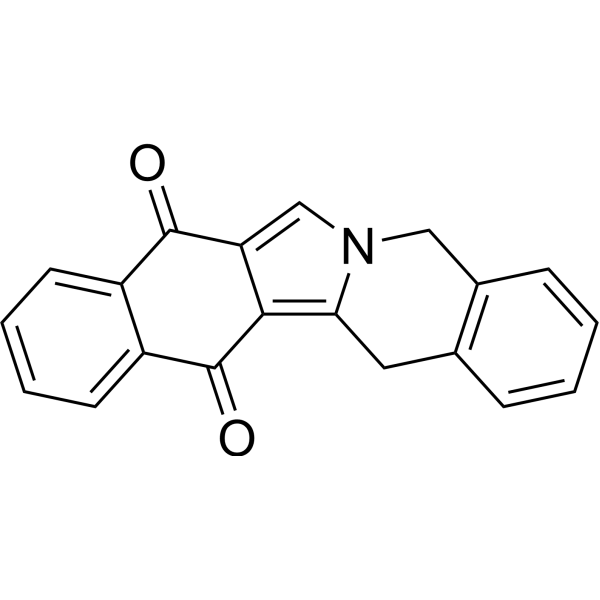
  • HY-128470

    GR-30921

    Drug Derivative Cancer
    Mitoquidone (GR-30921) is is the first member of a group of pentacyclic pyrroloquinones. Mitoquidone shows good activity in a range of experimental solid tumour models. Mitoquidone can be used for the research of anti-cancer .
    Mitoquidone
  • HY-P991344

    PD-1/PD-L1 Cancer
    AMP-224 is a fusion protein targeting PD-L2. AMP-224 specifically binds to PD-1 T cells (chronically stimulated/exhausted T cells). AMP-224 can be used in Colorectal cancer and Solid tumours research .
    AMP-224
  • HY-13432A

    CHR-3996 TFA

    HDAC Apoptosis Cancer
    Nanatinostat (CHR-3996) TFA is a potent, class I selective and orally active HDAC inhibitor with IC50s of 3 nM, 4 nM, and 7 nM for HDAC1, HDAC2, and HDAC3, respectively. Nanatinostat TFA has low activity against HDAC5 (IC50 of 200 nM) and HDAC6 (IC50 of 2100 nM). Nanatinostat TFA induces apoptosis in myeloma cells. Nanatinostat TFA has potent anticancer effects, such as myeloma, advanced solid tumours and colorectal cancer .
    Nanatinostat TFA
  • HY-P991438

    Interleukin Related Cancer
    XmAb-662 is a fusion protein targeting IL-12. XmAb-662 can be used in solid tumours research .
    XmAb-662
  • HY-P991390

    Transmembrane Glycoprotein Cancer
    BAT-6021 is a human monoclonal antibody (mAb) targeting TIGIT. BAT-6021 can be used in Solid tumours research .
    BAT-6021
  • HY-P991605

    LAG-3 Cancer
    HLX26 is a humanised anti-LAG-3 monoclonal antibody. HLX26 has antitumor activity especially advanced solid tumours. HLX26 can be used for lymphoma research .
    HLX26
  • HY-P991357

    PD-1/PD-L1 Cancer
    STT-001 is a human monoclonal antibody (mAb) targeting B7-H1/PD-L1/CD274. STT-001 can be used in Solid tumours research .
    STT-001
  • HY-P991367

    CD47 Cancer
    ES004 is a human monoclonal antibody (mAb) targeting SIRPα/CD172a. ES004 enhances macrophage phagocytosis and induces potent T cell responses to promote tumor killing. ES004 can be used in Solid tumours research .
    ES004
  • HY-P991354

    PD-1/PD-L1 Cancer
    GR-1405 is a human monoclonal antibody (mAb) targeting B7-H1/PD-L1/CD274. GR-1405 enhances cytotoxic T lymphocyte (CTL)-mediated antitumor immune responses against PD-L1-expressing tumor cells. GR-1405 can be used in Lymphoma and Solid tumours research .
    GR-1405
  • HY-P991349

    PD-1/PD-L1 Cancer
    GNR-051 is a human monoclonal antibody (mAb) targeting PDCD1/PD-1/CD279. GNR-051 can be used in Solid tumours research .
    GNR-051
  • HY-P992315

    PTZ-522

    TNF Receptor Cancer
    ASP1951 (PTZ-522) is a monoclonal antibody that targets GITR and is a GITR agonist. ASP1951 can be used for the research of advanced solid tumours .
    ASP1951
  • HY-P992368

    TNF Receptor Cancer
    HLX51 is a regulatory T cell inhibitor and OX40/CD134/TNFRSF4 agonist with tumour growth inhibitory activity. HLX51 inhibits regulatory T cell differentiation and activity, relieves tumour microenvironment immunosuppression, enhances effector T cell function. HLX51 competitively binds OX40, activates OX40, promotes immune cell proliferation and T cell killing ability. HLX51 modulates immune cell function to inhibit tumour growth. HLX51 can be used for the research of advanced/metastatic solid tumours and lymphomas .
    HLX51
  • HY-P991944A

    CCR Cancer
    ZL-1218 (FUT8-KO) is an anti-CCR8 monoclonal antibody expressed by CHO cells with the fucosyltransferase 8 gene (FUT8) knocked out. Fucose deficiency enhances the antibody-dependent cellular cytotoxicity (ADCC) effect of the antibody. ZL-1218 (FUT8-KO) can be used for the research of solid tumour .
    ZL-1218 (FUT8-KO)
  • HY-P991944

    CCR Cancer
    ZL-1218 is a selective humanized IgG1 antibody, targeting CCR8. ZL-1218 induces antibody-dependent cellular cytotoxicity (ADCC), leading to NK cell-mediated depletion of CCR8-expressing regulatory T cells (Tregs). ZL-1218 blocks the binding of the CCR8 ligand CCL1 to CCR8 and reduces Treg recruitment by inhibiting the chemotaxis of CCR8 + cells. ZL-1218 reduces intratumoral Treg levels in a dose-dependent manner. ZL-1218 exerts enhanced antitumor activity when combined with the anti-PD-1 antibody. ZL-1218 can be used for solid tumour research .
    ZL-1218
  • HY-182450

    Ser/Thr Protease Cancer
    WX-293 is a highly selective urokinase-type plasminogen activator (uPA) inhibitor with a Ki value of 2.4 μM. WX-293 abolishes hypoxia-induced keratinocyte migration and in vitro wound closure. WX-293 can be used in research on hypoxia-mediated skin wounds and solid malignant tumors .
    WX-293
  • HY-P992434

    PD-1/PD-L1 SHP1 Interleukin Related Cancer
    OSE-279 is a high-affinity humanized monoclonal bivalent antibody targeting PD-1, the recommended isotype control is HY-P99003. OSE-279 blocks PD-1 ligand binding, inhibits PDL1-induced SHP1 phosphorylation, restores T cell activation, and promotes reactivation of primary T cell effector functions. OSE-279 binds hFcRn receptor, predicts long half-life, induces CD4 and CD8 T cell proliferation, and promotes interleukin 2 and interferon gamma secretion. OSE-279 can be used for the research of advanced malignancies, colon cancer, hepatocarcinoma, mesothelioma .
    OSE-279

Inquiry Online

Your information is safe with us. * Required Fields.

Salutation


Country or Region *

Applicant Name *


Organization Name *

Department *


Email Address *


Product Name *

Cat. No.


Requested quantity *

Phone Number *


Remarks

Inquiry Online

Inquiry Information

Product Name:
Cat. No.:
Quantity:
MCE Japan Authorized Agent:

