
1. Search Result
Search Result
Results for "

sphingolipid metabolism

" in MedChemExpress (MCE) Product Catalog:

21

Inhibitors & Agonists

1

Screening Libraries

3

Natural
Products

1

Isotope-Labeled Compounds

1

Click Chemistry

1

Oligonucleotides

Targets Recommended:
Cat. No. Product Name Target Research Areas Chemical Structure
  • HY-113498
    Sphingomyelin
    1 Publications Verification

    Endogenous Metabolite Neurological Disease Metabolic Disease Inflammation/Immunology
    Sphingomyelin is a eukaryotic sphingolipid and one of the major constituents of cell membranes and particularly abundant in the myelin sheath that surrounds neuronal axons. Sphingomyelin plays an important role in cell processes, the regulation of inflammatory responses, and signal transduction. Sphingomyelin metabolism is associated with various central nervous system diseases and Niemann–Pick disease .
    Sphingomyelin
  • HY-N11709

    Apoptosis VEGFR ATM/ATR PTEN Akt mTOR HIF/HIF Prolyl-Hydroxylase NF-κB Notch Cholinesterase (ChE) Amyloid-β γ-secretase Ferroptosis Fungal Infection Neurological Disease Metabolic Disease Cancer
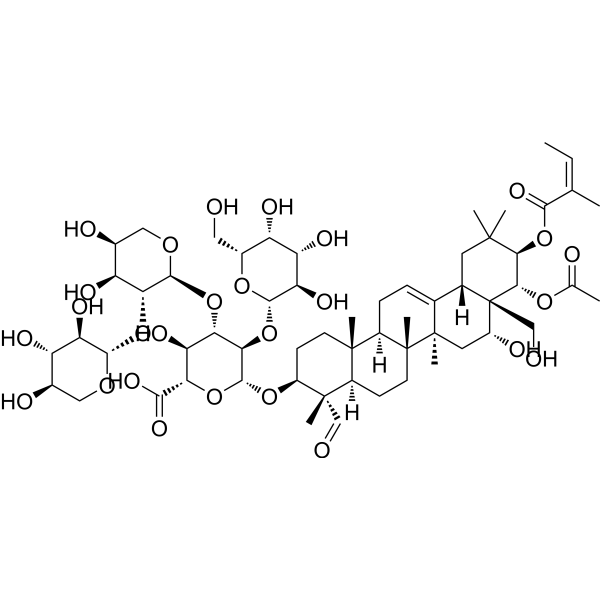
    Theasaponin E1 is an orally effective tea saponin. Theasaponin E1 inhibits the proliferation of cancer cells by activating apoptosis. Theasaponin E1 inhibits angiogenesis in ovarian cancer cells and HUVECs by reducing the expression of VEGF. Theasaponin E1 upregulates the phosphorylation level of ATM protein and the expression level of PTEN protein in cancer cells, decreases the phosphorylation levels of Akt, mTOR, p70S6K and 4E-BP1 proteins, downregulates the expression of HIF-1α and NF-κB, and reduces the protein expression of Notch ligands Dll4 and Jagged1. Theasaponin E1 exerts neuroprotective effects by inhibiting the activity of acetylcholinesterase, activating α-secretase and neprilysin, reducing the concentration of , and inhibiting the activities of β-secretase and γ-secretase. Theasaponin E1 exhibits toxic effects on cancer cells and quinone reductase-inducing activity, and inhibits tumor growth in vivo. Theasaponin E1 induces ferroptosis in Pomacea canaliculata by synergistically disrupting cholesterol homeostasis and sphingolipid metabolism. Theasaponin E1 possesses anti-biofilm activity against Candida albicans. Theasaponin E1 can be used in the research of ovarian cancer, obesity, Alzheimer's disease and fungal infections .
    Theasaponin E1
  • HY-139286

    Pacsph; Pacsphingosine (d18:1)

    Biochemical Assay Reagents Others
    Photoclick sphingosine (Pacsph) is a photosensitizing and clickable sphingosine analog. Photoclick sphingosine is metabolized in cells into endogenous lipid metabolic pathways and can be visualized by its clickable alkyne group. Photoclick sphingosine can be used to study intracellular sphingolipid metabolism and subcellular localization .
    Photoclick sphingosine
  • HY-178174

    DNA/RNA Synthesis Topoisomerase Cancer
    MGB4 is a DNA minor groove binder. MGB4 binds to ARE-containing DNA and inhibition of topoisomerase I activity. MGB4 can impacts key cellular pathways, including inhibition oftranslation and alterations in sphingolipid and amino acid metabolism. MGB4 also reduces spermine and spermidine metabolism companied with Doxorubicin (HY-15142A). MGB4 can be used for the research of cancer, such as Prostate cancer .
    MGB4
  • HY-168764

    Endogenous Metabolite Metabolic Disease Inflammation/Immunology
    C16 Galactosylceramide is a sphingolipid compound. C16 Galactosylceramide participates in the physiological processes of lipid metabolism and immune regulation in cells. C16 Galactosylceramide can be used in the study of diabetes .
    C16 Galactosylceramide
  • HY-W158234

    Parasite Infection
    N-Methylbenzo[d]oxazol-2-amine (compound 1) is an anthelmintic activity and lower cytotoxicity against T. spiralis adult worm. N-Methylbenzo[d]oxazol-2-amine up-regulates the metabolism of purine, pyrimidine and down-regulates sphingolipid metabolism .
    N-Methylbenzo[d]oxazol-2-amine
  • HY-119327

    Autophagy AMPK Others
    Butylate is a compound involved in platelet research. Platelet activation can cause autophagy, which is partly mediated by the AMPK-MTOR pathway and is related to sphingolipid metabolism. Butylate mentioned in the study may be a tool or control substance for studying related metabolic processes.
    Butylate
  • HY-119327R

    Autophagy AMPK Reference Standards Others
    Butylate (Standard) is the analytical standard of Butylate. This product is intended for research and analytical applications. Butylate is a compound involved in platelet research. Platelet activation can cause autophagy, which is partly mediated by the AMPK-MTOR pathway and is related to sphingolipid metabolism. Butylate mentioned in the study may be a tool or control substance for studying related metabolic processes.
    Butylate (Standard)
  • HY-N7697R

    Reference Standards Others Others
    Butylate (Standard) is the analytical standard of Butylate. This product is intended for research and analytical applications. Butylate is a compound involved in platelet research. Platelet activation can cause autophagy, which is partly mediated by the AMPK-MTOR pathway and is related to sphingolipid metabolism. Butylate mentioned in the study may be a tool or control substance for studying related metabolic processes.
    Chitotetraose tetrahydrochloride (Standard)
  • HY-173540

    C22:1(13Z) 1-Deoxyceramide

    Ceramidase Neurological Disease
    C22:1 1-Deoxyceramide (m18:1/22:1) (C22:1(13Z) 1-Deoxyceramide) is a deoxyceramide lipid that lacks the 1-hydroxyl group and is a ceramide variant. C22:1 1-Deoxyceramide (m18:1/22:1) has potential neurotoxicity and is involved in mitochondrial stress and cell death signaling. It can be used to study abnormal sphingolipid metabolism and neurodegenerative diseases .
    C22:1 1-Deoxyceramide (m18:1/22:1)
  • HY-168066

    Fungal Infection
    Antifungal agent 117 is a bis-pyrazole carboxamide derivative with antifungal activity, exhibiting an EC50 value of 11.58 mg/L against Sclerotinia sclerotiorum. Antifungal agent 117 increases cell membrane permeability, causing an imbalance in osmotic pressure inside and outside the cell, and induces the accumulation of reactive oxygen species (ROS), leading to oxidative damage to the cell membrane, resulting in leakage of cellular contents and eventually cell death. RNA sequencing analysis reveals that Antifungal agent 117 downregulates catalase genes and upregulates neutral ceramidase genes, disrupting cell membrane structure, accelerating sphingolipid metabolism, and promoting cell death. Antifungal agent 117 shows great potential in the fields of plant protection and antifungal infection .
    Antifungal agent 117
  • HY-N16342

    Others Others
    N-C16-desoxymethylsphinganine is an effective inhibitor of sphingolipid metabolism.
    N-C16-Desoxymethylsphinganine
  • HY-N16335

    Others Others
    N-C24:1-desoxymethylsphinganine is an effective inhibitor of sphingolipid metabolism.
    N-C24:1-Desoxymethylsphinganine
  • HY-121683A

    (E/Z)-16:1 Aldehyde

    Apoptosis Reactive Oxygen Species (ROS) Metabolic Disease
    2-Hexadecenal, a long-chain fatty aldehyde, is a byproduct of sphingolipid metabolism, involved in cytoskeletal reorganization, DNA damage, and apoptosis. 2-Hexadecenal regulates ROS production and induces apoptosis in polymorphonuclear leucocytes.
    2-Hexadecenal
  • HY-121683S

    16:1 Aldehyde-d5

    Isotope-Labeled Compounds Metabolic Disease
    2-Hexadecenal-d5 is the deuterated 2-Hexadecenal. 2-Hexadecenal, a long-chain fatty aldehyde, is a byproduct of sphingolipid metabolism, involved in cytoskeletal reorganization, DNA damage, and apoptosis.
    2-Hexadecenal-d5
  • HY-E70940A

    Endogenous Metabolite Metabolic Disease
    Sphingomyelinase, Streptomyces sp. (EC 3.1.4.12) is a hydrolase enzyme that is involved in sphingolipid metabolism reactions. Sphingomyelinase is a member of the DNase I superfamily of enzymes and is responsible for breaking sphingomyelin (SM) down into phosphocholine and ceramide.
    Sphingomyelinase, Streptomyces sp.
  • HY-E70940

    Endogenous Metabolite Metabolic Disease
    Sphingomyelinase, Staphylococcus aureus (EC 3.1.4.12) is a hydrolase enzyme that is involved in sphingolipid metabolism reactions. Sphingomyelinase is a member of the DNase I superfamily of enzymes and is responsible for breaking sphingomyelin (SM) down into phosphocholine and ceramide.
    Sphingomyelinase, Staphylococcus aureus
  • HY-E70940B

    Biochemical Assay Reagents Metabolic Disease
    Sphingomyelinase, Bacillus cereus (EC 3.1.4.12) is a hydrolase enzyme that is involved in sphingolipid metabolism reactions. Sphingomyelinase, Bacillus cereus (EC 3.1.4.12) is a member of the DNase I superfamily of enzymes and is responsible for breaking sphingomyelin (SM) down into phosphocholine and ceramide.
    Sphingomyelinase, Bacillus cereus
  • HY-128395

    C20-DHSM; DHSM (d18:0/20:0)

    Liposome Endogenous Metabolite Metabolic Disease
    C20-Dihydrosphingomyelin (C20-DHSM; DHSM (d18:0/20:0)) is a saturated form of Sphingomyelin (HY-113498). C20-Dihydrosphingomyelin is a secondary component of most cell sphingolipids and its levels significantly decrease after intermittent fasting during Ramadan. C20-Dihydrosphingomyelin can be used for the development of liposome reagents .
    C20-Dihydrosphingomyelin
  • HY-148747

    Biochemical Assay Reagents Neurological Disease Cancer
    Ganglioside GD3 (d18:1/12:0) is a type of glycosphingolipid, the d18:1 indicates the sphingosine base, and the 12:0 represents the fatty acid part which is lauric acid. Ganglioside GD3 (d18:1/12:0) is a crucial intermediate in the biosynthesis pathway of gangliosides and is mainly found in the brain tissues of mammals. Ganglioside GD3 (d18:1/12:0) plays significant roles in development, cell signal transduction, and various diseases .
    Ganglioside GD3 (d18:1/12:0)
  • HY-164158

    Drug Derivative Others
    N,N-Dimethyl psychosine is a derivative of Psychosine (HY-136490). N,N-Dimethyl psychosine can be used as an internal standard compound to quantify Psychosine in alkaline-treated lipid extracts .
    N,N-Dimethyl psychosine

Inquiry Online

Your information is safe with us. * Required Fields.

Salutation


Country or Region *

Applicant Name *


Organization Name *

Department *


Email Address *


Product Name *

Cat. No.


Requested quantity *

Phone Number *


Remarks

Inquiry Online

Inquiry Information

Product Name:
Cat. No.:
Quantity:
MCE Japan Authorized Agent:

