



Sphingomyelin
Based on 1 publication(s) in Google Scholar
Sphingomyelin is a eukaryotic sphingolipid and one of the major constituents of cell membranes and particularly abundant in the myelin sheath that surrounds neuronal axons. Sphingomyelin plays an important role in cell processes, the regulation of inflammatory responses, and signal transduction. Sphingomyelin metabolism is associated with various central nervous system diseases and Niemann–Pick disease.
For research use only. We do not sell to patients.
- Purity : 98.0%
- CAS No.: 85187-10-6
-
Storage:Powder -20°C, 3 years ; In solvent -80°C, 6 months , -20°C, 1 month

To place orders, for customer services and technical support, please contact: MedChemExpress USA
Tel: 609-228-6898 E-mail: [email protected] [email protected]


-
 Biological Activity
-
Chemical Information
-
Solvent & Solubility
- Protocols
- Purity & Documentation
- References
-
 Help & FAQs


-
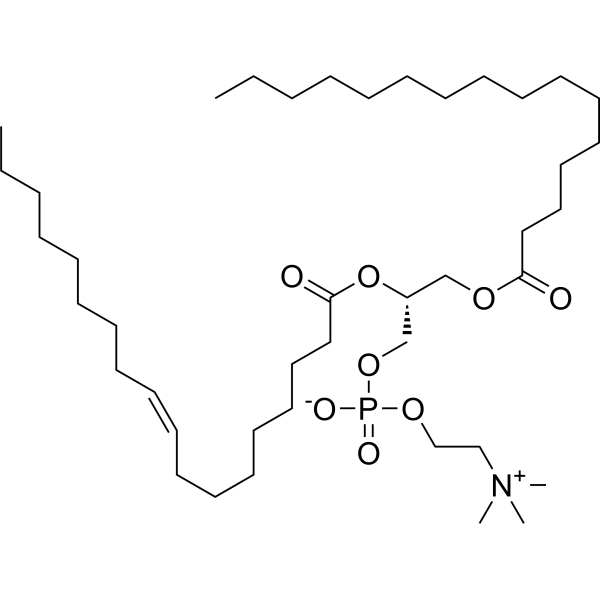
HY-130462
1-Palmitoyl-2-oleoyl-sn-glycero-3-PCSaturated Monobasic Alcohol -
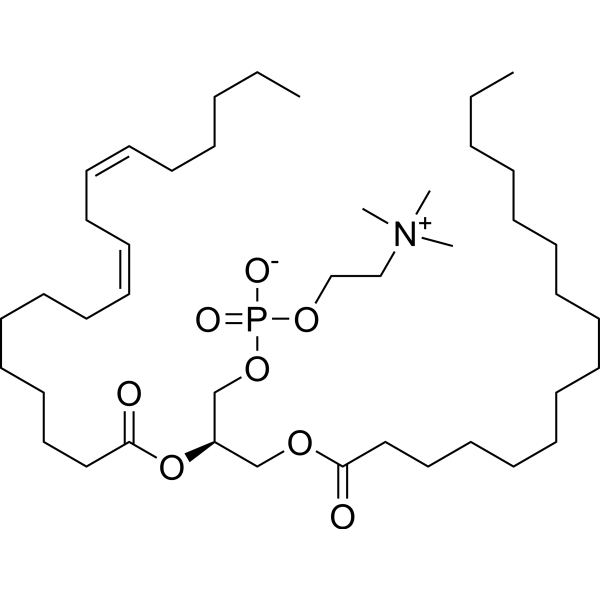
HY-B2235
LecithinEndogenous Metabolite -
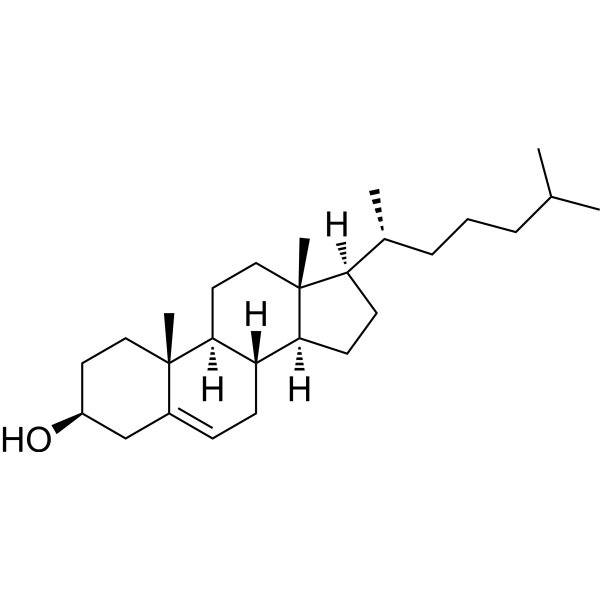
HY-N0322
Cholesterol (from animal)ERRα Agonist -
HY-109590
Arachidonic acidPolyunsaturated Fatty Acid -
HY-W040193
DSPCLiposome Compound -
HY-W251428
Phosphatidylglycerols (egg) sodium saltBiochemical Assay Reagent -

HY-B2235A
L-α-Lecithin (egg yolk), 75%Biochemical Reagent -
HY-125854
Phosphatidylcholines, eggPhosphatidylcholine -
HY-W250118
Cephalin form bovine brainBiochemical Assay Reagent -
HY-125853
Phosphatidylcholines,soyaPhosphatidylcholine -
HY-113679
Ceramides MixtureEndogenous Ceramide -

HY-B2235B
L-α-Lecithin (egg yolk, Type XVI-E), 99%Biochemical Reagent
Publications Citing Use of MedChemExpress (MCE) Sphingomyelin
More Customer Validation & Images

-
Histological Imaging/Staining
-
In Vivo Efficacy Study
All Endogenous Metabolite Isoforms
More

Biological Activity
Description
IC50 & Target
|
Human Endogenous Metabolite |
Microbial Metabolite |
In Vitro
Sphingomyelin metabolism resulting in the production of various interconvertible bioactive sphingolipids or derivatives such as ceramide, diacylglyceride, and sphingosine-1-phosphate. These bioactive lipids act on their specific targets within the cell and regulate various signal transduction pathways, thereby affecting cellular functions[1].
Sphingomyelin enriched lipid raft mediated cell signaling[1].
MedChemExpress (MCE) has not independently confirmed the accuracy of these methods. They are for reference only.
Clinical Trial
| NCT Number | Sponsor | Condition | Start Date |
Phase

|
|---|---|---|---|---|
| NCT01329991 | 2011-05 | PHASE1 |


Chemical Information
-
CAS No. 85187-10-6
-
Appearance Solid
-
Color White to off-white
-
SMILES
[Sphingomyelin]
-
Structure Classification
-
Initial Source
-
Shipping
Room temperature in continental US; may vary elsewhere.
-
Storage
Powder -20°C 3 years In solvent -80°C 6 months -20°C 1 month


Publications (1)
-
Journal Impact Factor
-
Most Recent
-
Microbiol Spectr
Effects of azithromycin on alleviating airway inflammation in asthmatic mice by regulating airway microbiota and metabolites. [Abstract]2025 Mar 4;13(3):e0221724. PMID: 39932326
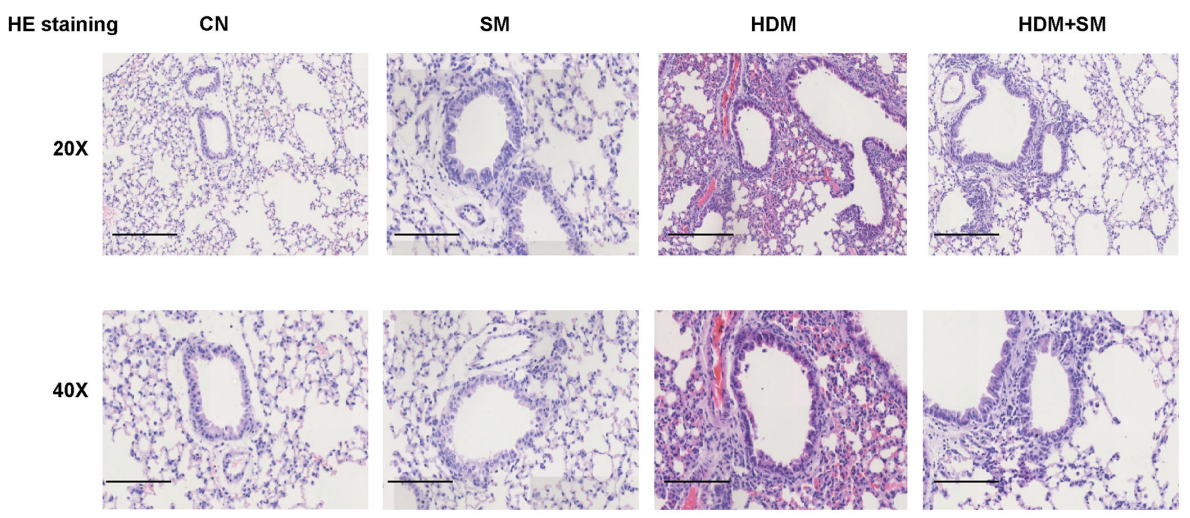
Sphingomyelin purchased from MedChemExpress. Usage Cited in: Microbiol Spectr. 2025 Mar 4;13(3):e0221724. [Abstract]
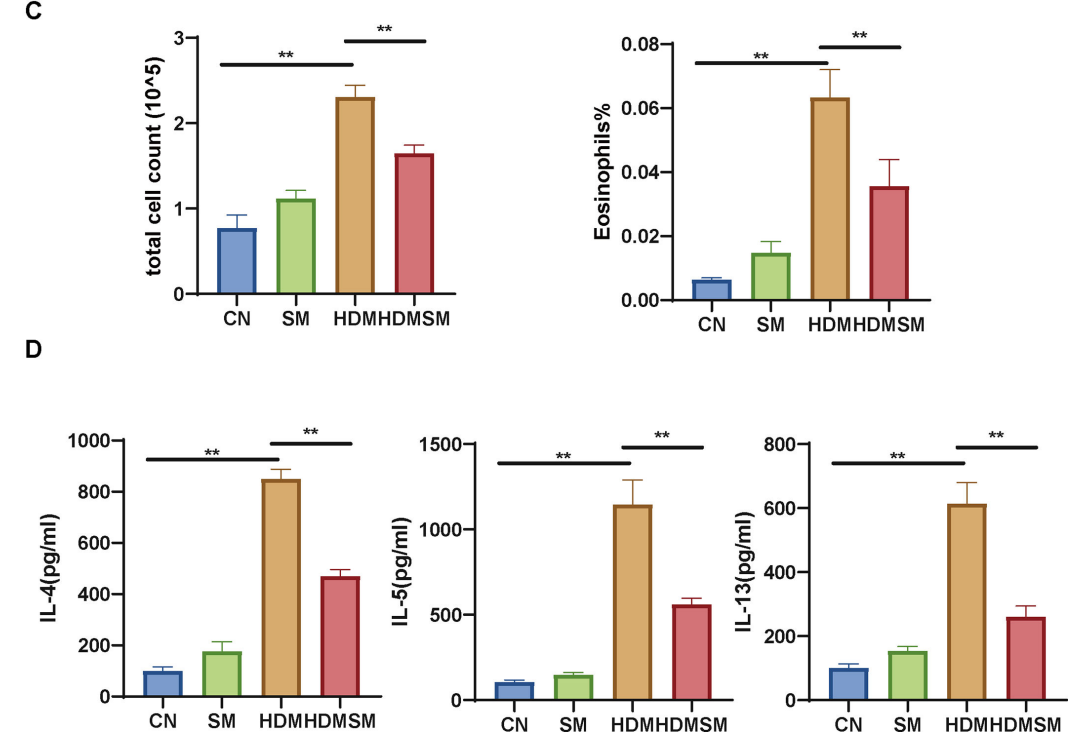
Sphingomyelin (SM) significantly reduced inflammatory cell infiltration in the airways of HDM-induced asthmatic mice.
Sphingomyelin purchased from MedChemExpress. Usage Cited in: Microbiol Spectr. 2025 Mar 4;13(3):e0221724. [Abstract]
(C) BALF total cell count and BALF eosinophilia percentage among groups. (D) BALF IL-4, IL-5, and IL-13 levels among groups. The results showed that compared with the HDM group, Sphingomyelin (SM) administration will alleviate airway inflammation in mice, manifested by lower total cell counts, EOS percentage, and T2 cytokines.


Solvent & Solubility
In Vitro:
Ethanol : 25 mg/mL (Need ultrasonic)
In Vivo:
Select the appropriate dissolution method based on your experimental animal and administration route.
- For the following dissolution methods, please ensure to first prepare a clear stock solution using an In Vitro approach and then sequentially add co-solvents:
- To ensure reliable experimental results, the clarified stock solution can be appropriately stored based on storage conditions. As for the working solution for In Vivo experiments, it is recommended to prepare freshly and use it on the same day.
- The percentages shown for the solvents indicate their volumetric ratio in the final prepared solution. If precipitation or phase separation occurs during preparation, heat and/or sonication can be used to aid dissolution.
Add each solvent one by one: 10% EtOH 90% (20% SBE-β-CD in Saline)
Solubility: 1.67 mg/mL; Suspended solution; Need ultrasonic
This protocol yields a suspended solution of 1.67 mg/mL. Suspended solution can be used for oral and intraperitoneal injection.
Taking 1 mL working solution as an example, add 100 μL EtOH stock solution (16.7 mg/mL) to 900 μL 20% SBE-β-CD in Saline, and mix evenly.
Preparation of 20% SBE-β-CD in Saline (4°C, storage for one week): 2 g SBE-β-CD powder is dissolved in 10 mL Saline, completely dissolve until clear.
Add each solvent one by one: 10% EtOH 90% Corn Oil
Solubility: ≥ 1.67 mg/mL; Clear solution
This protocol yields a clear solution of ≥ 1.67 mg/mL (saturation unknown). If the continuous dosing period exceeds half a month, please choose this protocol carefully.
Taking 1 mL working solution as an example, add 100 μL EtOH stock solution (16.7 mg/mL) to 900 μL Corn oil, and mix evenly.
In Vivo Dissolution Calculator
Please enter the basic information of animal experiments:
-
-
-
-
Recommended: Prepare an additional quantity of animals to account for potential losses during experiments.
Working solution concentration: 0.22 mg/mL


Purity & Documentation
-
Data Sheet (276 KB)
-
SDS (252 KB)
- English - EN (252 KB)
- Français - FR (252 KB)
- Deutsch - DE (252 KB)
- Norwegian - NO (252 KB)
- Español - ES (252 KB)
- Swedish - SV (252 KB)
- Italian - IT (252 KB)
- Korean - KR (252 KB)
- Portuguese - PT (252 KB)
-
Handling Instructions (2659 KB)
References
[1]. Chakraborty M, et al. Sphingomyelin and its role in cellular signaling. Adv Exp Med Biol. 2013;991:1-14. [Content Brief]
[2]. Schneider N, et al. Sphingomyelin in Brain and Cognitive Development: Preliminary Data. eNeuro. 2019 Aug 6;6(4). pii: ENEURO.0421-18.2019. [Content Brief]
[3]. Bienias K, et al. Regulation of sphingomyelin metabolism. Pharmacol Rep. 2016 Jun;68(3):570-81. [Content Brief]
[4]. Schuchman EH, et al. Types A and B Niemann-Pick disease. Mol Genet Metab. 2017 Jan - Feb;120(1-2):27-33. [Content Brief]

Calculators
Concentration (start) × Volume (start) = Concentration (final) × Volume (final)


Sphingomyelin Related Classifications
HY-113498 Related Classifications
 Powered by Bioz