



Phosphatidylglycerols (egg) sodium salt
Based on 1 publication(s) in Google Scholar
Phosphatidylglycerols (PG) is a selective inhibitor targeting the TLR4 accessory protein CD14/MD-2 complex, inhibiting LPS or virus (such as RSV)-mediated inflammatory signaling pathways through competitive binding. Phosphatidylglycerols directly bind to viral particles to block infection, inhibit COX-2 expression to reduce the release of inflammatory factors (IL-6, IL-8), and improve oxidative stress by regulating mitochondrial membrane phospholipid remodeling. Phosphatidylglycerols can be taken orally or by inhalation and can be used in the study of chronic inflammatory diseases (such as atherosclerosis) and respiratory viral infections (such as RSV).
For research use only. We do not sell to patients.
- Purity : 99.53%
- CAS No.: 383907-64-0
- Formula: C42H80NaO9P
- Molecular Weight:783.04
-
Storage:
-20°C, sealed storage, away from moisture
* In solvent : -80°C, 6 months; -20°C, 1 month (sealed storage, away from moisture)

To place orders, for customer services and technical support, please contact: MedChemExpress USA
Tel: 609-228-6898 E-mail: [email protected] [email protected]


-
 Biological Activity
-
Chemical Information
-
Solvent & Solubility
- Purity & Documentation
- References
-
 Help & FAQs


-

HY-W250118
Cephalin form bovine brain -

HY-125853
Phosphatidylcholines,soya -

HY-125854
Phosphatidylcholines, egg -

HY-113498
Sphingomyelin -

HY-139414
Lysophosphatidylcholines -
HY-134238
Cardiolipin (Heart, Bovine) sodium -
HY-139533
Phosphatidylinositols, soya, sodium salts -
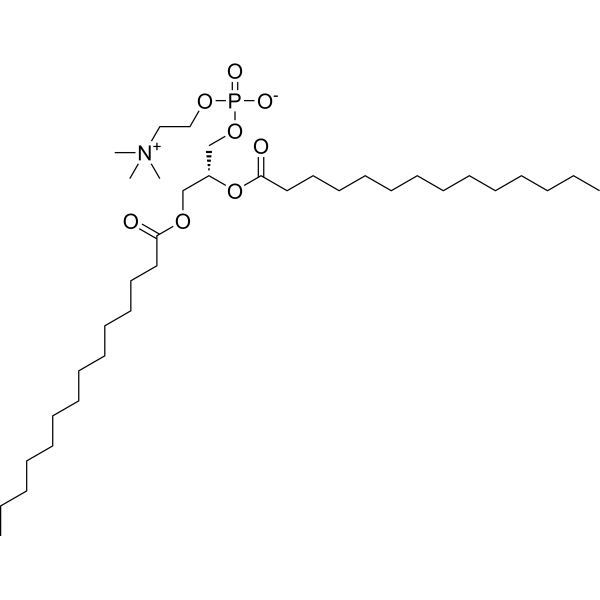
HY-109541
Colfosceril miristate -
HY-125940
DPPG -
HY-148123
Glycerophospholipids, cephalins -
HY-B2235
Lecithin -

HY-B2235B
L-α-Lecithin (egg yolk, Type XVI-E), 99%
Publications Citing Use of MedChemExpress (MCE) Phosphatidylglycerols (egg) sodium salt
More

Biological Activity
Description
In Vitro
Phosphatidylglycerol is present in lower amounts than phosphatidylethanolamine in prokaryotes and eukaryotes and in lower amounts than phosphatidylcholine in eukaryotes. Phosphatidylglycerol is formed by the reaction between CDP-diacylglycerol and L-α-glycerol 3-phosphate followed by dephosphorylation and is a metabolic precursor of cardiolipin. Phosphatidylglycerols containing polyunsaturated and monounsaturated fatty acyl chains inhibit and promote proliferation of murine keratinocytes, respectively. Phosphatidylglycerol is the second largest lipid component of mammalian lung surfactant, accounting for 10% of lipids, and levels are reduced in the lung surfactant of infants with respiratory distress syndrome. Phosphatidylglycerol (egg) is a mixture of phosphatidylglycerols isolated from eggs with various fatty acyl groups at the sn-1 and sn-2 positions.
MedChemExpress (MCE) has not independently confirmed the accuracy of these methods. They are for reference only.


Chemical Information
-
CAS No. 383907-64-0
-
Appearance Solid
-
Molecular Weight 783.04
-
Formula C42H80NaO9P
-
Color White to off-white
-
SMILES
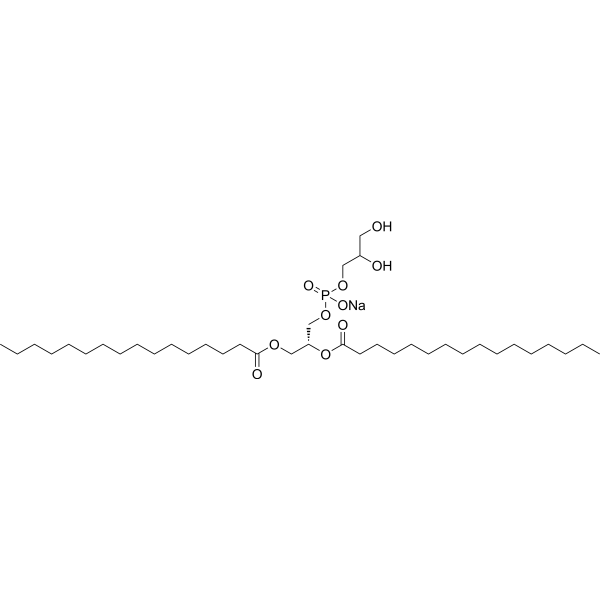
CCCCCCCCCCCCCCCC(OC[C@](CC(CCCCCCC/C=C\CCCCCCCC)=O)(C)COP(OCC(O)CO)(O[Na])=O)=O
-
Synonyms
Egg PG
-
Shipping
Room temperature in continental US; may vary elsewhere.
-
Storage
-20°C, sealed storage, away from moisture
* In solvent : -80°C, 6 months; -20°C, 1 month (sealed storage, away from moisture)


Publications (1)
-
Journal Impact Factor
-
Most Recent
-
Adv Sci (Weinh)
2026 Jul;13(39):e20095. PMID: 41972457


Solvent & Solubility
In Vitro:
DMSO : 10 mg/mL (12.77 mM; ultrasonic and warming and heat to 60°C; Hygroscopic DMSO has a significant impact on the solubility of product, please use newly opened DMSO)
Please refer to the solubility information to select the appropriate solvent. Once prepared, please aliquot and store the solution to prevent product inactivation from repeated freeze-thaw cycles.
Storage method and period of stock solution: -80°C, 6 months; -20°C, 1 month (sealed storage, away from moisture). When stored at -80°C, please use it within 6 months. When stored at -20°C, please use it within 1 month.
Please refer to the solubility information to select the appropriate solvent. Once prepared, please aliquot and store the solution to prevent product inactivation from repeated freeze-thaw cycles.
Storage method and period of stock solution: -80°C, 6 months; -20°C, 1 month (sealed storage, away from moisture). When stored at -80°C, please use it within 6 months. When stored at -20°C, please use it within 1 month.
Concentration (start) × Volume (start) = Concentration (final) × Volume (final)
In Vivo:
Select the appropriate dissolution method based on your experimental animal and administration route.
- For the following dissolution methods, please ensure to first prepare a clear stock solution using an In Vitro approach and then sequentially add co-solvents:
- To ensure reliable experimental results, the clarified stock solution can be appropriately stored based on storage conditions. As for the working solution for In Vivo experiments, it is recommended to prepare freshly and use it on the same day.
- The percentages shown for the solvents indicate their volumetric ratio in the final prepared solution. If precipitation or phase separation occurs during preparation, heat and/or sonication can be used to aid dissolution.
Add each solvent one by one: 10% DMSO 40% PEG300 5% Tween-80 45% Saline
Solubility: ≥ 1 mg/mL (1.28 mM); Clear solution
This protocol yields a clear solution of ≥ 1 mg/mL (saturation unknown).
Taking 1 mL working solution as an example, add 100 μL DMSO stock solution (10.0 mg/mL) to 400 μL PEG300, and mix evenly; then add 50 μL Tween-80 and mix evenly; then add 450 μL Saline to adjust the volume to 1 mL.
Preparation of Saline: Dissolve 0.9 g sodium chloride in ddH₂O and dilute to 100 mL to obtain a clear Saline solution.
In Vivo Dissolution Calculator
Please enter the basic information of animal experiments:
-
-
-
-
Recommended: Prepare an additional quantity of animals to account for potential losses during experiments.
Please enter your animal formula composition:
-
%DMSO +
Recommended: Keep the proportion of DMSO in working solution below 2% if your animal is weak.
-
%+
-
+%Tween-80 + +
-
%Saline +
The co-solvents required include: DMSO, . All of co-solvents are available by MedChemExpress (MCE). , Tween 80. All of co-solvents are available by MedChemExpress (MCE).
Working solution concentration: 0.22 mg/mL
Method for preparing stock solution: mg drug dissolved in μL DMSO. Stock solution concentration: mg/mL. * In solvent : -80°C, 6 months; -20°C, 1 month (sealed storage, away from moisture)
1. Take μL DMSO stock solution;
2. Add μL .
μL , mix evenly;
3. Then add μL Tween 80, mix evenly;
4. Then add μL
Please ensure that the stock solution in the first step is dissolved to a clear state, and add co-solvents in sequence. You can use ultrasonic heating (ultrasonic cleaner, recommended frequency 20-40 kHz), vortexing, etc. to assist dissolution.


Purity & Documentation
-
Data Sheet (269 KB)
-
SDS (394 KB)
- English - EN (394 KB)
- Français - FR (394 KB)
- Deutsch - DE (394 KB)
- Norwegian - NO (394 KB)
- Español - ES (394 KB)
- Swedish - SV (394 KB)
- Italian - IT (394 KB)
- Korean - KR (394 KB)
- Portuguese - PT (394 KB)
-
Handling Instructions (2659 KB)
References
[1]. Chen WW, et al. Phosphatidylglycerol Incorporates into Cardiolipin to Improve Mitochondrial Activity and Inhibits Inflammation. Sci Rep. 2018 Mar 20;8(1):4919. [Content Brief]
[2]. Numata M, et al. Pulmonary surfactant phosphatidylglycerol inhibits respiratory syncytial virus-induced inflammation and infection. Proc Natl Acad Sci U S A. 2010 Jan 5;107(1):320-5. [Content Brief]
[3]. Poelma DL, et al. Influence of phosphatidylglycerol on the uptake of liposomes by alveolar cells and on lung function. J Appl Physiol (1985). 2005 May;98(5):1784-91. [Content Brief]


Complete Stock Solution Preparation Table
Please refer to the solubility information to select the appropriate solvent. Once prepared, please aliquot and store the solution to prevent product inactivation from repeated freeze-thaw cycles.
Storage method and period of stock solution: -80°C, 6 months; -20°C, 1 month (sealed storage, away from moisture). When stored at -80°C, please use it within 6 months. When stored at -20°C, please use it within 1 month.
| Optional Solvent | Concentration Solvent Mass | 1 mg | 5 mg | 10 mg | 25 mg |
|---|---|---|---|---|---|
| DMSO | 1 mM | 1.2771 mL | 6.3854 mL | 12.7707 mL | 31.9269 mL |
| 5 mM | 0.2554 mL | 1.2771 mL | 2.5541 mL | 6.3854 mL | |
| 10 mM | 0.1277 mL | 0.6385 mL | 1.2771 mL | 3.1927 mL |


Phosphatidylglycerols (egg) sodium salt Related Classifications
HY-W251428 Related Classifications
 Powered by Bioz