



Glycerophospholipids, cephalins

Based on 1 Customer Validation
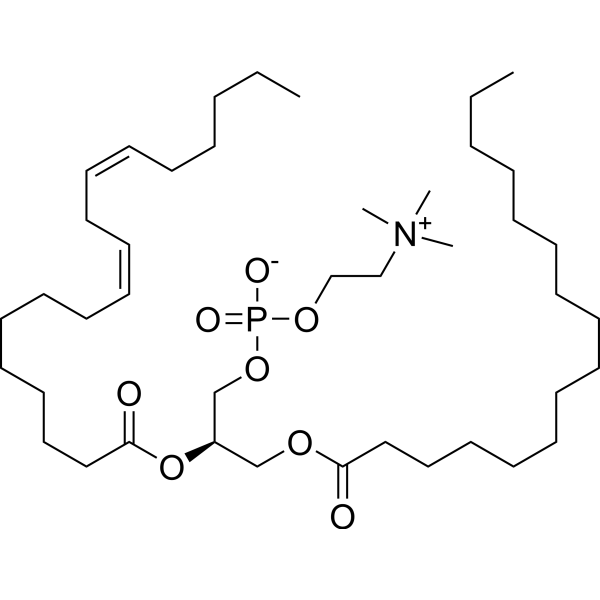
Glycerophospholipids and cephalins are a class of phospholipid compounds and important components of neural membranes. Glycerophospholipids and cephalins are hydrolysis substrates of phospholipase (such as PLA2, PLC, and PLD). After complete hydrolysis, they produce 1 mol of glycerol, phosphate, ethanolamine, and 2 mol of fatty acids, respectively. Glycerophospholipids and cephalins can maintain membrane structure, fluidity, and ion permeability, and serve as precursors of second messengers such as arachidonic acid and diacylglycerol. Glycerophospholipids and cephalins can regulate signal transduction, cell apoptosis, and membrane transport, and are used in the study of neurodegenerative diseases (such as Alzheimer's disease).
For research use only. We do not sell to patients.
- Purity: 88.59%
- CAS No.: 39382-08-6
-
Storage:Powder -20°C, 3 years ; In solvent -80°C, 6 months , -20°C, 1 month

To place orders, for customer services and technical support, please contact: MedChemExpress USA
Tel: 609-228-6898 E-mail: [email protected] [email protected]


-
 Biological Activity
-
Chemical Information
-
Solvent & Solubility
- Purity & Documentation
- References
-
 Help & FAQs


-

HY-112747
Soy PE -
HY-W251428
Phosphatidylglycerols (egg) sodium salt -

HY-113498
Sphingomyelin -
HY-W250118
Cephalin form bovine brain -

HY-B2235B
L-α-Lecithin (egg yolk, Type XVI-E), 99% -
HY-B2235
Lecithin -
HY-139414
Lysophosphatidylcholines -

HY-B2235A
L-α-Lecithin (egg yolk), 75% -
HY-W040193
DSPC -

HY-B2235C
L-α-Lecithin (soybean) -
HY-109541
Colfosceril miristate -
HY-125940
DPPG


Biological Activity
Description
In Vitro
Glycerophospholipids, cephalins (50 μM; 24 h) increase the apoptotic rate of rat cortical neurons by activating phospholipase PLA2 and releasing arachidonic acid[2].
MedChemExpress (MCE) has not independently confirmed the accuracy of these methods. They are for reference only.
-
Cell Line:Rat hippocampal neurons
-
Concentration:20 μM
-
Incubation Time:12 h
-
Result:Increased phosphorylation of PKC and ERK1/2, indicating activation of the PLC/DAG signaling pathway.
In Vivo
MedChemExpress (MCE) has not independently confirmed the accuracy of these methods. They are for reference only.
-
Animal Model:Tg2576 mice (male, weight 18-22g, 6 months old) with Alzheimer’s disease model[1]
-
Dosage:100 mg/kg Arachidonic acid (Glycerophospholipids, cephalins metabolism)
-
Administration:Intraperitoneal injection, once daily, 4 weeks
-
Result:Induced significant increase in brain F₂-isoprostane levels and promoted Aβ1-42 aggregation, leading to cognitive impairment.


Chemical Information
-
CAS No. 39382-08-6
-
Appearance Solid
-
Color Off-white to light yellow
-
SMILES
[Glycerophospholipids, cephalins]
-
Shipping
Room temperature in continental US; may vary elsewhere.
-
Storage
Powder -20°C 3 years In solvent -80°C 6 months -20°C 1 month


Solvent & Solubility
In Vitro:
THF : ≥ 100 mg/mL
* "≥" means soluble, but saturation unknown.


Purity & Documentation
-
Data Sheet (269 KB)
-
SDS (647 KB)
- English - EN (647 KB)
- Français - FR (647 KB)
- Deutsch - DE (647 KB)
- Norwegian - NO (647 KB)
- Español - ES (647 KB)
- Swedish - SV (647 KB)
- Italian - IT (647 KB)
- Korean - KR (647 KB)
- Portuguese - PT (647 KB)
-
Handling Instructions (2659 KB)
References
[1]. Frisardi V, et al. Glycerophospholipids and glycerophospholipid-derived lipid mediators: a complex meshwork in Alzheimer's disease pathology. Prog Lipid Res. 2011 Oct;50(4):313-30. [Content Brief]
[2]. Farooqui AA, et al. Glycerophospholipids in brain: their metabolism, incorporation into membranes, functions, and involvement in neurological disorders. Chem Phys Lipids. 2000 Jun;106(1):1-29. [Content Brief]

Calculators
Concentration (start) × Volume (start) = Concentration (final) × Volume (final)


Glycerophospholipids, cephalins Related Classifications
HY-148123 Related Classifications
 Powered by Bioz