



N-Desmethyl imatinib
Based on 1 publication(s) in Google Scholar
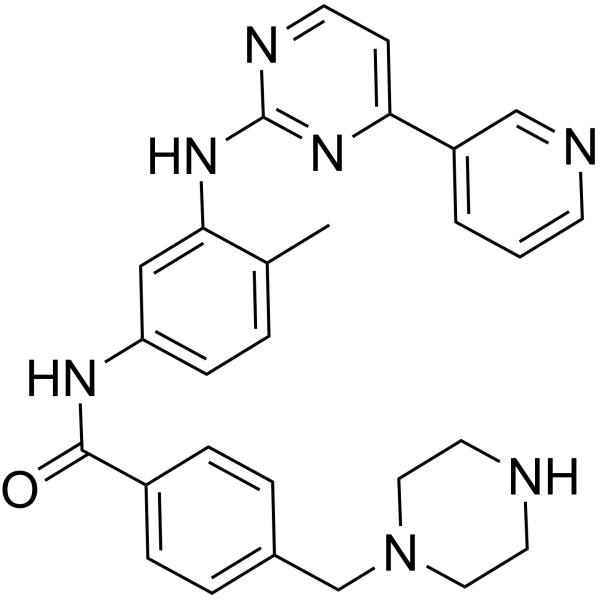
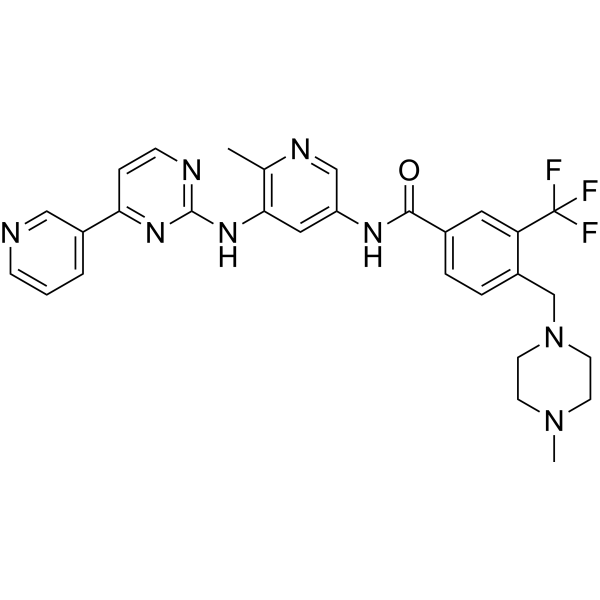
N‑Desmethyl imatinib (Norimatinib) is an active metabolite of Imatinib (HY-15463), a selective c‑Abl inhibitor, and a substrate of P‑glycoprotein. N-Desmethyl imatinib binds to the c-Abl catalytic domain to prevent substrate phosphorylation, inhibits c-Abl-mediated α-synuclein activation and downstream inflammatory signaling pathways. N-Desmethyl imatinib induces apoptosis in K562 human leukemia cells. N-Desmethyl imatinib shows significantly elevated plasma levels in gastrointestinal stromal tumor (GIST) models with mild SARS-CoV-2 infection. N-Desmethyl imatinib can be used for the research of Parkinson’s disease, gastrointestinal stromal tumor, and chronic myeloid leukemia.
For research use only. We do not sell to patients.
- Purity : 98.33%
- CAS No.: 404844-02-6
- Formula: C28H29N7O
- Molecular Weight:479.59
-
Storage:Powder -20°C, 3 years , 4°C, 2 years ; In solvent -80°C, 2 years , -20°C, 1 year

To place orders, for customer services and technical support, please contact: MedChemExpress USA
Tel: 609-228-6898 E-mail: [email protected] [email protected]


-
 Biological Activity
-
Chemical Information
-
Solvent & Solubility
- Purity & Documentation
- References
-
 Help & FAQs





Publications Citing Use of MedChemExpress (MCE) N-Desmethyl imatinib
More

Biological Activity
Description
In Vitro
N-Desmethyl imatinib (CGP 74588) (0.3-30 μM) acts as a substrate for P-glycoprotein, stimulating ATPase activity in P-glycoprotein-expressing Sf9 cell membrane vesicles at concentrations ranging from 0.3 to 30 μM[3].
N-Desmethyl imatinib (48 h) inhibits K562 cell proliferation with an IC50 of 0.58 μM and shows no significant inhibition of K562/Dox cell proliferation (IC50 > 20 μM) after 48 h of treatment[3].
N-Desmethyl imatinib (1.6 μM, 20 μM; 48 h) induces apoptosis in K562 cells, but does not significantly induce apoptosis in K562/Dox cells[3].
MedChemExpress (MCE) has not independently confirmed the accuracy of these methods. They are for reference only.
-
Cell Line:human chronic myelogenous leukemia K562 cells, K562/Dox cells
-
Concentration:0.1, 0.2, 0.4, 0.8, 1.6, 3.0 μM (K562 cells); 1, 2, 5, 10, 20 μM (K562/Dox cells)
-
Incubation Time:48 h
-
Result:Inhibited K562 cell proliferation with an IC50 of 0.58 μM.
Showed no substantial proliferation inhibition in K562/Dox cells, with an IC50 greater than 20 μM.
-
Cell Line:human chronic myelogenous leukemia K562 cells, K562/Dox cells
-
Concentration:1.6 μM (K562 cells); 20 μM (K562/Dox cells)
-
Incubation Time:48 h
-
Result:Induced apoptosis in K562 cells, resulting in a hypoploid apoptotic population of 22.5%.
Did not induce a significant apoptotic response in K562/Dox cells, with a hypoploid population of 1.6% (similar to untreated control).


Chemical Information
-
CAS No. 404844-02-6
-
Appearance Solid
-
Molecular Weight 479.59
-
Formula C28H29N7O
-
Color Light yellow to yellow
-
SMILES
O=C(NC1=CC=C(C)C(NC2=NC(C3=CC=CN=C3)=CC=N2)=C1)C4=CC=C(CN5CCNCC5)C=C4
-
Synonyms
Norimatinib; Imatinib metabolite N-Desmethyl imatinib; CGP 74588
-
Shipping
Room temperature in continental US; may vary elsewhere.
-
Storage
Powder -20°C 3 years 4°C 2 years In solvent -80°C 2 years -20°C 1 year


Publications (1)
-
Journal Impact Factor
-
Most Recent
-
J Chromatogr B Analyt Technol Biomed Life Sci
Imatinib and norimatinib therapeutic monitoring using dried blood spots: Analytical and clinical validation, and performance comparison of volumetric collection devices. [Abstract]2025 Apr 1:1255:124526. PMID: 39985852


Solvent & Solubility
In Vitro:
DMSO : 100 mg/mL (208.51 mM; Need ultrasonic; Hygroscopic DMSO has a significant impact on the solubility of product, please use newly opened DMSO)
Please refer to the solubility information to select the appropriate solvent. Once prepared, please aliquot and store the solution to prevent product inactivation from repeated freeze-thaw cycles.
Storage method and period of stock solution: -80°C, 2 years; -20°C, 1 year. When stored at -80°C, please use it within 2 years. When stored at -20°C, please use it within 1 year.
Please refer to the solubility information to select the appropriate solvent. Once prepared, please aliquot and store the solution to prevent product inactivation from repeated freeze-thaw cycles.
Storage method and period of stock solution: -80°C, 2 years; -20°C, 1 year. When stored at -80°C, please use it within 2 years. When stored at -20°C, please use it within 1 year.
Concentration (start) × Volume (start) = Concentration (final) × Volume (final)
In Vivo:
Select the appropriate dissolution method based on your experimental animal and administration route.
- For the following dissolution methods, please ensure to first prepare a clear stock solution using an In Vitro approach and then sequentially add co-solvents:
- To ensure reliable experimental results, the clarified stock solution can be appropriately stored based on storage conditions. As for the working solution for In Vivo experiments, it is recommended to prepare freshly and use it on the same day.
- The percentages shown for the solvents indicate their volumetric ratio in the final prepared solution. If precipitation or phase separation occurs during preparation, heat and/or sonication can be used to aid dissolution.
Add each solvent one by one: 10% DMSO 40% PEG300 5% Tween-80 45% Saline
Solubility: ≥ 2.5 mg/mL (5.21 mM); Clear solution
This protocol yields a clear solution of ≥ 2.5 mg/mL (saturation unknown).
Taking 1 mL working solution as an example, add 100 μL DMSO stock solution (25.0 mg/mL) to 400 μL PEG300, and mix evenly; then add 50 μL Tween-80 and mix evenly; then add 450 μL Saline to adjust the volume to 1 mL.
Preparation of Saline: Dissolve 0.9 g sodium chloride in ddH₂O and dilute to 100 mL to obtain a clear Saline solution.
In Vivo Dissolution Calculator
Please enter the basic information of animal experiments:
-
-
-
-
Recommended: Prepare an additional quantity of animals to account for potential losses during experiments.
Please enter your animal formula composition:
-
%DMSO +
Recommended: Keep the proportion of DMSO in working solution below 2% if your animal is weak.
-
%+
-
+%Tween-80 + +
-
%Saline +
The co-solvents required include: DMSO, . All of co-solvents are available by MedChemExpress (MCE). , Tween 80. All of co-solvents are available by MedChemExpress (MCE).
Working solution concentration: 0.22 mg/mL
Method for preparing stock solution: mg drug dissolved in μL DMSO. Stock solution concentration: mg/mL.
1. Take μL DMSO stock solution;
2. Add μL .
μL , mix evenly;
3. Then add μL Tween 80, mix evenly;
4. Then add μL
Please ensure that the stock solution in the first step is dissolved to a clear state, and add co-solvents in sequence. You can use ultrasonic heating (ultrasonic cleaner, recommended frequency 20-40 kHz), vortexing, etc. to assist dissolution.


Purity & Documentation
-
Data Sheet (287 KB)
-
SDS (419 KB)
- English - EN (419 KB)
- Français - FR (419 KB)
- Deutsch - DE (419 KB)
- Norwegian - NO (419 KB)
- Español - ES (419 KB)
- Swedish - SV (419 KB)
- Italian - IT (419 KB)
- Korean - KR (419 KB)
- Portuguese - PT (419 KB)
-
Handling Instructions (2659 KB)
References
[1]. Rymbai E, et al. The identification of c-Abl inhibitors as potential agents for Parkinson's disease: a preliminary in silico approach. Mol Divers. 2024;28(6):4051-4065. [Content Brief]
[2]. Gagno S, et al. Increased plasma imatinib exposure and toxicity in chronically treated GIST patients with SARS-CoV-2 infection: a case series. Front Immunol. 2024;15:1441620. Published 2024 Oct 9. [Content Brief]
[3]. Mlejnek P, et al. Interactions of N-desmethyl imatinib, an active metabolite of imatinib, with P-glycoprotein in human leukemia cells. Ann Hematol. 2011;90(7):837-842. [Content Brief]


Complete Stock Solution Preparation Table
Please refer to the solubility information to select the appropriate solvent. Once prepared, please aliquot and store the solution to prevent product inactivation from repeated freeze-thaw cycles.
Storage method and period of stock solution: -80°C, 2 years; -20°C, 1 year. When stored at -80°C, please use it within 2 years. When stored at -20°C, please use it within 1 year.
| Optional Solvent | Concentration Solvent Mass | 1 mg | 5 mg | 10 mg | 25 mg |
|---|---|---|---|---|---|
| DMSO | 1 mM | 2.0851 mL | 10.4256 mL | 20.8511 mL | 52.1279 mL |
| 5 mM | 0.4170 mL | 2.0851 mL | 4.1702 mL | 10.4256 mL | |
| 10 mM | 0.2085 mL | 1.0426 mL | 2.0851 mL | 5.2128 mL | |
| 15 mM | 0.1390 mL | 0.6950 mL | 1.3901 mL | 3.4752 mL | |
| 20 mM | 0.1043 mL | 0.5213 mL | 1.0426 mL | 2.6064 mL | |
| 25 mM | 0.0834 mL | 0.4170 mL | 0.8340 mL | 2.0851 mL | |
| 30 mM | 0.0695 mL | 0.3475 mL | 0.6950 mL | 1.7376 mL | |
| 40 mM | 0.0521 mL | 0.2606 mL | 0.5213 mL | 1.3032 mL | |
| 50 mM | 0.0417 mL | 0.2085 mL | 0.4170 mL | 1.0426 mL | |
| 60 mM | 0.0348 mL | 0.1738 mL | 0.3475 mL | 0.8688 mL | |
| 80 mM | 0.0261 mL | 0.1303 mL | 0.2606 mL | 0.6516 mL | |
| 100 mM | 0.0209 mL | 0.1043 mL | 0.2085 mL | 0.5213 mL |


N-Desmethyl imatinib Related Classifications
HY-G0017 Related Classifications
 Powered by Bioz
Keywords
- N-Desmethyl imatinib
- 404844-02-6
- Norimatinib
- Imatinib metabolite N-Desmethyl imatinib
- CGP 74588
- CGP74588
- CGP 74588
- CGP-74588
- Drug Metabolite
- P-glycoprotein
- Apoptosis
- Bcr-Abl
- gastrointestinal stromal tumor
- SARS-CoV-2
- CYP3A4
- K562/Dox cells
- chronic myeloid leukemia
- c-Abl
- Parkinson’s disease
- GIST patients
- K562 cells
- Inhibitor
- inhibitor
- inhibit