



Sapropterin dihydrochloride
Based on 3 publication(s) in Google Scholar
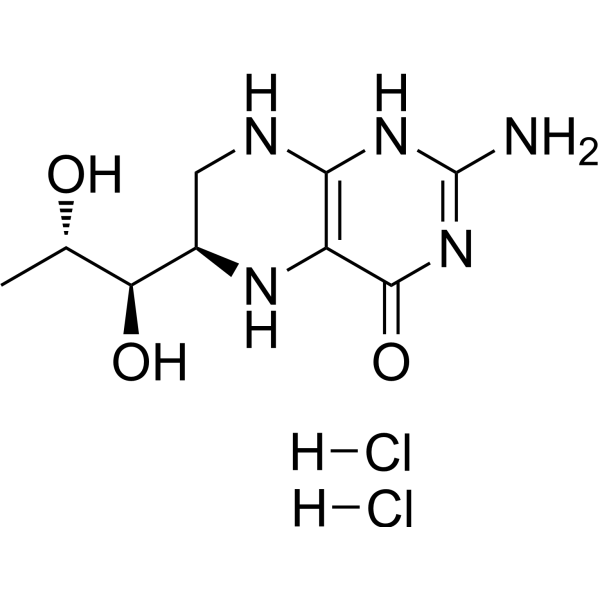
Sapropterin ((6R)-BH4; (6R)-Tetrahydro-L-biopterin) dihydrochloride is an orally active phenylalanine hydroxylase (PAH) cofactor, which is effective in reducing blood phenylalanine concentrations. Sapropterin dihydrochloride can be used in study of phenylketonuria (PKU) phenylketonuria. Sapropterin dihydrochloride can aggravate experimental autoimmune encephalomyelitis (EAE).
For research use only. We do not sell to patients.
- Purity : 99.61%
- CAS No.: 69056-38-8
- Formula: C9H17Cl2N5O3
- Molecular Weight:314.17
-
Storage:
4°C, stored under nitrogen, away from moisture
* In solvent : -80°C, 6 months; -20°C, 1 month (stored under nitrogen, away from moisture)

To place orders, for customer services and technical support, please contact: MedChemExpress USA
Tel: 609-228-6898 E-mail: [email protected] [email protected]


-
 Biological Activity
-
Chemical Information
-
Solvent & Solubility
- Purity & Documentation
- References
-
 Help & FAQs




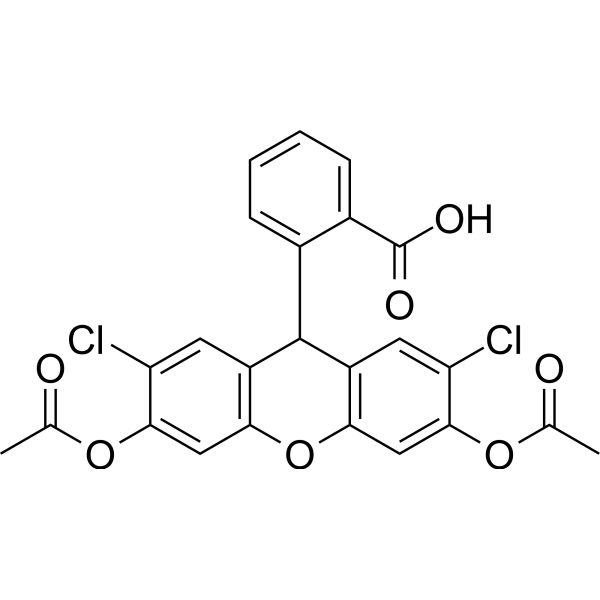
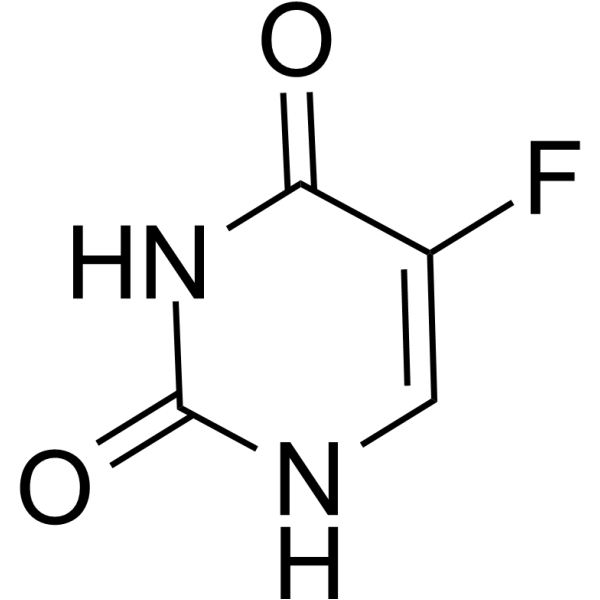
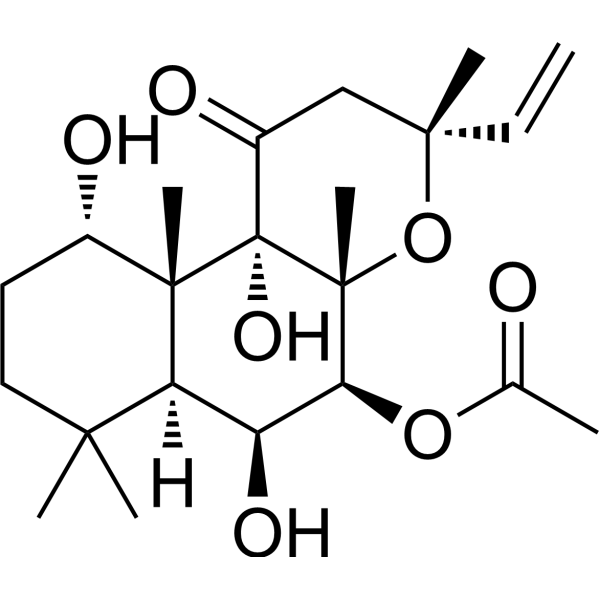
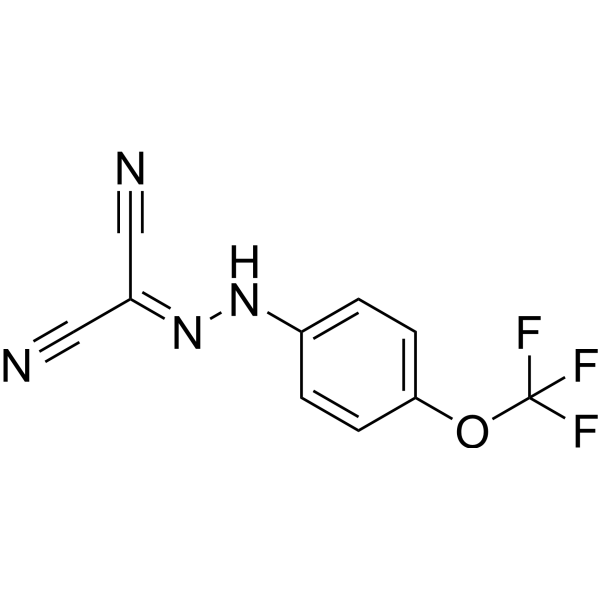
Publications Citing Use of MedChemExpress (MCE) Sapropterin dihydrochloride
MoreAll Endogenous Metabolite Isoforms
More

Biological Activity
Description
In Vitro
Sapropterin dihydrochloride enhances residual phenylalanine hydroxylase activity to increase phenylalanine oxidation[1].
MedChemExpress (MCE) has not independently confirmed the accuracy of these methods. They are for reference only.
In Vivo
MedChemExpress (MCE) has not independently confirmed the accuracy of these methods. They are for reference only.
-
Animal Model:SJL/J (female, 10-12-week-old, primary progressive and PLP-induced-relapsing-remitting EAE)[2]
-
Dosage:100 mg/kg/day
-
Administration:oral; daily; 22 days
-
Result:Reached higher maximum clinical EAE scores and showed a significant increase in the area under the curve (AUC) of EAE scores.
Elevated plasma levels of long-chain ceramides (C14Cer, C16Cer, C18Cer, C20Cer, C18GluCer, C24:1GluCer).
Reduced plasma linolenic acid (FA18:3) levels and increased plasma levels of the endocannabinoid 1+2AG.
Showed no significant effect on peripheral T-cell proliferation or subpopulations in the spleen, but increased infiltration of CD4+ and CD8+ T-cells in the spinal cord.
Clinical Trial
| NCT Number | Sponsor | Condition | Start Date |
Phase

|
|---|---|---|---|---|
| NCT01329991 | Plexxikon| | 2011-05 | PHASE1 |


Chemical Information
-
CAS No. 69056-38-8
-
Appearance Solid
-
Molecular Weight 314.17
-
Formula C9H17Cl2N5O3
-
Color White to off-white
-
SMILES
O=C1N=C(N)NC2=C1N[C@@H]([C@@H](O)[C@@H](O)C)CN2.[H]Cl.[H]Cl
-
Synonyms
(6R)-BH4 dihydrochloride; (6R)-Tetrahydro-L-biopterin dihydrochloride
-
Shipping
Room temperature in continental US; may vary elsewhere.
-
Storage
4°C, stored under nitrogen, away from moisture
* In solvent : -80°C, 6 months; -20°C, 1 month (stored under nitrogen, away from moisture)


Publications (3)
-
Journal Impact Factor
-
Most Recent
-
Mol Cell
PTPS Facilitates Compartmentalized LTBP1 S-Nitrosylation and Promotes Tumor Growth under Hypoxia. [Abstract]2020 Jan 2;77(1):95-107.e5. PMID: 31628042 -
Immunol Invest
2025 Nov;54(8):1542-1560. PMID: 41031680 -


Solvent & Solubility
In Vitro:
H2O : 100 mg/mL (318.30 mM; Need ultrasonic)
DMSO : 100 mg/mL (318.30 mM; Need ultrasonic; Hygroscopic DMSO has a significant impact on the solubility of product, please use newly opened DMSO)
Please refer to the solubility information to select the appropriate solvent. Once prepared, please aliquot and store the solution to prevent product inactivation from repeated freeze-thaw cycles.
Storage method and period of stock solution: -80°C, 6 months; -20°C, 1 month (stored under nitrogen, away from moisture). When stored at -80°C, please use it within 6 months. When stored at -20°C, please use it within 1 month.
* Note: If you choose water as the stock solution, please dilute it to the working solution, then filter and sterilize it with a 0.22 μm filter before use.
Please refer to the solubility information to select the appropriate solvent. Once prepared, please aliquot and store the solution to prevent product inactivation from repeated freeze-thaw cycles.
Storage method and period of stock solution: -80°C, 6 months; -20°C, 1 month (stored under nitrogen, away from moisture). When stored at -80°C, please use it within 6 months. When stored at -20°C, please use it within 1 month.
* Note: If you choose water as the stock solution, please dilute it to the working solution, then filter and sterilize it with a 0.22 μm filter before use.
Concentration (start) × Volume (start) = Concentration (final) × Volume (final)
In Vivo:
Select the appropriate dissolution method based on your experimental animal and administration route.
- For the following dissolution methods, please ensure to first prepare a clear stock solution using an In Vitro approach and then sequentially add co-solvents:
- To ensure reliable experimental results, the clarified stock solution can be appropriately stored based on storage conditions. As for the working solution for In Vivo experiments, it is recommended to prepare freshly and use it on the same day.
- The percentages shown for the solvents indicate their volumetric ratio in the final prepared solution. If precipitation or phase separation occurs during preparation, heat and/or sonication can be used to aid dissolution.
Add each solvent one by one: 10% DMSO 40% PEG300 5% Tween-80 45% Saline
Solubility: ≥ 5 mg/mL (15.91 mM); Clear solution
This protocol yields a clear solution of ≥ 5 mg/mL (saturation unknown).
Taking 1 mL working solution as an example, add 100 μL DMSO stock solution (50.0 mg/mL) to 400 μL PEG300, and mix evenly; then add 50 μL Tween-80 and mix evenly; then add 450 μL Saline to adjust the volume to 1 mL.
Preparation of Saline: Dissolve 0.9 g sodium chloride in ddH₂O and dilute to 100 mL to obtain a clear Saline solution.
Add each solvent one by one: 10% DMSO 90% (20% SBE-β-CD in Saline)
Solubility: ≥ 5 mg/mL (15.91 mM); Clear solution
This protocol yields a clear solution of ≥ 5 mg/mL (saturation unknown).
Taking 1 mL working solution as an example, add 100 μL DMSO stock solution (50.0 mg/mL) to 900 μL 20% SBE-β-CD in Saline, and mix evenly.
Preparation of 20% SBE-β-CD in Saline (4°C, storage for one week): 2 g SBE-β-CD powder is dissolved in 10 mL Saline, completely dissolve until clear.
In Vivo Dissolution Calculator
Please enter the basic information of animal experiments:
-
-
-
-
Recommended: Prepare an additional quantity of animals to account for potential losses during experiments.
Working solution concentration: 0.22 mg/mL
This product has good water solubility, please refer to the measured solubility data in water/PBS/Saline for details.


Purity & Documentation
-
Data Sheet (277 KB)
-
SDS (396 KB)
- English - EN (396 KB)
- Français - FR (396 KB)
- Deutsch - DE (396 KB)
- Norwegian - NO (396 KB)
- Español - ES (396 KB)
- Swedish - SV (396 KB)
- Italian - IT (396 KB)
- Korean - KR (396 KB)
- Portuguese - PT (396 KB)
-
Handling Instructions (2659 KB)
References
[1]. Levy H L, et al. Efficacy of sapropterin dihydrochloride (tetrahydrobiopterin, 6R-BH4) for reduction of phenylalanine concentration in patients with phenylketonuria: a phase III randomised placebo-controlled study[J]. The Lancet, 2007, 370(9586): 504-510. [Content Brief]
[2]. Schmitz K, et al. Sapropterin (BH4) Aggravates Autoimmune Encephalomyelitis in Mice. Neurotherapeutics. 2021 Jul;18(3):1862-1879. [Content Brief]


Complete Stock Solution Preparation Table
Please refer to the solubility information to select the appropriate solvent. Once prepared, please aliquot and store the solution to prevent product inactivation from repeated freeze-thaw cycles.
Storage method and period of stock solution: -80°C, 6 months; -20°C, 1 month (stored under nitrogen, away from moisture). When stored at -80°C, please use it within 6 months. When stored at -20°C, please use it within 1 month.
| Optional Solvent | Concentration Solvent Mass | 1 mg | 5 mg | 10 mg | 25 mg |
|---|---|---|---|---|---|
| H2O / DMSO | 1 mM | 3.1830 mL | 15.9149 mL | 31.8299 mL | 79.5747 mL |
| 5 mM | 0.6366 mL | 3.1830 mL | 6.3660 mL | 15.9149 mL | |
| 10 mM | 0.3183 mL | 1.5915 mL | 3.1830 mL | 7.9575 mL | |
| 15 mM | 0.2122 mL | 1.0610 mL | 2.1220 mL | 5.3050 mL | |
| 20 mM | 0.1591 mL | 0.7957 mL | 1.5915 mL | 3.9787 mL | |
| 25 mM | 0.1273 mL | 0.6366 mL | 1.2732 mL | 3.1830 mL | |
| 30 mM | 0.1061 mL | 0.5305 mL | 1.0610 mL | 2.6525 mL | |
| 40 mM | 0.0796 mL | 0.3979 mL | 0.7957 mL | 1.9894 mL | |
| 50 mM | 0.0637 mL | 0.3183 mL | 0.6366 mL | 1.5915 mL | |
| 60 mM | 0.0530 mL | 0.2652 mL | 0.5305 mL | 1.3262 mL | |
| 80 mM | 0.0398 mL | 0.1989 mL | 0.3979 mL | 0.9947 mL | |
| 100 mM | 0.0318 mL | 0.1591 mL | 0.3183 mL | 0.7957 mL |
* Note: If you choose water as the stock solution, please dilute it to the working solution, then filter and sterilize it with a 0.22 μm filter before use.


Sapropterin dihydrochloride Related Classifications
HY-A0124A Related Classifications
 Powered by Bioz