



Sapropterin
Based on 3 publication(s) in Google Scholar
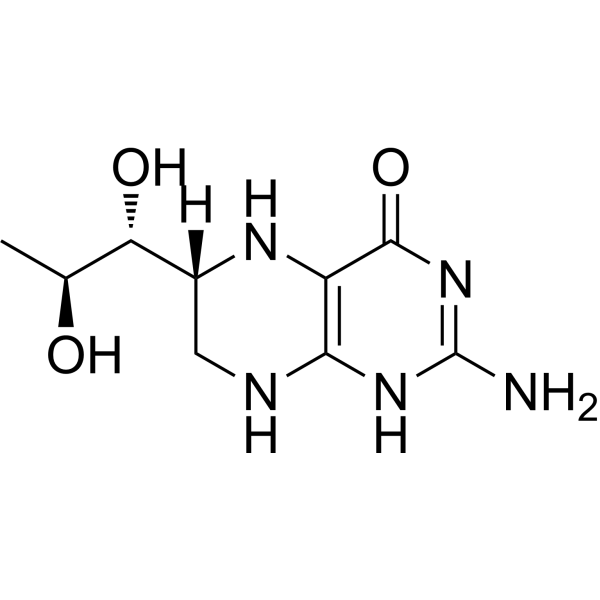
Sapropterin ((6R)-BH4; (6R)-Tetrahydro-L-biopterin) is an orally active phenylalanine hydroxylase (PAH) cofactor, which is effective in reducing blood phenylalanine concentrations. Sapropterin can be used in study of phenylketonuria (PKU) phenylketonuria. Sapropterin can aggravate experimental autoimmune encephalomyelitis (EAE).
Nur für Forschungszwecke. Wir verkaufen nicht an Patienten.
- CAS. Nr.: 62989-33-7
- Formel: C9H15N5O3
- Molecular Weight:241.25
-
Speicherung:
Please store the product under the recommended conditions in the Certificate of Analysis.

To place orders, for customer services and technical support, please contact: MedChemExpress USA
Tel: 609-228-6898 E-mail: [email protected] [email protected]


-
 Biologische Aktivität
-
Chemical Information
- Reinheit & Dokumentation
- Verweise
-
 Help & FAQs


Publications Citing Use of MedChemExpress (MCE) Sapropterin
MoreAlle Endogenous Metabolite Isoform-spezifische Produkte anzeigen
More

Biologische Aktivität
Beschreibung
IC50 & Target
|
Human Endogenous Metabolite |
In Vitro
Sapropterin enhances residual phenylalanine hydroxylase activity to increase phenylalanine oxidation[1].
MedChemExpress (MCE) has not independently confirmed the accuracy of these methods. They are for reference only. .
In Vivo
MedChemExpress (MCE) has not independently confirmed the accuracy of these methods. They are for reference only.
-
Animal Model:SJL/J (female, 10-12-week-old, primary progressive and PLP-induced-relapsing-remitting EAE)[2]
-
Dosage:100 mg/kg/day
-
Administration:oral; daily; 22 days
-
Result:Reached higher maximum clinical EAE scores and showed a significant increase in the area under the curve (AUC) of EAE scores.
Elevated plasma levels of long-chain ceramides (C14Cer, C16Cer, C18Cer, C20Cer, C18GluCer, C24:1GluCer).
Reduced plasma linolenic acid (FA18:3) levels and increased plasma levels of the endocannabinoid 1+2AG.
Showed no significant effect on peripheral T-cell proliferation or subpopulations in the spleen, but increased infiltration of CD4+ and CD8+ T-cells in the spinal cord.


Chemical Information
-
CAS. Nr. 62989-33-7
-
Molecular Weight 241.25
-
Formel C9H15N5O3
-
SMILES
O=C1C2=C(NC(N)=N1)NC[C@](N2)([H])[C@@H](O)[C@@H](O)C
-
Synonyms
(6R)-BH4; (6R)-Tetrahydro-L-biopterin
-
Versand
Room temperature in continental US; may vary elsewhere.
-
Speicherung
Please store the product under the recommended conditions in the Certificate of Analysis.


Publications (3)
-
Journal Impact Factor
-
Most Recent
-
Mol Cell
PTPS Facilitates Compartmentalized LTBP1 S-Nitrosylation and Promotes Tumor Growth under Hypoxia. [Abstract]2020 Jan 2;77(1):95-107.e5. PMID: 31628042 -
Immunol Invest
2025 Nov;54(8):1542-1560. PMID: 41031680 -


Reinheit & Dokumentation
Verweise
[1]. Levy H L, et al. Efficacy of sapropterin dihydrochloride (tetrahydrobiopterin, 6R-BH4) for reduction of phenylalanine concentration in patients with phenylketonuria: a phase III randomised placebo-controlled study[J]. The Lancet, 2007, 370(9586): 504-510. [Content Brief]
[2]. Schmitz K, et al. Sapropterin (BH4) Aggravates Autoimmune Encephalomyelitis in Mice. Neurotherapeutics. 2021;18(3):1862-1879. [Content Brief]

Calculators
Konzentration (Stammlösung) × Volumen (Stammlösung) = Konzentration (Ziellösung) × Volumen (Ziellösung)


Sapropterin Related Classifications
HY-A0124 Related Classifications
 Powered by Bioz