



62989-33-7
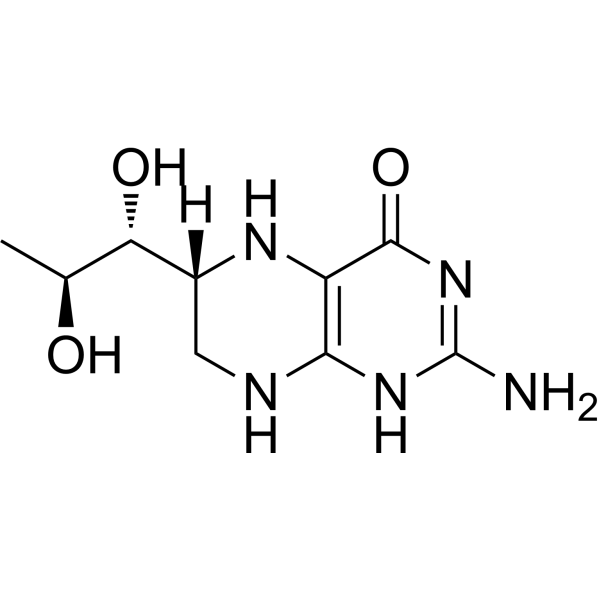
Chemical Structure
Sapropterin
Synonym(s): (6R)-BH4; (6R)-Tetrahydro-L-biopterin
- CAS No.: 62989-33-7
- Formula:C9H15N5O3
- Molecular Weight:241.25
IUPAC Name: (R)-2-amino-6-((1R,2S)-1,2-dihydroxypropyl)-5,6,7,8-tetrahydropteridin-4(1H)-one
InChIKey: FNKQXYHWGSIFBK-RPDRRWSUSA-N
SMILES: O=C1C2=C(NC(N)=N1)NC[C@](N2)([H])[C@@H](O)[C@@H](O)C
Biological Activity: Sapropterin Sapropterin ((6R)-BH4; (6R)-Tetrahydro-L-biopterin) is an orally active cofactor of phenylalanine hydroxylase (PAH) that effectively reduces blood phenylalanine concentrations. Sapropterin can be used in research on phenylketonuria (PKU). Sapropterin can aggravate experimental autoimmune encephalomyelitis (EAE)[1][2].
| Cat. No. | Product Name | Purity | Description | Pricing | |||||||||||||||||||
|---|---|---|---|---|---|---|---|---|---|---|---|---|---|---|---|---|---|---|---|---|---|---|---|
|
|
Sapropterin | Sapropterin Sapropterin ((6R)-BH4; (6R)-Tetrahydro-L-biopterin) is an orally active cofactor of phenylalanine hydroxylase (PAH) that effectively reduces blood phenylalanine concentrations. Sapropterin can be used in research on phenylketonuria (PKU). Sapropterin can aggravate experimental autoimmune encephalomyelitis (EAE). | |||||||||||||||||||||
|
loading...
/
|
|||||||||||||||||||||||
|
|
Sapropterin-d3 | Sapropterin-d3 ((6R)-BH4-d3) is deuterium labeled Sapropterin. Sapropterin ((6R)-BH4) is an orally active phenylalanine hydroxylase (PAH) cofactor, which is effective in reducing blood phenylalanine concentrations. Sapropterin can be used in study of phenylketonuria (PKU). | |||||||||||||||||||||
|
loading...
/
|
|||||||||||||||||||||||
References
- [1]. Levy H L, et al. Efficacy of sapropterin dihydrochloride (tetrahydrobiopterin, 6R-BH4) for reduction of phenylalanine concentration in patients with phenylketonuria: a phase III randomised placebo-controlled study[J]. The Lancet, 2007, 370(9586): 504-510. [Content Brief]
- [2]. Schmitz K, et al. Sapropterin (BH4) Aggravates Autoimmune Encephalomyelitis in Mice. Neurotherapeutics. 2021;18(3):1862-1879. [Content Brief]



