



Cholinesterase (ChE)
Cholinesterase (ChE) is a family of enzymes present in the central nervous system, particularly in nervous tissue, muscle and red cells, which catalyze the hydrolysis of the neurotransmitter acetylcholine into choline and acetic acid, a reaction necessary to allow a cholinergic neuron to return to its resting state after activation. It is one of many important enzymes needed for the proper functioning of the nervous systems of humans.
There are two types: acetylcholinesterase (AChE, acetylcholine hydrolase) and butyrylcholinesterase (BChE, acylcholine acylhydrolase), also known as nonspecific cholinesterase or pseudocholinesterase. AChE is primarily found in the blood on red blood cell membranes, in neuromuscular junctions, and in neural synapses, while BChE is produced in the liver and found primarily in plasma. The difference between the two types of cholinesterase is their relative preferences for substrates: AChE hydrolyzes acetylcholine faster while BChE hydrolyzes butyrylcholine faster.
Cholinesterase (ChE) Isoform Specific Products
All Product Categories
-
Cholinesterase (ChE) Inhibitors
(947)
View all products
-
Cholinesterase (ChE) Agonists
(5)
View all products
-
Cholinesterase (ChE) Antagonists
(10)
View all products
-
Cholinesterase (ChE) Activators
(34)
View all products
-
Cholinesterase (ChE) Modulators
(11)
View all products
-
Cholinesterase (ChE) Chemical
(1)
View all products
-
Cholinesterase (ChE) Inducer
(1)
View all products
-
Cholinesterase (ChE) Controls
(6)
View all products
-
Cholinesterase (ChE) Substrates
(3)
View all products
-
Cholinesterase (ChE) Related Products (1096)
Related Products (1096)

-
Antibodies (2)
-
Cholinesterase (ChE) Isoform Comparison
-
Pirimiphos-methyl-d6
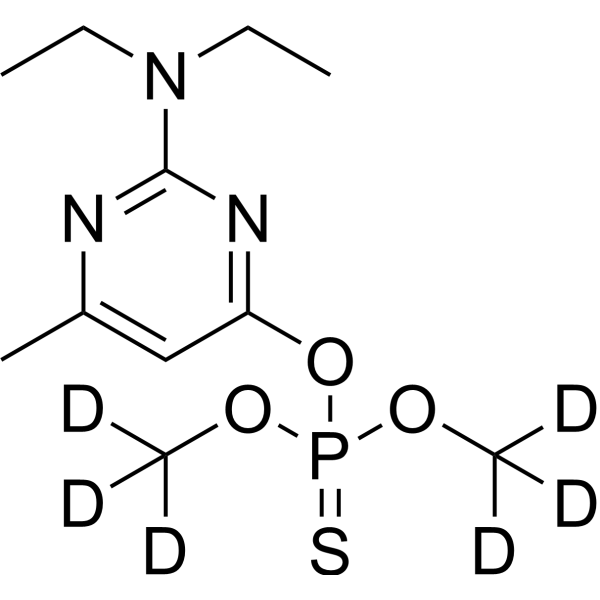 0 ImagesCat. No.: HY-B1881SCAS No.: 1793055-06-7Pirimiphos-methyl-d6 is the deuterium labeled Pirimiphos-methyl (HY-B1881). Pirimiphos-methyl is an organophosphorus insecticide and acaricide that can inhibit AChE in target organisms. Pirimiphos-methyl is often used for prevention and control of beetles, snout beetles, moths and Ephestia cautella during storage of agricultural grains.
-
Pirimiphos ethyl
 0 ImagesCat. No.: HY-129468CAS No.: 23505-41-1Pirimiphos ethyl is a kind of organophosphorus pesticide that commonly employes for the protection of crops including vegetables, bananas, turf and mushrooms through the inhibition of acetylcholinesterase activity.
-
Iprobenfos (Standard)
 0 ImagesCat. No.: HY-B1863RCAS No.: 26087-47-8Iprobenfos (Standard) is the analytical standard of Iprobenfos (HY-B1863). This product is intended for research and analytical applications. Iprobenfos is an organophosphorus fungicide and is widely used to control the rice blast fungus. Iprobenfos can phosphorylate the -OH group on the serine residue in the active (esteratic) site of ChEs and so inhibit both AChE and BChE activity.
-
Galanthamine-d3 hydrochloride
 0 ImagesCat. No.: HY-76299S2CAS No.: 2012598-44-4Synonyms: Galantamine-d3 hydrochloride

-
Jatrorrhizine chloride (Standard)
 0 ImagesJatrorrhizine chloride (Standard) is the analytical standard of Jatrorrhizine chloride. This product is intended for research and analytical applications. Jatrorrhizine chloride is an alkaloid isolated from Coptis chinensis with neuroprotective, antimicrobial, antiplasmodial and antioxidant activities. Jatrorrhizine chloride is a potent and orally active inhibitor of AChE (IC50=872 nM) over >115-fold selectivity for BuChE. Jatrorrhizine chloride reduces uptake of serotonin (5-HT) and norepinephrine (NE) via inhibition of uptake-2 transporters.
-
Quinolactacin A2
 0 ImagesCat. No.: HY-N14533CAS No.: 386211-69-4Quinolactacin A2 inhibits acetylcholinesterase and TNF production.
-
Arisugacin B
 0 ImagesCat. No.: HY-N13902CAS No.: 182068-83-3Arisugacin B is a potent, orally active and selective acetylcholinesterase (AChE) inhibitor.
-
(Rac)-Rivastigmine-d6
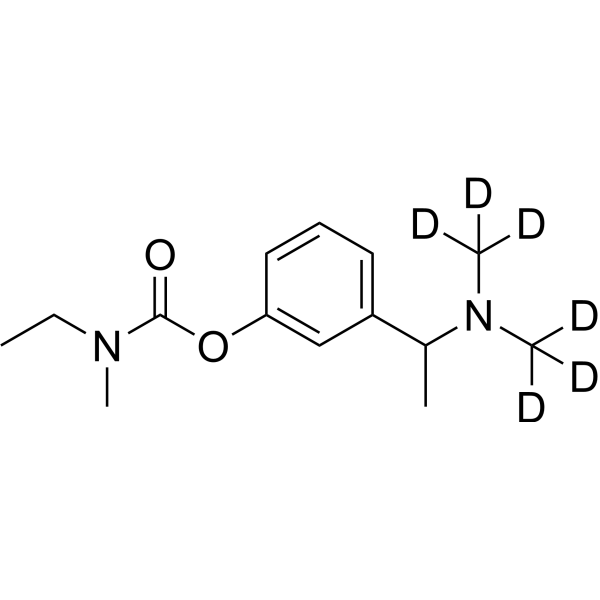 0 ImagesCat. No.: HY-17368S1CAS No.: 194930-04-6Synonyms: (Rac)-ENA 713-d6 free base; (Rac)-SDZ-ENA 713-d6 free base(Rac)-Rivastigmine-d6 is a labelled racemic Rivastigmine. Rivastigmine (ENA 713 free base) is an orally active and potent cholinesterase (ChE) inhibitor and inhibits butyrylcholinesterase (BChE) and acetylcholinesteras (AChE) with IC50s of 0.037 μM , 4.15 μM, respectively. Rivastigmine can pass the blood brain barrier (BBB). Rivastigmine is a parasympathomimetic or cholinergic agent used for the research of mild to moderate dementia of the Alzheimer's type and dementia due to Parkinson's disease.
-
AE027
 0 ImagesCat. No.: HY-163662CAS No.: 1011351-65-7AE027 is a potent inhibitor against both WT and resistant mutation F348Y AChE with the IC50 values of 10 and 43 μM, respectively.
-
Ipidacrine (Standard)
 0 ImagesSynonyms: NIK-247 free base (Standard); Amiridine free base (Standard)Ipidacrine (Standard) is the analytical reference standard of Ipidacrine. This product is used for research and analytical applications. Ipidacrine is orally active and blood-brain-barrier-penetrant AChE and BuChE inhibitors with IC50 values of 1 μM and 1.9 μM, respectively, which is also a partial agonist of M2-cholinergic receptors and a reversible cholinesterase inhibitor. Ipidacrine has a stimulating effect on neuromuscular transmission and excitation along the nerve fibres with a moderately anti-pain effect. Ipidacrine is an aminopyridines and is structurally similar to Tacrine (HY-111338). Ipidacrine is effective in various amnesia models, improves erectile function and inhibits K+ and Na+-channels in the neuronal membrane in diabetic rats. Ipidacrine is promising for research of Alzheimer’s disease, ischaemic stroke, idiopathic neuropathy of the facial nerve, diabetes mellitus-induced erectile dysfunction and other deficits in central or peripheral cholinergic deseases.
-
P11149 (Standard)
 0 ImagesCat. No.: HY-105327RCAS No.: 164724-79-2P11149 (Standard) is the analytical standard of P11149 (HY-105327). This product is intended for research and analytical applications. P11149 is a competitive, BBB-penetarated weakly, orally active and selective inhibitor of AChE. P11149 exhibits an IC50 of 1.3 μM for rat BChE/AChE. P11149, a Galanthamine derivative, demonstrates central cholinergic activity, behavioral efficacy and safety. P11149 is used in the study for Alzheimer's disease.

-
N-Methylcalycinine
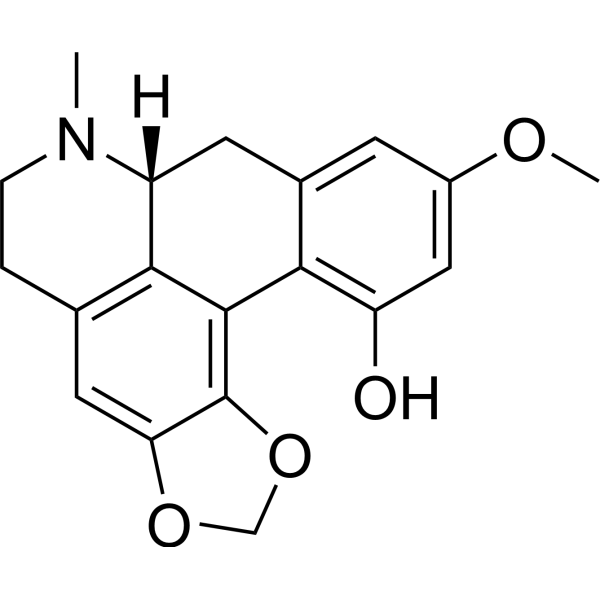 0 ImagesCat. No.: HY-N3185CAS No.: 86537-66-8N-Methylcalycinine is a nature product with AChE inhibitory activity. N-Methylcalycinine can be isolated from the roots of Stephania epigaea. N-Methylcalycinine can be used for the research of asthma, cancer, dysentery, fever, hyperglycemia, intestinal complaints, inflammation, sleep disturbances, tuberculosis and so on.
-
Suberogorgin
 0 ImagesCat. No.: HY-187600CAS No.: 110043-85-1Suberogorgin is a selective and reversible Acetylcholinesterase inhibitor. It is found in the Gorgoniae suberogorgia species from the South China Sea. Suberogorgin improves memory capacity in mice and reverses memory retention impairment induced by Cycloheximide (HY-12320) or Scopolamine (HY-N0296). It reduces urine output in rats and anesthetized cats. Suberogorgin increases respiratory rate, tidal volume, and minute ventilation in anesthetized cats, and exerts no significant effect on in vivo blood pressure in anesthetized cats. Suberogorgin is used in research related to memory disorders.
-
Flavonol (Standard)
 0 ImagesFlavonol (Standard) is the analytical standard of Flavonol. This product is intended for research and analytical applications. Flavonol is a cholinesterase (ChE) inhibitor, with an IC50 value of 120 μM and a Ki value of 74 μM. Flavonol has antioxidant, free radical-scavenging, antibacterial properties, and immune modulation functions. Flavonol inhibits the PriA helicase of Staphylococcus aureus. Flavonol can suppress the production of NO in LPS-activated RAW 264.7 cells by inhibiting the expression of the iNOS enzyme. Flavonol shows protective and analgesic effects in mice through various neuronal pathways. Flavonol can be used in research related to tumors and atherosclerosis diseases.
-
Ambenonium chloride (Standard)
 0 ImagesCat. No.: HY-100919RCAS No.: 115-79-7Synonyms: WIN 8077 chloride (Standard)Ambenonium (chloride) (Standard) is the analytical standard of Ambenonium (chloride). This product is intended for research and analytical applications. Ambenonium (WIN 8077) chloride is an orally active and reversible inhibitor of Acetyicholinesterase (AChE) with high affinity. Ambenonium chloride inhibits human AChE with an IC50 value of 0.7 nM (hAChE).
-
Samioside
 0 ImagesCat. No.: HY-N15323CAS No.: 360768-68-9Samioside is an effective acetylcholinesterase inhibitor that can be isolated from Phlomis nissolii and P. capitata. Samioside possesses free-radical scavenging and antimicrobial activities. Samioside can be used in research on its anti-Alzheimer’s potency.
-
Fosthiazate (Standard)
 0 ImagesCat. No.: HY-W020785RCAS No.: 98886-44-3Fosthiazate (Standard) is the analytical standard of Fosthiazate (HY-W020785). This product is intended for research and analytical applications. Fosthiazate is an inhibitor of acetylcholinesterase (Acetylcholinesterase, AChE). Fosthiazate exhibits significant nematicidal activity and systemic insecticidal activity. Fosthiazate is applicable to studies on plant-parasitic nematodes, root-knot diseases, agricultural pests, as well as the ecotoxicology and environmental behavior of organophosphorus compounds.
-
FK960
 0 ImagesFK960 is a potential anti-dementia agent that reverses the reduction in cerebral blood flow (rCBF) caused by sensory stimulation by enhancing cholinergic neurotransmission. In macaque experiments, physostigmine (AChE inhibitor; HY-N6608) was able to completely eliminate the rCBF in the sensory cortex increased by vibrotactile stimulation. FK960 (1-1000 μg/kg) can restore the eliminated rCBF response, and the action time can last for 1 hour. However, FK960 cannot restore the rCBF response eliminated by HA-966 (NMDA modulator; HY-100822), indicating that its function is not dependent on non-glutamatergic neurotransmission.




