



Apoptosis
Apoptosis
Apoptosis is a distinctive form of cell death exhibiting specific morphological and biochemical characteristics, including cell membrane blebbing, chromatin condensation, genomic DNA fragmentation, and exposure of specific phagocytosis signaling molecules on the cell surface. Cells undergoing apoptosis differ from those dying through necrosis. Necrotic cells are usually recognized by the immune system as a danger signal and, thus, resulting in inflammation; in contrast, apoptotic death is quiet and orderly.
There are two major pathways of apoptotic cell death induction: The intrinsic pathway, also called the Bcl-2-regulated or mitochondrial pathway, is activated by various developmental cues or cytotoxic insults, such as viral infection, DNA damage and growth-factor deprivation, and is strictly controlled by the BCL-2 family of proteins. The extrinsic or death-receptor pathway is triggered by ligation of death receptors (members of the tumor necrosis factor (TNF) receptor family, such as Fas or TNF receptor-1 (TNFR1)) that contain an intracellular death domain, which can recruit and activate caspase-8 through the adaptor protein Fas-associated death domain (FADD; also known as MORT1) at the cell surface. This recruitment causes subsequent activation of downstream (effector) caspases, such as caspase-3, -6 or -7, without any involvement of the BCL-2 family.
Studies suggest that alterations in cell survival contribute to the pathogenesis of a number of human diseases, including cancer, viral infections, autoimmune diseases, neurodegenerative disorders, and AIDS (acquired immunodeficiency syndrome). Treatments designed to specifically alter the apoptotic threshold may have the potential to change the natural progression of some of these diseases.
All Product Categories
-
Apoptosis Inhibitors
(904)
View all products
-
Apoptosis Agonists
(7)
View all products
-
Apoptosis Antagonists
(9)
View all products
-
Apoptosis Activators
(363)
View all products
-
Apoptosis Modulators
(60)
View all products
-
Apoptosis Inducers
(7944)
View all products
-
Apoptosis Degrader
(1)
View all products
-
Apoptosis Controls
(33)
View all products
-
Apoptosis Related Products (9888)
Related Products (9888)

-
Antibodies (120)
-
Bergenin (Standard)
 0 ImagesBergenin (Standard) is the analytical standard of Bergenin. This product is intended for research and analytical applications. Bergenin is a cytoprotective and antioxidative polyphenol found in many medicinal plants. Bergenin has a wide spectrum activities such as hepatoprotective, antiinflammatory, immunomodulatory, antitumor, antiviral, and antifungal properties.
-
DNMT1-IN-5
 0 ImagesCat. No.: HY-172217CAS No.: 2982511-19-1DNMT1-IN-5 (Compound 55) is the inhibitor for DNMT that inhibits DNMT1 and DNMT3A with IC50 of 2.42 μM and 14.4 μM. DNMT1-IN-5 exhibits antiproliferative activity in a variety of cancer cell lines (IC50s for TMD-8, DOHH2, MOLM-13, THP-1, RPIM-8226 and HCT116 are 0.19-2.37 μM), arrests the cell cycle at G2/M phase, and induces apoptosis in TMD-8 and DOHH2 cells. DNMT1-IN-5 exhibits antitumor efficacy in TMD-8 xenograft mouse models.
-
(±)-Enterodiol-13C3
 0 ImagesCat. No.: HY-W778288CAS No.: 918502-74-6(±)-Enterodiol-13C3 is the 13C-labeled (±)-Enterodiol (HY-108695B). (±)-Enterodiol is the racemate of Enterodiol (HY-108695). Enterodiol is transformed by human intestinal bacteria from lignans contained in various whole-grain cereals, nuts, legumes, flaxseed, and vegetables. Enterodiol has an apoptotic effect in colorectal cancer (CRC) cells. Enterodiol has anti-cancer activities.
-
(Rac)-Epoxiconazole
 0 ImagesCat. No.: HY-119683ACAS No.: 135319-73-2(Rac)-Epoxiconazole is a chiral triazole fungicide that is released into the environment as a racemate and has broad-spectrum, long-acting, and excellent fungicidal effects. (Rac)-Epoxiconazole is highly persistent in soil, with a reported half-life of more than 300 days.
-
DL78
 0 ImagesDL78 is an effective anti-mitotic agent. DL78 induces mitotic arrest, mitotic catastrophe and apoptosis in cancer cells by disrupting the interaction between Myc and α-tubulin. DL78 exhibits broad anti-cancer activity, especially against cancer cells with chromosomal instability and excessive expression of MYC. DL78 significantly reduces tumor burden in the OV81.2 xenograft model. DL78 can be used for the study of ovarian cancer.
-
Wee1/HDAC-IN-1
 0 ImagesCat. No.: HY-179272CAS No.: 3037071-29-4Wee1/HDAC-IN-1 is a dual Wee1/HDAC inhibitor with an IC50 of 1.2 nM for Wee1 and IC50 values of 196 nM for HDAC1, 156 nM for HDAC3, and 55 nM for HDAC6. Wee1/HDAC-IN-1 exhibits strong antiproliferative activity against MV4-11 cells with an IC50 of 0.076 μM. Wee1/HDAC-IN-1 selectively binds to Wee1 and HDACs. Wee1/HDAC-IN-1 interferes with DNA damage repair pathways and induces apoptosis in MV4-11 cells. Wee1/HDAC-IN-1 Wee1/HDAC-IN-1 can be used for the research of acute myeloid leukemia (AML).
-
Capsaicin (Purity 65%) (Standard)
 0 ImagesCapsaicin (Purity 65%) (Standard) is the analytical standard of Capsaicin (Purity 65%). This product is intended for research and analytical applications. Capsaicin (Purity 65%) is a mixture of Capsaicin and Dihydrocapsaicin (Ratio >2:1).Capsaicin (Purity 65%) is an orally active capsaicin receptor (TRPV1) agonist.
-
Cannflavin A (Standard)
 0 ImagesCat. No.: HY-W748591RCAS No.: 76735-57-4Cannflavin A (Standard) is the analytical standard of Cannflavin A. This product is intended for research and analytical applications. Cannflavin A can be isolated from Cannabis sativa L.. Cannflavin A has anti-cancer, neuroprotective and anti-inflammatory activity. Cannflavin A inhibits Aβ1-42 aggregation. Cannflavin A also inhibits kynurenine-3-monooxygenase (KMO) (IC50 = 29.4 μM). Cannflavin A activates apoptosis via caspase-3 cleavage. Cannflavin A exerts anti-inflammatory effects by inhibiting pro-inflammatory enzymes, including prostaglandin E2 and cytochrome c oxidases I and II in PC12 cell line.
-
YM281
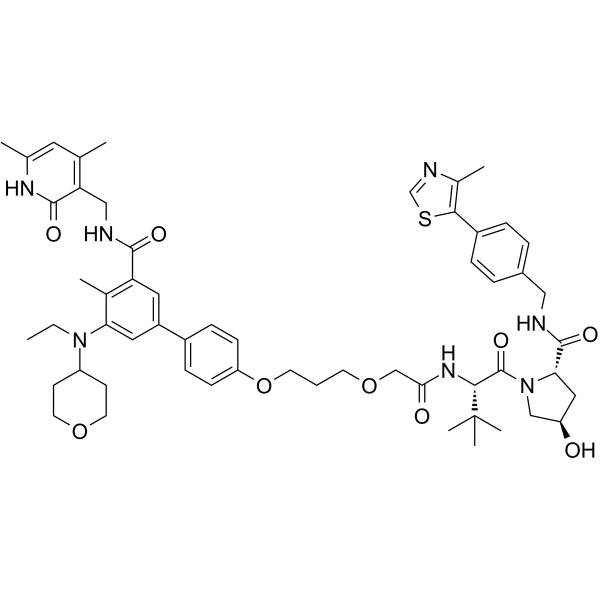 0 ImagesCat. No.: HY-145762CAS No.: 2230914-84-6
-
Mensacarcin
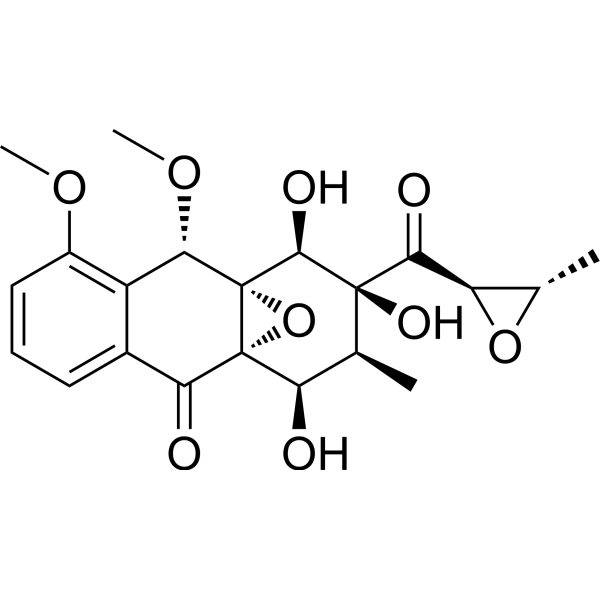 0 ImagesCat. No.: HY-122534CAS No.: 808750-39-2Mensacarcin, a highly complex polyketide, strongly inhibits cell growth universally in cancer cell lines and potently induces apoptosis in melanoma cells. Mensacarcin targets to mitochondria, affects energy metabolism in mitochondria, and activates caspase-dependent apoptotic pathways. Mensacarcin, an antibiotic, can be used as a cytotoxic component of antibody-drug conjugates (ADCs).
-
XSJ110
 0 ImagesCat. No.: HY-174151CAS No.: 203923-65-3XSJ110 is a potent irreversible topoisomerase I (Topo I) inhibitor with an IC50 value of 0.133 μM. XSJ110 blocks DNA topoisomerization, induces DNA double-strand breaks, and triggers cell cycle arrest at G0/G1 phase, inducing tumor cell apoptosis. XSJ110 is promising for research of ampullary carcinoma (AC).
-
2'-epi-2'-O-Acetylthevetin B
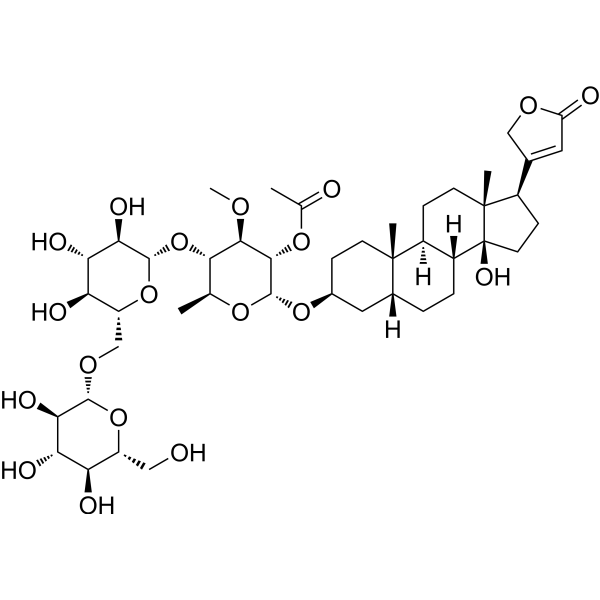 0 ImagesCat. No.: HY-N12140CAS No.: 82145-55-9Synonyms: GHSC-742'-epi-2'-O-Acetylthevetin B (GHSC-74) is a cardiac glycoside that can be isolated from the seeds of Cerbera manghas L. 2'-epi-2'-O-Acetylthevetin B inhibits cell viability, induces apoptosis and loss of mitochondrial membrane potential in HepG2 cells.
-
DefNEtTrp
 0 ImagesCat. No.: HY-170433DefNEtTrp is a Fe dual chelator ligand, consisting of the Def and Trp moieties. DefNEtTrp exhibits potent and broad-spectrum antiproliferative and cell death behavior in cancer cell lines. DefNEtTrp induces both apoptosis and ferroptosis and has cytotoxicity with an IC50 value of 0.77 μM.
-
Delphinidin chloride (Standard)
 0 ImagesDelphinidin (chloride) (Standard) is the analytical standard of Delphinidin (chloride). This product is intended for research and analytical applications. Delphinidin chloride is an anthocyanin isolated from berries and red wine. Delphinidin chloride exhibits endothelium-dependent vasodilation and anticancer activity. Delphinidin chloride also modulates JAK/STAT3 and MAPK signaling, thereby inducing apoptosis in HCT116 cells. Delphinidin chloride is also a potent inhibitor of EGFR (IC50: 1.3 μM), shutting down downstream signaling cascades.
-
Sunitinib-platinum(IV) prodrug-1
 0 ImagesCat. No.: HY-179392Sunitinib-platinum(IV) prodrug-1 (Complex A) is a Pt(IV) prodrug based on Cisplatin (HY-17394), and this design aims to enable Pt(IV) to be reduced to active Pt(II) under intracellular reducing conditions, while simultaneously releasing a derivative of Sunitinib (HY-10255A) with tyrosine kinase inhibitor (TKI) activity. Sunitinib-platinum(IV) prodrug-1 exhibits excellent cytotoxicity against renal cell carcinoma (RCC), causing DNA crosslinking and apoptosis. Sunitinib-platinum(IV) prodrug-1 inhibits the VEGFR/PDGFR signaling pathway, suppressing tumor growth and angiogenesis. Sunitinib-platinum(IV) prodrug-1 can be used for research on renal cell carcinoma.
-
Tubulin polymerization-IN-89
 0 ImagesCat. No.: HY-182039Tubulin polymerization-IN-89 is a tubulin polymerization inhibitor. Tubulin polymerization-IN-89 binds to the colchicine-binding site on tubulin heterodimers, disrupting tubulin polymerization and microtubule formation. Tubulin polymerization-IN-89 induces apoptosis in melanoma cells and arrests the cell cycle at the G2/M phase. Tubulin polymerization-IN-89 can be used in studies related to metastatic melanoma.
-
PySAHA
 0 ImagesCat. No.: HY-174854PySAHA is a multifunctional HDAC inhibitor. PySAHA can degrade intracellular HDAC via a hydrophobic tagging mechanism. PySAHA also possesses photodynamic therapeutic activity and can generate reactive oxygen species under light irradiation. PySAHA can inhibit the proliferation, migration and induce cell apoptosis of breast cancer cells. PySAHA has antitumor activity and can be used in breast cancer research.
-
Oxymatrine (Standard)
 0 ImagesOxymatrine (Standard) is the analytical standard of Oxymatrine. This product is intended for research and analytical applications. Oxymatrine, an alkaloid from Sophora flavescens Alt. with anti-inflammatory, antifibrosis, and antitumor effects, inhibits the iNOS expression and TGF-β/Smad pathway. Oxymatrine inhibits bocavirus minute virus of canines (MVC) replication, reduces viral gene expression and decreases apoptosis induced by viral infection.
-
PARP1/CDK12-IN-2
 0 ImagesCat. No.: HY-189660PARP1/CDK12-IN-2 is a selective dual PARP1/CDK12 inhibitor with an IC50 of 42 nM for CDK12 and an IC50 of 35 nM for PARP1. PARP1/CDK12-IN-2 inhibits CDK13. PARP1/CDK12-IN-2 induces Apoptosis and induces G2/M phase arrest. PARP1/CDK12-IN-2 exhibits anticancer activity against breast cancer and lung cancer. PARP1/CDK12-IN-2 can be used for research on triple-negative breast cancer.




