



YAP
Yes-associated protein
YAP (Yes-associated protein) is a transcription co-activator in the Hippo tumor suppressor pathway and controls cell growth, tissue homeostasis and organ size. YAP is inhibited by the kinase Lats, which phosphorylates YAP to induce its cytoplasmic localization and proteasomal degradation. YAP induces gene expression by binding to the TEAD family transcription factors.
The function of YAP in human cancer is complex and could be cell-type-dependent. For instance, YAP could function as a tumor suppressor in some cell types, such as hematological cancers, by inducing apoptosis in response to DNA damage.
YAP Isoform Specific Products
All Product Categories
-
YAP Related Products (158)
Related Products (158)

-
Antibodies (8)
-
YAP Isoform Comparison
-
α-Ionone (Standard)
 0 Imagesα-Ionone (Standard) is the analytical standard of α-Ionone. This product is intended for research and analytical applications. α-Ionone (alpha-Ionone) is an activator of the olfactory receptor OR10A6. α-Ionone induces apoptosis by activating OR10A6 and increasing the phosphorylation of the LATS-YAP-TAZ signaling axis in the Hippo pathway. α-Ionone can inhibit tumor formation both in vivo and in vitro.
-
VT102
 0 ImagesCat. No.: HY-182673CAS No.: 1119382-90-9VT102 is a TEAD1 inhibitor with a human IC50 of 391 nM. VT102 inhibits auto-palmitoylation, attenuates YAP/TEAD1 interaction, reduces expression of TEAD target genes, and inhibits YAP-mediated luciferase reporter activity. VT102 exerts weak cell growth inhibitory activity in cancer cells. VT102 can be used for the research of cancer.
-
TEAD-IN-13
 0 ImagesCat. No.: HY-158395CAS No.: 3034813-74-3TEAD-IN-13 (64) is an orally active TEAD inhibitor, with an IC50 of <100 nM and a half-life of 3.2 h in mouse.
-
TEAD-IN-23
 0 ImagesCat. No.: HY-179395CAS No.: 3074990-47-6TEAD-IN-23 (Compound 22) is an efficient pan-TEAD inhibitor with an IC50 of 10 nM. TEAD-IN-23 exhibits potent anti-proliferative activity in both NCI-H226 and MSTO-211H. TEAD-IN-23 causes complete tumor regression in the MSTO-211H xenograft tumor model. TEAD-IN-23 can be used for the study of mesothelioma and hepatocellular carcinoma.
-
TEAD-IN-12
 0 ImagesCat. No.: HY-158394CAS No.: 3034813-66-3TEAD-IN-12 (58B) is an orally active TEAD inhibitor, with an IC50 of <100 nM and a half-life of 3.6 h in mouse.
-
Verteporfin (Standard)
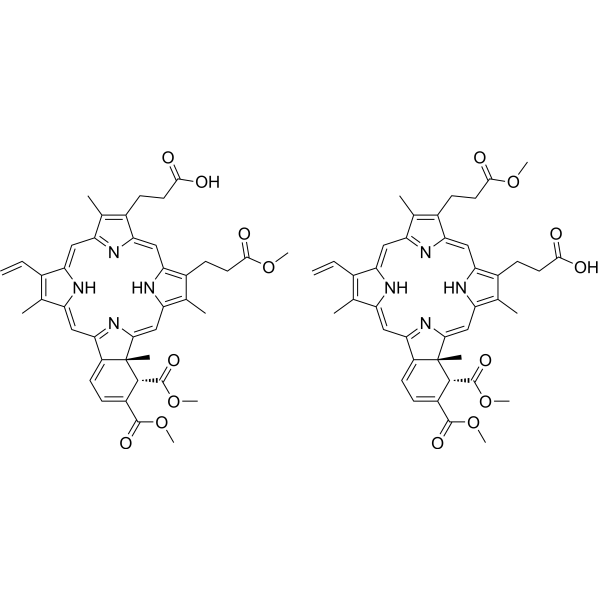 0 ImagesSynonyms: CL 318952 (Standard)Verteporfin (Standard) is the analytical standard of Verteporfin. This product is intended for research and analytical applications. Verteporfin (CL 318952) is a photosensitizer for photodynamic therapy to eliminate the abnormal blood vessels in the eye associated with conditions such as age-related macular degeneration. Verteporfin is a YAP inhibitor which disrupts YAP-TEAD interactions. Verteporfin induces cell apoptosis. Verteporfinis an autophagy inhibitor that blocks autophagy at an early stage by inhibiting autophagosome formation.
-
PROTAC TEAD1/IAP degrader-3
 0 ImagesCat. No.: HY-181590PROTAC TEAD1/IAP degrader-3 is a TEAD1/IAP PROTAC degrader. PROTAC TEAD1/IAP degrader-3 recruits the cIAP1 and XIAP E3 ligases to form a ternary complex, drives proteasomal degradation of TEAD1, and triggers autoubiquitination and proteasomal degradation of cIAP1. PROTAC TEAD1/IAP degrader-3 inhibits cell proliferation. PROTAC TEAD1/IAP degrader-3 regulates Hippo pathway activity by downregulating CTGF gene expression in a TEAD-dependent manner. PROTAC TEAD1/IAP degrader-3 is applicable to the research of mesothelioma.
-
GQ127
 0 ImagesCat. No.: HY-182405CAS No.: 2625582-70-7GQ127 is an orally active Gαq/11 inhibitor with an IC50 of 22.6 μM. GQ127 binds directly to Gαq/11 protein and inhibits its activity. GQ127 induces Apoptosis, suppresses viability, migration and invasion of uveal melanoma cells. GQ127 increases the phosphorylation level of YAP and decreases the phosphorylation level of ERK. GQ127 inhibits the growth of uveal melanoma xenografts in mouse models. GQ127 can be used for research related to uveal melanoma.
-
TEAD degrader-1
 0 ImagesCat. No.: HY-184179CAS No.: 3103984-17-1TEAD degrader-1 is a potent FBXO22-mediated molecular glue degrader of TEAD, with a 24 h DC50 of 1.0 nM. TEAD degrader-1 binds reversibly and covalently to FBXO22 C326, assembles a functional ternary complex, and mediates proteasomal degradation of TEAD. TEAD degrader-1 exhibits high selectivity for the Hippo pathway and specifically downregulates only TEAD and its downstream target proteins. TEAD degrader-1 is applicable to research related to malignant pleural mesothelioma and non-small cell lung cancer.
-
TEAD ligand-Linker Conjugate 1
 0 ImagesCat. No.: HY-186023CAS No.: 2918762-34-0
-
YL-602
 0 ImagesCat. No.: HY-186148CAS No.: 3081701-84-7YL-602 is an orally active Hippo pathway activator. YL-602 activates the Hippo pathway via MST1/2, with downstream pathway activation. YL-602 inhibits YAP and CTGF expression in cells irrespective of cell density and serum presence. YL-602 induces tumor cell apoptosis and inhibits colony formation. YL-602 suppresses tumor growth in mice. YL-602 can be used for the research of cancer, such as breast cancer.

-
CX-Se13
 0 ImagesCat. No.: HY-187219CX-Se13 is an orally active pulmonary fibrosis inhibitor with anti-inflammatory and antioxidant activities. CX-Se13 regulates the Keap1/Nrf2/HO-1/NQO1, YAP/TAZ-TEAD, NF-κB p65 and TGF-β/Smads signaling pathways. CX-Se13 activates the cellular antioxidant defense system, restores redox balance, alleviates inflammatory responses, reduces collagen deposition, decreases pro-inflammatory cytokine levels and inhibits pathological progression. CX-Se13 can be used in studies related to pulmonary fibrosis.
-
N-Acetylgalactosaminyltransferase 12
 0 ImagesCat. No.: HY-E70293Synonyms: GALNT12N-Acetylgalactosaminyltransferase 12 (GALNT12) belongs to the uridine diphosphate N-acetylgalactosamine gene family and is involved in the biological processes of many diseases, such as tumor progression. N-Acetylgalactosaminyltransferase 12 is a potential biomarker for fibrosarcoma, and its high expression level is closely related to the yes1-associated transcriptional regulator (YAP1) signaling pathway.

-
TEAD-IN-19
 0 ImagesCat. No.: HY-173139TEAD-IN-19 (Compound 1l) is a transcriptional inhibitor of TEAD, exhibiting inhibition rates of 38.5%, 36.2%, 57.8%, and 71.3% against TEAD1, TEAD2, TEAD3, and TEAD4, respectively, at a concentration of 10 μM. TEAD-IN-19 shows potent anti-proliferative and anti-migratory activities in prostate cancer cell lines and significantly reduces the expression of TEAD-regulated downstream genes. TEAD-IN-19 holds promise for research in the field of cancer therapy.


-
Tubulin polymerization-IN-58
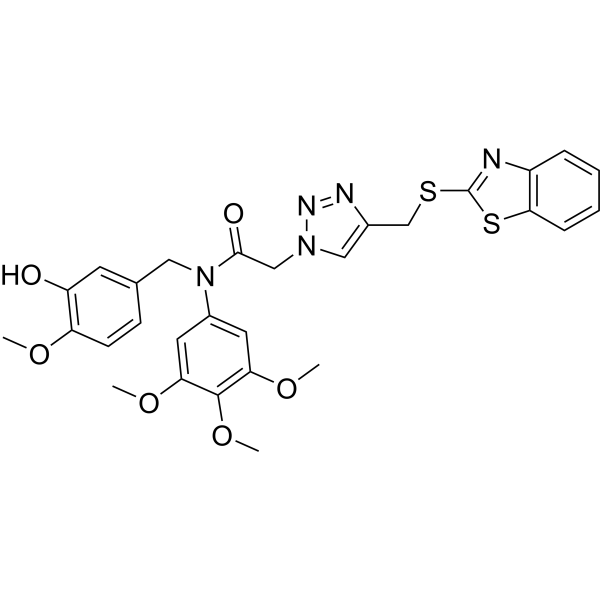 0 ImagesCat. No.: HY-162126CAS No.: 3027015-30-8




