



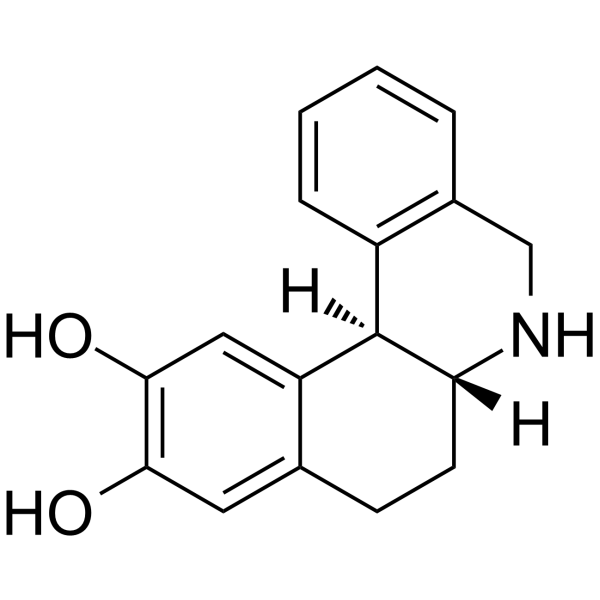
Dihydrexidine
Based on 5 publication(s) in Google Scholar
Dihydrexidine (DAR-0100) is a high potent, selective and full efficacy D1-like dopamine receptor (D1/D5) agonist with an IC50 of 10 nM for D1 receptor. Dihydrexidine exhibits potent antiparkinsonian activity. Dihydrexidine can stimulate YAP phosphorylation.
For research use only. We do not sell to patients.
- CAS No.: 123039-93-0
- Formula: C17H17NO2
- Molecular Weight:267.32
-
Storage:
Please store the product under the recommended conditions in the Certificate of Analysis.

To place orders, for customer services and technical support, please contact: MedChemExpress USA
Tel: 609-228-6898 E-mail: [email protected] [email protected]


-
 Biological Activity
-
Chemical Information
- Protocols
- Purity & Documentation
- References
-
 Help & FAQs


Publications Citing Use of MedChemExpress (MCE) Dihydrexidine
MoreAll Dopamine Receptor Isoforms
MoreAll YAP Isoforms
More

Biological Activity
Description
IC50 & Target
|
D1 Receptor 10 nM (IC50) |
Cellular Effect
|
Cell Line

|
Type | Value | Description | References |
|---|---|---|---|---|
| HEK293 | EC50 |
17 nM
Compound: DHX, 1
|
Activity at human dopamine D4.4 receptor expressed in HEK293 cells assessed as inhibition of forskolin-stimulated cAMP production
Activity at human dopamine D4.4 receptor expressed in HEK293 cells assessed as inhibition of forskolin-stimulated cAMP production
|
[PMID: 17154515] |
| HEK293 | EC50 |
19 nM
Compound: DHX, 1
|
Activity at human dopamine D1 receptor expressed in HEK293 cells assessed as stimulation of cAMP production
Activity at human dopamine D1 receptor expressed in HEK293 cells assessed as stimulation of cAMP production
|
[PMID: 17154515] |
| HEK293 | EC50 |
7.2 nM
Compound: 3, DHX
|
Agonist activity at human dopamine D1 receptor expressed in HEK293 cells assessed as cAMP accumulation after 15 mins
Agonist activity at human dopamine D1 receptor expressed in HEK293 cells assessed as cAMP accumulation after 15 mins
|
[PMID: 21862338] |
| HEK293 | EC50 |
70 nM
Compound: DHX, 1
|
Activity at rat dopamine D2L receptor expressed in HEK293 cells assessed as inhibition of forskolin-stimulated cAMP production
Activity at rat dopamine D2L receptor expressed in HEK293 cells assessed as inhibition of forskolin-stimulated cAMP production
|
[PMID: 17154515] |
In Vitro
In Vivo
Dihydrexidine (3 mg/kg; i.p.) produces prominent dopamine D1 receptor agonist effects in vivo[4].
MedChemExpress (MCE) has not independently confirmed the accuracy of these methods. They are for reference only.
-
Animal Model:Adult male Sprague–Dawley rats (275-300 g)[4]
-
Dosage:Adult male Sprague–Dawley rats (275-300 g)[4]
-
Administration:Intraperitoneal injection
-
Result:Produces prominent dopamine D1 receptor agonist effects in vivo
Clinical Trial
| NCT Number | Sponsor | Condition | Start Date |
Phase
|
|---|---|---|---|---|
| NCT01329991 | Plexxikon| | 2011-05 | PHASE1 |


Chemical Information
-
CAS No. 123039-93-0
-
Molecular Weight 267.32
-
Formula C17H17NO2
-
SMILES
OC1=C(O)C=C(CC[C@]2([H])[C@]3([H])C4=C(C=CC=C4)CN2)C3=C1
-
Synonyms
DAR-0100
-
Shipping
Room temperature in continental US; may vary elsewhere.
-
Storage
Please store the product under the recommended conditions in the Certificate of Analysis.


Publications (5)
-
Journal Impact Factor
-
Most Recent
-
ACS Nano
Delineating, Imaging, and Assessing Pulmonary Fibrosis Remodeling via Collagen Hybridization. [Abstract]2024 Oct 15;18(41):27997-28011. PMID: 39361472 -
Arthritis Res Ther
PSTPIP2 regulates synovial macrophages polarization and dynamics via ERβ in the joint microenvironment. [Abstract]2022 Nov 2;24(1):247. PMID: 36324152 -
Molecules
Hazel Leaf Polyphenol Extract Alleviated Cisplatin-Induced Acute Kidney Injury by Reducing Ferroptosis through Inhibiting Hippo Signaling. [Abstract]2024 Apr 11;29(8):1729. PMID: 38675549 -
ACS Chem Neurosci
Estimation of Dopamine D1 Receptor Agonist Binding Kinetics Using Time-Resolved Functional Assays: Relation to Agonist-Induced Receptor Internalization by Investigational Antiparkinsonian Therapeutics. [Abstract]2025 Jul 2;16(13):2502-2512. PMID: 40537032 -
Exp Cell Res
Vaspin alleviates the lncRNA LEF1-AS1-induced osteogenic differentiation of vascular smooth muscle cells via the Hippo/YAP signaling pathway. [Abstract]2022 Dec 15;421(2):113407. PMID: 36334793


Purity & Documentation
References
[1]. Lovenberg TW, et al. Dihydrexidine, a novel selective high potency full dopamine D-1 receptor agonist. Eur J Pharmacol. 1989 Jul 4;166(1):111-3. [Content Brief]
[2]. Mottola DM, et al. Dihydrexidine, a novel full efficacy D1 dopamine receptor agonist. J Pharmacol Exp Ther. 1992 Jul;262(1):383-93. [Content Brief]
[3]. Salmi P,et al. Dihydrexidine--the first full dopamine D1 receptor agonist. CNS Drug Rev. 2004 Fall;10(3):230-42. [Content Brief]
[4]. Gleason, S. D., et al. Effects of dopamine D1 receptor agonists in rats trained to discriminate dihydrexidine. Psychopharmacology, 2006;186(1), 25–31. [Content Brief]
[5]. Yu FX, et al. Regulation of the Hippo-YAP pathway by G-protein-coupled receptor signaling. Cell. 2012;150(4):780-791. [Content Brief]

Calculators
Concentration (start) × Volume (start) = Concentration (final) × Volume (final)


Dihydrexidine Related Classifications
HY-101299A Related Classifications
 Powered by Bioz