



mAChR
Muscarinic acetylcholine receptor
mAChRs (muscarinic acetylcholine receptors) are acetylcholine receptors that form G protein-receptor complexes in the cell membranes of certainneurons and other cells. They play several roles, including acting as the main end-receptor stimulated by acetylcholine released from postganglionic fibersin the parasympathetic nervous system. mAChRs are named as such because they are more sensitive to muscarine than to nicotine. Their counterparts are nicotinic acetylcholine receptors (nAChRs), receptor ion channels that are also important in the autonomic nervous system. Many drugs and other substances (for example pilocarpineand scopolamine) manipulate these two distinct receptors by acting as selective agonists or antagonists. Acetylcholine (ACh) is a neurotransmitter found extensively in the brain and the autonomic ganglia.
mAChR Isoform Specific Products
All Product Categories
-
mAChR Inhibitors
(114)
View all products
-
mAChR Agonists
(146)
View all products
-
mAChR Antagonists
(320)
View all products
-
mAChR Activators
(20)
View all products
-
mAChR Modulators
(48)
View all products
-
mAChR Inducer
(1)
View all products
-
mAChR Controls
(9)
View all products
-
mAChR Ligands
(8)
View all products
-
mAChR Related Products (719)
Related Products (719)

-
Antibodies (2)
-
mAChR Isoform Comparison
-
Metixene hydrochloride hydrate (Standard)
 0 ImagesMetixene (hydrochloride hydrate) (Standard) is the analytical standard of Metixene (hydrochloride hydrate). This product is intended for research and analytical applications. Metixene (Piperidine) hydrochloride hydrate is an anticholinergic and antiparkinsonian agent. Metixene hydrochloride hydrate potently inhibits binding of quinuclidinyl benzilate (QNB) with the muscarinic receptor, IC50 and Ki values of 55 nM and 15 nM, respectively. Metixene hydrochloride hydrate can be used for the research of parkinsonian.
-
Tiquizium bromide
 0 ImagesCat. No.: HY-135754CAS No.: 71731-58-3Synonyms: HSR-902Tiquizium bromide is an orally active, atropine-type, nonselective muscarinic antagonist and novel spasmolytic agent. Tiquizium bromide inhibits the developments of gastric lesions and duodenal lesions. Tiquizium bromide induces the mydoriasis and inhibits the Pilocarpine (HY-B0726A)-induced salivation.
-
(Rac)-Sabcomeline hydrochloride
 0 ImagesCat. No.: HY-167933CAS No.: 133642-67-8Synonyms: (Rac)-SB-202026 hydrochloride; (Rac)-Memric hydrochloride(Rac)-Sabcomeline ((Rac)-SB-202026) hydrochloride serves as an M1 receptor agonist, making it a valuable tool for research into Alzheimer's disease.
-
Tazomeline
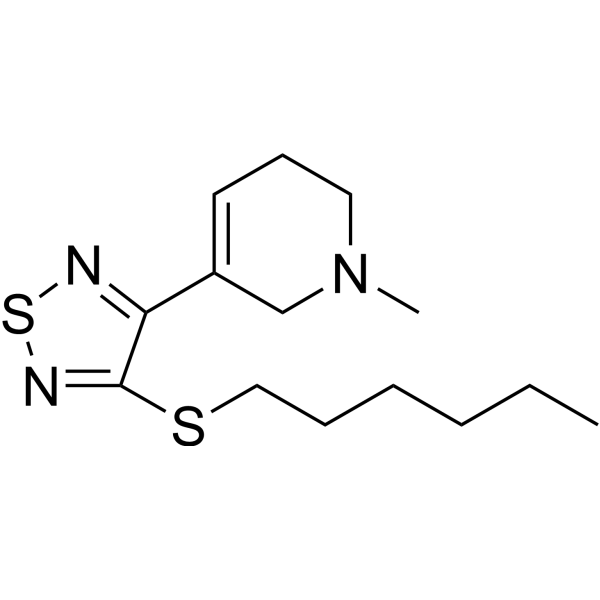 0 ImagesTazomeline is a selective M1 muscarinic receptor agonist. Tazomeline inhibits twitch height in rabbit vas deferens(IC50= 0.001 nM). Tazomeline can be used for research of neuropsychiatric disorders.
-
(E/Z)-VU0029767
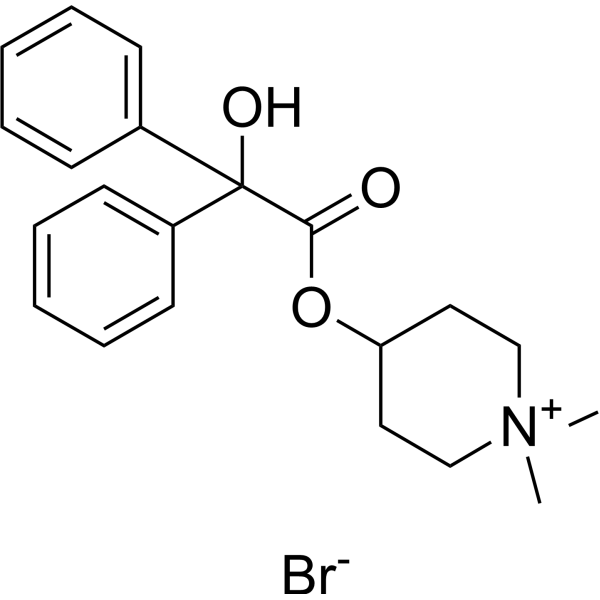
 0 ImagesCat. No.: HY-119082CAS No.: 326001-01-8(E/Z)-VU0029767 is an allosteric enhancer of M1 muscarinic receptors with the activity to modulate M1 receptor activity. (E/Z)-VU0029767 can enhance M1 receptor activity by increasing agonist affinity, but exhibits different properties from other compounds under different experimental conditions, such as effects on mutant M1 receptors and effects on downstream signaling pathways.

-
VU0415248
 0 ImagesCat. No.: HY-182587CAS No.: 1359087-83-4VU0415248 is a selective muscarinic acetylcholine receptor 1 (M1) inhibitor. VU0415248 inhibits acetylcholine-induced calcium mobilization in cells expressing human and rat M1 muscarinic acetylcholine receptors, with an IC50 of 0.4 and 0.18 μM, respectively. VU0415248 is applicable to the research of Parkinson's disease, movement disorders and fragile X syndrome.
-
Trihexyphenidyl-d5
 0 ImagesCat. No.: HY-B1277ASTrihexyphenidyl-d5 is deuterium labeled Trihexyphenidyl (HY-B1277A). Trihexyphenidyl is a selective and orally active M1 muscarinic receptor antagonist with an IC50 of 3.7 nM for rat cerebral cortex M1 muscarinic receptors. Trihexyphenidyl modulates cholinergic activity, countering acetylcholine supersensitivity in neural pathways. Trihexyphenidyl improves movement disorder, inhibits McN-A-343 (HY-107648)-induced pressor responses, vagally-induced bradycardia and vasodilatation. Trihexyphenidyl can be used for the research of Parkinson's disease..
-
β2AR agonist 6
 0 ImagesCat. No.: HY-184680CAS No.: 3109318-04-6β2AR agonist 6 is a MABA with both muscarinic acetylcholine M3 receptor antagonistic activity and β2 adrenergic receptor agonistic activity, with a Ki of 1.95 nM against hM3 and an EC50 of 0.266 nM against hβ2. β2AR agonist 6 binds to the M3 muscarinic receptor with high affinity and exhibits long-lasting binding, while displaying subnanomolar agonist activity at the β2 adrenergic receptor. β2AR agonist 6 induces smooth muscle relaxation and provides long-lasting bronchoprotective effects. β2AR agonist 6 can be used in research related to asthma and chronic obstructive pulmonary disease.
-
VU0476406
 0 ImagesCat. No.: HY-183203CAS No.: 1451993-12-6VU0476406 is a blood-brain barrier-permeable and selective muscarinic acetylcholine receptor subtype 4 (M4) activator with human EC50 of 91.0 nM and human pEC50 of 7.04. VU0476406 potentiates endogenous acetylcholine activity at M4 receptors. VU0476406 can be used for the research of Parkinson's disease.
-
Tropicamide (Standard)
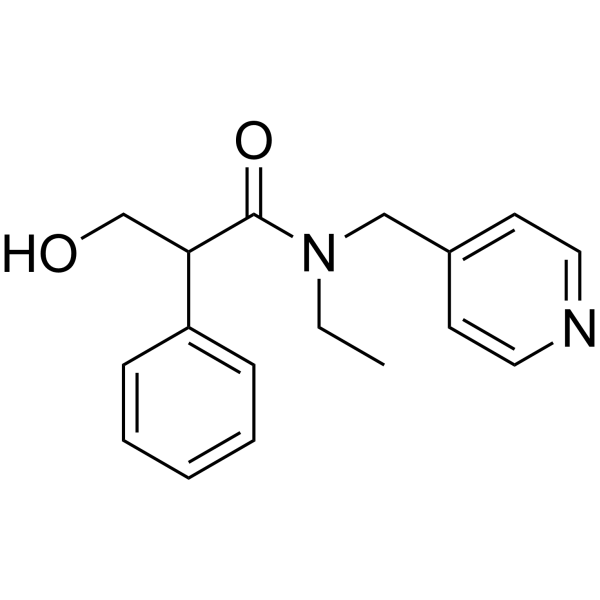 0 ImagesTropicamide (Standard) is the analytical standard of Tropicamide. This product is intended for research and analytical applications. Tropicamide (Ro 1-7683) is a selective M4 muscarinic acetylcholine receptor antagonist. Tropicamide produces short acting mydriasis (dilation of the pupil) and cycloplegia when applied as eye drops.
-
(Rac)-5-Hydroxymethyl tolterodine-d5
 0 ImagesCat. No.: HY-76570S2CAS No.: 2012598-78-4Synonyms: (Rac)-Desfesoterodine-d5; (Rac)-PNU-200577-d5(Rac)-5-hydroxymethyl Tolterodine-d5 ((Rac)-Desfesoterodine-d5; (Rac)-PNU-200577-d5) is deuterium-labeled (Rac)-5-Hydroxymethyl Tolterodine (HY-76570).
-
DC-98-LC74
 0 ImagesCat. No.: HY-188044DC-98-LC74 is a selective modulator of adult skeletal muscle-type nicotinic acetylcholine receptor (α1β1δε), with an EC50 value of 6.5 µM for the human receptor and an IC50 of 13.45 µM for the human α3β4 nicotinic acetylcholine receptor. DC-98-LC74 increases the ligand-free opening probability of the receptor via the ε subunit M2-M3 loop, and prolongs the burst duration and opening probability of wild-type and fast-channel mutant AChR. DC-98-LC74 exerts weak effects on neuronal AChR subtypes and has no agonist activity. DC-98-LC74 prolongs the mouse diaphragm endplate current and improves muscle contractility in isolated neuromuscular preparations from sarcopenic mice. DC-98-LC74 can be used for studies on neuromuscular junction function and myasthenia-related diseases.

-
MK-0969
 0 ImagesCat. No.: HY-120322CAS No.: 203321-88-4MK-0969 is a M3 antagonist. MK-0969 can be used for research about chronic obstructive pulmonary disease and urinary incontinence.
-
Ilmetropium iodide
 0 ImagesCat. No.: HY-109006CAS No.: 129109-88-2Ilmetropium iodide is an anticholinergic agent. Ilmetropium iodide selectively blocks M-cholinergic receptors of bronchial muscle, reduces or prevents bronchoconstrictor response associated with both cholinergic stimulation, as well as the impact of the factors that provoke bronchospasm. Strength and selectivity of ilmetropium iodide action substantially exceeds Atropine sulfate (HY-B1205A) and Ipratropium bromide (HY-B0241).
-
Sintropium bromide
 0 ImagesCat. No.: HY-19685ACAS No.: 79467-19-9Sintropium bromide is a mAChR antagonist with anticholinergic effects. Sintropium bromide can be used for pain and spasm research.
-
(S)-Albuterol hydrochloride
 0 ImagesCat. No.: HY-137311CAS No.: 50293-91-9(S)-Albuterol hydrochloride is a muscarinic receptor and phospholipase C activator. (S)-Albuterol hydrochloride increases intracellular free calcium in airway smooth muscle.
-
(Rac)-AF710B
 0 ImagesCat. No.: HY-116586ACAS No.: 1235733-73-9




