



Small Interfering RNA (siRNA)
Small Interfering RNA (siRNA) is a small exogenous double-stranded RNA (dsRNA) (20-25 nucleotides), which triggers the RNA interference (RNAi) pathway. The short dsRNA unwinds and the sense strand is degraded. Antisense strand forms RNA induced silencing complex (RISC) with various protein components. The antisense strand retained in RISC is specifically complementary to the target gene mRNA. Meanwhile, RISC has nuclease activity, which can cut and degrade the target gene mRNA, and inhibit the expression of target gene. Incomplete complementarity results in mRNA translation inhibition.
All Product Categories
-
Small Interfering RNA (siRNA) Related Products (29611)
Related Products (29611)

-
SiRNA Negative Control
 0 ImagesCat. No.: HY-150150Purity: 99.24%SiRNA Negative Control is a siRNA of 21 nucleotides, and can be used as a negative control. SiRNA Negative Control has no homology to most known gene sequence. SiRNA Negative Control can be used in human, mouse and rat cells in vitro. SiRNA Negative Control can be used as experimental control benchmark, verification of experimental reliability and standardization reference. SiRNA Negative Control is a common negative control used in most research articles.
-
Inclisiran sodium
 0 ImagesCat. No.: HY-132591APurity: 99.08%Synonyms: ALN-PCSsc sodiumInclisiran sodium is a double-stranded small interfering RNA (siRNA) molecule. Inclisiran sodium inhibits the transcription of PCSK9. Inclisiran sodium inhibits Pyroptosis, activates PPARγ, and reduces NLRP3, cleaved caspase-1, IL-1β, and IL-18. Inclisiran sodium has anti-inflammatory, lipid-regulating and anti-atherosclerotic activities. Inclisiran sodium can be used in researches of hyperlipidemia and cardiovascular disease (CVD).
-
Patisiran sodium
 0 ImagesPatisiran sodium is a double-stranded small interfering RNA that targets a sequence within the transthyretin (TTR) messenger RNA. Patisiran sodium specifically inhibits hepatic synthesis of mutant and wild-type TTR. Patisiran sodium can be used for the research of hereditary TTR amyloidosis.
-
Inclisiran
 0 ImagesSynonyms: ALN-PCSscInclisiran is a double-stranded small interfering RNA (siRNA) molecule. Inclisiran inhibits the transcription of PCSK9. Inclisiran inhibits Pyroptosis, activates PPARγ, and reduces NLRP3, cleaved caspase-1, IL-1β, and IL-18. Inclisiran has anti-inflammatory, lipid-regulating and anti-atherosclerotic activities. Inclisiran can be used in researches of hyperlipidemia and cardiovascular disease (CVD).
-
Givosiran sodium
 0 ImagesSynonyms: ALN-AS1 sodiumGivosiran (ALN-AS1) sodium is a small interfering RNA that targets hepatic aminolevulinate synthase 1 (ALAS1) messenger RNA. Givosiran sodium downregulates ALAS1 mRNA and prevents accumulation of neurotoxic δ-aminolevulinic acid (ALA) and porphobilinogen (PBG) levels. Givosiran sodium demonstrates potent inhibitory activity against ALAS1 in mouse, rat, and cynomolgus monkey models. Givosiran sodium can be used for the research of acute hepatic porphyria (AHP).
-
Etedesiran
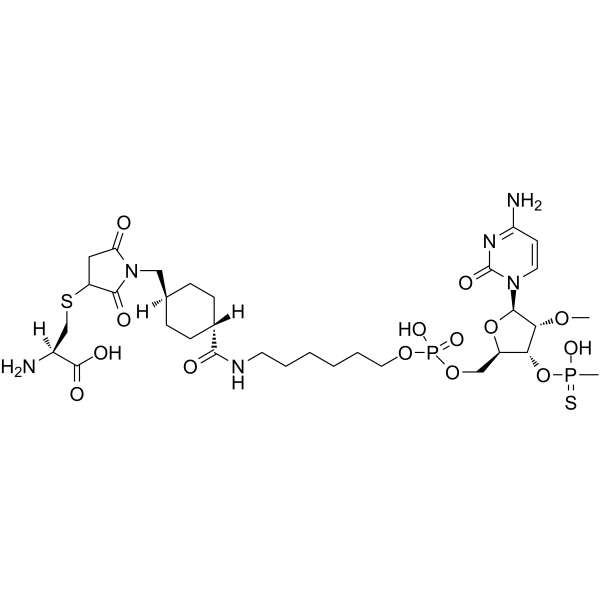 0 ImagesCat. No.: HY-147262Etedesiran is a component of the AOC drug Delpacibart etedesiran (HY-177565), formed by the reaction of an siRNA that induces cleavage of mRNA encoding myotonic dystrophy protein kinase (MTPK or DMPK) with SMCC linker (HY-42360). Etedesiran carries a maleimide group at its terminus, which can react with cysteine or lysine and is used for the synthesis of AOC drugs. Etedesiran is applicable to research related to myotonic dystrophy type 1.
-
Tivanisiran
 0 ImagesCat. No.: HY-132596CAS No.: 1848224-71-4Synonyms: SYL1001Tivanisiran (SYL1001) is a small interfering RNA (siRNA) targeting TRPV1 . Tivanisiran induces the degradation of TRPV1 mRNA, thereby inhibiting protein synthesis. Tivanisiran alleviates ocular discomfort and pain, and improves ocular hyperemia and tear quality. Tivanisiran is applicable to research related to dry eye disease.
-
Braxlosiran
 0 ImagesCat. No.: HY-177971Braxlosiran is a component of the AOC reagent Delpacibart braxlosiran (HY-177566), consisting of an siRNA targeting DUX4 (double homeobox protein) and SMCC linker (HY-42360). Delpacibart braxlosiran binds to TfR1. Aberrant expression of the DUX4 protein causes changes in gene expression in muscle cells, which are associated with muscle function loss in facioscapulohumeral muscular dystrophy (FSHD).
-
DSPE-PEG2000-Mannose
 0 ImagesCat. No.: HY-168374CAS No.: 1829524-73-3DSPE-PEG 2000-Mannose is a mannose-containing lipid. DSPE-PEG 2000-Mannose is used to prepare mannose-conjugated Liposome (Man-lipo) for siRNA delivery. Mannose-modified liposomes encapsulating IDO siRNA (Man-lipo-siIDO) preferentially knock down IDO expression in the draining lymph nodes and spleens of melanoma-bearing mice. Man-lipo-siIDO delays the onset time of melanoma and reduces tumor volume.
-
Lumasiran
 0 ImagesCat. No.: HY-132588CAS No.: 1834610-13-7Synonyms: ALN-G01Lumasiran (ALN-G01), a siRNA product, reduces hepatic oxalate production by targeting glycolate oxidase. By silencing the gene encoding glycolate oxidase, Lumasiran depletes glycolate oxidase and thereby inhibits the synthesis of oxalate, which is the toxic metabolite that is directly associated with the clinical manifestations of Primary hyperoxaluria type 1 (PH1).

-
Givosiran
 0 ImagesCat. No.: HY-132610CAS No.: 1639325-43-1Synonyms: ALN-AS1Givosiran (ALN-AS1) is a small interfering RNA that targets hepatic aminolevulinate synthase 1 (ALAS1) messenger RNA. Givosiran downregulates ALAS1 mRNA and prevents accumulation of neurotoxic δ-aminolevulinic acid (ALA) and porphobilinogen (PBG) levels. Givosiran demonstrates potent inhibitory activity against ALAS1 in mouse, rat, and cynomolgus monkey models. Givosiran can be used for the research of acute hepatic porphyria (AHP).
-
Vutrisiran
 0 ImagesCat. No.: HY-132589CAS No.: 1867157-35-4Synonyms: ALN-TTRsc02Vutrisiran (ALN-TTRsc02) is a liver-directed, investigational, small interfering ribonucleic acid (siRNA) agent. Vutrisiran can be used for transthyretin (TTR)-mediated amyloidosis research.
-
Lumasiran sodium
 0 ImagesLumasiran sodium, an investigational RNA interference (RNAi) therapeutic agent, reduces hepatic oxalate production by targeting glycolate oxidase. Lumasiran sodium reduces urinary oxalate excretion, the cause of progressive kidney failure in primary hyperoxaluria type 1 (PH1) .
-
Nedosiran sodium
 0 ImagesCat. No.: HY-132606ACAS No.: 2247026-22-6Synonyms: DCR-PHXC sodiumNedosiran (DCR-PHXC) sodium is an RNA interference (RNAi) targeting lactate dehydrogenase (LDH). Nedosiran sodium represents an impactful potential therapeutic for primary hyperoxaluria (PH) with end-stage renal disease (ESRD). Nedosiran sodium is a GalNAc-dsRNA conjugate.
-
SS(no Galnac)-Inclisiran sodium
 0 ImagesCat. No.: HY-143220Purity: 98.05%SS (no Galnac)-Inclisiran sodium is the sense strand of Inclisiran (HY-132591) without GalNAc modification. Inclisiran is a double-stranded small interfering RNA (siRNA) molecule that inhibits the transcription of PCSK-9. SS (no Galnac)-Inclisiran sodium can be used in cardiovascular disease research.
-
Vutrisiran sodium
 0 ImagesCat. No.: HY-132589ASynonyms: ALN-TTRsc02 sodiumVutrisiran sodium (ALN-TTRsc02 sodium) is a liver-directed small interfering RNA (siRNA). Vutrisiran sodium targets the mRNA of transthyretin (TTR), and is applicable to studies on transthyretin (TTR)-mediated amyloidosis.
-
GalNAc unconjugated/naked Inclisiran
 0 ImagesCat. No.: HY-150223Purity: 98.83%GalNAc unconjugated/naked Inclisiran is a double-stranded small interfering RNA molecule that targets hepatic PCSK9 production to reduce LDL-C levels. GalNAc unconjugated/naked Inclisiran can be used in the research of cardiovascular diseases and hypercholesterolemia.
-
Fitusiran
 0 ImagesSynonyms: ALN-AT3SC; SAR439774Fitusiran (ALN-AT3SC) is a siRNA strategy. Fitusiran delivers siRNA targeting the SERPINC1 gene in hepatocytes to inhibit antithrombin synthesis. Fitusiran enhances thrombin activity and increases Thrombin generation, thereby restoring hemostatic function. Fitusiran can be used in hemophilia-related research.
-
Tivanisiran sodium
 0 ImagesCat. No.: HY-132596ACAS No.: 1848239-71-3Synonyms: SYL1001 sodiumTivanisiran sodium (SYL1001 sodium) is a small interfering RNA (siRNA) targeting TRPV1 . Tivanisiran sodium induces the degradation of TRPV1 mRNA, thereby inhibiting protein synthesis. Tivanisiran sodium alleviates ocular discomfort and pain, and improves ocular hyperemia and tear quality. Tivanisiran sodium is applicable to research related to dry eye disease.



