



DSPE-PEG2000-Mannose
Based on 1 publication(s) in Google Scholar
DSPE-PEG2000-Mannose is a mannose-containing lipid. DSPE-PEG2000-Mannose is used to prepare mannose-conjugated Liposome (Man-lipo) for siRNA delivery. Mannose-modified liposomes encapsulating IDO siRNA (Man-lipo-siIDO) preferentially knock down IDO expression in the draining lymph nodes and spleens of melanoma-bearing mice. Man-lipo-siIDO delays the onset time of melanoma and reduces tumor volume.
Nos produits utilisent uniquement pour la recherche. Nous ne vendons pas aux patients.
- Pureté : 90.0%
- CAS No.: 1829524-73-3
- Masse moléculaire:2000 (Average)
-
Stockage:Powder -20°C, 3 years ; In solvent -80°C, 6 months , -20°C, 1 month


To place orders, for customer services and technical support, please contact: MedChemExpress USA
Tel: 609-228-6898 E-mail: [email protected] [email protected]


-
 Activité biologique
-
Chemical Information
-
Solvant et solubilité
- Protocole
- Pureté et documentation
- Références
-
 Help & FAQs


-
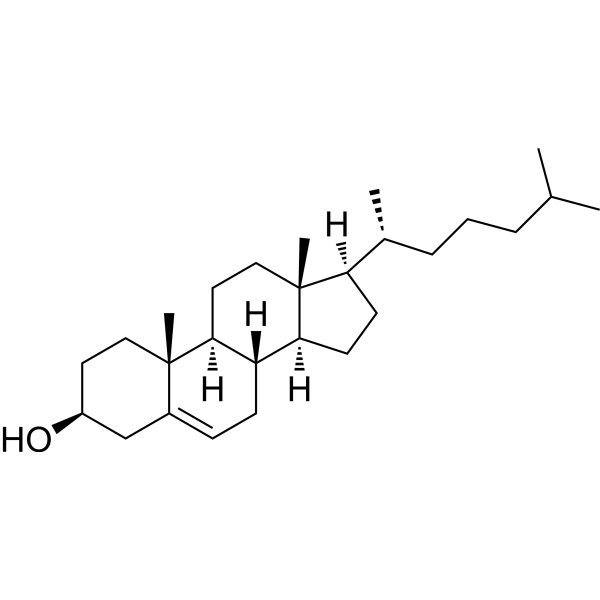
HY-N0322
Cholesterol (from animal)ERRα Agonist -

HY-134541
SM-102Ionizable Amino Lipid -

HY-142979
DSPE-PEG 2000PEG Lipid -

HY-112005
DOPEFerroptosis Inhibitor -

HY-112251
D-Lin-MC3-DMAsiRNA Delivery Vehicle -

HY-112764
mPEG2000-DMGLiposome -

HY-17026
GemcitabineDNA Synthesis Inhibitor -

HY-12216
ResmetiromTHR-β Agonist -

HY-W040193
DSPCLiposome Compound -

HY-12047
PonatinibMulti-targeted Kinase Inhibitor -

HY-138170
ALC-0315Lipid Nanoparticle Component -

HY-112768
PEG2000-DMPEMicelle Raw Material
Publications Citing Use of MedChemExpress (MCE) DSPE-PEG2000-Mannose
More

Activité biologique
Description
In Vitro
DSPE-PEG2000-Mannose (3:10:10:4 molar ratio with DOTAP, DPPC, cholesterol; 10 min hydration, 10 min post-extrusion incubation) was used to prepare mannose-conjugated liposomes (Man-lipo) for siRNA delivery, with formulation steps including lipid mixing, hydration with siRNA-protamine mixture, vortexing, sonication, extrusion, and post-extrusion incubation[1].
DSPE-PEG2000-Mannose-formulated Man-lipo-siIDO (24 h post-transfection) significantly reduced IDO mRNA levels in mouse bone marrow-derived dendritic cells (DCs) compared to Man-lipo-siScramble control[1].
MedChemExpress (MCE) has not independently confirmed the accuracy of these methods. They are for reference only.
In Vivo
MedChemExpress (MCE) has not independently confirmed the accuracy of these methods. They are for reference only.


Chemical Information
-
CAS No. 1829524-73-3
-
Appearance Solid
-
Masse moléculaire 2000 (Average)
-
Color White to off-white
-
SMILES
CCCCCCCCCCCCCCCCCC(O[C@@H](COP(OCCNC(OCCOCCNC(NC1=CC=C(O[C@@H]2[C@@H](O)[C@@H](O)[C@H](O)[C@@H](CO)O2)C=C1)=S)=O)(O)=O)COC(CCCCCCCCCCCCCCCCC)=O)=O.[n]
-
Livraison
Room temperature in continental US; may vary elsewhere.
-
Stockage
Powder -20°C 3 years In solvent -80°C 6 months -20°C 1 month


Publications (1)
-
Journal Impact Factor
-
Most Recent


Solvant et solubilité
In Vitro:
DMSO : 16.67 mg/mL (ultrasonic and warming and heat to 60°C; Hygroscopic DMSO has a significant impact on the solubility of product, please use newly opened DMSO)
Ethanol : 10 mg/mL (Need ultrasonic)


Pureté et documentation
-
Fiche technique (271 KB)
-
SDS (251 KB)
- English - EN (251 KB)
- Français - FR (251 KB)
- Deutsch - DE (251 KB)
- Norwegian - NO (251 KB)
- Español - ES (251 KB)
- Swedish - SV (251 KB)
- Italian - IT (251 KB)
- Korean - KR (251 KB)
- Portuguese - PT (251 KB)
-
Instruction de manipulation (2659 KB)
Références

Calculators
Concentration (start) × Volume (start) = Concentration (final) × Volume (final)


DSPE-PEG2000-Mannose Related Classifications
HY-168374 Related Classifications
 Powered by Bioz