1. Cell Cycle/DNA Damage TGF-beta/Smad Stem Cell/Wnt Cytoskeleton
  2. ROCK
  3. Y-33075

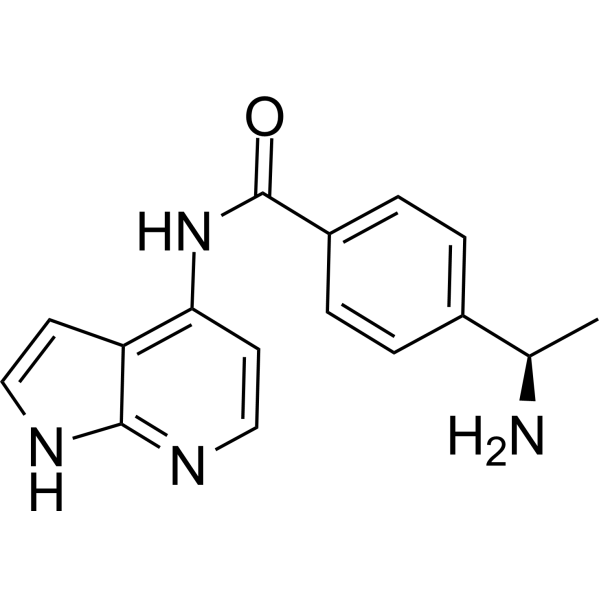
Y-33075  (Synonyms: Y-39983 free base)

製品番号: HY-10067 純度: 98.44%
COA 取扱説明書 Technical Support

Y-33075 is a selective ROCK inhibitor derived from Y-27632, and is more potent than Y-27632, with an IC50 of 3.6 nM.

商品は「研究用試薬」です。人や動物の医療用・臨床診断用・食品用の製品ではありません。
研究用途以外に使用した場合、当社は一切の責任を負いかねます。

CAS 番号 : 199433-58-4

容量 価格(税別) 在庫状況 数量
Solid + Solvent (Highly Recommended)
10 mM * 1 mL in DMSO
ready for reconstitution
USD 257 在庫あり
Solution
10 mM * 1 mL in DMSO USD 257 在庫あり
Solid
5 mg $234 在庫あり
10 mg $363 在庫あり
25 mg $732 在庫あり
50 mg $1307 在庫あり
100 mg $1730 在庫あり
200 mg   お問い合わせ  
500 mg   お問い合わせ  

* アイテムを追加する前、数量をご選択ください

This product is a controlled substance and not for sale in your territory.

カスタマーレビュー

Based on 14 publication(s) in Google Scholar

Other Forms of Y-33075:

Top Publications Citing Use of Products

    Y-33075 purchased from MedChemExpress. Usage Cited in: PLoS One. 2023 Jan 31;18(1):e0270288.  [Abstract]

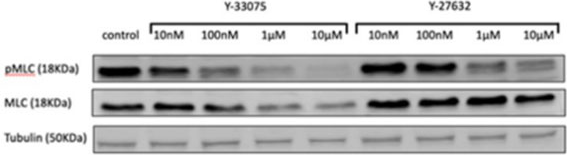
    Y-27632 (10, 100 nM and 10, 100 µM; 24 h) decreases phosphorylation of MLC starting at a concentration of 100 nM in HSCs.

    Y-33075 purchased from MedChemExpress. Usage Cited in: Neurotox Res. 2013 Apr;23(3):238-48.  [Abstract]

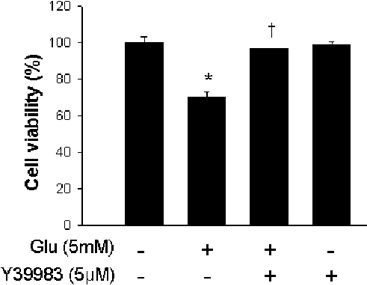
    Effect of Y39983 on glutamate-treated HT22 cell viability.

    ROCK アイソフォーム固有の製品をすべて表示:

    • 生物活性

    • プロトコル

    • 純度とドキュメンテーション

    • 参考文献

    • カスタマーレビュー

    製品説明

    Y-33075 is a selective ROCK inhibitor derived from Y-27632, and is more potent than Y-27632, with an IC50 of 3.6 nM.

    IC50 & Target[1]

    ROCK

    3.6 nM (IC50)

    PKC

    420 nM (IC50)

    CaMKII

    810 nM (IC50)

    体外実験

    Y-33075 (Y-39983) is a potent ROCK inhibitor, with an IC50 of 3.6 nM. Y-33075 also inhibits PKC and CaMKII more potently than Y-27632, and the IC50s of Y-27632 and Y-33075 for PKC are 9.0 μM and 0.42 μM, respectively, whereas the IC50s of Y-27632 and Y-33075 for CaMKII are 26 μM and 0.81 μM, respectively. The IC50s of Y-27632 and Y-33075 for PKC is 82 and 117 times those for ROCK, respectively, whereas the IC50s of Y-27632 and Y-33075 for CaMKII is 236 and 225 times those for ROCK, respectively[1]. Y-33075 (Y-39983, 10 μM) extends neurites in the retinal ganglion cells (RGCs) compared with those in RGCs treated without Y-39983[2]. Y-33075 (Y-39983, 1 μM) inhibits the contraction of rabbit ciliary artery segments evoked by histamine in Ca2+-free solutions. Y-33075 (10 μM) shows no effect on the [Ca2+]i increase with the high-potassium (high-K) solution[3].

    MedChemExpress (MCE) has not independently confirmed the accuracy of these methods. They are for reference only.

    体内実験

    In rabbits, Y-39983 (≥0.01%) significantly lowers intraocular pressure (IOP) at 2 hours after topical administration. In monkeys, Y-39983 (0.05%)-treated eyes show significant reduction of IOP between 2 and 7 hours after topical administration[1]. Y-39983 (100 μM) increases the regenerating axons of retinal ganglion cells (RGCs) in the eyes of the rats[2].

    MedChemExpress (MCE) has not independently confirmed the accuracy of these methods. They are for reference only.

    分子量

    280.33

    分子式

    C16H16N4O

    CAS 番号
    Appearance

    Solid

    Color

    White to off-white

    SMILES

    O=C(NC1=C2C(NC=C2)=NC=C1)C3=CC=C(C=C3)[C@H](N)C

    輸送条件

    Room temperature in continental US; may vary elsewhere.

    保管条件
    Powder -20°C 3 years
      4°C 2 years
    In solvent -80°C 6 months
      -20°C 1 month
    溶剤 & 溶解度
    体外: 

    DMSO : 50 mg/mL (178.36 mM; Need ultrasonic and warming; Hygroscopic DMSO has a significant impact on the solubility of product, please use newly opened DMSO)

    H2O : < 0.1 mg/mL (insoluble)

    Preparing
    Stock Solutions
    Concentration Solvent Mass 1 mg 5 mg 10 mg
    1 mM 3.5672 mL 17.8361 mL 35.6721 mL
    5 mM 0.7134 mL 3.5672 mL 7.1344 mL
    10 mM 0.3567 mL 1.7836 mL 3.5672 mL
    View the Complete Stock Solution Preparation Table

    * Please refer to the solubility information to select the appropriate solvent. Once prepared, please aliquot and store the solution to prevent product inactivation from repeated freeze-thaw cycles.
    Storage method and period of stock solution: -80°C, 2 years; -20°C, 1 year. When stored at -80°C, please use it within 2 years. When stored at -20°C, please use it within 1 year.

    • Molarity Calculator

    • Dilution Calculator

    Mass (g) = Concentration (mol/L) × Volume (L) × Molecular Weight (g/mol)

    Mass
    =
    Concentration
    ×
    Volume
    ×
    Molecular Weight *

    Concentration (start) × Volume (start) = Concentration (final) × Volume (final)

    一般には略語で表示されます:C1V1 = C2V2

    濃度 (開始)

    C1

    ×
    体積 (開始)

    V1

    =
    濃度 (終了)

    C2

    ×
    体積 (終了)

    V2

    体内:

    Select the appropriate dissolution method based on your experimental animal and administration route.

    For the following dissolution methods, please ensure to first prepare a clear stock solution using an In Vitro approach and then sequentially add co-solvents:
    To ensure reliable experimental results, the clarified stock solution can be appropriately stored based on storage conditions. As for the working solution for in vivo experiments, it is recommended to prepare freshly and use it on the same day.
    The percentages shown for the solvents indicate their volumetric ratio in the final prepared solution. If precipitation or phase separation occurs during preparation, heat and/or sonication can be used to aid dissolution.

    • Protocol 1

      Add each solvent one by one:  10% DMSO    40% PEG300    5% Tween-80    45% Saline

      Solubility: ≥ 2.5 mg/mL (8.92 mM); Clear solution

      This protocol yields a clear solution of ≥ 2.5 mg/mL (saturation unknown).

      Taking 1 mL working solution as an example, add 100 μL DMSO stock solution (25.0 mg/mL) to 400 μL PEG300, and mix evenly; then add 50 μL Tween-80 and mix evenly; then add 450 μL Saline to adjust the volume to 1 mL.

      Preparation of Saline: Dissolve 0.9 g sodium chloride in ddH₂O and dilute to 100 mL to obtain a clear Saline solution.
    • Protocol 2

      Add each solvent one by one:  10% DMSO    90% (20% SBE-β-CD in Saline)

      Solubility: ≥ 2.5 mg/mL (8.92 mM); Clear solution

      This protocol yields a clear solution of ≥ 2.5 mg/mL (saturation unknown).

      Taking 1 mL working solution as an example, add 100 μL DMSO stock solution (25.0 mg/mL) to 900 μL 20% SBE-β-CD in Saline, and mix evenly.

      Preparation of 20% SBE-β-CD in Saline (4°C, storage for one week): 2 g SBE-β-CD powder is dissolved in 10 mL Saline, completely dissolve until clear.
    In Vivo Dissolution Calculator
    Please enter the basic information of animal experiments:

    Dosage

    mg/kg

    Animal weight
    (per animal)

    g

    Dosing volume
    (per animal)

    μL

    Number of animals

    Recommended: Prepare an additional quantity of animals to account for potential losses during experiments.
    Please enter your animal formula composition:
    %
    DMSO +
    +
    %
    Tween-80 +
    %
    Saline
    Recommended: Keep the proportion of DMSO in working solution below 2% if your animal is weak.
    The co-solvents required include: DMSO, . All of co-solvents are available by MedChemExpress (MCE). , Tween 80. All of co-solvents are available by MedChemExpress (MCE).
    Calculation results:
    Working solution concentration: mg/mL
    Method for preparing stock solution: mg drug dissolved in μL  DMSO (Stock solution concentration: mg/mL).
    The concentration of the stock solution you require exceeds the measured solubility. The following solution is for reference only. If necessary, please contact MedChemExpress (MCE).
    Method for preparing in vivo working solution for animal experiments: Take μL DMSO stock solution, add μL . μL , mix evenly, next add μL Tween 80, mix evenly, then add μL Saline.
     If the continuous dosing period exceeds half a month, please choose this protocol carefully.
    Please ensure that the stock solution in the first step is dissolved to a clear state, and add co-solvents in sequence. You can use ultrasonic heating (ultrasonic cleaner, recommended frequency 20-40 kHz), vortexing, etc. to assist dissolution.
    純度とドキュメンテーション
    参考文献
    キナーゼ実験
    [1]

    Recombinant ROCK (ROK α/ROCK II), purified protein kinase C (PKC: mixture of α, β, γ isoforms), and recombinant calmodulin-dependent protein kinase II (CaMK II) are used in the assay. ROCK (0.2 U/mL) is incubated with 1 μM [γ-32P] ATP and 10 μg/mL histone as substrates in the absence or presence of various concentrations of Y-27632, Y-33075, or staurosporine at room temperature for 20 minutes in 20 mM MOPS (3-(N-morpholino)propanesulfonic acid) buffer (pH 7.2) containing 0.1 mg/mL bovine serum albumin (BSA), 5 mM dithiothreitol [DTT], 10 mM β-glycerophosphate, 50 μM Na3VO4, and 10 mM MgCl2 in a total volume of 100 μL. PKC (10 ng/mL) is incubated with 1 μM [γ-32P] ATP and 20 μM PKC substrate in the absence or presence of various concentrations of Y-27632, Y-33075, or staurosporine at room temperature for 30 minutes in 20 mM MOPS buffer (pH 7.5) containing 0.1 mg/mL BSA, 10 mM DTT, 10 mM β-glycerophosphate, 50 μM Na3VO4, 2 mM CaCl2, 20 μg/mL phosphatidyl-l-serine, and 10 mM MgCl2 in a total volume of 100 μL. CaMK II (125 U/mL) is incubated with 1 μM [γ-32P] ATP, 10 μM calmodulin, and 20 μM CaMK II substrate, in the absence or presence of various concentrations of Y-27632, Y-33075, or staurosporine at room temperature for 30 minutes in 20 mM MOPS buffer (pH 7.5) containing 0.2 mg/mL BSA, 0.5 mM DTT, 0.1 mM β-glycerophosphate, 50 μM Na3VO4, 1 mM CaCl2, and 5 mM MgCl2 in a total volume of 100 μL. Incubation is terminated by the addition of 100 μL of 0.7% phosphoric acid. A 160 μL portion of the mixture is transferred to Multiscreen-PH plate. A positively charged phosphocellulose filter absorbs the substrate that binds 32P. The filter is washed with 300 μL of 0.5% phosphoric acid and then twice with purified water and then dried. The radioactivity of the dried filter is measured with a liquid scintillation counter. Results are presented as 50% inhibitory concentrations and 95% confidence intervals (CIs)[1].

    MedChemExpress (MCE) はこれらの方法の精度を確認していません。 こちらは参照専用です。

    細胞実験
    [2]

    In brief, retinal cell suspensions are obtained from dissected retinas of Wistar rats by papain treatment. Retinal ganglion cells (RGCs) are purified by the panning method using anti-rat CD11 antibody for removal of microglia cells and anti-rat Thy-1 antibody for isolation of ganglion cells. The purified RGCs (5000 cells/plate) are seeded into 24-well plates coated by 50 μg/mL of poly-l-lysine and 2 μg/mL of merosin, and are cultured in serum-free neurobasal medium supplemented with 2% B27 supplement, 50 ng/mL BDNF, 50 ng/mL CNTF, 5 μM forskolin, and 1 mM glutamine under a 95% air-5% CO2 atmosphere at 37°C. After completion of 24-hour cultivation, RGCs are cultured in medium with or without 10 μM Y-33075 as the final concentration for 24 hours and morphologically observed by phase-contrast microscopy. The concentration used is determined based on the effect of Y-33075 on trabecular meshwork contraction in vitro. Since this study is conducted in order to confirm whether Y-33075 has a potential of effect on axonal regeneration of RGCs, the effect is unquantitateively evaluated[2].

    MedChemExpress (MCE) はこれらの方法の精度を確認していません。 こちらは参照専用です。

    動物実験
    [2]

    In brief, SD rats is anesthetized with an intraperitoneal injection of sodium pentobarbital (0.4 mg/kg body weight), and the optic nerve of one eye is transected 4 to 6 mm posterior to the eyeball, taking care to avoid injury to the ophthalmic artery. The anterior branch of the sciatic nerve is excised and sutured autologously to the optic nerve stump with nylon sutures. The other end of the graft is sutured to the temporalis muscle. A small piece (3 mm × 3 mm) of gelatin sponge soaked with 10 μM Y-33075 or saline as a control is implanted in the space behind the optic stump after optic nerve transection in intact animals. Five μL of 0.12 mM or 1.2 mM Y-33075 solution or saline is administered into the vitreous body to final concentrations of 10 μM or 100 μM, respectively. The concentrations of Y-33075 used is determined as 10 μM that is effective in the in vitro study on axonal regeneration of RGCs, and also as 100 μM in order to confirm the dose response of Y-33075. Six weeks after surgery, rats is anesthetized with an intraperitoneal injection of sodium pentobarbital (0.4 mg/kg body weight), and 4-Di-10ASP is embedded in the transplanted sciatic nerve to retrogradely label RGCs with axonal regeneration into the sciatic nerve. Three days after dye embedding, rats is euthanized and the eyes is enucleated for preparation of retinal flat-mounts. The posterior eyecup is then separated from the vitreous body and postfixed with 4% paraformaldehyde solution in phosphate buffer for around 1 hour at room temperature. Fluorescence micrographs of the labeled cells is imported using a fluorescence microscope connected to a computer. Labeled cells is counted using image analysis software. As a normal group, the subsequent procedure for retrograde labeling with 4-Di-10ASP is performed without grafting sciatic nerve and administering the test drug. Statistical analysis is performed using logarithmically transformed values due to differences in variance among the groups. The statistical significance of differences between the normal and saline groups and the saline and Y-33075 groups is examined by t-test (onesided) and William’s test (one-sided). Findings of p < 0.05 is considered significant[2].

    MedChemExpress (MCE) はこれらの方法の精度を確認していません。 こちらは参照専用です。

    参考文献

    Complete Stock Solution Preparation Table

    * Please refer to the solubility information to select the appropriate solvent. Once prepared, please aliquot and store the solution to prevent product inactivation from repeated freeze-thaw cycles.
    Storage method and period of stock solution: -80°C, 2 years; -20°C, 1 year. When stored at -80°C, please use it within 2 years. When stored at -20°C, please use it within 1 year.

    Optional Solvent Concentration Solvent Mass 1 mg 5 mg 10 mg 25 mg
    DMSO 1 mM 3.5672 mL 17.8361 mL 35.6721 mL 89.1803 mL
    5 mM 0.7134 mL 3.5672 mL 7.1344 mL 17.8361 mL
    10 mM 0.3567 mL 1.7836 mL 3.5672 mL 8.9180 mL
    15 mM 0.2378 mL 1.1891 mL 2.3781 mL 5.9454 mL
    20 mM 0.1784 mL 0.8918 mL 1.7836 mL 4.4590 mL
    25 mM 0.1427 mL 0.7134 mL 1.4269 mL 3.5672 mL
    30 mM 0.1189 mL 0.5945 mL 1.1891 mL 2.9727 mL
    40 mM 0.0892 mL 0.4459 mL 0.8918 mL 2.2295 mL
    50 mM 0.0713 mL 0.3567 mL 0.7134 mL 1.7836 mL
    60 mM 0.0595 mL 0.2973 mL 0.5945 mL 1.4863 mL
    80 mM 0.0446 mL 0.2230 mL 0.4459 mL 1.1148 mL
    100 mM 0.0357 mL 0.1784 mL 0.3567 mL 0.8918 mL
    • No file chosen (Maximum size is: 1024 Kb)
    • If you have published this work, please enter the PubMed ID.
    • Your name will appear on the site.
    • Molarity Calculator

    • Dilution Calculator

    The molarity calculator equation

    Mass (g) = Concentration (mol/L) × Volume (L) × Molecular Weight (g/mol)

    質量   濃度   体積   分子量 *
    = × ×

    The dilution calculator equation

    Concentration (start) × Volume (start) = Concentration (final) × Volume (final)

    一般には略語で表示されます:C1V1 = C2V2

    濃度 (開始) × 体積 (開始) = 濃度 (終了) × 体積 (終了)
    × = ×
    C1   V1   C2   V2
    Help & FAQs
    • Do most proteins show cross-species activity?

      Species cross-reactivity must be investigated individually for each product. Many human cytokines will produce a nice response in mouse cell lines, and many mouse proteins will show activity on human cells. Other proteins may have a lower specific activity when used in the opposite species.

    最近チェックした製品:

    オンラインお問い合わせ

    Your information is safe with us. * Required Fields.

    製品名


    カスタマ需要量 *

    お名前 *


    タイトル

    メールアドレス *


    電話番号 *

    デパートメント


    組纖名 *

    市区町村

    都道府県

    国或いは地域 *


    必ず会社名を記載ください。個人への返信は行いません。

    備考

    バルクお問い合わせ

    Inquiry Information

    製品名:
    Y-33075
    製品番号:
    HY-10067
    数量:
    MCE 日本正規代理店: