



Inolitazone dihydrochloride
Based on 5 publication(s) in Google Scholar
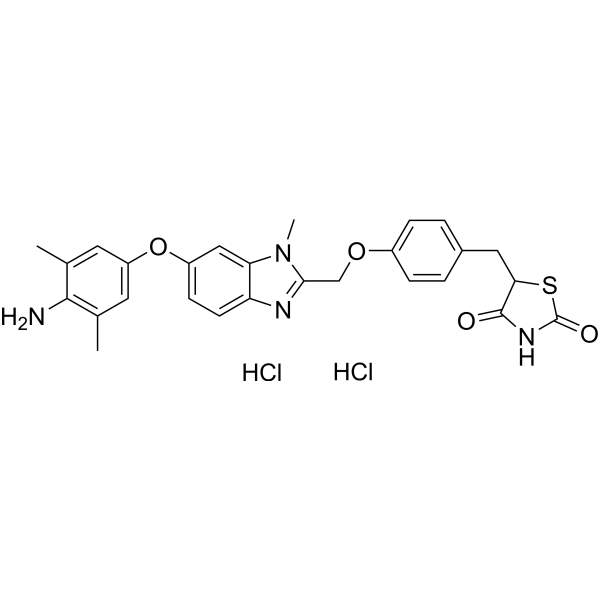
Inolitazone dihydrochloride (Efatutazone dihydrochloride) is a novel high-affinity PPARγ agonist that is dependent upon PPARγ for its biological activity with IC50 of 0.8 nM for growth inhibition.
For research use only. We do not sell to patients.
- Purity: 98.45%
- CAS No.: 223132-38-5
- Formula: C27H28Cl2N4O4S
- Molecular Weight:575.51
-
Storage:
4°C, sealed storage, away from moisture
* In solvent : -80°C, 6 months; -20°C, 1 month (sealed storage, away from moisture)

To place orders, for customer services and technical support, please contact: MedChemExpress USA
Tel: 609-228-6898 E-mail: [email protected] [email protected]


-
 Biological Activity
-
Chemical Information
-
Solvent & Solubility
- Protocol
- Purity & Documentation
- References
-
 Help & FAQs


Publications Citing Use of MedChemExpress (MCE) Inolitazone dihydrochloride
More Customer Validation & Images

-
WB
-
WB


Biological Activity
Description
IC50 & Target
[1]|
PPARγ |
In Vitro
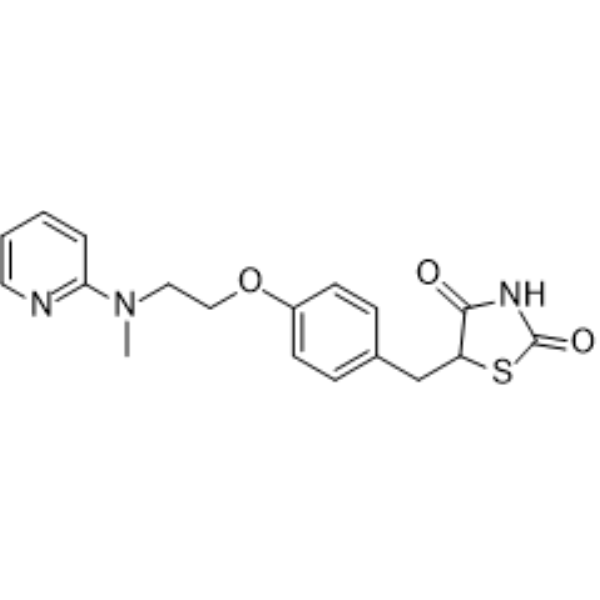
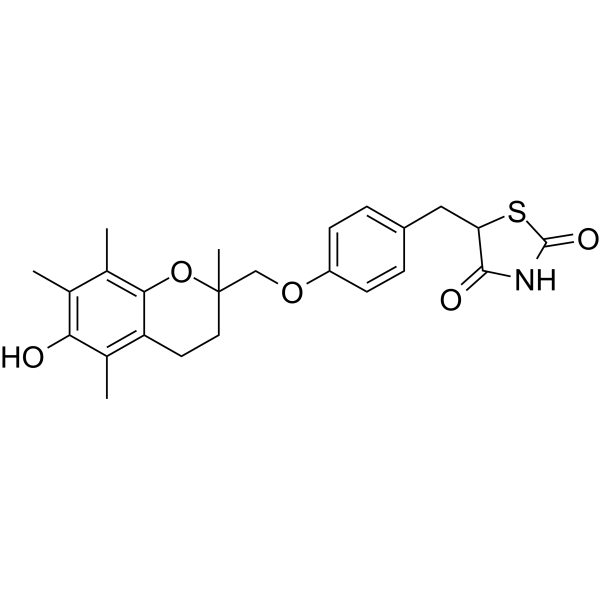
Inolitazone dihydrochloride (Efatutazone dihydrochloride) upregulates the cell cycle kinase inhibitor, p21WAF1/CIP1. Silencing p21WAF1/CIP1 rendered cells insensitive to Inolitazone. A 10 nM dose of Inolitazone activates PPARγ:RXRα-dependent transcription as demonstrated in a transient transfection assay utilizing a PPRE response element fused to a luciferase reporter gene (PPRE3-tk-luc). DRO cells are treated in culture with Inolitazone, Rosiglitazone, or Troglitazone at the indicated concentrations. DRO cells are transiently transfected with PPRE3-tk-luc to examine effective concentrations at which EC50 occurs. The EC50s are 1 nM (Inolitazone), 65 nM (Rosiglitazone) and 631 nM (Troglitazone). Similarly, the calculated inhibitory concentration at IC50 is 0.8 nM for Inolitazone, 75 nM for Rosiglitazone, and 1412 nM for Troglitazone. Inolitazone specifically activates PPARγ, but not PPARα or PPARδ. Exposure of 10 nM Inolitazone following transient transfection with the appropriate PPAR isoform (γ, α, or δ) and PPAR response element linked to a luciferase reporter in RIE rat small intestinal cell line, which does not express PPARs, yields increased luciferase activity only in the presence of PPARγ and PPRE3-tk-luc[1].
DRO cells are growth inhibited by 10 nM Inolitazone (RS5444) through a PPARγ-dependent mechanism[2].
MedChemExpress (MCE) has not independently confirmed the accuracy of these methods. They are for reference only.
In Vivo
MedChemExpress (MCE) has not independently confirmed the accuracy of these methods. They are for reference only.


Chemical Information
-
CAS No. 223132-38-5
-
Appearance Solid
-
Molecular Weight 575.51
-
Formula C27H28Cl2N4O4S
-
Color Pale purple to purple
-
SMILES
O=C(N1)SC(CC2=CC=C(OCC3=NC4=CC=C(OC5=CC(C)=C(N)C(C)=C5)C=C4N3C)C=C2)C1=O.Cl.Cl
-
Synonyms
Efatutazone dihydrochloride; CS-7017 dihydrochloride; RS5444 dihydrochloride
-
Shipping
Room temperature in continental US; may vary elsewhere.
-
Storage
4°C, sealed storage, away from moisture
* In solvent : -80°C, 6 months; -20°C, 1 month (sealed storage, away from moisture)


Publications (5)
-
Journal Impact Factor
-
Most Recent
-
Int J Oncol
2018 Jun;52(6):1991-2000. PMID: 29620161 -
Front Microbiol
Troglitazone Impedes the Oligomerization of Sodium Taurocholate Cotransporting Polypeptide and Entry of Hepatitis B Virus Into Hepatocytes. [Abstract]2019 Jan 8:9:3257. PMID: 30671048 -
Cancer Med
Efatutazone and T0901317 exert synergistically therapeutic effects in acquired gefitinib-resistant lung adenocarcinoma cells. [Abstract]2018 May;7(5):1955-1966. PMID: 29573196
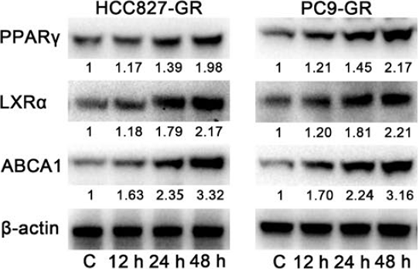
Inolitazone dihydrochloride purchased from MedChemExpress. Usage Cited in: Cancer Med. 2018 May;7(5):1955-1966. [Abstract]
Protein expression in cells incubated with 40 μM Efatutazone for 12, 24, and 48 h.
-
Exp Cell Res
PPARγ agonist efatutazone and gefitinib synergistically inhibit the proliferation of EGFR-TKI-resistant lung adenocarcinoma cells via the PPARγ/PTEN/Akt pathway. [Abstract]2017 Dec 15;361(2):246-256. PMID: 29080795
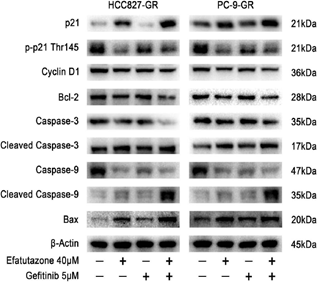
Inolitazone dihydrochloride purchased from MedChemExpress. Usage Cited in: Exp Cell Res. 2017 Dec 15;361(2):246-256. [Abstract]
Western blot analysis for p21, p-p21, Cyclin D1. Bcl-2, Caspase 3, Cleaved Caspase 3, Caspase 9, Cleaved Caspase 9 and Bax in HCC827-GR and PC-9-GR cells treated with control, Efatutazone alone, Gefitinib alone, or Efatutazone combined with gefitinib for 48 h.
-


Solvent & Solubility
In Vitro:
DMSO : 2 mg/mL (3.48 mM; ultrasonic and warming and heat to 80°C; Hygroscopic DMSO has a significant impact on the solubility of product, please use newly opened DMSO)
H2O : < 0.1 mg/mL (insoluble)
Please refer to the solubility information to select the appropriate solvent. Once prepared, please aliquot and store the solution to prevent product inactivation from repeated freeze-thaw cycles.
Storage method and period of stock solution: -80°C, 6 months; -20°C, 1 month (sealed storage, away from moisture). When stored at -80°C, please use it within 6 months. When stored at -20°C, please use it within 1 month.
Please refer to the solubility information to select the appropriate solvent. Once prepared, please aliquot and store the solution to prevent product inactivation from repeated freeze-thaw cycles.
Storage method and period of stock solution: -80°C, 6 months; -20°C, 1 month (sealed storage, away from moisture). When stored at -80°C, please use it within 6 months. When stored at -20°C, please use it within 1 month.
Concentration (start) × Volume (start) = Concentration (final) × Volume (final)
In Vivo:
Select the appropriate dissolution method based on your experimental animal and administration route.
- For the following dissolution methods, please ensure to first prepare a clear stock solution using an In Vitro approach and then sequentially add co-solvents:
- To ensure reliable experimental results, the clarified stock solution can be appropriately stored based on storage conditions. As for the working solution for In Vivo experiments, it is recommended to prepare freshly and use it on the same day.
- The percentages shown for the solvents indicate their volumetric ratio in the final prepared solution. If precipitation or phase separation occurs during preparation, heat and/or sonication can be used to aid dissolution.
Add each solvent one by one: 10% DMSO 40% PEG300 5% Tween-80 45% Saline
Solubility: ≥ 2.5 mg/mL (4.34 mM); Clear solution
This protocol yields a clear solution of ≥ 2.5 mg/mL (saturation unknown).
Taking 1 mL working solution as an example, add 100 μL DMSO stock solution (25.0 mg/mL) to 400 μL PEG300, and mix evenly; then add 50 μL Tween-80 and mix evenly; then add 450 μL Saline to adjust the volume to 1 mL.
Preparation of Saline: Dissolve 0.9 g sodium chloride in ddH₂O and dilute to 100 mL to obtain a clear Saline solution.
Add each solvent one by one: 10% DMSO 90% (20% SBE-β-CD in Saline)
Solubility: ≥ 2.5 mg/mL (4.34 mM); Clear solution
This protocol yields a clear solution of ≥ 2.5 mg/mL (saturation unknown).
Taking 1 mL working solution as an example, add 100 μL DMSO stock solution (25.0 mg/mL) to 900 μL 20% SBE-β-CD in Saline, and mix evenly.
Preparation of 20% SBE-β-CD in Saline (4°C, storage for one week): 2 g SBE-β-CD powder is dissolved in 10 mL Saline, completely dissolve until clear.
In Vivo Dissolution Calculator
Please enter the basic information of animal experiments:
-
-
-
-
Recommended: Prepare an additional quantity of animals to account for potential losses during experiments.
Please enter your animal formula composition:
-
%DMSO +
Recommended: Keep the proportion of DMSO in working solution below 2% if your animal is weak.
-
%+
-
+%Tween-80 + +
-
%Saline +
The co-solvents required include: DMSO, . All of co-solvents are available by MedChemExpress (MCE). , Tween 80. All of co-solvents are available by MedChemExpress (MCE).
Working solution concentration: 0.22 mg/mL
Method for preparing stock solution: mg drug dissolved in μL DMSO. Stock solution concentration: mg/mL. * In solvent : -80°C, 6 months; -20°C, 1 month (sealed storage, away from moisture)
1. Take μL DMSO stock solution;
2. Add μL .
μL , mix evenly;
3. Then add μL Tween 80, mix evenly;
4. Then add μL
Please ensure that the stock solution in the first step is dissolved to a clear state, and add co-solvents in sequence. You can use ultrasonic heating (ultrasonic cleaner, recommended frequency 20-40 kHz), vortexing, etc. to assist dissolution.

Protocol
Cell Assay[1]
DRO90-1 (DRO) and ARO81 (ARO) cells are plated in 12-well culture plates in triplicate for each condition at an initial concentration of 2×10⁴ cells/well. After overnight incubation, cells are treated with either Inolitazone, Rosiglitazone, Troglitazone, GW9662, or Paclitaxel diluted in DMSO at concentrations indicated in figure legends. All cells receive identical volumes of DMSO and are exposed to each drug for 6 days with medium and drug changed every 48 h. After 6 days, cells are washed with PBS, trypsinized and counted by Beckman Coulter Counter[1].
MedChemExpress (MCE) has not independently confirmed the accuracy of these methods. They are for reference only.
Animal Administration[1]
Mice[1]
Suspensions of 1×10⁶/0.1 mL DRO or ARO cells in RPMI medium are injected subcutaneously in one flank of 3-4 week athymic female nude mice. Mice are changed to specialized diets either 1 week prior or 1 week after tumor implantation and randomly assigned to experimental or control groups with 10 mice per group. Diets consisted either placebo, 0.00025%, 0.0025%, or 0.025% Inolitazone formulated into the diet. Mice weighed between 20-25 g and consume on average 4 g of food per day. For combinatorial studies either placebo, 10 mg/kg or 15 mg/kg paclitaxel is injected i.p. twice weekly. Tumors are measured every 3-4 days for 35 days with calipers and tumor volumes are calculated by the formula: 0.5236(a×b×c), where a is the shortest diameter, b is the diameter perpendicular to a and c is the diameter height.
MedChemExpress (MCE) has not independently confirmed the accuracy of these methods. They are for reference only.


Purity & Documentation
-
Data Sheet (278 KB)
-
SDS (252 KB)
- English - EN (252 KB)
- Français - FR (252 KB)
- Deutsch - DE (252 KB)
- Norwegian - NO (252 KB)
- Español - ES (252 KB)
- Swedish - SV (252 KB)
- Italian - IT (252 KB)
- Korean - KR (252 KB)
- Portuguese - PT (252 KB)
-
Handling Instructions (2659 KB)
References
[1]. Copland JA, et al. Novel high-affinity PPARgamma agonist alone and in combination with paclitaxel inhibits human anaplastic thyroid carcinoma tumor growth via p21WAF1/CIP1. Oncogene. 2006 Apr 13;25(16):2304-17. [Content Brief]
[2]. Marlow LA, et al. Reactivation of suppressed RhoB is a critical step for the inhibition of anaplastic thyroid cancer growth. Cancer Res. 2009 Feb 15;69(4):1536-44. [Content Brief]


Complete Stock Solution Preparation Table
Please refer to the solubility information to select the appropriate solvent. Once prepared, please aliquot and store the solution to prevent product inactivation from repeated freeze-thaw cycles.
Storage method and period of stock solution: -80°C, 6 months; -20°C, 1 month (sealed storage, away from moisture). When stored at -80°C, please use it within 6 months. When stored at -20°C, please use it within 1 month.
| Optional Solvent | Concentration Solvent Mass | 1 mg | 5 mg | 10 mg | 25 mg |
|---|---|---|---|---|---|
| DMSO | 1 mM | 1.7376 mL | 8.6879 mL | 17.3759 mL | 43.4397 mL |


Inolitazone dihydrochloride Related Classifications
HY-14792B Related Classifications
 Powered by Bioz