



Poly-D-lysine hydrobromide (MW 150000-300000)

Based on 1 Customer Validation
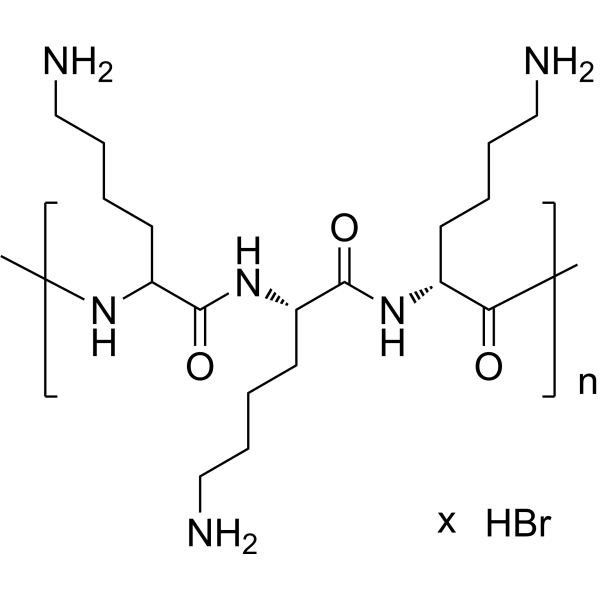
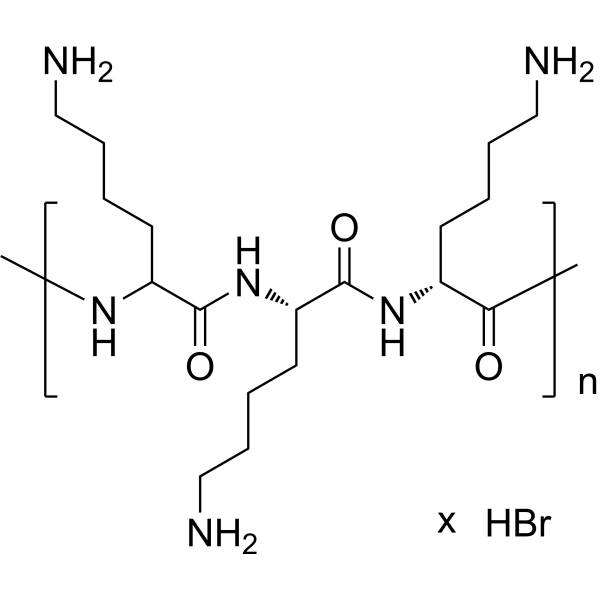
Poly-D-lysine hydrobromide (MW 150000-300000) is a synthetic polymer composed of D-lysine residues and is one of the most widely used matrices in neural cell culture applications. Poly-D-lysine hydrobromide (MW 150000-300000) can be used as a non-specific cell adhesion enhancer. Poly-D-lysine hydrobromide (MW 30000-70000) is an orally active CaSR agonist peptide that indirectly activates the 5-HT₃ receptor signaling pathway, delaying gastric emptying and thereby slowing the rate at which glucose enters the small intestine and is absorbed.
For research use only. We do not sell to patients.
- CAS No.: 27964-99-4
- Formula: (C6H14N2O2)n.xHBr
- Molecular Weight:150000-300000
-
Storage:Powder -20°C, 3 years ; In solvent -80°C, 6 months , -20°C, 1 month


To place orders, for customer services and technical support, please contact: MedChemExpress USA
Tel: 609-228-6898 E-mail: [email protected] [email protected]


-
 Biological Activity
-
Chemical Information
- Purity & Documentation
- References
-
 Help & FAQs


-
HY-139201A
Poly-D-lysine hydrobromide (MW 70000-150000) -
HY-139201
Poly-D-lysine hydrobromide (MW 30000-70000) -

HY-139201B
Poly-D-lysine hydrobromide (MW 84000) -

HY-139201D
Poly-D-lysine hydrobromide (MW 4000-15000) -

HY-139201H
Poly-D-lysine hydrobromide (MW ≥300000) -

HY-126437J
Poly-L-lysine solution (0.01%, sterile-filtered, MW 150000-300000) -

HY-126437E
Poly-L-lysine hydrobromide (MW 15000-30000) -

HY-126437H
Poly-L-lysine hydrobromide (MW 4000-15000) -

HY-126437K
Poly-L-lysine solution (0.01%, sterile-filtered, MW 70000-150000) -
HY-126437B
Poly-L-lysine hydrobromide (MW 70000-150000) -
HY-126437C
Poly-L-lysine hydrobromide (MW 150000-300000) -

HY-139201C
Poly-D-lysine hydrobromide (MW 1000-5000)
All 5-HT Receptor Isoforms
More

Biological Activity
Description
In Vitro
Poly-D-lysine hydrobromide (0.1 mg/mL,0-24 h) promotes the formation of strong and stable adhesion plaques in primary cultured rat pulmonary artery smooth muscle cells (PASMCs), while restricting their migration ability[2].
MedChemExpress (MCE) has not independently confirmed the accuracy of these methods. They are for reference only.
-
Cell Line:PASMCs
-
Concentration:0.1 mg/mL
-
Incubation Time:0, 8, 12, 24 h
-
Result:Inhibited cell migration.
In Vivo
MedChemExpress (MCE) has not independently confirmed the accuracy of these methods. They are for reference only.
-
Animal Model:Oral glucose tolerance test (OGTT) and intraperitoneal glucose tolerance test (IPGTT) established in male Sprague-Dawley rats (7 weeks old), weighing 210-230 g[1]
-
Dosage:50 mg/kg
-
Administration:Oral gavage (i.g.) or duodenum administration, single dose
-
Result:Significantly reduced the peak blood glucose level after oral glucose administration, but had no significant hypoglycemic effect in the intraperitoneal glucose tolerance test (IPGTT).
Delayed the absorption of glucose by slowing down the rate at which food moves from the stomach to the small intestine.


Chemical Information
-
CAS No. 27964-99-4
-
Appearance Solid
-
Molecular Weight 150000-300000
-
Formula (C6H14N2O2)n.xHBr
-
Color White to off-white
-
SMILES
CNC(CCCCN)C(N[C@@H](CCCCN)C(N[C@H](CCCCN)C(C)=O)=O)=O.[x].Br.[n]
-
Synonyms
PDLHB (MW 150000-300000)
-
Shipping
Room temperature in continental US; may vary elsewhere.
-
Storage
Powder -20°C 3 years In solvent -80°C 6 months -20°C 1 month


Purity & Documentation
-
Data Sheet (274 KB)
-
SDS (252 KB)
- English - EN (252 KB)
- Français - FR (252 KB)
- Deutsch - DE (252 KB)
- Norwegian - NO (252 KB)
- Español - ES (252 KB)
- Swedish - SV (252 KB)
- Italian - IT (252 KB)
- Korean - KR (252 KB)
- Portuguese - PT (252 KB)
-
Handling Instructions (2659 KB)
References
[1]. Maya Muramatsu, et al. Activation of the gut calcium-sensing receptor by peptide agonists reduces rapid elevation of plasma glucose in response to oral glucose load in rats. Am J Physiol Gastrointest Liver Physiol. 2014 Jun 15;306(12):G1099-107. [Content Brief]
[2]. Wang F, et al. [Migratory properties of vascular smooth muscle cells on extracellular matrix: a study on inverted coverslip migration assay]. Sheng Li Xue Bao. 2013 Apr 25;65(2):135-42. Chinese. [Content Brief]

Calculators
Concentration (start) × Volume (start) = Concentration (final) × Volume (final)


Poly-D-lysine hydrobromide (MW 150000-300000) Related Classifications
HY-139201E Related Classifications
 Powered by Bioz