1. Search Result
Search Result
Pathways Recommended: Stem Cell/Wnt Cell Cycle/DNA Damage
Results for "

corneal endothelial cells

" in MedChemExpress (MCE) Product Catalog:

16

Inhibitors & Agonists

1

Biochemical Assay Reagents

3

Peptides

Cat. No. Product Name Target Research Areas Chemical Structure
  • HY-13813
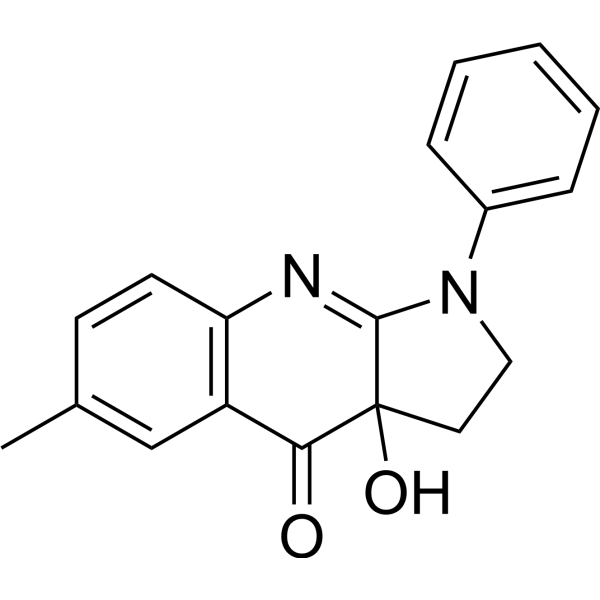
    Blebbistatin
    Maximum Cited Publications
    42 Publications Verification

    Myosin Others
    Blebbistatin is a selective non-muscle myosin II (NMII) inhibitor, promotes directional migration of corneal endothelial cells (CECs) and accelerates wound healing, and better preserves cell junctional integrity and barrier function. Blebbistatin blocks cell migration .
    Blebbistatin
  • HY-E70005K

    Proteasome Others
    Collagenase (Type A, animal free) is a proteolytic enzyme targeting collagen, capable of releasing corneal endothelial cells (CECs) without damaging cell junctions .
    Collagenase (Type A, animal free)
  • HY-B1076
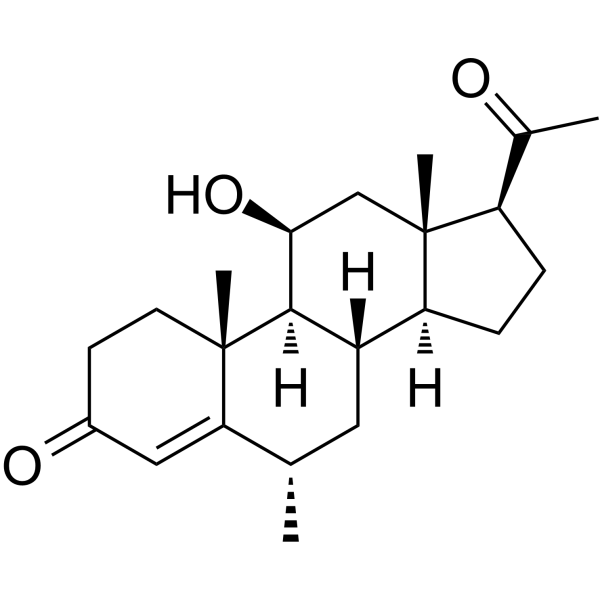
    Medrysone
    1 Publications Verification

    HMS; 6α-Methyl-11β-hydroxyprogesterone

    VEGFR CCR STAT Neurological Disease
    Medrysone (HMS; 6α-Methyl-11β-hydroxyprogesterone) is a STAT6 modulator and M2 macrophage polarization inducer. Medrysone enhances IL-4-triggered STAT6 activation, upregulates the expression of M2 markers, and promotes the secretion of VEGF and CCL2. Medrysone also enhances the pro-migratory activity of M2-like macrophages toward endothelial cells. By regulating macrophage polarization and related repair pathways, Medrysone significantly promotes corneal wound repair in a rat mechanical injury model. Medrysone can be used for research related to corneal injury .
    Medrysone
  • HY-E70005M

    Proteasome Others
    Collagenase (Type C, animal free) is a proteolytic enzyme targeting collagen, capable of releasing corneal endothelial cells (CECs) without damaging cell junctions .
    Collagenase (Type C, animal free)
  • HY-Y0850U3

    Polyvinyl alcohol (Mw 125000, 98-99% hydrolyzed, ~2800 polymerization); Poly(Ethenol) (Mw 125000, 98-99% hydrolyzed, ~2800 polymerization)

    Biochemical Assay Reagents Others
    PVA (Polyvinyl alcohol) (Mw 125000, 98-99% hydrolyzed, ~2800 polymerization) is a water-soluble, biodegradable, biocompatible and non-immunogenic polymer. PVA (Mw 125000, 98-99% hydrolyzed, ~2800 polymerization) causes no irritation to rabbit eyes, no skin sensitization in guinea pigs, promotes the proliferation of human skin keratinocytes, and reduces the loss of corneal endothelial cells. The LD50 of PVA (Mw 125000, 98-99% hydrolyzed, ~2800 polymerization) in rats and dogs is greater than 10 g/kg. PVA (Mw 125000, 98-99% hydrolyzed, ~2800 polymerization) is hardly absorbed by the digestive system, causes no adverse effects upon long-term oral administration, and shows no mutagenicity or carcinogenicity. However, repeated intravenous or portal vein injection of PVA (Mw 125000, 98-99% hydrolyzed, ~2800 polymerization) may induce pathological changes such as glomerular lesions, anemia, hypertension or liver fibrosis in rats or dogs. Crosslinked nanofibers prepared by modifying PVA (Mw 125000, 98-99% hydrolyzed, ~2800 polymerization) can be used in studies related to wound dressings and other applications .
    PVA (Mw 125000, 98-99% hydrolyzed, ~2800 polymerization)
  • HY-E70005L

    Proteasome Others
    Collagenase (Type B, animal free) is a proteolytic enzyme targeting collagen, capable of releasing corneal endothelial cells (CECs) without damaging cell junctions .
    Collagenase (Type B, animal free)
  • HY-176886

    Large Tumor Suppressor (LATS) YAP Others
    LATS-IN-2 is an efficiently acting LATS (large tumor suppressor kinase) inhibitor. LATS-IN-2 shows potent inhibitory activity against LATS1 with an IC50 value of 1.3 nM. LATS-IN-2 suppresses the phosphorylation of YAP by inhibiting LATS kinase activity. LATS-IN-2 increases the thickness of the epidermis in mice. LATS-IN-2 can be used for the study of ocular diseases such as limbal stem cell deficiency and corneal endothelial dysfunction .
    LATS-IN-2
  • HY-P4846
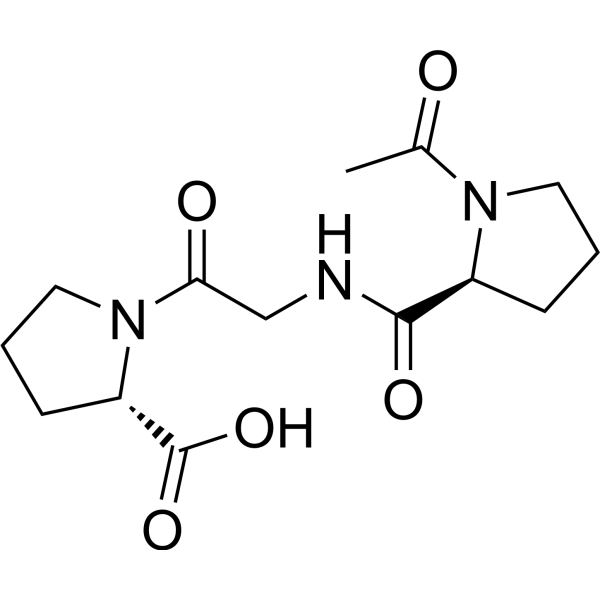
    Ac-Pro-Gly-Pro-OH
    2 Publications Verification

    CXCR Apoptosis IFNAR TNF Receptor Interleukin Related Infection Inflammation/Immunology
    Ac-Pro-Gly-Pro-OH is an endogenous degradation product of extracellular collagen and acts as a CXCR2 agonist . Ac-Pro-Gly-Pro-OH exerts bactericidal activity by generating hydrogen peroxide, inhibits pulmonary inflammation, and reduces immune cell apoptosis (apoptosis). Ac-Pro-Gly-Pro-OH promotes the production of IFN-γ and inhibits the production of TNF-α and IL-6 in leukocytes. Ac-Pro-Gly-Pro-OH increases the survival rate of mice in sepsis models, enhances the bactericidal activity of neutrophils, acts as a neutrophil chemoattractant, induces neutrophil polarization, and regulates inflammatory and repair processes. Ac-Pro-Gly-Pro-OH induces chronic inflammation and tissue remodeling through sustained action. Ac-Pro-Gly-Pro-OH is released via alkaline hydrolysis of corneal proteins in alkali-injured eyes, thereby driving the early infiltration of neutrophils into the cornea. Ac-Pro-Gly-Pro-OH is applicable to research related to sepsis, chronic obstructive pulmonary disease, cystic fibrosis, bronchiolitis obliterans syndrome, severe asthma, idiopathic pulmonary fibrosis, and corneal ulcer .
    Ac-Pro-Gly-Pro-OH
  • HY-116116

    SIM010603

    c-Kit RET VEGFR Cancer
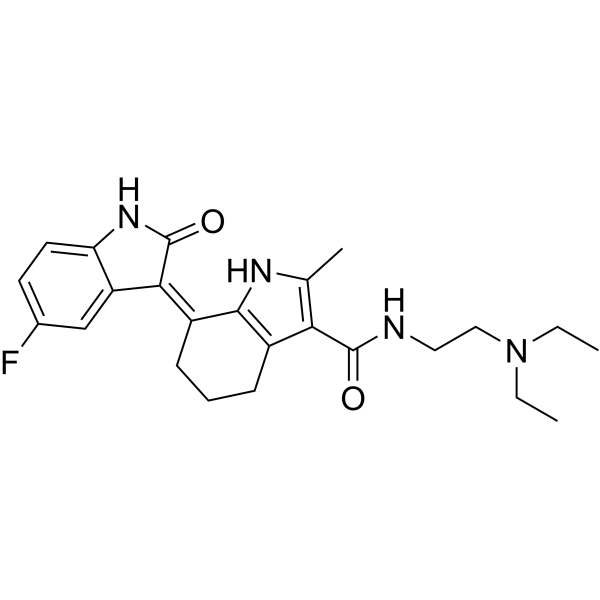
    Tafetinib (SIM010603) is an oral multi-targets receptor tyrosine kinases inhibitor. Tafetinib inhibitsstem cell factor receptor (Kit),vascular endothelial growth factor receptor-2 (VEGFR-2),platelet-derived growth factor receptor-β (PDGFR-β),glial cell line-derived neurotrophic factor receptor (Rearranged during Transfection; RET), andFms-like tyrosine kinase-3 (FLT3)withIC50values between 5.0 and 68.1 nmol/l. Tafetinib inhibits the phosphorylation ofPDGFR-βandVEGFR-2. Tafetinib inhibits endothelial cell proliferation, endothelial cells chemotaxis, and corneal angiogenesis .
    Tafetinib
  • HY-E70005O

    Proteasome Others
    Collagenase (Type A, filtered, animal free) is a proteolytic enzyme targeting collagen, capable of releasing corneal endothelial cells (CECs) without damaging cell junctions .
    Collagenase (Type A, filtered, animal free)
  • HY-13813R

    Myosin Others
    Blebbistatin (Standard) is the analytical standard of Blebbistatin. This product is intended for research and analytical applications. Blebbistatin is a selective non-muscle myosin II (NMII) inhibitor, promotes directional migration of corneal endothelial cells (CECs) and accelerates wound healing, and better preserves cell junctional integrity and barrier function. Blebbistatin blocks cell migration .
    Blebbistatin (Standard)
  • HY-17495

    OPC-1085

    Adrenergic Receptor Caspase Bcl-2 Family Neurological Disease
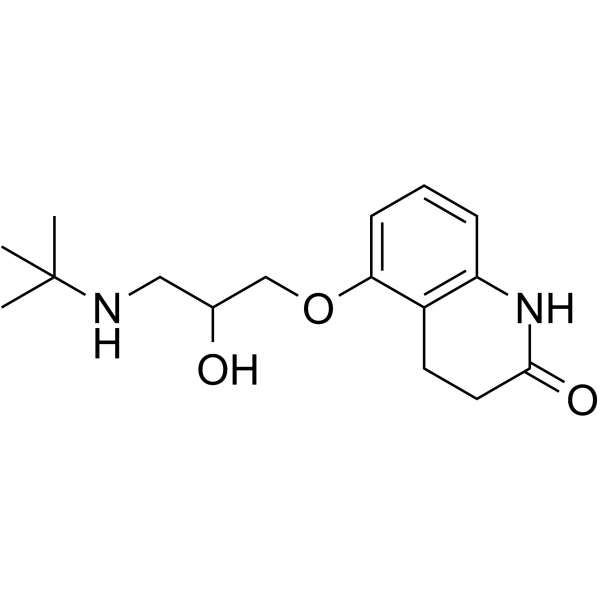
    Carteolol is a non-selective β-adrenoceptor antagonist. Carteolol induces apoptosis via a caspase activated and mitochondrial-dependent pathway. Carteolol can be used for glaucoma research .
    Carteolol
  • HY-B1076R

    HMS (Standard); 6α-Methyl-11β-hydroxyprogesterone (Standard)

    Reference Standards STAT VEGFR CCR Inflammation/Immunology
    Medrysone (Standard) is the analytical standard of Medrysone. This product is intended for research and analytical applications. Medrysone (HMS; 6α-Methyl-11β-hydroxyprogesterone) is a STAT6 modulator and M2 macrophage polarization inducer. Medrysone enhances IL-4-triggered STAT6 activation, upregulates the expression of M2 markers, and promotes the secretion of VEGF and CCL2. Medrysone also enhances the pro-migratory activity of M2-like macrophages toward endothelial cells. By regulating macrophage polarization and related repair pathways, Medrysone significantly promotes corneal wound repair in a rat mechanical injury model. Medrysone can be used for research related to corneal injury .
    Medrysone (Standard)
  • HY-123864

    S 448

    Integrin Cardiovascular Disease Cancer
    SC-68448 (S 448) is a selective αvβ3 antagonist (IC50 = 1 nM). SC-68448 inhibits αvβ3-mediated endothelial cell proliferation. SC-68448 reduces the total level of αvβ6 in NHBE cells. SC-68448 inhibits angiogenesis in a rat corneal neoplasia model. SC-68448 inhibits tumor growth and completely prevents the development of hypercalcemia in a rat Ledich cell tumor model. SC-68448 can be used in research on cardiovascular and cerebrovascular diseases such as hypercalcemia and cancers such as testicular interstitial cell tumors .
    SC-68448
  • HY-P11775A

    VEGFR Cardiovascular Disease
    Peptide HRH acetate is a polypeptide that specifically binds to VEGF receptors. Peptide HRH acetate inhibits VEGF-stimulated endothelial cell proliferation. Peptide HRH acetate inhibits angiogenesis and suppresses corneal neovascularization. Peptide HRH acetate can be used in anti-angiogenesis related studies .
    Peptide HRH acetate
  • HY-P11775

    VEGFR Cardiovascular Disease
    Peptide HRH is a polypeptide that specifically binds to VEGF receptors. Peptide HRH inhibits VEGF-stimulated endothelial cell proliferation. Peptide HRH inhibits angiogenesis and suppresses corneal neovascularization. Peptide HRH can be used in anti-angiogenesis related studies .
    Peptide HRH

Inquiry Online

Your information is safe with us. * Required Fields.

Salutation


Country or Region *

Applicant Name *


Organization Name *

Department *


Email Address *


Product Name *

Cat. No.


Requested quantity *

Phone Number *


Remarks

Inquiry Online

Inquiry Information

Product Name:
Cat. No.:
Quantity:
MCE Japan Authorized Agent:

