1. Search Result
Search Result
Results for "

radicals scavenging capacities

" in MedChemExpress (MCE) Product Catalog:

12

阻害剤およびアゴニスト

1

生化学アッセイ試薬

1

ペプチド

6

天然物

製品番号 製品名 Target 研究分野 構造式
  • HY-W004761

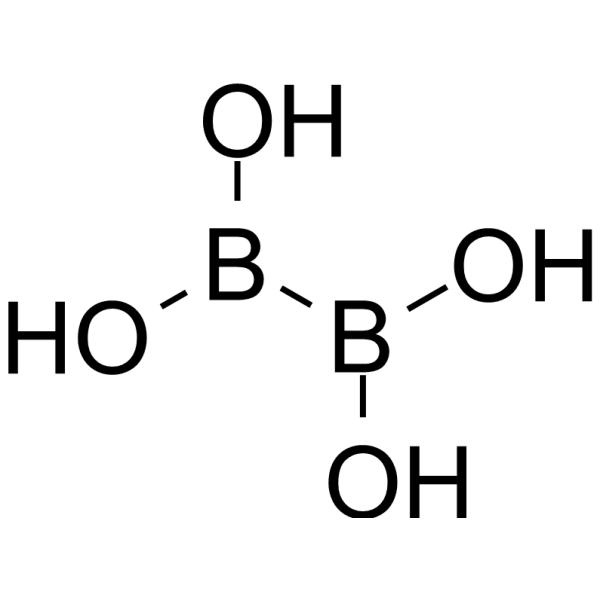
    Hypodiboric acid

    Bacterial Reactive Oxygen Species (ROS) Infection Inflammation/Immunology
    Tetrahydroxydiboron (Hypodiboric acid) acts as a hydrogel initiator and bioadhesion promoter, with broad-spectrum antibacterial activity, ROS scavenging capacity, and osteogenic induction properties. Tetrahydroxydiboron initiates rapid gelation by generating free radicals through reactions with vinyl monomers and dissolved oxygen, overcoming oxygen inhibition without deoxygenation or external triggers. Tetrahydroxydiboron achieves strong bioadhesion via interaction with carboxymethyl chitosan. Tetrahydroxydiboron can be used in the research of periodontitis and related inflammatory diseases .
    Tetrahydroxydiboron
  • HY-N1521

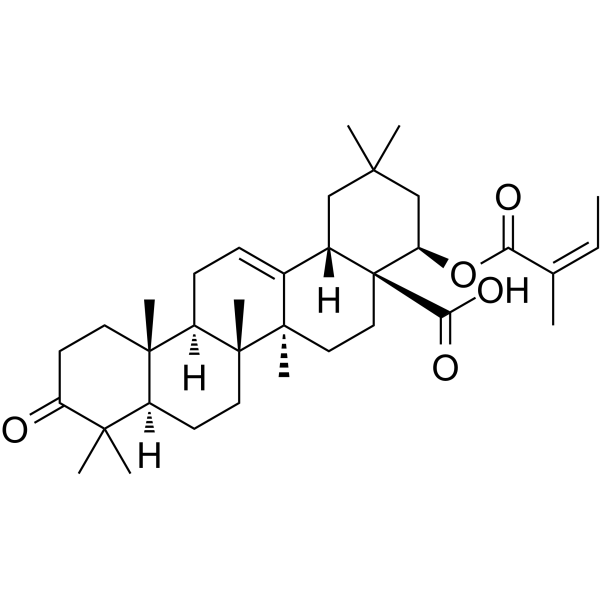
    Lantadene A

    Others Inflammation/Immunology
    Rehmannic acid (lantadene A) is a compound isolated from Lantana camara. Rehmannic acid shows considerable in vitro antioxidant, free radical scavenging capacity activities in a dose dependant manner. Rehmannic acid is a promising candidate for use as an antioxidant and hepatoprotective agent .
    Rehmannic acid
  • HY-W540232

    4-Methylphenyl ITC

    Cholinesterase (ChE) Neurological Disease
    4-Methoxyphenyl isothiocyanate (4-Methylphenyl ITC) is an antioxidant, with a IC50 value of 1.25 mM for scavenging DPPH radicals. ORAC testing indicates its antioxidant capacity as 11.7 mM TE (indicating that the antioxidant efficacy of this compound is equivalent to 11.7 mmol of Trolox (HY-101445, a standard antioxidant) under the same conditions), and it extends the oxidation process by approximately 9180 seconds in the Briggs–Rauscher reaction. Additionally, 4-Methoxyphenyl isothiocyanate exhibits moderate cholinesterase inhibitory activity, with an inhibition rate of 30.4% against acetylcholinesterase (AChE) and 17.9% against butyrylcholinesterase (BChE). 4-Methoxyphenyl isothiocyanate holds potential for research in the fields of antioxidation and neurological disorders .
    4-Methoxyphenyl isothiocyanate
  • HY-N16406

    SOD Metabolic Disease
    Auroglaucin is a potent antioxidant. Auroglaucin shows 1,1-diphenyl-2-picrylhydrazyl (DPPH) radical scavenging capacity and superoxide radical scavenging activity with EC50 value of 74.6, 12.3 µM, respectively. Auroglaucin shows low activity for inhibiting the autoxidation of docosahexaenoic acid (DHA) .
    Auroglaucin
  • HY-N3315

    Others Inflammation/Immunology
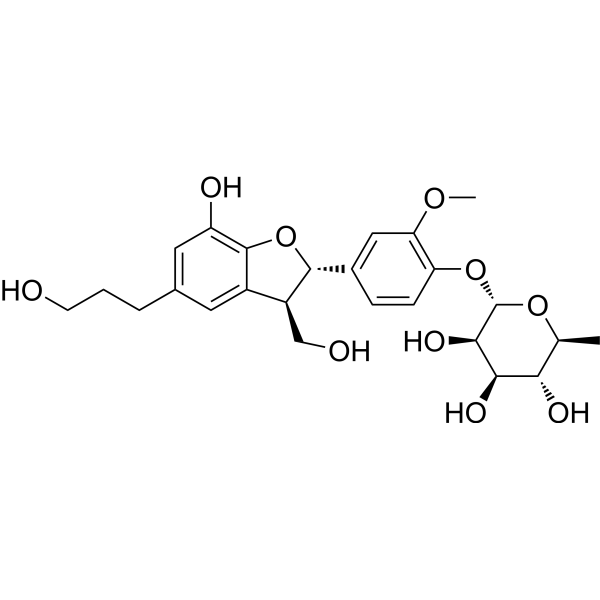
    Massonianoside B is an antioxidant, which can be isolated from Cedrus deodara pine needle. Massonianoside B exhibits radicals scavenging capacities, and restores CCL4-impaired activity of antioxidant enzymes .
    Massonianoside B
  • HY-N10770

    Others Metabolic Disease
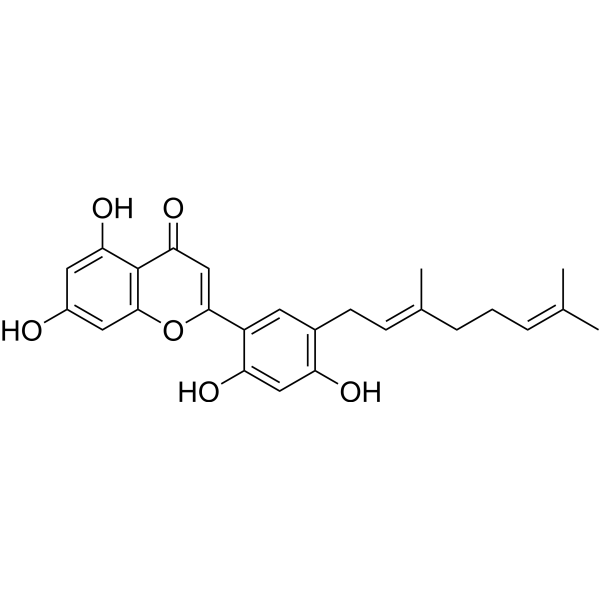
    5'-Geranyl-5,7,2',4'-tetrahydroxyflavone, a phenolic compound, presents strong oxygen radical absorbance capacity (ORAC), DPPH radical-scavenging capacity, ABTS radical-scavenging capacity, ferric reducing antioxidant power (FRAP) and nitrite-scavenging capacity. 5'-Geranyl-5,7,2',4'-tetrahydroxyflavone has the potential for natural antioxidant research .
    5'-Geranyl-5,7,2',4'-tetrahydroxyflavone
  • HY-N12291

    Others Others
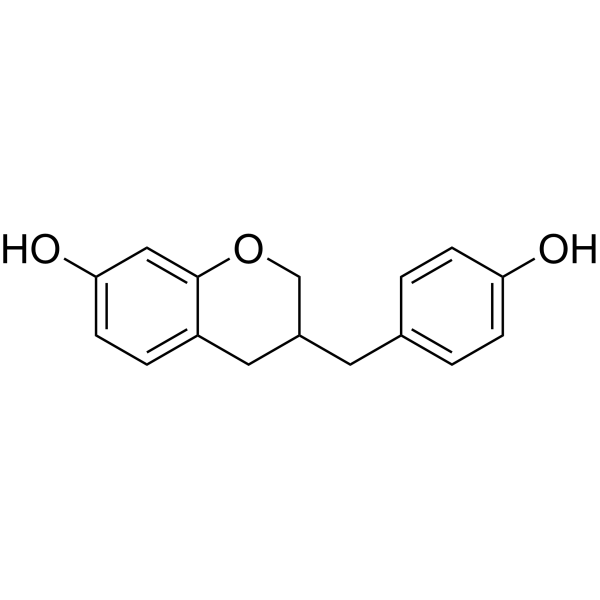
    7,4'-Dihydroxyhomoisoflavane is a natural antioxidant. 7,4'-Dihydroxyhomoisoflavane has ABTS radical-scavenging capacity with an IC50 of 0.22 mg/mL .
    7,4'-Dihydroxyhomoisoflavane
  • HY-150585

    Amyloid-β Cholinesterase (ChE) Tau Protein Neurological Disease
    BuChE-IN-5 (compound 25b) is a potent BuChE inhibitor with an IC50 value of 1.94 μM. BuChE-IN-5 efficiently inhibits aggregation and tau protein in Escherichia coli. BuChE-IN-5 also has free radical scavenging capacity and antioxidant activity. BuChE-IN-5 can be used for researching Alzheimer’s disease .
    BuChE-IN-5
  • HY-175027

    RIP kinase Ferroptosis Neurological Disease
    RIPK1-IN-33 is a blood-brain barrier-permeable and orally active RIPK1 inhibitor, with an IC50 of 0.115 μM. RIPK1-IN-33 demonstrates remarkable anti-ferroptosis activity, radical scavenging capacity (IC50 = 123.3 μM), and anti-lipid peroxidation effects (IC50 = 9.72 μM). RIPK1-IN-33 markedly reduces cerebral infarction volume and improves neurological function scores in transient middle cerebral artery occlusion (tMCAO) model. RIPK1-IN-33 can be used for the study of ischemic stroke .
    RIPK1-IN-33
  • HY-181029

    Tyrosinase Neurological Disease Inflammation/Immunology
    Tyrosinase-IN-49 (Compound 12) is a potent and mixed-type chalcone-based tyrosinase inhibitor with an IC50 of 0.19 μM. Tyrosinase-IN-49 has potent antioxidant potential with significant DPPH and ABTS radical scavenging capacity. Tyrosinase-IN-49 can chelate the binuclear copper ions in the active center of tyrosinase and reduce Cu 2+ to Cu +, thereby reducing the catalytic activity of the enzyme. Tyrosinase-IN-49 has low cytotoxicity for HEK293 cells and zebrafish embryo. Tyrosinase-IN-49 shows antibrowning effects to improve food quality and can be used for research of food preservation .
    Tyrosinase-IN-49
  • HY-181028

    Tyrosinase Neurological Disease Inflammation/Immunology
    Tyrosinase-IN-48 (Compound 3) is a potent and competitive chalcone-based tyrosinase inhibitor with an IC50 of 0.49 μM. Tyrosinase-IN-48 has potent antioxidant potential with significant DPPH and ABTS radical scavenging capacity. Tyrosinase-IN-48 can chelate the binuclear copper ions in the active center of tyrosinase and reduce Cu 2+ to Cu +, thereby reducing the catalytic activity of the enzyme. Tyrosinase-IN-48 has low cytotoxicity for HEK293 cells and zebrafish embryo. Tyrosinase-IN-48 shows antibrowning effects to improve food quality and can be used for research of food preservation .
    Tyrosinase-IN-48
  • HY-W115785

    Environmental Pollutants VEGFR RUNX Metabolic Disease
    Zinc borate is a bioactive inorganic substance with properties including osteogenic induction, pro-angiogenesis, antioxidation, antimutagenesis and cytotoxicity. In the field of bone tissue engineering, Zinc borate is often incorporated into chitosan scaffolds. By releasing zinc ions and borate ions, Zinc borate induces the differentiation of human dental pulp stem cells into osteoblasts, upregulates the expression of bone-related genes and promotes calcium deposition. Zinc borate also promotes angiogenesis by upregulating key factors such as vascular endothelial growth factor. Zinc borate exhibits antioxidant capacity to scavenge free radicals, and can specifically reduce mutagenicity under specific conditions. Zinc borate reduces the survival rate of mouse fibroblasts, but it can still be used in studies related to bone tissue engineering .
    Zinc borate

オンラインお問い合わせ

入力情報は安全に管理されます. 必須入力項目.

タイトル


国或いは地域 *

お名前 *


組纖名 *

デパートメント *


メールアドレス *


製品名 *

製品番号


カスタマ需要量 *

電話番号 *


必ず会社名を記載ください。個人への返信は行いません。

備考

バルクお問い合わせ

Inquiry Information

製品名:
製品番号:
数量:
MCE 日本正規代理店:

