1. Search Result
Search Result
Results for "

radioactive labeling

" in MedChemExpress (MCE) Product Catalog:

31

Inhibitors & Agonists

9

Peptides

1

Isotope-Labeled Compounds

1

Click Chemistry

Cat. No. Product Name Target Research Areas Chemical Structure
  • HY-W1124925

    Radionuclide-Drug Conjugates (RDCs) Glycoprotein VI Cancer
    DOTA-GPC3 targeting peptide 2 (Sequence 30) is a RDC peptide targeting GPC3, with Kd of 0.3 nM. DOTA-GPC3 targeting peptide 2 is composed of DOTA and GPC3 targeting peptide 2. DOTA-GPC3 targeting peptide 2 can be labeled with radioactive elements .
    DOTA-GPC3 targeting peptide 2
  • HY-P10913

    Bacterial Infection
    HYNIC-UBI29-41 is composed of a bifunctional chelator HYNIC and an antimicrobial peptide UBI 29-41 (HY-P10364) (HY-P10364). HYNIC-UBI29-41 retains the antibacterial properties of UBI 29-41, and exhibits good affinity to Gram-positive and Gram-negative bacteria. HYNIC-UBI29-41 can be used as an imaging agent for bacterial infection detection in mouse models, when labeled with the radioactive element technetium (99mTc) .
    HYNIC-UBI29-41
  • HY-12761

    Cannabinoid Receptor Cardiovascular Disease Others Neurological Disease Metabolic Disease Inflammation/Immunology Cancer
    A-836339 is a selective CB2 receptor agonist, with Ki values of 0.4 nM and 0.8 nM in humans and rats, respectively. A-836339 exhibits multiple effects such as analgesia, gastric protection, anti-inflammation, and antioxidant activity. A-836339 produces antinociceptive and analgesic activities by activating CB2 receptors in the dorsal root ganglia and spinal cord. A-836339 can also exert gastric protective effects through anti-inflammatory mechanisms (reducing TNF-α and IL-1β) and antioxidant mechanisms (enhancing the activities of CAT and SOD, and reducing H2O2). Radioactively labeled A-836339 can serve as a CB2-specific radioligand for autoradiography and PET imaging. A-836339 can be used in research on inflammatory pain, neuropathic pain, gastric ulcers, cerebral ischemia, etc .
    A-836339
  • HY-164577

    Radionuclide-Drug Conjugates (RDCs) Cancer
    BCN-DOTA-GA is a cyclooctyne-linked DOTA chelator that can be labeled with radioactive zirconium-89 and used as a radionuclide-labeled drug conjugate (RDC) to target specific biomolecules, cells or tissues.
    BCN-DOTA-GA
  • HY-164576

    NODA-Bz-SCN

    Radionuclide-Drug Conjugates (RDCs) Cancer
    NCS-MP-NODA (NODA-Bz-SCN) is a bifunctional chelator that can be used to bind to the labeled peptide DK222 with high specificity for PD-L1. The corresponding fluorinated radioactive is synthesized by the aluminum fluoride method, and NCS-MP-NODA targets DK222 to obtain the radioactive analog [18/19F]DK222. [18F]DK222 can quantify PD-L1 in vivo via PET tracking in xenograft models of multiple cancer types.
    NCS-MP-NODA
  • HY-164725

    Radionuclide-Drug Conjugates (RDCs) FAP Cancer
    FAPI-mFS is an irreversible fibroblast activation protein (FAP) inhibitor, that enhances the uptake and retention time in cancer cells through its covalent binding property for FAP. FAPI-mFS can be used for cancer imaging the therapy, when labeled with radioactive 68Ga or 177Lu . FAPI-mFS can be used for the synthesis/research of Radionuclide-Drug Conjugates (RDCs).
    FAPI-mFS
  • HY-P5292A

    Radionuclide-Drug Conjugates (RDCs) PSMA Cancer
    HYNIC-iPSMA TFA is a ligand for molecular imaging of tumors. Hynic-ipsma consists of two components: HYNIC (6-hydrazinonicotinamide) and iPSMA (Inhibitor of Prostate-Specific Membrane Antigen). HYNIC is a compound used to attach radioactive isotopes to targeted molecules. iPSMA is a specific inhibitor used to inhibit prostate-specific membrane antigen (PSMA). 68GA-labeled iPSMA has been used to detect prostate cancer by PET imaging. The further 99mTc-EDDA/HYNIC-iPSMA TFA has excellent specificity and sensitivity . HYNIC-iPSMA TFA can be used for the synthesis/research of Radionuclide-Drug Conjugates (RDCs).
    HYNIC-iPSMA TFA
  • HY-19888

    P2X Receptor Interleukin Related Neurological Disease Inflammation/Immunology
    GSK-1482160 is an orally active and blood-brain barrier penetrant P2X7 receptor (P2X7R) negative allosteric modulator with pIC50s of 8.5 (human) and 6.5 (rat). GSK-1482160 reduces the efficacy of ATP at the P2X7 receptor without affecting its affinity, thereby inhibiting the release of IL-1β. GSK-1482160 is an effective radioligand and can be labeled with radioactive isotopes like 11C or 18F to image P2X7R. GSK-1482160 can be used for the studies of chronic joint pain and chronic constriction injury (CCI) .
    GSK-1482160
  • HY-158118

    DNA-PK Cancer
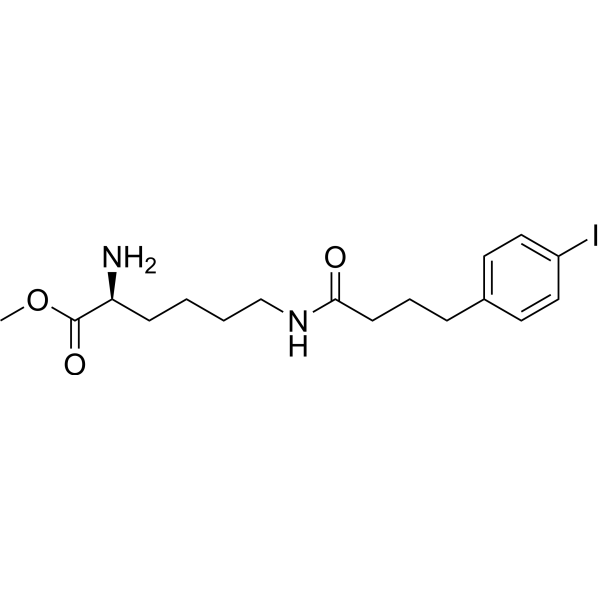
    Lys(CO-C3-p-I-Ph)-OMe is a pharmacokinetic modifier (PK modifier) that can improve the PK properties of PSMA ligand molecules (such as Ac-PSMA-trillium). Lys(CO-C3-p-I-Ph)-OMe can increase the residence time of Ac-PSMA-trillium in plasma by increasing its binding capacity to albumin. Lys(CO-C3-p-I-Ph)-OMe also reduces salivary gland absorption of Ac-PSMA-trillium, potentially extending its half-life. Ac-PSMA-trillium is a suitable PSMA-targeting compound that has different biological applications after modification with different radioactive isotopes. If labeled with 111In, it can be used as DOTA chelating agent and imaging agent. Or labeled with 225Ac as a Macropa chelator for targeted radionuclide therapy (TRT) in the study of metastatic castration-resistant prostate cancer (mCRPC) .
    Lys(CO-C3-p-I-Ph)-OMe
  • HY-172205

    Cytochrome P450 Cancer
    CHL2310 is the inhibitor for CYP46A1 with an IC50 of 0.11 nM, and a Kd of 0.37 nM. CHL2310 can cross blood-brain barrier. CHL2310 can be used as a PET imaging agent, when labeled with radioactive 18F .
    CHL2310
  • HY-158125

    PSMA Cancer
    PSMA binder-2 is a ligand for PSMA and can be used to synthesize Ac-PSMA-trillium. Ac-PSMA-trillium is a suitable PSMA-targeting compound with improved PSMA binding properties and pharmacokinetic properties. PSMA ligands have different biological applications after being modified with different radioactive isotopes. If labeled with 111In, it can be used as DOTA chelating agent and imaging agent. Or labeled with 225Ac as a Macropa chelator for targeted radionuclide therapy (TRT) in the study of metastatic castration-resistant prostate cancer (mCRPC) .
    PSMA binder-2
  • HY-P5292

    Radionuclide-Drug Conjugates (RDCs) PSMA Cancer
    HYNIC-iPSMA is a ligand for molecular imaging of tumors. Hynic-ipsma consists of two components: HYNIC (6-hydrazinonicotinamide) and iPSMA (Inhibitor of Prostate-Specific Membrane Antigen). HYNIC is a compound used to attach radioactive isotopes to targeted molecules. iPSMA is a specific inhibitor used to inhibit prostate-specific membrane antigen (PSMA). 68GA-labeled iPSMA has been used to detect prostate cancer by PET imaging. The further 99mTc-EDDA/HYNIC-iPSMA has excellent specificity and sensitivity . HYNIC-iPSMA can be used for the synthesis/research of Radionuclide-Drug Conjugates (RDCs).
    HYNIC-iPSMA
  • HY-154850

    STING Cancer
    F-CRI1 is a potent STING agonist with a Kd value of 40.62 nM. F-CRI1 is a radioactive probe with 18F-labeled modification. F-CRI1 can be used to study STING visualization in the tumor microenvironment .
    F-CRI1
  • HY-P10239A

    Radionuclide-Drug Conjugates (RDCs) Cancer
    Tyr3-Octreotate acetate is a somatostatin analog. Tyr3-Octreotate acetate exhibits high uptake into tumor, that is capable to be labeled with radioactive metal and thus exhibits antitumor efficacy. Tyr3-Octreotate acetate can be used for the synthesis/research of Radionuclide-Drug Conjugates (RDCs) .
    Tyr3-Octreotate acetate
  • HY-179227

    HDAC Neurological Disease
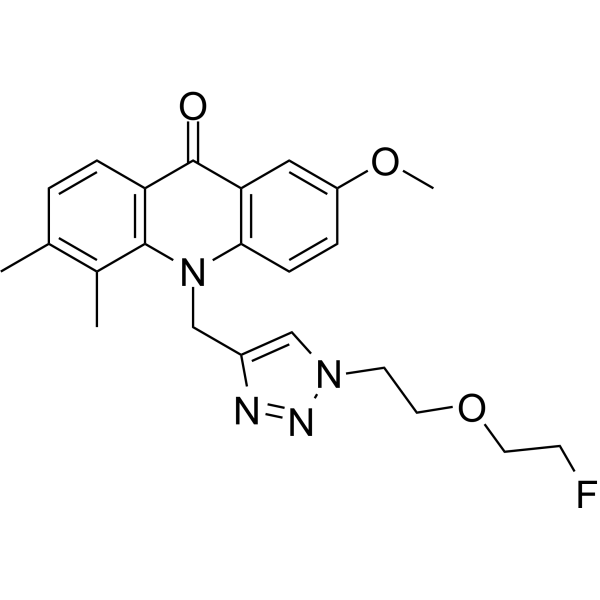
    HDAC6 ligand-7 (Compound 16a) is a positron emission tomography (PET) tracer for the deacetylase 6 (HDAC6) enzyme with a Kd value of 1.66 nM. HDAC6 ligand-7 exhibits excellent HDAC6 inhibitory activity, with IC50 values of 2.7 and 3.7 nM for hHDAC6 and mHDAC6, respectively, and has high selectivity for HDAC1/4/7/8. HDAC6 ligand-7 after being radioactively labeled with fluorine-18, [¹⁸F]HDAC6 ligand-7 shows varying degrees of radioactive uptake in PET, which can reflect the specific binding to HDAC6. HDAC6 ligand-7 can be used for the study of HDAC6 imaging .
    HDAC6 ligand-7
  • HY-P10913A

    Bacterial Infection
    HYNIC-UBI29-41 TFA is composed of a bifunctional chelator HYNIC and an antimicrobial peptide UBI 29-41 (HY-P10364). HYNIC-UBI29-41 TFA retains the antibacterial properties of UBI 29-41, and exhibits good affinity to Gram-positive and Gram-negative bacteria. HYNIC-UBI29-41 TFA can be used as an imaging agent for bacterial infection detection in mouse models, when labeled with the radioactive element technetium (99mTc) .
    HYNIC-UBI29-41 TFA
  • HY-159771

    FAP Cancer
    FAP6-19 is a fibroblast activation protein (FAP) targeting radioligand with a Kd of 18.2 nM. FAP6-19 selectively delivers therapeutic radioactive nuclides (such as 177Lu) to the tumor site by targeting the overexpressed FAP protein in the tumor microenvironment, achieving precise killing of cancer cells while minimizing radiation damage to healthy tissues. FAP6-19 exhibits extremely high total cellular uptake and good intracellular retention ability in HT1080 cells. After being labeled with 111In, FAP6-19 produced extremely high tumor/kidney and tumor/liver dose ratios in the mouse model with 4T1 tumors. FAP6-19 can be used in the research of solid tumors expressing FAP.
    FAP6-19
  • HY-134391

    Endogenous Metabolite Biochemical Assay Reagents Others
    6-Phe-ADP is an ATP analog used as a precursor to prepare the corresponding radiolabeled triphosphate for chemical genetics approaches to study substrate specificity and catalytic efficiency of protein kinases .
    6-Phe-ADP
  • HY-149926

    Ser/Thr Protease Others
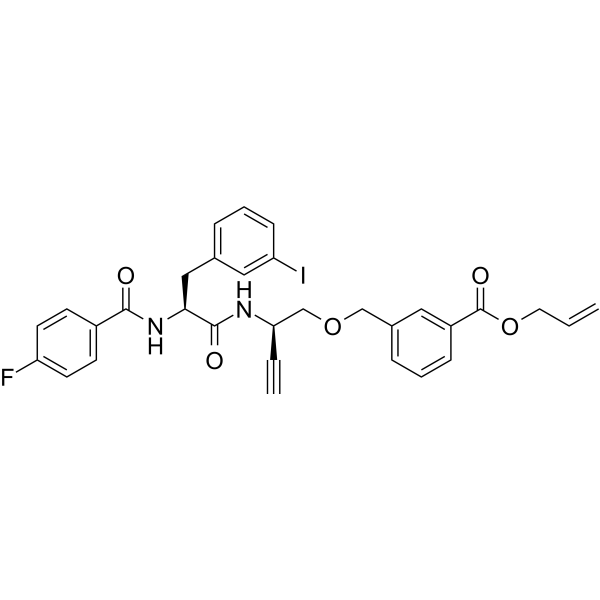
    Cathepsin Inhibitor 3 (Compound 53k) is a non-radioactive intermediate in compound [ 18F] 2k radioactive synthesis, which has selectivity for cathepsin S. Cathepsin Inhibitor 3 can undergo radioactive fluorination and can be used for fluorine-18 labeling research . Cathepsin Inhibitor 3 is a click chemistry reagent, it contains an Alkyne group and can undergo copper-catalyzed azide-alkyne cycloaddition (CuAAc) with molecules containing Azide groups.
    Cathepsin Inhibitor 3
  • HY-18037

    Phosphodiesterase (PDE) Others
    AMG-7980 exhibits high affinity to phosphodiesterase 10A (PDE10A), with a KD of 0.94 nM. AMG-7980 can be used as a tracer of PDE10A, when labeled with radioactive isotope .
    AMG-7980
  • HY-158317

    CXCR Biochemical Assay Reagents Others
    SFB-AMD3465 is an AMD3465 (HY-15971A) derivative. SFB-AMD3465 is utilized as positron emission tomography (PET) tracer for CXCR4, when labeled with radioactive Fluorine .
    SFB-AMD3465
  • HY-136405

    Fluorescent Dye Others
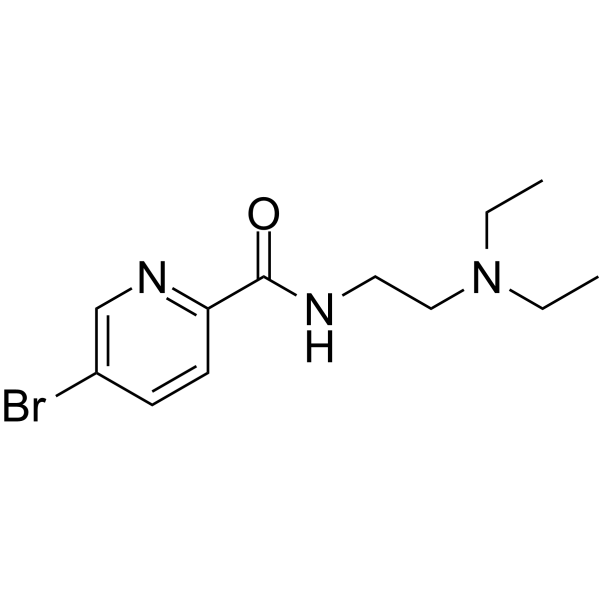
    Melanin probe-2 (compound 5) is a non-radioactive bromopicolinamide precursor. Melanin probe-2 can be used for 18F-Labeled Picolinamide PET probe synthesis (HY-136404) .
    Melanin probe-2
  • HY-14608S12

    L-Glutamic acid-14C

    iGluR Ferroptosis Apoptosis Neurological Disease
    L-Glutamic acid-14C is L-Glutamic acid (HY-14608) labeled with the radioactive isotope carbon-14. L-Glutamic acid is an excitatory amino acid neurotransmitter and an agonist for all subtypes of glutamate receptors (metabotropic, NMDA, and AMPA). L-Glutamic acid acts as an agonist in the release of DA from dopaminergic nerve terminals and can be used in the study of neurological diseases .
    L-Glutamic acid-14C
  • HY-114253

    EGFR Cancer
    ODS-2004436 is a small molecule radiotracer that uses positron emission tomography (PET) imaging to measure the activity of the epidermal growth factor receptor (EGFR) in tumors. ODS-2004436 labeled with the radioactive isotope fluorine-18 shows significantly higher uptake in the xenograft models of lung cancer with EGFR mutations compared to the wild-type models, and could be used to distinguish the mutation status. ODS-2004436 can be used to identify EGFR-positive tumors and predict their response to certain reagent treatments, especially for non-small cell lung cancer (NSCLC) .
    ODS-2004436
  • HY-123382

    Drug Isomer Neurological Disease Inflammation/Immunology
    GSK-1482160 isomer is the isomer of GSK-1482160 (HY-19888). GSK-1482160 is an orally active and blood-brain barrier penetrant P2X7 receptor (P2X7R) negative allosteric modulator with pIC50s of 8.5 (human) and 6.5 (rat). GSK-1482160 reduces the efficacy of ATP at the P2X7 receptor without affecting its affinity, thereby inhibiting the release of IL-1β. GSK-1482160 is an effective radioligand and can be labeled with radioactive isotopes like 11C or 18F to image P2X7R. GSK-1482160 can be used for the studies of chronic joint pain and chronic constriction injury (CCI).
    GSK-1482160 (isomer)
  • HY-176895

    Others Cardiovascular Disease
    L-Dopa precursor-1 (Compound 5a) is the precursor of 18F-L-Dopa. L-Dopa precursor-1 serves as a core basis for radioactive labeling precursors, allowing the introduction of non-metallic radioactive elements through radiolabeling reactions. L-Dopa precursor-1 can be used for the study of RDN surgery for refractory hypertension, chronic kidney disease .
    L-Dopa precursor-1
  • HY-W704091

    Isotope-Labeled Compounds Others
    α-Amino-β-methylaminopropionic acid-d3 hydrochloride is the deuterium labeled α-Amino-β-methylaminopropionic acid. Radioactive isotopes labeled compounds can be used in metabolic analysis, allowing the movement of individual atoms to be precisely tracked and quantified .
    α-Amino-β-methylaminopropionic acid-d3 hydrochloride
  • HY-180534

    Drug Intermediate Metabolic Disease
    AldoView precursor-1 (Compound 7) is the key labeling precursor for the synthetic radioactive PET tracer [ 18F] AldoView. [ 18F] AldoView is a selective aldosterone synthase PET tracer used for imaging in primary hyperaldosteronism .
    AldoView precursor-1
  • HY-153709

    IPN-01087

    Neurokinin Receptor Cancer
    Zalsenertant tetraxetan (IPN-01087) is a DOTA-conjugated antagonist of the neurohypophyseal hormone receptor subtype 1 (NTSR1). Zalsenertant tetraxetan is labeled with the radioactive isotope Lu-177 (177Lu), which can be used for molecular imaging to identify potential responders. Zalsenertant tetraxetan can be used in the radiotherapy research of solid tumors .
    Zalsenertant tetraxetan
  • HY-P3440A

    Drug Derivative PD-1/PD-L1 Cancer
    NOTA-WL12 is a conjugate of WL12 (HY-P3440) (peptide targeting PD-L1) and NOTA (HY-134418) (chelate). NOTA-WL12 shows high binding affinity to the PD-L1 (KD = 3.012 nM). NOTA-WL12 can be labeled with radioactive isotopes for tumor imaging .
    NOTA-WL12
  • HY-178248

    PSMA Cancer
    PSMA ligand 2 is a prostate specific membrane antigen (PSMA) ligand with a glutamate-urea-lysine (GUL) moiety. PSMA ligand 2 can be efficiently labeled with radioactive nuclides such as 68Ga and 177Lu and specifically binds to PSMA-positive tumor cells. PSMA ligand 2 can be used for imaging of PSMA-expressing tumors or cells via PET or SPECT imaging. PSMA ligand 2 can be used for the research of prostate cancer .
    PSMA-R2

Inquiry Online

Your information is safe with us. * Required Fields.

Salutation


Country or Region *

Applicant Name *


Organization Name *

Department *


Email Address *


Product Name *

Cat. No.


Requested quantity *

Phone Number *


Remarks

Inquiry Online

Inquiry Information

Product Name:
Cat. No.:
Quantity:
MCE Japan Authorized Agent:

