1. Others Neuronal Signaling Membrane Transporter/Ion Channel
  2. nAChR Environmental Pollutants Insecticide
  3. Thiacloprid

Thiacloprid  (Synonyms: Thiacloprid)

製品番号: HY-B1953 純度: 99.66%
COA 取扱説明書 Technical Support

Thiacloprid is an orally active neurotoxic insecticide and also a nAChR agonist. Thiacloprid reduces the viability of healthy cells, depletes reduced glutathione, and increases MDA levels, thereby inducing cytotoxicity and oxidative stress damage. In practical applications, Thiacloprid has lower acute toxicity to honeybees than other compounds of the same class such as Imidacloprid (HY-B0838), but it still significantly impairs the learning and memory function, immune capacity and survival status of honeybees. Thiacloprid induces intestinal microbial dysbiosis and reduces survival rate in middle-aged honeybees, increases the risk of premature collapse in bumblebee colonies, and significantly decreases the final colony weight and reproductive output. Thiacloprid is used in broad-spectrum agricultural pest control, often alone or in combination with Deltamethrin (HY-B1971), and meets the pest management needs of various crops including potatoes, cabbages, various fruits and vegetables, and nuts.

商品は「研究用試薬」です。人や動物の医療用・臨床診断用・食品用の製品ではありません。
研究用途以外に使用した場合、当社は一切の責任を負いかねます。

Thiacloprid

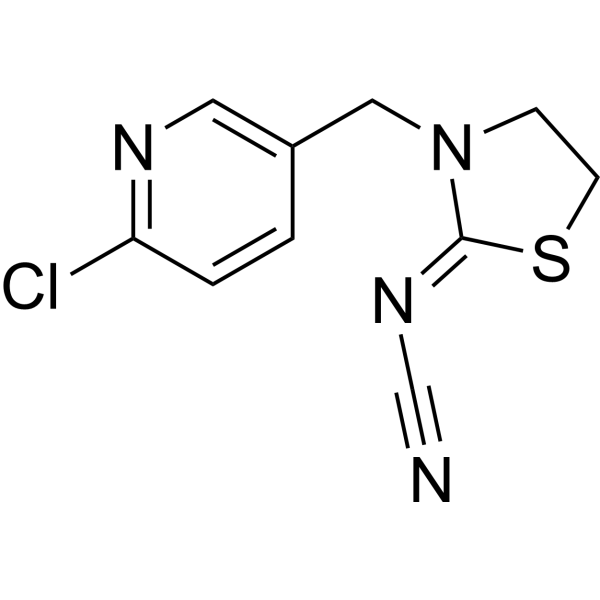
Thiacloprid 構造式

CAS 番号 : 111988-49-9

容量 価格(税別) 在庫状況 数量
Solid + Solvent (Highly Recommended)
10 mM * 1 mL in DMSO
ready for reconstitution
USD 27 在庫あり
Solution
10 mM * 1 mL in DMSO USD 27 在庫あり
Solid
5 mg $25 在庫あり
10 mg $35 在庫あり
25 mg $63 在庫あり
50 mg $90 在庫あり
100 mg $125 在庫あり
200 mg   お問い合わせ  
500 mg   お問い合わせ  

* アイテムを追加する前、数量をご選択ください

This product is a controlled substance and not for sale in your territory.

カスタマーレビュー

Based on 1 publication(s) in Google Scholar

Other Forms of Thiacloprid:

Top Publications Citing Use of Products
  • 生物活性

  • 純度とドキュメンテーション

  • 参考文献

  • カスタマーレビュー

製品説明

Thiacloprid is an orally active neurotoxic insecticide and also a nAChR agonist. Thiacloprid reduces the viability of healthy cells, depletes reduced glutathione, and increases MDA levels, thereby inducing cytotoxicity and oxidative stress damage. In practical applications, Thiacloprid has lower acute toxicity to honeybees than other compounds of the same class such as Imidacloprid (HY-B0838), but it still significantly impairs the learning and memory function, immune capacity and survival status of honeybees. Thiacloprid induces intestinal microbial dysbiosis and reduces survival rate in middle-aged honeybees, increases the risk of premature collapse in bumblebee colonies, and significantly decreases the final colony weight and reproductive output. Thiacloprid is used in broad-spectrum agricultural pest control, often alone or in combination with Deltamethrin (HY-B1971), and meets the pest management needs of various crops including potatoes, cabbages, various fruits and vegetables, and nuts[1][2][3].

Cellular Effect
Cell Line Type Value Description References
SH-SY5Y IC50
100 3
Compound: THIA
Inhibition of [3H]alpha-BGT binding to alpha7 nicotinic acetylcholine receptor in Homo sapiens (human) SH-SY5Y cells
[PMID: 11312774]
SH-SY5Y IC50
100 3
Compound: THIA
Inhibition of [3H]alpha-BGT binding to alpha7 nicotinic acetylcholine receptor in Homo sapiens (human) SH-SY5Y cells
[PMID: 11312774]
TE-671 IC50
120 3
Compound: THIA
Inhibition of [3H]alpha-BGT binding to alpha1 nicotinic acetylcholine receptor in Homo sapiens (human) TE671 cells co-expressing gammaalpha1deltabeta1 nicotinic acetylcholine receptor subunits
[PMID: 11312774]
TE-671 IC50
120 3
Compound: THIA
Inhibition of [3H]alpha-BGT binding to alpha1 nicotinic acetylcholine receptor in Homo sapiens (human) TE671 cells co-expressing gammaalpha1deltabeta1 nicotinic acetylcholine receptor subunits
[PMID: 11312774]
体外実験

Combination treatment with Thiacloprid (7.5-3000 μM; 24-72 h) and Deltamethrin (HY-B1971) reduces the viability of human lung fibroblast cell line WTHBF-6 in a time- and concentration-dependent manner. Specifically, significant viability reduction is observed at concentrations of 1500 μM, 2250 μM and 3000 μM after 48 h and 72 h of treatment, as well as at 750 μM after 72 h of treatment[1].
Thiacloprid (75-375 μM; 24-72 h) significantly reduces the level of GSH, increases the level of malondialdehyde (MDA), and induces cellular lipid peroxidation damage in human lung fibroblast cell line WTHBF-6[1].

MedChemExpress (MCE) has not independently confirmed the accuracy of these methods. They are for reference only.

Cell Viability AssayWestern Blot AnalysisCell Proliferation AssayApoptosis AnalysisCell Cytotoxicity AssayCell Cycle AnalysisRT-PCRCell Autophagy AssayImmunofluorescenceCell Differentiation AssayCell Invasion AssayCell Migration Assay Real Time qPCRELISA Assay[1]

Cell Line: WTHBF-6 (human telomerase reverse transcriptase (hTERT)-expressing human lung fibroblasts)
Concentration: 7.5 μM, 18.75 μM, 37.5 μM, 75 μM, 187.5 μM, 375 μM, 750 μM, 1500 μM, 2250 μM, 3000 μM
Incubation Time: 24 h, 48 h, 72 h
Result: Co-administered with Deltamethrin at a fixed concentration ratio of 7.5:1.
Reduced the viability of WTHBF-6 cells in a time- and concentration-dependent manner.
Significantly decreased cell viability at the concentrations of 1500 μM, 2250 μM and 3000 μM of Thiacloprid after 48 h and 72 h treatment, and at 750 μM of Thiacloprid (HY-B1953) after 72 h treatment, compared with the 0.1% DMSO vehicle control group.
体内実験

Thiacloprid (0.2-2.0 mg/L; oral; daily; 13 consecutive days) continuous oral exposure of middle-aged honeybees to 0.6 mg/L and 2.0 mg/L thiacloprid for 13 days significantly reduces survival by up to 25%, impairs weight gain, alters sucrose consumption at the highest dose, induces dose-dependent gut microbiome dysbiosis on day 7, and is associated with gut microbiome recovery by day 13[2].
Thiacloprid (recommended manufacturer spray rate; free foraging on treated crop flowers) under field-realistic exposure to treated raspberry crops leads to accumulation of thiacloprid residues in bumblebee colony food stores, with maximum concentrations of 771 ppb in pollen and 561 ppb in nectar[3].

MedChemExpress (MCE) has not independently confirmed the accuracy of these methods. They are for reference only.

Animal Model: Bombus terrestris audax (commercially reared colonies)[3]
Dosage: recommended manufacturer spray rate
Administration: free foraging on treated crop flowers
Result: Detected thiacloprid residues in pollen and nectar stores up to 771 ppb in pollen and 561 ppb in nectar 2-4 weeks postspraying.
Detected no thiacloprid in nectar and only minimal levels in pollen at 4 weeks (pre-spraying).
分子量

252.72

分子式

C10H9ClN4S

CAS 番号
Appearance

Solid

Color

White to off-white

SMILES

N#C/N=C1N(CCS/1)CC(C=C2)=CN=C2Cl

輸送条件

Room temperature in continental US; may vary elsewhere.

保管条件
Powder -20°C 3 years
  4°C 2 years
In solvent -80°C 6 months
  -20°C 1 month
溶剤 & 溶解度
体外: 

DMSO : 50 mg/mL (197.85 mM; Need ultrasonic; Hygroscopic DMSO has a significant impact on the solubility of product, please use newly opened DMSO)

Preparing
Stock Solutions
Concentration Solvent Mass 1 mg 5 mg 10 mg
1 mM 3.9569 mL 19.7847 mL 39.5695 mL
5 mM 0.7914 mL 3.9569 mL 7.9139 mL
10 mM 0.3957 mL 1.9785 mL 3.9569 mL
View the Complete Stock Solution Preparation Table

* Please refer to the solubility information to select the appropriate solvent. Once prepared, please aliquot and store the solution to prevent product inactivation from repeated freeze-thaw cycles.
Storage method and period of stock solution: -80°C, 6 months; -20°C, 1 month. When stored at -80°C, please use it within 6 months. When stored at -20°C, please use it within 1 month.

  • Molarity Calculator

  • Dilution Calculator

Mass (g) = Concentration (mol/L) × Volume (L) × Molecular Weight (g/mol)

Mass
=
Concentration
×
Volume
×
Molecular Weight *

Concentration (start) × Volume (start) = Concentration (final) × Volume (final)

一般には略語で表示されます:C1V1 = C2V2

濃度 (開始)

C1

×
体積 (開始)

V1

=
濃度 (終了)

C2

×
体積 (終了)

V2

体内:

Select the appropriate dissolution method based on your experimental animal and administration route.

For the following dissolution methods, please ensure to first prepare a clear stock solution using an In Vitro approach and then sequentially add co-solvents:
To ensure reliable experimental results, the clarified stock solution can be appropriately stored based on storage conditions. As for the working solution for in vivo experiments, it is recommended to prepare freshly and use it on the same day.
The percentages shown for the solvents indicate their volumetric ratio in the final prepared solution. If precipitation or phase separation occurs during preparation, heat and/or sonication can be used to aid dissolution.

  • Protocol 1

    Add each solvent one by one:  10% DMSO    90% Corn Oil

    Solubility: ≥ 2.5 mg/mL (9.89 mM); Clear solution

    This protocol yields a clear solution of ≥ 2.5 mg/mL (saturation unknown). If the continuous dosing period exceeds half a month, please choose this protocol carefully.

    Taking 1 mL working solution as an example, add 100 μL DMSO stock solution (25.0 mg/mL) to 900 μL Corn oil, and mix evenly.

In Vivo Dissolution Calculator
Please enter the basic information of animal experiments:

Dosage

mg/kg

Animal weight
(per animal)

g

Dosing volume
(per animal)

μL

Number of animals

Recommended: Prepare an additional quantity of animals to account for potential losses during experiments.
Please enter your animal formula composition:
%
DMSO +
+
%
Tween-80 +
%
Saline
Recommended: Keep the proportion of DMSO in working solution below 2% if your animal is weak.
The co-solvents required include: DMSO, . All of co-solvents are available by MedChemExpress (MCE). , Tween 80. All of co-solvents are available by MedChemExpress (MCE).
Calculation results:
Working solution concentration: mg/mL
Method for preparing stock solution: mg drug dissolved in μL  DMSO (Stock solution concentration: mg/mL).
The concentration of the stock solution you require exceeds the measured solubility. The following solution is for reference only. If necessary, please contact MedChemExpress (MCE).
Method for preparing in vivo working solution for animal experiments: Take μL DMSO stock solution, add μL . μL , mix evenly, next add μL Tween 80, mix evenly, then add μL Saline.
 If the continuous dosing period exceeds half a month, please choose this protocol carefully.
Please ensure that the stock solution in the first step is dissolved to a clear state, and add co-solvents in sequence. You can use ultrasonic heating (ultrasonic cleaner, recommended frequency 20-40 kHz), vortexing, etc. to assist dissolution.
純度とドキュメンテーション

純度: 99.66%

参考文献

Complete Stock Solution Preparation Table

* Please refer to the solubility information to select the appropriate solvent. Once prepared, please aliquot and store the solution to prevent product inactivation from repeated freeze-thaw cycles.
Storage method and period of stock solution: -80°C, 6 months; -20°C, 1 month. When stored at -80°C, please use it within 6 months. When stored at -20°C, please use it within 1 month.

Optional Solvent Concentration Solvent Mass 1 mg 5 mg 10 mg 25 mg
DMSO 1 mM 3.9569 mL 19.7847 mL 39.5695 mL 98.9237 mL
5 mM 0.7914 mL 3.9569 mL 7.9139 mL 19.7847 mL
10 mM 0.3957 mL 1.9785 mL 3.9569 mL 9.8924 mL
15 mM 0.2638 mL 1.3190 mL 2.6380 mL 6.5949 mL
20 mM 0.1978 mL 0.9892 mL 1.9785 mL 4.9462 mL
25 mM 0.1583 mL 0.7914 mL 1.5828 mL 3.9569 mL
30 mM 0.1319 mL 0.6595 mL 1.3190 mL 3.2975 mL
40 mM 0.0989 mL 0.4946 mL 0.9892 mL 2.4731 mL
50 mM 0.0791 mL 0.3957 mL 0.7914 mL 1.9785 mL
60 mM 0.0659 mL 0.3297 mL 0.6595 mL 1.6487 mL
80 mM 0.0495 mL 0.2473 mL 0.4946 mL 1.2365 mL
100 mM 0.0396 mL 0.1978 mL 0.3957 mL 0.9892 mL
  • No file chosen (Maximum size is: 1024 Kb)
  • If you have published this work, please enter the PubMed ID.
  • Your name will appear on the site.
  • Molarity Calculator

  • Dilution Calculator

The molarity calculator equation

Mass (g) = Concentration (mol/L) × Volume (L) × Molecular Weight (g/mol)

質量   濃度   体積   分子量 *
= × ×

The dilution calculator equation

Concentration (start) × Volume (start) = Concentration (final) × Volume (final)

一般には略語で表示されます:C1V1 = C2V2

濃度 (開始) × 体積 (開始) = 濃度 (終了) × 体積 (終了)
× = ×
C1   V1   C2   V2
Help & FAQs
  • Do most proteins show cross-species activity?

    Species cross-reactivity must be investigated individually for each product. Many human cytokines will produce a nice response in mouse cell lines, and many mouse proteins will show activity on human cells. Other proteins may have a lower specific activity when used in the opposite species.

最近チェックした製品:

オンラインお問い合わせ

Your information is safe with us. * Required Fields.

製品名


カスタマ需要量 *

お名前 *


タイトル

メールアドレス *


電話番号 *

デパートメント


組纖名 *

市区町村

都道府県

国或いは地域 *


必ず会社名を記載ください。個人への返信は行いません。

備考

バルクお問い合わせ

Inquiry Information

製品名:
Thiacloprid
製品番号:
HY-B1953
数量:
MCE 日本正規代理店: