



Thiacloprid (Standard)
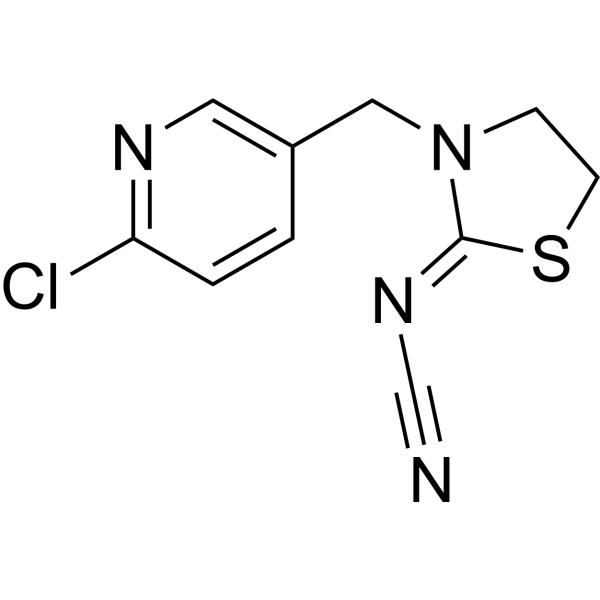
Thiacloprid (Standard) is the analytical standard of Thiacloprid. This product is intended for research and analytical applications. Thiacloprid is an orally active neurotoxic insecticide and also a nAChR agonist. Thiacloprid reduces the viability of healthy cells, depletes reduced glutathione, and increases MDA levels, thereby inducing cytotoxicity and oxidative stress damage. In practical applications, Thiacloprid has lower acute toxicity to honeybees than other compounds of the same class such as Imidacloprid (HY-B0838), but it still significantly impairs the learning and memory function, immune capacity and survival status of honeybees. Thiacloprid induces intestinal microbial dysbiosis and reduces survival rate in middle-aged honeybees, increases the risk of premature collapse in bumblebee colonies, and significantly decreases the final colony weight and reproductive output. Thiacloprid is used in broad-spectrum agricultural pest control, often alone or in combination with Deltamethrin (HY-B1971), and meets the pest management needs of various crops including potatoes, cabbages, various fruits and vegetables, and nuts.
For research use only. We do not sell to patients.
- CAS No.: 111988-49-9
- Formula: C10H9ClN4S
- Molecular Weight:252.72
-
Storage:
Please store the product under the recommended conditions in the Certificate of Analysis.


To place orders, for customer services and technical support, please contact: MedChemExpress USA
Tel: 609-228-6898 E-mail: [email protected] [email protected]


-
 Product Information
-
Chemical Information
- Purity & Documentation
-
 Help & FAQs


-
HY-B1953
ThiaclopridInsecticide -
HY-B0840
ChlorfenapyrPyrrole Insecticide -

HY-B0840R
Chlorfenapyr (Standard)Pyrrole Insecticide -
HY-B0817
PyridabenMETI Acaricide -
HY-B1161A
S-MethopreneInsecticide -
HY-W059342
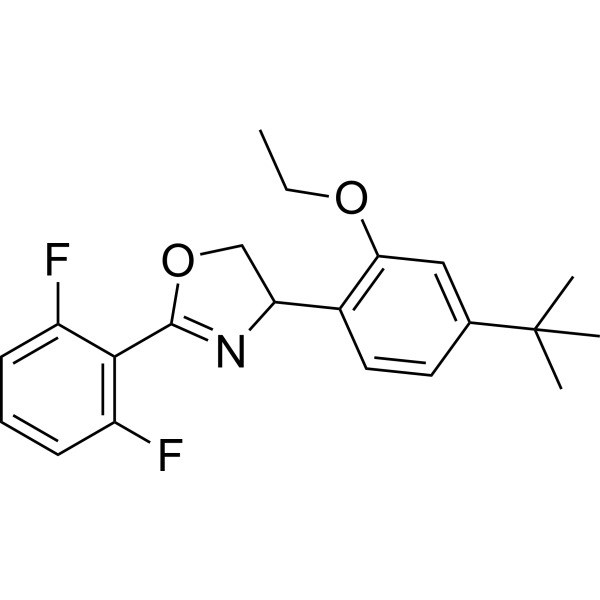
EtoxazoleInsecticide -
HY-133167
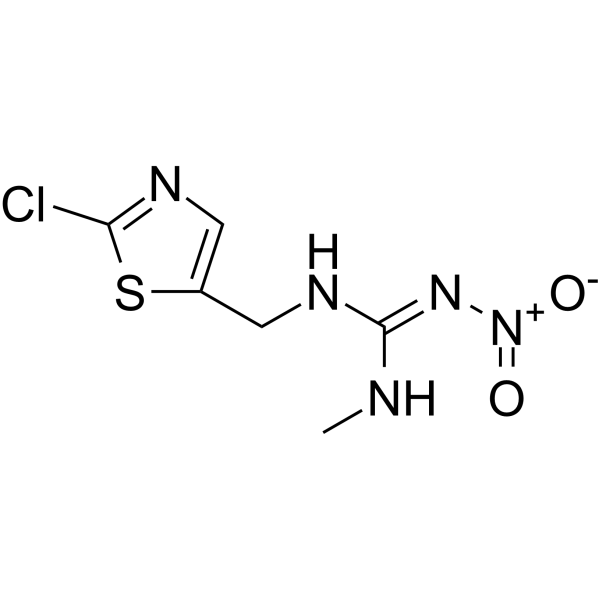
ClothianidinInsecticide -

HY-133167R
Clothianidin (Standard)Insecticide -

HY-B0817R
Pyridaben (Standard)METI Acaricide -

HY-W059342R
Etoxazole (Standard)Insecticide -

HY-B1161AR
S-Methoprene (Standard)Insecticide


Product Information
Information
Application
The compound is the grade of analytical standard, which is the reference standard supplied assay. It is commonly used in qualitative, quantitative and methodological research experiments in HPLC, GC and MS.


Chemical Information
-
CAS No. 111988-49-9
-
Molecular Weight 252.72
-
Formula C10H9ClN4S
-
SMILES
N#C/N=C1N(CCS/1)CC(C=C2)=CN=C2Cl
-
Shipping
Room temperature in continental US; may vary elsewhere.
-
Storage
Please store the product under the recommended conditions in the Certificate of Analysis.


Purity & Documentation
References
[2]. Liu YJ, et al. Thiacloprid exposure perturbs the gut microbiota and reduces the survival status in honeybees. J Hazard Mater. 2020;389:121818. [Content Brief]
[3]. Ellis C, et al. The Neonicotinoid Insecticide Thiacloprid Impacts upon Bumblebee Colony Development under Field Conditions. Environ Sci Technol. 2017;51(3):1727-1732. [Content Brief]

Calculators
Concentration (start) × Volume (start) = Concentration (final) × Volume (final)


Thiacloprid (Standard) Related Classifications
HY-B1953R Related Classifications
 Powered by Bioz