1. Neuronal Signaling GPCR/G Protein Cytoskeleton
  2. Amyloid-β Natriuretic Peptide Receptor (NPR) α-synuclein Transthyretin (TTR) Claudin
  3. Homogentisic acid

ホモゲンチジン酸  (Synonyms: Homogentisic acid)

製品番号: HY-113283 純度: 99.68%
COA 取扱説明書 Technical Support

Homogentisic acid is an orally active, blood-brain barrier-permeable amyloidogenic compound that functions as both an amyloid component and a pigment precursor. Accumulation of homogentisic acid downregulates tight junction proteins (such as claudin-5, occludin, ZO-1) and impairs blood-brain barrier integrity. Homogentisic acid and its oxidation product benzoquinone acetic acid not only induce the aggregation and fibrosis of multiple proteins (such as 1-42, α-synuclein, SAA, Transthyretin (TTR), atrial natriuretic peptide), but also trigger oxidative stress, damage to the Wnt/β-catenin pathway, and neurotoxicity, leading to ochronosis pigment deposition and synaptic dysfunction. At specific concentrations, homogentisic acid exerts no cytotoxicity or genotoxicity on human peripheral blood lymphocytes, and even counteracts the genotoxicity induced by Irinotecan (HY-16562). Homogentisic acid serves as an important tool molecule for investigating the mechanisms of diseases including ochronosis, secondary amyloidosis, Alzheimer's disease, and colorectal cancer.

商品は「研究用試薬」です。人や動物の医療用・臨床診断用・食品用の製品ではありません。
研究用途以外に使用した場合、当社は一切の責任を負いかねます。

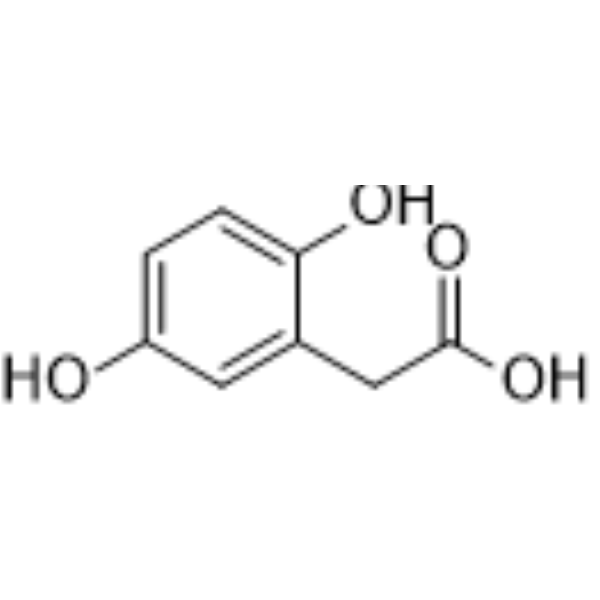
Homogentisic acid

ホモゲンチジン酸 構造式

CAS 番号 : 451-13-8

容量 価格(税別) 在庫状況 数量
Solid + Solvent (Highly Recommended)
10 mM * 1 mL in DMSO
ready for reconstitution
USD 42 在庫あり
Solution
10 mM * 1 mL in DMSO USD 42 在庫あり
Solid
25 mg $39 在庫あり
50 mg $63 在庫あり
100 mg $100 在庫あり
200 mg   お問い合わせ  
500 mg   お問い合わせ  

* アイテムを追加する前、数量をご選択ください

This product is a controlled substance and not for sale in your territory.

カスタマーレビュー

Based on 0 publication(s) in Google Scholar

Other Forms of Homogentisic acid:

Top Publications Citing Use of Products

α-synuclein アイソフォーム固有の製品をすべて表示:

  • 生物活性

  • 純度とドキュメンテーション

  • 参考文献

  • カスタマーレビュー

製品説明

Homogentisic acid is an orally active, blood-brain barrier-permeable amyloidogenic compound that functions as both an amyloid component and a pigment precursor. Accumulation of homogentisic acid downregulates tight junction proteins (such as claudin-5, occludin, ZO-1) and impairs blood-brain barrier integrity. Homogentisic acid and its oxidation product benzoquinone acetic acid not only induce the aggregation and fibrosis of multiple proteins (such as 1-42, α-synuclein, SAA, Transthyretin (TTR), atrial natriuretic peptide), but also trigger oxidative stress, damage to the Wnt/β-catenin pathway, and neurotoxicity, leading to ochronosis pigment deposition and synaptic dysfunction. At specific concentrations, homogentisic acid exerts no cytotoxicity or genotoxicity on human peripheral blood lymphocytes, and even counteracts the genotoxicity induced by Irinotecan (HY-16562). Homogentisic acid serves as an important tool molecule for investigating the mechanisms of diseases including ochronosis, secondary amyloidosis, Alzheimer's disease, and colorectal cancer[1][2][3][4][5][6][7][8].

IC50 & Target

NPR-A


体外実験

Homogentisic acid (0.165-0.33 mM; 37 °C; 2-6 d) induces time- and dose-dependent aggregation of 1-42 peptide, α-Syn, and Ttr proteins. During days 2-6, homogentisic acid reduces the monomer level of Aβ1-42 and increases high molecular weight (HMW) aggregates; after days 7-14, homogentisic acid generates a unique 24 kDa product from α-Syn; and during days 1-5, homogentisic acid elevates oligomer levels[1].
Homogentisic acid (0.33 mM; 37 °C; 14 d+14 d) increases the abundance and maturity of SAA amyloid fibrils, forming thick filament bundles and slender protofibrils, and promotes further growth of pre-aggregated SAA fibrils upon re-stimulation; it also induces α-Syn protein to form protofibrillar aggregates, spherical oligomers, and curvilinear fibrils[1].
Homogentisic acid (0.165-0.66 mM; 37 °C; 7 d for α-Syn assay, 14 d for SAA assay) promotes the formation of benzoquinone acetic acid (BQA)-protein adducts in α-Syn after 7 days and in SAA after 14 days[1].
Homogentisic acid (0.01 μM) induces aggregation in HT22 neuronal cells, SY5Y neuronal cells, and primary neuron cultures without significant cytotoxicity[2].
Homogentisic acid (0.01-0.5 μM) downregulates tight junction proteins (claudin-5, occludin, ZO-1) in a dose-dependent manner, disrupts junctional structures, and directly impairs the integrity of the blood-brain barrier in primary brain microvascular endothelial cells (BMECs)[2].
Homogentisic acid (0.01 μM; 18 h) transcriptionally suppresses the expression of tight junction proteins (claudin-5, occludin, ZO-1) in HT22 and SY5Y neuronal cells[2].
Homogentisic acid (400 μM; pH 7.45) catalyzes the co-oxidation of ascorbic acid, producing H2O2 and synergistically increasing oxygen consumption[6].
Homogentisic acid (500 μM; 30-90 min) and Fe3+-EDTA generate hydroxyl radicals, and SOD promotes the production of such radicals, whereas catalase, thiourea and sodium formate inhibit their production. Fe3+-EDTA also depolymerizes hyaluronic acid, and hydroxyl radical scavengers and catalase inhibit this degradation process[6].
Homogentisic acid (0.046 mM; 3 w) induces intracellular ochronotic pigment deposition in primary human articular osteoblasts[8].
Homogentisic acid (0.046 mM; 2-4 w) reduces the level of free thiols in primary human articular osteoblasts, decreasing this level by 20% after 2 weeks of treatment and by 50% after 3 and 4 weeks of treatment[8].
Homogentisic acid (0.046 mM; 2-4 w) impairs the Wnt/β-catenin pathway in primary human articular osteoblasts; it increases β-catenin levels by 80% after 2 weeks, while it reduces β-catenin levels by 60% and 40% after 3 and 4 weeks, respectively, and simultaneously increases its phosphorylation levels by 100% and 50%, respectively[8].

MedChemExpress (MCE) has not independently confirmed the accuracy of these methods. They are for reference only.

Real Time qPCR[2]

Cell Line: HT22 neuronal cells, SY5Y neuronal cells
Concentration: 0.01 μM
Incubation Time: 18 h
Result: Significantly reduced claudin-5, occludin, and ZO-1 mRNA levels in both HT22 and SY5Y cells.
体内実験

Homogentisic acid (20-50 mg/kg; intragastric administration; consecutive daily dosing for 5 days per week, for a total of 6 weeks) exacerbates cognitive impairment, blood-brain barrier disruption, Aβ aggregation, and synaptic damage in both APP/PS1 mice and P301S tauopathy mice, with a more pronounced effect observed in APP/PS1 mice[2].
Homogentisic acid (16 mg/kg; tail vein injection; single dose) can efficiently cross the blood-brain barrier of healthy C57BL/6 mice[2].

MedChemExpress (MCE) has not independently confirmed the accuracy of these methods. They are for reference only.

Animal Model: APP/PS1 transgenic mice, P301S transgenic mice (2-3 months old, 20-25 g, Alzheimer's disease modeling)[2]
Dosage: 20 mg/kg; 50 mg/kg
Administration: oral gavage; five consecutive days per week; 6 weeks
Result: Significantly decreased the novel object recognition discrimination index (50 mg/kg).\nReduced Morris water maze platform crossings and time spent in the target quadrant (20 mg/kg, 50 mg/kg).\n
Significantly shortened auditory fear conditioning freezing time (20 mg/kg, 50 mg/kg).
Downregulated cortical levels of tight junction proteins claudin-5, occludin, and ZO-1, with the greatest reduction observed at 50 mg/kg (20 mg/kg, 50 mg/kg).\n
Caused discontinuous ZO-1 staining and increased blood-brain barrier permeability (measured via Evans Blue extravasation) (50 mg/kg).
Significantly increased cerebral Aβ burden compared with controls (50 mg/kg).\n
Reduced cortical levels of synaptic proteins PSD93 and synaptophysin, with the greatest reduction observed at 50 mg/kg.
Exacerbated cognitive deficits in P301S mice, but effects were less pronounced than in APP/PS1 mice.
Animal Model: C57BL/6 mice (2-3 months old, 20-25 g, male)[2]
Dosage: 16 mg/kg
Administration: tail vein injection; single dose
Result: Achieved significantly greater concentrations in brain tissue than in vehicle controls, demonstrating efficient blood-brain barrier penetration.
分子量

168.15

分子式

C8H8O4

CAS 番号
Appearance

Solid

Color

White to yellow

SMILES

O=C(O)CC1=CC(O)=CC=C1O

Structure Classification
Initial Source
輸送条件

Room temperature in continental US; may vary elsewhere.

保管条件
Powder -20°C 3 years
  4°C 2 years
In solvent -80°C 6 months
  -20°C 1 month
溶剤 & 溶解度
体外: 

DMSO : 100 mg/mL (594.71 mM; Need ultrasonic; Hygroscopic DMSO has a significant impact on the solubility of product, please use newly opened DMSO)

H2O : 100 mg/mL (594.71 mM; Need ultrasonic)

Preparing
Stock Solutions
Concentration Solvent Mass 1 mg 5 mg 10 mg
1 mM 5.9471 mL 29.7354 mL 59.4707 mL
5 mM 1.1894 mL 5.9471 mL 11.8941 mL
10 mM 0.5947 mL 2.9735 mL 5.9471 mL
View the Complete Stock Solution Preparation Table

* Please refer to the solubility information to select the appropriate solvent. Once prepared, please aliquot and store the solution to prevent product inactivation from repeated freeze-thaw cycles.
Storage method and period of stock solution: -80°C, 6 months; -20°C, 1 month. When stored at -80°C, please use it within 6 months. When stored at -20°C, please use it within 1 month.

* Note: If you choose water as the stock solution, please dilute it to the working solution, then filter and sterilize it with a 0.22 μm filter before use.

  • Molarity Calculator

  • Dilution Calculator

Mass (g) = Concentration (mol/L) × Volume (L) × Molecular Weight (g/mol)

Mass
=
Concentration
×
Volume
×
Molecular Weight *

Concentration (start) × Volume (start) = Concentration (final) × Volume (final)

一般には略語で表示されます:C1V1 = C2V2

濃度 (開始)

C1

×
体積 (開始)

V1

=
濃度 (終了)

C2

×
体積 (終了)

V2

体内:

Select the appropriate dissolution method based on your experimental animal and administration route.

For the following dissolution methods, please ensure to first prepare a clear stock solution using an In Vitro approach and then sequentially add co-solvents:
To ensure reliable experimental results, the clarified stock solution can be appropriately stored based on storage conditions. As for the working solution for in vivo experiments, it is recommended to prepare freshly and use it on the same day.
The percentages shown for the solvents indicate their volumetric ratio in the final prepared solution. If precipitation or phase separation occurs during preparation, heat and/or sonication can be used to aid dissolution.

  • Protocol 1

    Add each solvent one by one:  10% DMSO    40% PEG300    5% Tween-80    45% Saline

    Solubility: ≥ 2.5 mg/mL (14.87 mM); Clear solution

    This protocol yields a clear solution of ≥ 2.5 mg/mL (saturation unknown).

    Taking 1 mL working solution as an example, add 100 μL DMSO stock solution (25.0 mg/mL) to 400 μL PEG300, and mix evenly; then add 50 μL Tween-80 and mix evenly; then add 450 μL Saline to adjust the volume to 1 mL.

    Preparation of Saline: Dissolve 0.9 g sodium chloride in ddH₂O and dilute to 100 mL to obtain a clear Saline solution.
  • Protocol 2

    Add each solvent one by one:  10% DMSO    90% (20% SBE-β-CD in Saline)

    Solubility: ≥ 2.5 mg/mL (14.87 mM); Clear solution

    This protocol yields a clear solution of ≥ 2.5 mg/mL (saturation unknown).

    Taking 1 mL working solution as an example, add 100 μL DMSO stock solution (25.0 mg/mL) to 900 μL 20% SBE-β-CD in Saline, and mix evenly.

    Preparation of 20% SBE-β-CD in Saline (4°C, storage for one week): 2 g SBE-β-CD powder is dissolved in 10 mL Saline, completely dissolve until clear.
In Vivo Dissolution Calculator
Please enter the basic information of animal experiments:

Dosage

mg/kg

Animal weight
(per animal)

g

Dosing volume
(per animal)

μL

Number of animals

Recommended: Prepare an additional quantity of animals to account for potential losses during experiments.
Calculation results:
Working solution concentration: mg/mL
This product has good water solubility, please refer to the measured solubility data in water/PBS/Saline for details.
The concentration of the stock solution you require exceeds the measured solubility. The following solution is for reference only.If necessary, please contact MedChemExpress (MCE).
純度とドキュメンテーション

純度: 99.68%

参考文献

Complete Stock Solution Preparation Table

* Please refer to the solubility information to select the appropriate solvent. Once prepared, please aliquot and store the solution to prevent product inactivation from repeated freeze-thaw cycles.
Storage method and period of stock solution: -80°C, 6 months; -20°C, 1 month. When stored at -80°C, please use it within 6 months. When stored at -20°C, please use it within 1 month.

Optional Solvent Concentration Solvent Mass 1 mg 5 mg 10 mg 25 mg
DMSO / H2O 1 mM 5.9471 mL 29.7354 mL 59.4707 mL 148.6768 mL
5 mM 1.1894 mL 5.9471 mL 11.8941 mL 29.7354 mL
10 mM 0.5947 mL 2.9735 mL 5.9471 mL 14.8677 mL
15 mM 0.3965 mL 1.9824 mL 3.9647 mL 9.9118 mL
20 mM 0.2974 mL 1.4868 mL 2.9735 mL 7.4338 mL
25 mM 0.2379 mL 1.1894 mL 2.3788 mL 5.9471 mL
30 mM 0.1982 mL 0.9912 mL 1.9824 mL 4.9559 mL
40 mM 0.1487 mL 0.7434 mL 1.4868 mL 3.7169 mL
50 mM 0.1189 mL 0.5947 mL 1.1894 mL 2.9735 mL
60 mM 0.0991 mL 0.4956 mL 0.9912 mL 2.4779 mL
80 mM 0.0743 mL 0.3717 mL 0.7434 mL 1.8585 mL
100 mM 0.0595 mL 0.2974 mL 0.5947 mL 1.4868 mL

* Note: If you choose water as the stock solution, please dilute it to the working solution, then filter and sterilize it with a 0.22 μm filter before use.

  • No file chosen (Maximum size is: 1024 Kb)
  • If you have published this work, please enter the PubMed ID.
  • Your name will appear on the site.
  • Molarity Calculator

  • Dilution Calculator

The molarity calculator equation

Mass (g) = Concentration (mol/L) × Volume (L) × Molecular Weight (g/mol)

質量   濃度   体積   分子量 *
= × ×

The dilution calculator equation

Concentration (start) × Volume (start) = Concentration (final) × Volume (final)

一般には略語で表示されます:C1V1 = C2V2

濃度 (開始) × 体積 (開始) = 濃度 (終了) × 体積 (終了)
× = ×
C1   V1   C2   V2
Help & FAQs
  • Do most proteins show cross-species activity?

    Species cross-reactivity must be investigated individually for each product. Many human cytokines will produce a nice response in mouse cell lines, and many mouse proteins will show activity on human cells. Other proteins may have a lower specific activity when used in the opposite species.

最近チェックした製品:

オンラインお問い合わせ

Your information is safe with us. * Required Fields.

製品名


カスタマ需要量 *

お名前 *


タイトル

メールアドレス *


電話番号 *

デパートメント


組纖名 *

市区町村

都道府県

国或いは地域 *


必ず会社名を記載ください。個人への返信は行いません。

備考

バルクお問い合わせ

Inquiry Information

製品名:
Homogentisic acid
製品番号:
HY-113283
数量:
MCE 日本正規代理店: