



PKC
Protein kinase C
PKC Isoform Specific Products
-
PKC
(384)
View all products
-
PKCα
(48)
View all products
-
PKCβ
(40)
View all products
-
PKCγ
(26)
View all products
-
PKCδ
(26)
View all products
-
PKCε
(30)
View all products
-
PKCη
(15)
View all products
-
PKCζ
(14)
View all products
-
PKCθ
(21)
View all products
-
PKCμ
(4)
View all products
-
PKC-ι ℩
(2)
View all products
-
PKCι
(7)
View all products
All Product Categories
-
PKC Related Products (504)
Related Products (504)

-
Antibodies (21)
-
PKC Isoform Comparison
-
GSK-943949A
 0 ImagesCat. No.: HY-130305ACAS No.: 913640-58-1GSK-943949A is a PRK1 inhibitor with an IC50 of 40.0 nM. GSK-943949A is applicable to research related to prostate cancer.
-
N-Desmethyltamoxifen hydrochloride (Standard)
 0 ImagesN-Desmethyltamoxifen (hydrochloride) (Standard) is the analytical standard of N-Desmethyltamoxifen (hydrochloride). This product is intended for research and analytical applications. N-Desmethyltamoxifen hydrochloride is the major metabolite of tamoxifen in humans. N-Desmethyltamoxifen, a poor antiestrogen, is a ten-fold more potent protein kinase C (PKC) inhibitor than Tamoxifen. N-Desmethyltamoxifen hydrochloride is also a potent regulator of ceramide metabolism in human AML cells, limiting ceramide glycosylation, hydrolysis, and sphingosine phosphorylation[1][2][3].
-
Prkce Rat Pre-designed siRNA Set A
 0 ImagesCat. No.: HY-RS11127
Prkce Rat Pre-designed siRNA Set A contains three designed siRNAs for Prkce gene (Rat), as well as a negative control, a positive control, and a FAM-labeled negative control.
-
Prkcd Mouse Pre-designed siRNA Set A
 0 ImagesCat. No.: HY-RS11123
Prkcd Mouse Pre-designed siRNA Set A contains three designed siRNAs for Prkcd gene (Mouse), as well as a negative control, a positive control, and a FAM-labeled negative control.
-
PKCζ-IN-2
 0 ImagesCat. No.: HY-208740CAS No.: 2488951-93-3PKCζ-IN-2 is an orally active, selective PKCζ inhibitor with an IC50 of 0.1 nM. As an anti-inflammatory agent, PKCζ-IN-2 reduces joint swelling and ameliorates disease progression in a mouse collagen-induced arthritis model. PKCζ-IN-2 can be used for the research of rheumatoid arthritis.
-
(S)-Ro 32-0432 free base
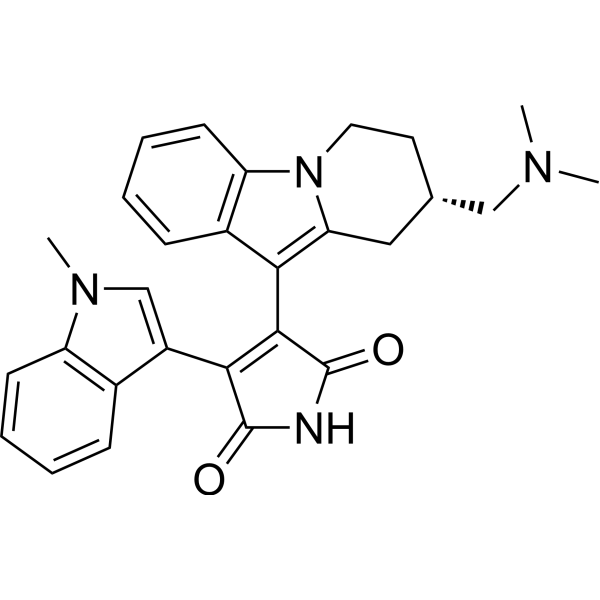 0 ImagesCat. No.: HY-108601CAS No.: 151342-35-7(S)-Ro 32-0432 free base is a potent, selective, ATP-competitive and orally active PKC inhibitor. The IC50 values of (S)-Ro 32-0432 free base for PKCα, PKCβI, PKCβII, PKCγ and PKCε are 9.3 nM, 28 nM, 30 nM, 36.5 nM and 108.3 nM, respectively. (S)-Ro 32-0432 free base is also a selective G protein-coupled receptor kinase 5 (GRK5) inhibitor. (S)-Ro 32-0432 free base prevents T-cell activation and has the potential for chronic inflammatory and autoimmune diseases research.
-
PRKCQ Human Pre-designed siRNA Set A
 0 ImagesCat. No.: HY-RS11137
PRKCQ Human Pre-designed siRNA Set A contains three designed siRNAs for PRKCQ gene (Human), as well as a negative control, a positive control, and a FAM-labeled negative control.
-
Prkci Mouse Pre-designed siRNA Set A
 0 ImagesCat. No.: HY-RS11135
Prkci Mouse Pre-designed siRNA Set A contains three designed siRNAs for Prkci gene (Mouse), as well as a negative control, a positive control, and a FAM-labeled negative control.
-
Sangivamycin (Standard)
 0 ImagesCat. No.: HY-118384RCAS No.: 18417-89-5Synonyms: NSC 65346 (Standard); BA-90912 (Standard)Sangivamycin (Standard) is the analytical standard of Sangivamycin. This product is intended for research and analytical applications. Sangivamycin (NSC 65346), a nucleoside analog, is a potent inhibitor of protein kinase C (PKC) with an Ki of 10 μM. Sangivamycin has potent antiproliferative activity against a variety of human cancers[1][2].
-
MDL 27032
 0 ImagesCat. No.: HY-105517CAS No.: 110124-55-5
-
Prkca Mouse Pre-designed siRNA Set A
 0 ImagesCat. No.: HY-RS11117
Prkca Mouse Pre-designed siRNA Set A contains three designed siRNAs for Prkca gene (Mouse), as well as a negative control, a positive control, and a FAM-labeled negative control.
-
Myricitrin (Standard)
 0 ImagesMyricitrin (Standard) is the analytical standard of Myricitrin. This product is intended for research and analytical applications. Myricitrin, a naturally occurring flavonoid, is an orally active nitric oxide (NO) and PKC inhibitor. Myricitrin has central nervous system activity, including anxiolytic-like action. Myricitrin possesses antioxidant, anti-inflammatory, antifibrotic and anti-malarial effects.
-
BTK-IN-50
 0 ImagesCat. No.: HY-184940BTK-IN-50 is a covalent BTK inhibitor with an IC50 of 6 nM. BTK-IN-50 blocks collagen-induced platelet aggregation by inhibiting the GPVI-mediated BTK-PLCγ2-PKC signaling cascade, and attenuates CRP-XL-induced phosphorylation of BTK, PLCγ2 and PKC substrates in platelets. BTK-IN-50 can be used for research related to thrombosis.
-
Myr-Tat-PKCβII
 0 ImagesCat. No.: HY-P10821Myr-Tat-PKCβII is a cell permeable protein kinase C β II peptide inhibitor. Myr-Tat-PKCβII mitigates the generation of reactive oxygen species in rat ex-vivo and porcine in-vivo ischemia-reperfusion injury.
-
H-Arg-Gly-Tyr-Ala-Leu-Gly-OH
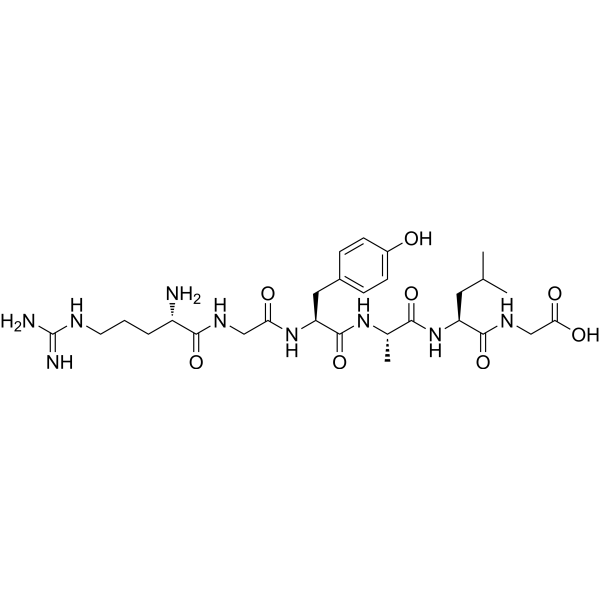 0 ImagesCat. No.: HY-P3786CAS No.: 59587-24-5H-Arg-Gly-Tyr-Ala-Leu-Gly-OH is a competitive and CAMP dependent protein kinase inhibitor.
-
Evo312
 0 ImagesCat. No.: HY-169006CAS No.: 2820245-53-0Evo312 is a dose-dependent inhibitor of protein kinase CβⅠ (PKCβⅠ) (IC50 is 117.34 nM). Evo312 induces PANC-GR (acquired gemcitabine-resistant PC cells) cell cycle arrest and apoptosis by inhibiting PKCβ1 protein expression. Evo312 has antiproliferative effects in pancreatic cancer cells PANC-1 and PANC-GR cells with IC50 of 0.08 μM and 0.07 μM, and in human normal pancreatic ductal epithelial cells HPDE6-c7 with IC50 of 2.95 μM. Evo312 exhibits antitumor activity in a PANC-GR cell transplantation mouse model.
-
Epsilon-V1-2, Cys-conjugated
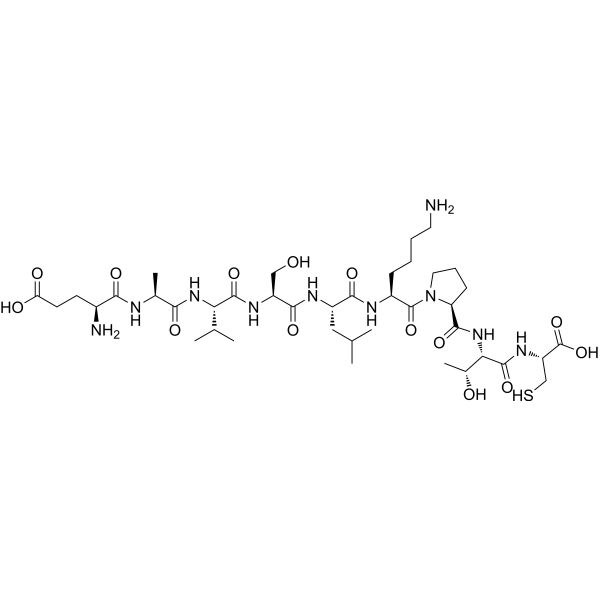 0 ImagesCat. No.: HY-P5439Epsilon-V1-2, Cys-conjugated is a biological active peptide. (This peptide is the εPKC specific inhibitor. Its inhibitory activity is based on εPKC translocation and MARCKS phosphorylation. This peptide interferes with εPKC interaction with the anchoring protein εRACK. This peptide contains a cysteine residue added to the C-terminus for potential S-S bond formation with a carrier protein.Pyroglutamyl (pGlu) peptides may spontaneously form when either Glutamine (Q) or Glutamic acid (E) is located at the sequence N-terminus. The conversion of Q or E to pGlu is a natural occurrence and in general it is believed that the hydrophobic γ-lactam ring of pGlu may play a role in peptide stability against gastrointestinal proteases. Pyroglutamyl peptides are therefore considered a normal subset of such peptides and are included as part of the peptide purity during HPLC analysis.)
-
PKCη pseudosubstrate inhibitor,myristoylated
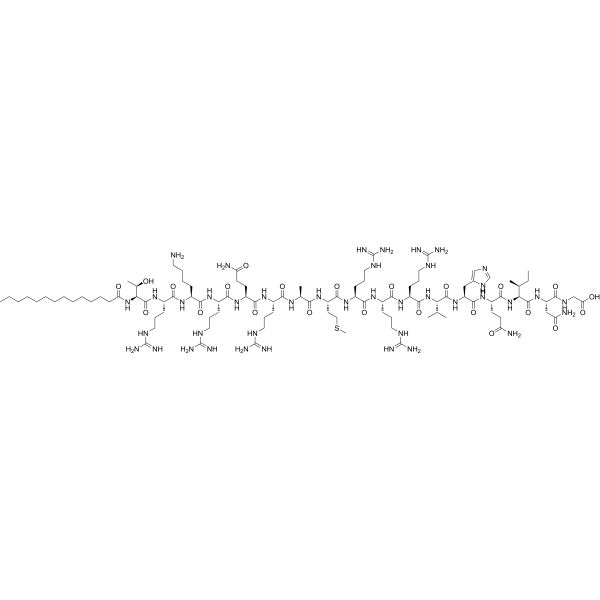 0 ImagesCat. No.: HY-P5885CAS No.: 908012-19-1

-
CP-46665 dihydrochloride
 0 ImagesCat. No.: HY-135254CAS No.: 72618-10-1Synonyms: CP-46665-1CP-46665 dihydrochloride is an anticancer agent that inhibits the incorporation of tritiated thymidine into leukemia cells and human solid tumor cells in vitro. It can lead to the loss of surface characteristics in tumor cells and disrupt cell membranes, inhibiting cell proliferation.




