



PKCμ
PKCµ, now designated PKD1, is a diacylglycerol- and phorbol ester-responsive serine/threonine kinase with a distinctive catalytic domain[1]. Mechanistically, PKCµ/PKD1 regulates transport-carrier fission from the trans-Golgi network and links membrane trafficking to cell-surface delivery[2]. This trafficking role connects directly with cell adhesion because PKD1/PKCµ promotes αvβ3 integrin recycling and delivery to nascent focal adhesions[3]. In gastric cancer models, PKD1 promoter methylation correlated with reduced PKD1 expression, and PKD1 downregulation affected migration and invasiveness[4]. Compared with related isoforms, PKD1 and PKD2 show non-redundant functions in vivo, with PKD1 catalytic activity required for normal embryogenesis whereas PKD2 catalytic activity was dispensable for that process[5]. For experimental applications, PKD inhibitors provide tools to test PKD-dependent proliferation, migration, survival, and pathway activation in cancer models[6][7].
References:
- [1]. Valverde AM, et al. Molecular cloning and characterization of protein kinase D: a target for diacylglycerol and phorbol esters with a distinctive catalytic domain. Proc Natl Acad Sci U S A. 1994 Aug 30;91(18):8572-6. [Content Brief]
- [2]. Liljedahl M, et al. Protein kinase D regulates the fission of cell surface destined transport carriers from the trans-Golgi network. Cell. 2001 Feb 9;104(3):409-20. [Content Brief]
- [3]. Woods AJ, et al. PKD1/PKCmu promotes alphavbeta3 integrin recycling and delivery to nascent focal adhesions. EMBO J. 2004 Jul 7;23(13):2531-43. [Content Brief]
- [4]. Kim M, et al. Epigenetic inactivation of protein kinase D1 in gastric cancer and its role in gastric cancer cell migration and invasion. Carcinogenesis. 2008 Mar;29(3):629-37. [Content Brief]
- [5]. Matthews SA, et al. Unique functions for protein kinase D1 and protein kinase D2 in mammalian cells. Biochem J. 2010 Nov 15;432(1):153-63. [Content Brief]
- [6]. Ali SR, et al. Nerve Density and Neuronal Biomarkers in Cancer. Cancers (Basel). 2022 Oct 1;14(19):4817. [Content Brief]
- [7]. Meredith EL, et al. Identification of potent and selective amidobipyridyl inhibitors of protein kinase D. J Med Chem. 2010 Aug 12;53(15):5422-38. [Content Brief]
All Product Categories
-
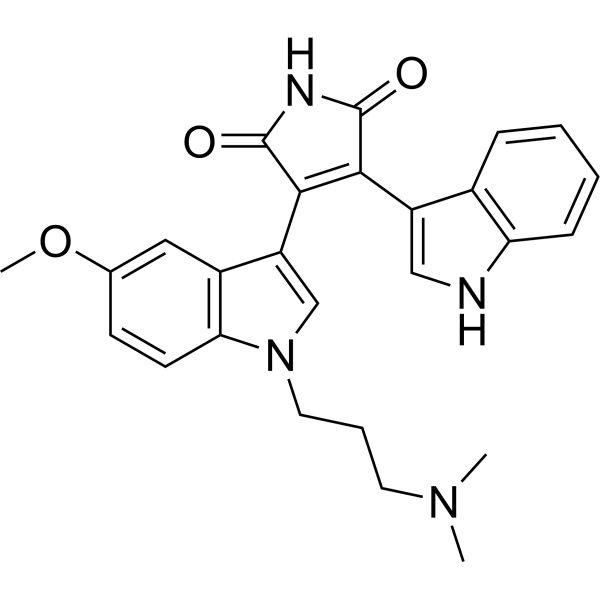
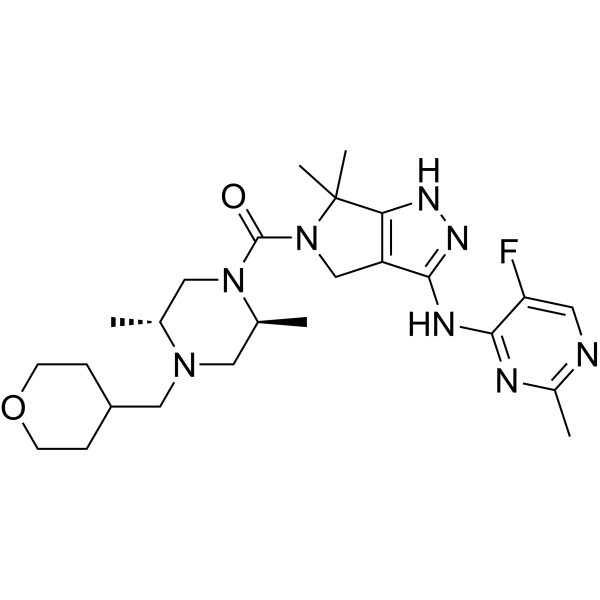
PKCμ Related Products (4)
Related Products (4)

-
Bisindolylmaleimide III
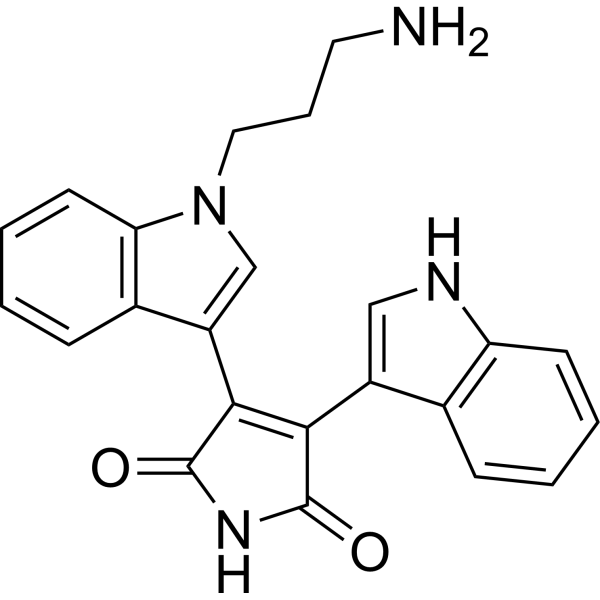 0 ImagesBisindolylmaleimide III is a protein kinase C (PKC) inhibitor with IC50 values of 0.26, 5.7, and 6 μM against PKCα, PKCδ, and PKCμ, respectively. Bisindolylmaleimide III also exhibits inhibitory activity against other off-targets, with IC50 values of 0.17, 1, and 2 μM against SLK, adenosine kinase (AK), and CDK2, respectively; its Ki for NQO2 is 16.5 μM. Bisindolylmaleimide III selectively binds to activated Rsk1 following EGF stimulation, and serves as a tool for detecting the activation status of intracellular Rsk1 and PKCα, as well as for functional analysis of SLK. Bisindolylmaleimide III can be used in studies of signal transduction and colorectal cancer.
-
Bisindolylmaleimide III hydrochloride
 0 ImagesCat. No.: HY-112454CAS No.: 683775-59-9Bisindolylmaleimide III hydrochloride is a protein kinase C (PKC) inhibitor with IC50 values of 0.26, 5.7, and 6 μM against PKCα, PKCδ, and PKCμ, respectively. Bisindolylmaleimide III hydrochloride also exhibits inhibitory activity against other off-targets, with IC50 values of 0.17, 1, and 2 μM against SLK, adenosine kinase (AK), and CDK2, respectively; its Ki for NQO2 is 16.5 μM. Bisindolylmaleimide III hydrochloride selectively binds to activated Rsk1 following EGF stimulation, and serves as a tool for detecting the activation status of intracellular Rsk1 and PKCα, as well as for functional analysis of SLK. Bisindolylmaleimide III hydrochloride can be used in studies of signal transduction and colorectal cancer.



