



PROTAC ATR degrader-2

Based on 1 Customer Validation
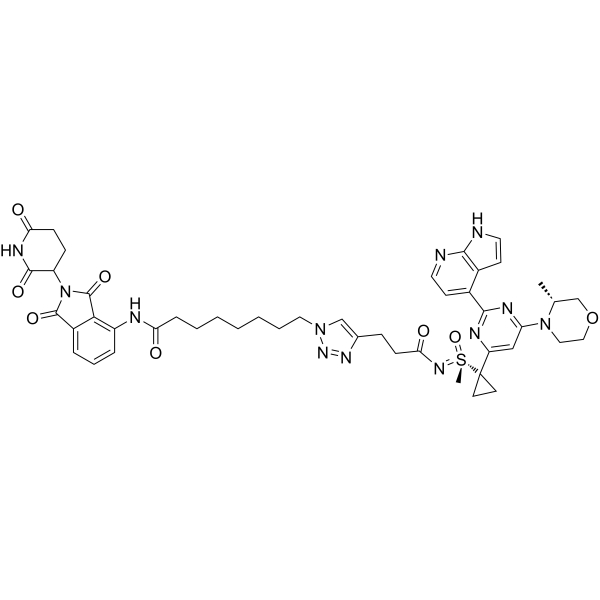
PROTAC ATR degrader-2 is a selective ATR PROTAC degrader. PROTAC ATR degrader-2 degrades ATR in acute myeloid leukemia (AML) cells MV-4-11 and MOLM-13, with DC50 values of 22.9 nM and 34.5 nM, respectively. PROTAC ATR degrader-2 has an IC50 of 29.6 nM against ATR, and its IC50 values against ATM and PI3K are both greater than 2000 nM. PROTAC ATR degrader-2 induces apoptosis, DNA damage, and upregulates p53 expression. PROTAC ATR degrader-2 inhibits cancer cell proliferation through the kinase-independent function of ATR protein. PROTAC ATR degrader-2 is applicable to research related to acute myeloid leukemia.
(Pink: ATR ligand (HY-161616); Blue: Cereblon ligand (HY-A0003); Black: linker (HY-43538)).
For research use only. We do not sell to patients.
- Purity : 99.73%
- CAS No.: 3010273-12-5
- Formula: C40H41N9O6
- Molecular Weight:743.81
-
Storage:Powder -20°C, 3 years , 4°C, 2 years ; In solvent -80°C, 6 months , -20°C, 1 month


To place orders, for customer services and technical support, please contact: MedChemExpress USA
Tel: 609-228-6898 E-mail: [email protected] [email protected]


-
 Biological Activity
-
Chemical Information
-
Solvent & Solubility
- Purity & Documentation
- References
-
 Help & FAQs


All PROTACs Isoforms
More

Biological Activity
Description
IC50 & Target
[1]|
ATR 29.6 nM (IC50) |
ATR 22.9 nM (DC50, MV-4-11) |
ATR 34.5 nM (DC50, MOLM-13) |
In Vitro
PROTAC ATR degrader-2 (Compound 8i) (3-10000 nM; 12-24 h) potently degrades ATR in MV-4-11 cells, with 75.7% and 93.4% degradation at 100 nM and 500 nM (12 h). Under 24 h treatment conditions, the DC50 values for MV-4-11 and MOLM-13 cells are 22.9 nM and 34.5 nM, respectively. and a DC50 of 22.9 nM[1].
PROTAC ATR degrader-2 potently inhibits the growth of multiple acute myeloid leukemia cell lines, with IC50 values ranging from 0.108 μM to 1.287 μM[1].
PROTAC ATR degrader-2 (0.3-1.2 μM; 24 h) does not induce cell cycle arrest in MV-4-11 or MOLM-13 acute myeloid leukemia cells[1].
PROTAC ATR degrader-2 (0.5 μM; 24-96 h) potently induces time-dependent apoptosis in MV-4-11 and MOLM-13 cells, with sustained apoptotic signaling even after compound removal[1].
PROTAC ATR degrader-2 (0.01-1 μM; 24-48 h) induces apoptosis in MV-4-11 and MOLM-13 cells by increasing p53 levels, modulating Bax/BCL-2 expression, activating caspase-mediated apoptotic signaling, and triggering extensive DNA damage, without upregulating the cell cycle arrest marker p21[1].
PROTAC ATR degrader-2 (0.5 μM; 24 h) disrupts nuclear envelope integrity in MV-4-11 cells, leading to nuclear deformation and breakdown of nuclear membrane structure[1].
PROTAC ATR degrader-2 (48-72 h) downregulates the PI3K-AKT signaling pathway in MV-4-11 and MOLM-13 cells by reducing p-PI3K and p-AKT levels, contributing to its potent apoptotic activity[1].
MedChemExpress (MCE) has not independently confirmed the accuracy of these methods. They are for reference only.
-
Cell Line:MV-4-11 and MOLM-13 acute myeloid leukemia cells
-
Concentration:0.5 μM
-
Incubation Time:48 h, 72 h, 96 h
-
Result:Induced 44%, 55%, and 75% apoptosis in MV-4-11 cells at 48, 72, and 96 h, respectively.
Induced 20%, 72%, and 84% apoptosis in MOLM-13 cells at 48, 72, and 96 h, respectively.
Induced ~50% apoptosis in MV-4-11 cells and ~30% apoptosis in MOLM-13 cells after 24 h treatment followed by 72 h culture without compound.
-
Cell Line:MV-4-11 and MOLM-13 acute myeloid leukemia cells
-
Concentration:0.01 μM; 0.1 μM; 0.2 μM; 0.5 μM; 1 μM
-
Incubation Time:24 h (0.01-1 μM); 48 h (0-1 μM)
-
Result:Significantly increased p53 protein levels, upregulated pro-apoptotic Bax, downregulated anti-apoptotic BCL-2, and had no effect on p21 levels (24 h treatment).
Reduced p-ATR and p-CHK1 levels (24 h treatment).
Significantly upregulated Cleaved-PARP1 and Cleaved-Caspase3 levels in a dose-dependent manner (48 h treatment).
Significantly increased γ-H2AX levels in a dose-dependent manner (24 h treatment), indicating extensive DNA damage.
Parmacokinetics


Chemical Information
-
CAS No. 3010273-12-5
-
Appearance Solid
-
Molecular Weight 743.81
-
Formula C40H41N9O6
-
Color Light yellow to yellow
-
SMILES
O=C(C1=NC(C2=CC=C(C(N3CCN(CCCCC(NC4=CC=CC5=C4CN(C(CC6)C(NC6=O)=O)C5=O)=O)CC3)=O)C=C2)=CN=C1N)NC7=CC=CC=C7
-
Shipping
Room temperature in continental US; may vary elsewhere.
-
Storage
Powder -20°C 3 years 4°C 2 years In solvent -80°C 6 months -20°C 1 month


Solvent & Solubility
In Vitro:
DMSO : 100 mg/mL (134.44 mM; Need ultrasonic; Hygroscopic DMSO has a significant impact on the solubility of product, please use newly opened DMSO)
Please refer to the solubility information to select the appropriate solvent. Once prepared, please aliquot and store the solution to prevent product inactivation from repeated freeze-thaw cycles.
Storage method and period of stock solution: -80°C, 6 months; -20°C, 1 month. When stored at -80°C, please use it within 6 months. When stored at -20°C, please use it within 1 month.
Please refer to the solubility information to select the appropriate solvent. Once prepared, please aliquot and store the solution to prevent product inactivation from repeated freeze-thaw cycles.
Storage method and period of stock solution: -80°C, 6 months; -20°C, 1 month. When stored at -80°C, please use it within 6 months. When stored at -20°C, please use it within 1 month.
Concentration (start) × Volume (start) = Concentration (final) × Volume (final)
In Vivo:
Select the appropriate dissolution method based on your experimental animal and administration route.
- For the following dissolution methods, please ensure to first prepare a clear stock solution using an In Vitro approach and then sequentially add co-solvents:
- To ensure reliable experimental results, the clarified stock solution can be appropriately stored based on storage conditions. As for the working solution for In Vivo experiments, it is recommended to prepare freshly and use it on the same day.
- The percentages shown for the solvents indicate their volumetric ratio in the final prepared solution. If precipitation or phase separation occurs during preparation, heat and/or sonication can be used to aid dissolution.
Add each solvent one by one: 10% DMSO 40% PEG300 5% Tween-80 45% Saline
Solubility: ≥ 2.5 mg/mL (3.36 mM); Clear solution
This protocol yields a clear solution of ≥ 2.5 mg/mL (saturation unknown).
Taking 1 mL working solution as an example, add 100 μL DMSO stock solution (25.0 mg/mL) to 400 μL PEG300, and mix evenly; then add 50 μL Tween-80 and mix evenly; then add 450 μL Saline to adjust the volume to 1 mL.
Preparation of Saline: Dissolve 0.9 g sodium chloride in ddH₂O and dilute to 100 mL to obtain a clear Saline solution.
In Vivo Dissolution Calculator
Please enter the basic information of animal experiments:
-
-
-
-
Recommended: Prepare an additional quantity of animals to account for potential losses during experiments.
Please enter your animal formula composition:
-
%DMSO +
Recommended: Keep the proportion of DMSO in working solution below 2% if your animal is weak.
-
%+
-
+%Tween-80 + +
-
%Saline +
The co-solvents required include: DMSO, . All of co-solvents are available by MedChemExpress (MCE). , Tween 80. All of co-solvents are available by MedChemExpress (MCE).
Working solution concentration: 0.22 mg/mL
Method for preparing stock solution: mg drug dissolved in μL DMSO. Stock solution concentration: mg/mL.
1. Take μL DMSO stock solution;
2. Add μL .
μL , mix evenly;
3. Then add μL Tween 80, mix evenly;
4. Then add μL
Please ensure that the stock solution in the first step is dissolved to a clear state, and add co-solvents in sequence. You can use ultrasonic heating (ultrasonic cleaner, recommended frequency 20-40 kHz), vortexing, etc. to assist dissolution.


Purity & Documentation
-
Data Sheet (275 KB)
-
SDS (254 KB)
- English - EN (254 KB)
- Français - FR (254 KB)
- Deutsch - DE (254 KB)
- Norwegian - NO (254 KB)
- Español - ES (254 KB)
- Swedish - SV (254 KB)
- Italian - IT (254 KB)
- Korean - KR (254 KB)
- Portuguese - PT (254 KB)
-
Handling Instructions (2659 KB)
References


Complete Stock Solution Preparation Table
Please refer to the solubility information to select the appropriate solvent. Once prepared, please aliquot and store the solution to prevent product inactivation from repeated freeze-thaw cycles.
Storage method and period of stock solution: -80°C, 6 months; -20°C, 1 month. When stored at -80°C, please use it within 6 months. When stored at -20°C, please use it within 1 month.
| Optional Solvent | Concentration Solvent Mass | 1 mg | 5 mg | 10 mg | 25 mg |
|---|---|---|---|---|---|
| DMSO | 1 mM | 1.3444 mL | 6.7221 mL | 13.4443 mL | 33.6107 mL |
| 5 mM | 0.2689 mL | 1.3444 mL | 2.6889 mL | 6.7221 mL | |
| 10 mM | 0.1344 mL | 0.6722 mL | 1.3444 mL | 3.3611 mL | |
| 15 mM | 0.0896 mL | 0.4481 mL | 0.8963 mL | 2.2407 mL | |
| 20 mM | 0.0672 mL | 0.3361 mL | 0.6722 mL | 1.6805 mL | |
| 25 mM | 0.0538 mL | 0.2689 mL | 0.5378 mL | 1.3444 mL | |
| 30 mM | 0.0448 mL | 0.2241 mL | 0.4481 mL | 1.1204 mL | |
| 40 mM | 0.0336 mL | 0.1681 mL | 0.3361 mL | 0.8403 mL | |
| 50 mM | 0.0269 mL | 0.1344 mL | 0.2689 mL | 0.6722 mL | |
| 60 mM | 0.0224 mL | 0.1120 mL | 0.2241 mL | 0.5602 mL | |
| 80 mM | 0.0168 mL | 0.0840 mL | 0.1681 mL | 0.4201 mL | |
| 100 mM | 0.0134 mL | 0.0672 mL | 0.1344 mL | 0.3361 mL |


PROTAC ATR degrader-2 Related Classifications
HY-161615 Related Classifications
 Powered by Bioz