Search Result
Results for "
amine protecting group
" in MedChemExpress (MCE) Product Catalog:
20
Biochemical Assay Reagents
6
Isotope-Labeled Compounds
| Cat. No. |
Product Name |
Target |
Research Areas |
Chemical Structure |
-
- HY-Y1636
-
-
-
- HY-Y1169
-
|
4-tert-Butyl N-(fluoren-9-ylmethoxycarbonyl)-L-aspartate; Fmoc-L-Asp(OtBu)-OH
|
Amino Acid Derivatives
|
Others
|
|
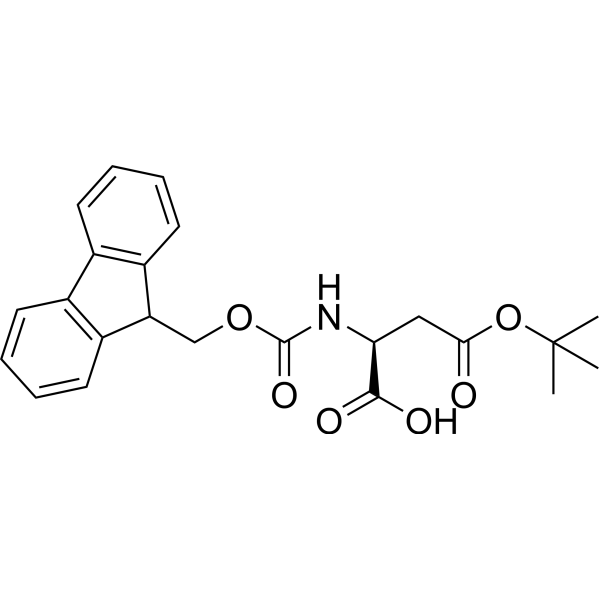
Fmoc-Asp(OtBu)-OH (4-tert-Butyl N-(fluoren-9-ylmethoxycarbonyl)-L-aspartate) is an aspartate derivative containing amine protecting group Fmoc. Fmoc-Asp(OtBu)-OH can be used for peptide synthesis .
|
-
-
- HY-W013081
-
|
|
Amino Acid Derivatives
|
Others
|
|
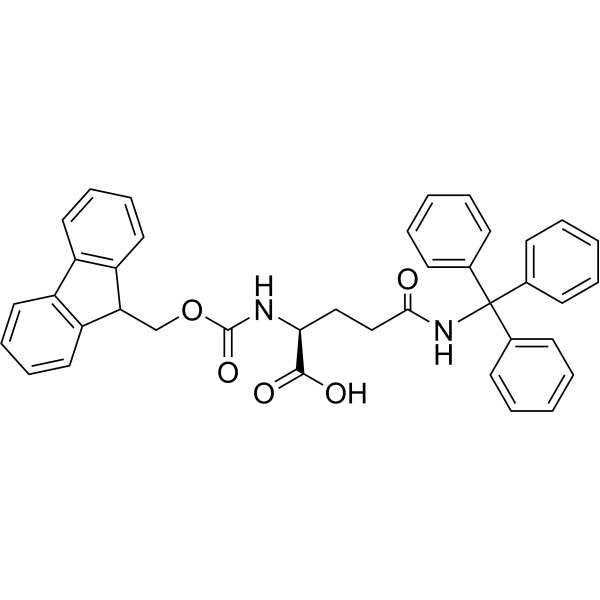
Fmoc-Gln(Trt)-OH is a glutamine derivative containing amine protecting group Fmoc. Fmoc-Gln(Trt)-OH can be used in solid-phase peptide synthesis .
|
-
-
- HY-W440823A
-
|
DSPE-PEG1000-NH2 ammonium
|
Liposome
|
Cancer
|
|
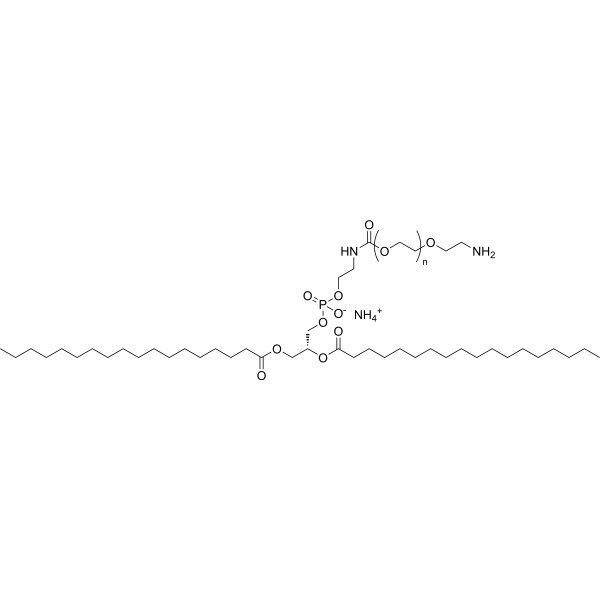
DSPE-PEG1000-Amine (DSPE-PEG1000-NH2) ammonium is a 1,2-distearoyl-sn-glycero-3-phosphoethanolamine-polyethylene glycol conjugate with a terminal amino group. DSPE-PEG1000-Amine ammonium can functionalize the surface of PLGA-lecithin-PEG core-shell nanoparticles to introduce positive surface charges. The amino group of DSPE-PEG1000-Amine ammonium can be converted into an aromatic aldehyde to react with the acetone-protected aromatic hydrazide on the surface of bovine carbonic anhydrase (BCA) molecules .
|
-
-
- HY-W012001
-
|
|
PROTAC Linkers
|
Cancer
|
|
Boc-7-Aminoheptanoic acid can be used as a PROTAC linker in the synthesis of PROTACs and other conjugation applications. Boc-7-Aminoheptanoic acid is an alkane chain with terminal carboxlic acid and Boc-protected amino groups. The terminal carboxylic acid can react with primary amine groups in the presence of activators (e.g. EDC, or HATU) to form a stable amide bond. The Boc group can be deprotected under mild acidic conditions to form the free amine.
|
-

-
- HY-42773
-
|
1-Boc-1,8-diaminooctane
|
PROTAC Linkers
|
Cancer
|
|
tert-Butyl (8-aminooctyl)carbamate (1-Boc-1,8-diaminooctane) can be used as a PROTAC linker in the synthesis of PROTACs. tert-butyl (8-aminooctyl)carbamate is an alkane chain with terminal amine and Boc-protected amino groups. Amine group is reactive with carboxylic acids, activated NHS esters, carbonyls (ketone, aldehyde) etc. The Boc group can be deprotected under mild acidic conditions to form the free amine.
|
-

-
- HY-W097128
-
|
|
PROTAC Linkers
|
Cancer
|
|
Fmoc-12-aminododecanoic acid is an alkane chain with terminal Fmoc-protected amine and carboxylic acid groups. The compound can be used as a PROTAC linker in the synthesis of PROTACs. The Fmoc group can be deprotected under basic condition to obtain the free amine which can be used for further conjugations. The terminal carboxylic acid can react with primary amine groups in the presence of activators (e.g. EDC, or HATU) to form a stable amide bond.
|
-

-
- HY-W047688
-
|
1-Boc-1,10-diaminodecane
|
PROTAC Linkers
|
Cancer
|
|
tert-Butyl (10-aminodecyl) carbamate (1-Boc-1,10-diaminodecane) is a synthetic intermediate that serves as a PROTAC linker in PROTAC synthesis and other conjugation applications. tert-Butyl (10-aminodecyl) carbamate is an alkane chain with a terminal amine and a Boc-protected amino group. The amine group can react with carboxylic acids, active NHS esters, carbonyl groups (ketones, aldehydes), etc. The Boc group can be deprotected under mild acidic conditions to form a free amine .
|
-

-
- HY-W041856
-
|
Boc-8-aminooctanoic acid
|
PROTAC Linkers
|
Cancer
|
|
N-Boc-8-amino-octanoic acid (Boc-8-aminooctanoic acid) can be used as a PROTAC linker in the synthesis of PROTACs. N-Boc-8-amino-octanoic acid is an alkane chain with terminal carboxlic acid and Boc-protected amino groups. The terminal carboxylic acid can react with primary amine groups in the presence of activators (e.g. EDC, or HATU) to form a stable amide bond. The Boc group can be deprotected under mild acidic conditions to form the free amine.
|
-

-
- HY-W575291
-
|
N-Boc-oct-7-yn-1-amine
|
Biochemical Assay Reagents
|
Others
|
|
tert-Butyl oct-7-yn-1-ylcarbamate (N-Boc-oct-7-yn-1-amine) is crosslinker consisting of a propargyl group and a t-Boc protected amine group. The propargyl group reacts with azide-bearing compounds or biomolecules via copper catalyzed Click Chemistry reactions. The t-Boc protected amine can be deprotected under mild acidic conditions.
|
-

-
- HY-W009030
-
|
|
PROTAC Linkers
|
Cancer
|
|
N-Fmoc-8-aminooctanoic acid can be used as a PROTAC linker in the synthesis of PROTACs. N-Fmoc-8-aminooctanoic acid is an alkane chain with terminal Fmoc-protected amine and carboxylic acid groups. The Fmoc group can be deprotected under basic condition to obtain the free amine which can be used for further conjugations. The terminal carboxylic acid can react with primary amine groups in the presence of activators (e.g. EDC, or HATU) to form a stable amide bond.
|
-

-
- HY-W009056
-
|
|
PROTAC Linkers
|
Cancer
|
|
Fmoc-7-amino-heptanoic acid is an alkane chain with terminal Fmoc-protected amine and carboxylic acid groups. Fmoc-7-amino-heptanoic acid can be used as a PROTAC linker in the synthesis of PROTACs. The Fmoc group can be deprotected under basic condition to obtain the free amine which can be used for further conjugations. The terminal carboxylic acid can react with primary amine groups in the presence of activators (e.g. EDC, or HATU) to form a stable amide bond.
|
-

-
- HY-W039729
-
|
|
Biochemical Assay Reagents
|
Others
|
|
5-(Boc-amino)-1-pentanol is a linker containing a hydroxyl group and Boc-protected amino group. The hydroxyl group enables further derivatization or replacement with other reactive functional groups. The Boc group can be deprotected under mild acidic conditions to form the free amine.
|
-

-
- HY-W005828
-
|
|
PROTAC Linkers
|
Cancer
|
|
9-(Boc-amino)nonanoic Acid is an alkane chain with terminal carboxlic acid and Boc-protected amino groups. 9-(Boc-amino)nonanoic acid can be used as a PROTAC linker in the synthesis of PROTACs. The terminal carboxylic acid can react with primary amine groups in the presence of activators (e.g. EDC, or HATU) to form a stable amide bond. The Boc group can be deprotected under mild acidic conditions to form the free amine.
|
-

-
- HY-155908
-
|
DSPE-PEG10000-NH2 ammonium
|
Liposome
|
Others
|
|
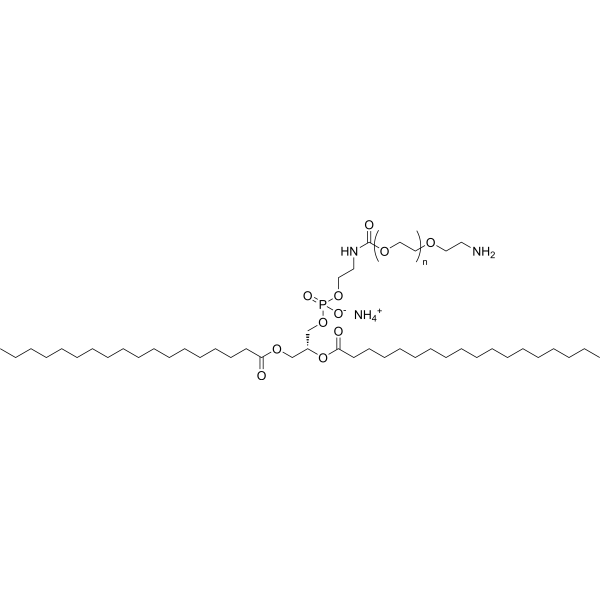
DSPE-PEG10000-Amine ammonium is a phosphoethanolamine involved in the synthesis of liposomes for delivery systems. The amino group of DSPE-PEG10000-Amine ammonium can be converted into aromatic aldehydes by reacting with acetone-protected aromatic hydrazines on the surface of bovine carbonic anhydrase (BCA) molecules. Liposomes form a liposome-BAH-BCA conjugate by forming a bisarylhydrazone (BAH) with the target enzyme molecule. The conjugate catalyzes the hydration of carbon dioxide to bicarbonate.
|
-
-
- HY-155907
-
|
DSPE-PEG5000-NH2 ammonium
|
Liposome
|
Others
|
|
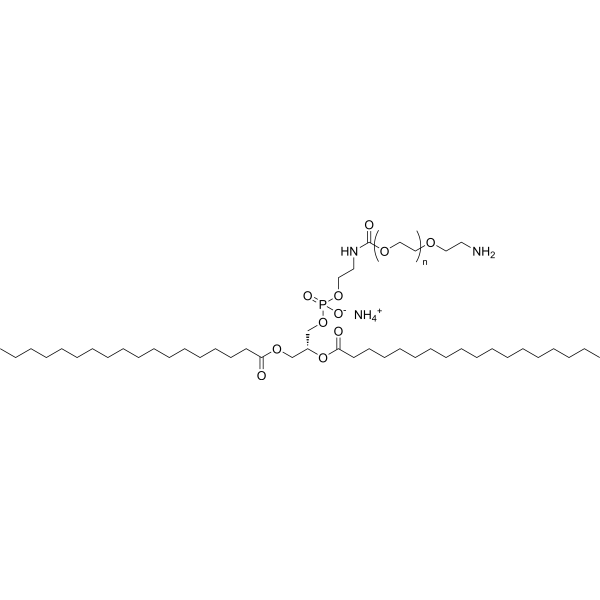
DSPE-PEG5000-Amine ammonium is a phosphoethanolamine involved in the synthesis of liposomes for delivery systems. DSPE-PEG5000-Amine ammonium amino group can be converted to aromatic aldehydes that react with acetone-protected aromatic hydrazides on the surface of the bovine carbonic anhydrase (BCA) molecule. Liposomes produce liposome-Bah-BCA conjugates by forming diaryl hydrazone (BAH) with target enzyme molecules. The conjugate catalyzes the hydration of carbon dioxide to bicarbonate.
|
-
-
- HY-W1049061
-
|
|
Biochemical Assay Reagents
|
Others
|
|
Boc-NH-PEG2000-COOH is a linear hetero-bifunctional PEG product with one Boc-protected amine and one carboxyl group. Boc-NH-PEG2000-COOH is an important cross-linker with PEG chains .
|
-

-
- HY-140232B
-
|
|
Biochemical Assay Reagents
|
Others
|
|
BOC-NH-PEG2000-NH2 is a linear hetero-bifunctional PEG product with one Boc-protected amine and one amino group. BOC-NH-PEG2000-NH2 is an important cross-linker with PEG chains .
|
-

-
- HY-W259542
-
|
|
Biochemical Assay Reagents
|
Others
|
|
O-Proparagyl-N-Boc-ethanolamine is crosslinker consisting of a propargyl group and a t-Boc protected amine group. The propargyl group reacts with azide-bearing compounds or biomolecules via copper catalyzed Click Chemistry reactions. The t-Boc protected amine can be deprotected under mild acidic conditions.
|
-

-
- HY-42222
-
|
|
Biochemical Assay Reagents
|
Others
|
|
N1,N5-Bis-Boc-spermidine is a linker containing an amino group with two Boc-protected amino groups. The amino group is reactive with carboxylic acids, activated NHS esters, carbonyls (ketone, aldehyde) etc. The Boc group can be deprotected under mild acidic conditions to form the free amine.
|
-

-
- HY-W088805
-
|
Fmoc-3-carboxypiperidine
|
Amino Acid Derivatives
|
Others
|
|
Fmoc-NIP-OH (Fmoc-3-carboxypiperidine) is a Fmoc-protected amino acid derivative commonly used in peptide synthesis .
|
-

-
- HY-W141765
-
|
|
Biochemical Assay Reagents
|
Others
|
|
Fmoc-Cit-PAB-OH is a peptide linker containing an Fmoc-protected amine and citrulline residue. The Fmoc group can be deprotected under basic conditions to obtain the free amine, which can be used for further conjugations.
|
-

-
- HY-W101722
-
|
|
PROTAC Linkers
|
Cancer
|
|
tert-Butyl (9-aminononyl)carbamate is an alkane chain with terminal amine and Boc-protected amino groups. The compound can be used as a PROTAC linker in the synthesis of PROTACs and other conjugation applications. Amine group is reactive with carboxylic acids, activated NHS esters, carbonyls (ketone, aldehyde) etc. The Boc group can be deprotected under mild acidic conditions to form the free amine.
|
-

-
- HY-W089232
-
|
|
PROTAC Linkers
|
Cancer
|
|
Boc-10-Aminodecanoic acid can be used as a PROTAC linker in the synthesis of PROTACs and other conjugation applications. Boc-10-Aminodecanoic acid is an alkane chain with terminal carboxlic acid and Boc-protected amino groups. The terminal carboxylic acid can react with primary amine groups in the presence of activators (e.g. EDC, or HATU) to form a stable amide bond. The Boc group can be deprotected under mild acidic conditions to form the free amine.
|
-

-
- HY-W101723
-
|
|
PROTAC Linkers
|
Cancer
|
|
Boc-12-Ado-OH can be used as a PROTAC linker in the synthesis of PROTACs. Boc-12-Ado-OH is an alkane chain with terminal carboxlic acid and Boc-protected amino groups. The terminal carboxylic acid can react with primary amine groups in the presence of activators (e.g. EDC, or HATU) to form a stable amide bond. The Boc group can be deprotected under mild acidic conditions to form the free amine.
|
-

-
- HY-140232D
-
|
|
Biochemical Assay Reagents
|
Others
|
|
BOC-NH-PEG5000-NH2 is a linear hetero-bifunctional PEG product with one Boc-protected amine and one amino group. BOC-NH-PEG5000-NH2 is an important cross-linker with PEG chains .
|
-

-
- HY-W800846
-
|
|
Biochemical Assay Reagents
|
Others
|
|
Fmoc-Amido-Tri-(carboxyethoxymethyl)-methane is a multifunctional reagent containing three carboxylic acids and a primary amine that is Fmoc-protected. The carboxylic acids can react with primary amine groups to form stable amide bonds. The Fmoc protecting group can be removed using piperidine, freeing up the amine for a variety of uses such as coupling with carboxylic acids to form amide bonds.
|
-

-
- HY-43781
-
|
|
Biochemical Assay Reagents
|
Others
|
|
Fmoc-Lys(Boc)-PAB-OH is a peptide linker containing an Fmoc-protected amine and a Boc-protected lysine residue. The Fmoc group can be deprotected under basic condition to obtain the free amine which can be used for further conjugations.
|
-

-
- HY-W348348
-
|
|
Biochemical Assay Reagents
|
Others
|
|
CbzNH-PEG3-CH2CH2NH2 is a PEG linker containing an amine group and a benzyl (Cbz) protecting group. The hydrophilic PEG spacer increases the water solubility of a compound in aqueous media. Amine group is reactive with carboxylic acids, activated NHS esters, carbonyls (ketone, aldehyde), etc. The benzyl protecting group can be removed via hydrogenolysis to form a free amine.
|
-

-
- HY-W591977
-
|
|
Biochemical Assay Reagents
|
Others
|
|
Boc-5-aminopentanoic NHS ester is a linker containing an NHS ester and a t-Boc protected amine group. The t-Boc group can be deprotected under mild acidic conditions to form a free amine. The NHS ester can be used to label the primary amines (-NH2) of proteins, amine-modified oligonucleotides, and other amine-containing molecules.
|
-

-
- HY-W460133
-
|
|
Biochemical Assay Reagents
|
Others
|
|
tert-Butyl (2-(2-(2-iodoethoxy)ethoxy)ethyl)carbamate is a PEG linker containing a Boc protected amine and an iodine group. The protected amine can be deprotected under mild acidic conditions. Iodine (I) is a very good leaving group for nucleophilic substitution reactions. The hydrophilic PEG spacer increases solubility in aqueous media.
|
-

-
- HY-W591969
-
|
|
Biochemical Assay Reagents
|
Others
|
|
Benzyl (6-oxohexyl)carbamate is a linker containing an aldehyde group and a benzyl (Cbz) protecting group. The aldehyde can react with hydrazine or hydrazide to form a hydrolytic acyl hydrozone linkage. The benzyl protecting group can be removed via hydrogenolysis to form a free amine.
|
-

-
- HY-W403327
-
|
|
Biochemical Assay Reagents
|
Others
|
|
CbzNH-PEG4-CH2COOH is a PEG linker containing an carboxylic acid (CO2H) group and a benzyl (Cbz) protecting group. The hydrophilic PEG spacer increases the water solubility of a compound in aqueous media. The terminal carboxylic acid is reactive with primary amine groups in the presence of activators (e.g. HATU) forming a stable amide bond. The benzyl protecting group can be removed via hydrogenolysis to form a free amine.
|
-

-
- HY-W451433
-
|
|
Biochemical Assay Reagents
|
Others
|
|
OTs-PEG1-NHCbz is a PEG linker containing a tosyl group and benzyl (Cbz) protecting group. The hydrophilic PEG spacer increases the water solubility of the compound in aqueous media. The tosyl group is a very good leaving group for nucleophilic substitution reactions. The benzyl protecting group can be removed via hydrogenolysis to form a free amine.
|
-

-
- HY-W190958
-
|
|
Biochemical Assay Reagents
|
Others
|
|
Boc-NH-Tri-(carbonylethoxymethyl)-methane is a branched PEG linker with a Boc-protected amino and three terminal carboxilic acid groups. The Boc group can be deprotected under mild acidic conditions to form the free amine. The terminal carboxylic acid groups can react with primary amine groups in the presence of activators (e.g. EDC, or HATU) to form a stable amide bond.
|
-

-
- HY-W286613
-
|
|
Biochemical Assay Reagents
|
Others
|
|
N-Boc-Biocytin is a biotin PEG linker containing a carboxylic group and Boc-protected amine. Reaction of carboxylic with primary amino (-NH2) forms stable, irreversible amide bonds. The Boc group can be deprotected under acidic condition to obtain the free amine which can be used for further conjugations.
|
-

-
- HY-W131541
-
|
|
PROTAC Linkers
|
Cancer
|
|
tert-Butyl (11-aminoundecyl)carbamate is an alkane chain with terminal amine and Boc-protected amino groups. tert-Butyl (11-aminoundecyl)carbamate can be used as a PROTAC linker in the synthesis of PROTACs and other conjugation applications. Amine group is reactive with carboxylic acids, activated NHS esters, carbonyls (ketone, aldehyde) etc. The Boc group can be deprotected under mild acidic conditions to form the free amine.
|
-

-
- HY-W800658
-
|
|
Biochemical Assay Reagents
|
Others
|
|
DBCO-PEG6-NH-Boc is a click chemistry reagent with a DBCO group and a Boc-protected amine. The DBCO can undergo copper-free Click Chemistry reactions with azides. The Boc protecting group can be removed under acidic conditions. The hydrophilic PEG linker increases the water solubility of the compound.
|
-

-
- HY-W111228
-
|
|
PROTAC Linkers
|
Cancer
|
|
Fmoc-9-aminononanoic acid is an alkane chain with terminal Fmoc-protected amine and carboxylic acid groups. The compound can be used as a PROTAC linker in the synthesis of PROTACs and and other conjugation applications. The Fmoc group can be deprotected under basic condition to obtain the free amine which can be used for further conjugations. The terminal carboxylic acid can react with primary amine groups in the presence of activators (e.g. EDC, or HATU) to form a stable amide bond.
|
-

-
- HY-W097110
-
|
|
PROTAC Linkers
|
Cancer
|
|
Fmoc-11-aminoundecanoic acid can be used as a PROTAC linker in the synthesis of PROTACs and other conjugation applications. Fmoc-11-aminoundecanoic acid is an alkane chain with terminal Fmoc-protected amine and carboxylic acid groups. The Fmoc group can be deprotected under basic condition to obtain the free amine which can be used for further conjugations. The terminal carboxylic acid can react with primary amine groups in the presence of activators (e.g. EDC, or HATU) to form a stable amide bond.
|
-

-
- HY-W591968
-
|
|
PROTAC Linkers
|
Cancer
|
|
14-(Fmoc-amino)-tetradecanoic acid can be used as a PROTAC linker in the synthesis of PROTACs. 14-(Fmoc-amino)-tetradecanoic acid is an alkane chain with terminal Fmoc-protected amine and carboxylic acid groups. The Fmoc group can be deprotected under basic condition to obtain the free amine which can be used for further conjugations. The terminal carboxylic acid can react with primary amine groups in the presence of activators (e.g. EDC, or HATU) to form a stable amide bond.
|
-

-
- HY-W800625
-
|
|
ADC Linker
|
Cancer
|
|
Boc-PEG4-Val-Cit-PAB-OH is an enzyme-cleavable ADC linker featuring a Boc-protected amine, a hydrophilic PEG spacer, and a Val-Cit-PAB dipeptide. The benzylic alcohol on the PAB can be used to attach with reactive groups such as PNP for conjugation with drug payloads. The Boc protecting group may be removed with acid to reveal a primary amine which may be used in coupling reactions to form amides. The Val-Cit-PAB is cleaved by cellular proteases for efficient release of payloads to the cell.
|
-

-
- HY-W800621
-
|
|
ADC Linker
|
Cancer
|
|
Fmoc-PEG2-Val-Cit-PAB-OH is an enzyme-cleavable ADC linker featuring a Boc-protected amine, a hydrophilic PEG spacer, and a Val-Cit-PAB dipeptide. The benzylic alcohol on the PAB can be used to attach with reactive groups such as PNP for conjugation with drug payloads. The Fmoc protecting group may be removed with piperidine to reveal a primary amine for use in coupling reactions to form amides. The Val-Cit-PAB is cleaved by cellular proteases for efficient release of payloads to the cell.
|
-

-
- HY-W800623
-
|
|
ADC Linker
|
Cancer
|
|
Fmoc-PEG6-Val-Cit-PAB-OH is an enzyme-cleavable ADC linker featuring a Boc-protected amine, a hydrophilic PEG spacer, and a Val-Cit-PAB dipeptide. The benzylic alcohol on the PAB can be used to attach with reactive groups such as PNP for conjugation with drug payloads. The Fmoc protecting group may be removed with piperidine to reveal a primary amine which may be used in coupling reactions to form amides. The Val-Cit-PAB is cleaved by cellular proteases for efficient release of payloads to the cell.
|
-

-
- HY-W800624
-
|
|
ADC Linker
|
Cancer
|
|
Boc-PEG2-Val-Cit-PAB-OH is an enzyme-cleavable ADC linker featuring a Boc-protected amine, a hydrophilic PEG spacer, and a Val-Cit-PAB dipeptide. The benzylic alcohol on the PAB can be used to attach with reactive groups such as PNP for conjugation with drug payloads. The Boc protecting group may be removed with acid to reveal a primary amine which may be used in coupling reactions to form amides. The Val-Cit-PAB is cleaved by cellular proteases for efficient release of payloads to the cell.
|
-

-
- HY-W800622
-
|
|
ADC Linker
|
Cancer
|
|
Fmoc-PEG4-Val-Cit-PAB-OH is an enzyme-cleavable ADC linker featuring a Boc-protected amine, a hydrophilic PEG spacer, and a Val-Cit-PAB dipeptide. The benzylic alcohol on the PAB can be used to attach with reactive groups such as PNP for conjugation with drug payloads. The Fmoc protecting group may be removed with piperidine to reveal a primary amine which may be used in coupling reactions to form amides. The Val-Cit-PAB is cleaved by cellular proteases for efficient release of payloads to the cell.
|
-

-
- HY-140232A
-
|
Boc-NH-PEG1000-amine
|
Biochemical Assay Reagents
|
Others
|
|
BOC-NH-PEG1000-NH2 (Boc-NH-PEG1000-Amine) is a linear hetero-bifunctional PEG product with one Boc-protected amine and one amino group. BOC-NH-PEG1000-NH2 is an important cross-linker with PEG chains .
|
-

-
- HY-140232H
-
|
Boc-NH-PEG20000-amine
|
Biochemical Assay Reagents
|
Others
|
|
BOC-NH-PEG20000-NH2 (Boc-NH-PEG20000-Amine) is a linear hetero-bifunctional PEG product with one Boc-protected amine and one amino group. BOC-NH-PEG20000-NH2 is an important cross-linker with PEG chains .
|
-

-
- HY-140232E
-
|
Boc-NH-PEG10000-amine
|
Biochemical Assay Reagents
|
Others
|
|
BOC-NH-PEG10000-NH2 (Boc-NH-PEG10000-Amine) is a linear hetero-bifunctional PEG product with one Boc-protected amine and one amino group. BOC-NH-PEG10000-NH2 is an important cross-linker with PEG chains .
|
-

-
- HY-140232I
-
|
Boc-NH-PEG40000-amine
|
Biochemical Assay Reagents
|
Others
|
|
BOC-NH-PEG40000-NH2 (Boc-NH-PEG40000-Amine) is a linear hetero-bifunctional PEG product with one Boc-protected amine and one amino group. BOC-NH-PEG40000-NH2 is an important cross-linker with PEG chains .
|
-

- HY-W092176
-
|
|
Biochemical Assay Reagents
|
Others
|
|
1,9-Bis-Boc-1,5,9-triazanonane is a linker containing two Boc-protected amino groups. The Boc groups can be deprotected under mild acidic conditions to form the free amines.
|
-

- HY-W800828
-
|
|
Biochemical Assay Reagents
|
Others
|
|
Iodoacetamido-PEG3-NHS ester is a PEG reagent containing an Iodoacetamide group and a Boc-protected amino group. The iodoacetamide group is an alkylating agent that can be used to bind covalently with the thiol group. The Boc group can be deprotected under mild acidic conditions to form the free amine.
|
-

- HY-W591439
-
|
|
Biochemical Assay Reagents
|
Others
|
|
Fmoc-Lys(Boc)-PAB-PNP is a Boc-protected Lysine linked to 4-aminobenzoiate (PAB) with terminal Fmoc and PNP groups. The Fmoc group can be deprotected under basic conditions to release the free amine which can be used for further conjugations.
|
-

- HY-W591964
-
|
|
Biochemical Assay Reagents
|
Others
|
|
t-Boc-Aminooxy-pentane-azide is a linker containing an azide group and Boc-protected amino group. The azide group can react with alkyne, BCN, DBCO via Click Chemistry to yield a stable triazole linkage. The Boc group can be deprotected under mild acidic conditions to form the free amine.
|
-

- HY-W591982
-
|
|
Biochemical Assay Reagents
|
Others
|
|
t-Boc-N-amido-PEG12-acid is a PEG linker containing a terminal carboxylic acid and Boc-protected amino group. The hydrophilic PEG spacer increases solubility in aqueous media. The terminal carboxylic acid can react with primary amine groups in the presence of activators (e.g. EDC, or HATU) to form a stable amide bond. The Boc group can be deprotected under mild acidic conditions to form the free amine.
|
-

- HY-W190905
-
|
|
Biochemical Assay Reagents
|
Others
|
|
N4, N9-di-Boc-spermine is a spermine linker containing two a Boc-protected amino groups and two amine groups. The Boc groups can be deprotected under mild acidic conditions to form the free amine. The amino groups are reactive with carboxylic acids, activated NHS esters, carbonyls (ketone, aldehyde) etc. Spermidine is a polyamine that modulates various cellular activities like cellular development and differentiation, stability of DNA, and apoptosis.
|
-

- HY-W591967
-
|
|
PROTAC Linkers
|
Cancer
|
|
N-Boc-15-aminopentadecanoic acid is an alkane chain with terminal carboxlic acid and Boc-protected amino groups. N-Boc-15-aminopentadecanoic acid can be used as a PROTAC linker in the synthesis of PROTACs. The terminal carboxylic acid can react with primary amine groups in the presence of activators (e.g. EDC, or HATU) to form a stable amide bond. The Boc group can be deprotected under mild acidic conditions to form the free amine.
|
-

- HY-W190930
-
|
|
Biochemical Assay Reagents
|
Others
|
|
t-Butyl 1,5-di(ethoxycarbonyl)pentan-3-ylcarbamate is a branched molecule with an n-Boc group and two ethyl ester moieties. The Boc-protected amine can be deprotected under acidic conditions.
|
-

- HY-42213
-
|
|
Biochemical Assay Reagents
|
Others
|
|
N1,N4-Bis-Boc-spermidine is a linker containing an amino group with two Boc-protected amino groups. The amino group is reactive with carboxylic acids, activated NHS esters, carbonyls (ketone, aldehyde) etc. The Boc group can be deprotected under mild acidic conditions to form the free amine.
|
-

- HY-W1049061E
-
|
|
Biochemical Assay Reagents
|
Others
|
|
Boc-NH-PEG1000-COOH is a linear hetero-bifunctional PEG product with one Boc-protected amine and one carboxyl group. Boc-NH-PEG1000-COOH is an important cross-linker with PEG chains .
|
-

- HY-W1049061D
-
|
|
Biochemical Assay Reagents
|
Others
|
|
Boc-NH-PEG40000-COOH is a linear hetero-bifunctional PEG product with one Boc-protected amine and one carboxyl group. Boc-NH-PEG40000-COOH is an important cross-linker with PEG chains .
|
-

- HY-W1049061A
-
|
|
Biochemical Assay Reagents
|
Others
|
|
Boc-NH-PEG5000-COOH is a linear hetero-bifunctional PEG product with one Boc-protected amine and one carboxyl group. Boc-NH-PEG5000-COOH is an important cross-linker with PEG chains .
|
-

- HY-W1049061H
-
|
|
Biochemical Assay Reagents
|
Others
|
|
Boc-NH-PEG3400-COOH is a linear hetero-bifunctional PEG product with one Boc-protected amine and one carboxyl group. Boc-NH-PEG3400-COOH is an important cross-linker with PEG chains .
|
-

- HY-140232C
-
|
|
Biochemical Assay Reagents
|
Others
|
|
BOC-NH-PEG3400-NH2 is a linear hetero-bifunctional PEG product with one Boc-protected amine and one amino group. BOC-NH-PEG3400-NH2 is an important cross-linker with PEG chains .
|
-

- HY-Y1636S1
-
-
- HY-W457953
-
|
|
Biochemical Assay Reagents
|
Others
|
|
tert-Butyl N-(4-azidobutyl)carbamate is N-Boc protected crosslinker. tert-Butyl N-(4-azidobutyl)carbamate can react with alkyne, BCN, DBCO via Click Chemistry to yield a stable triazole linkage. The Boc group can be deprotected under mild acidic conditions to form the free amine.
|
-

- HY-177344
-
|
|
Biochemical Assay Reagents
|
Cancer
|
|
IAJD-97 is a single-component ionizable amphiphilic Janus dendrimer carrier targeting mRNA delivery, which self-assembles into dendrimersomes (DNPs) via pH-responsive mechanisms to efficiently encapsulate and protect mRNA, while facilitating cellular uptake and endosomal escape through ionizable amine groups. IAJD-97 is promising for research of cancers .
|
-

- HY-W800660
-
|
|
Biochemical Assay Reagents
|
Others
|
|
endo-BCN-PEG4-Boc-amine is a PEG linker containing a BCN group and a Boc-protected amine. The protected amine can be deprotected under mild acidic conditions. The BCN group can react with azide-tagged biomolecules.
|
-

- HY-172719
-
|
|
Biochemical Assay Reagents
|
Others
|
|
Fmoc-PEG9-alcohol is a heterobifunctional PEG linker featuring a Fmoc-protected primary amine and an alcohol group. The hydroxy group is a versatile functionality while the Fmoc protecting group can be removed with base to reveal a primary amine.
|
-

- HY-W591971
-
|
|
Biochemical Assay Reagents
|
Others
|
|
5-((tert-Butoxycarbonyl)amino)pentyl 4-methylbenzenesulfonate is a PEG linker containing a Boc protected amine and a tosyl group. The protected amine can be deprotected under mild acidic conditions. The tosyl group is a very good leaving group for nucleophilic substitution reactions.
|
-

- HY-W590586
-
|
|
Biochemical Assay Reagents
|
Others
|
|
Mal-PEG4-NH-Boc is a PEG linker containing a maleimide group and a Boc protected amine group. The hydrophilic PEG spacer increases solubility in aqueous media. The protected amine can be deprotected under acidic conditions. The maleimide group will react with a thiol group to form a covalent bond.
|
-

- HY-W800803
-
|
|
Biochemical Assay Reagents
|
Others
|
|
Mal-PEG5-NH-Boc is a PEG linker containing a maleimide group and a Boc protected amine group. The hydrophilic PEG spacer increases solubility in aqueous media. The protected amine can be deprotected under acidic conditions. The maleimide group will react with a thiol group to form a covalent bond.
|
-

- HY-W800684
-
|
|
Biochemical Assay Reagents
|
Others
|
|
Benzyloxy carbonyl-PEG4-NHS ester is a reagent with a benzyl protecting group and an NHS ester. The NHS ester reacts with primary amines (-NH2). The benzyl protecting group can be removed by hydrogenolysis.
|
-

- HY-W160298
-
|
|
Biochemical Assay Reagents
|
Others
|
|
N-Cbz-7-Aminoheptanoic acid is a six carbon linker containing an carboxylic acid (CO2H) group and a benzyl (Cbz) protecting group. The terminal carboxylic acid is reactive with primary amine groups in the presence of activators (e.g. EDC, or HATU) forming a stable amide bond. The benzyl protecting group can be removed via hydrogenolysis to form a free amine.
|
-

- HY-W479025
-
|
|
Biochemical Assay Reagents
|
Others
|
|
Fmoc-DODA hydrochloride is a linker with an Fmoc-protected amine and a terminal amine group. The Fmoc group can be deprotected under basic condition to obtain the free amine which can be used for further conjugations. The amino group is reactive with carboxylic acids, activated NHS esters, carbonyls (ketone, aldehyde) etc.
|
-

- HY-W154175
-
|
|
Biochemical Assay Reagents
|
Others
|
|
Boc-DODA is a linker containing a Boc-protected amino group and a terminal amine. The Boc group can be deprotected under mild acidic conditions to form the free amine. The terminal amine is reactive with carboxylic acids, activated NHS esters, carbonyls (ketone, aldehyde) etc.
|
-

- HY-W800681
-
|
|
Biochemical Assay Reagents
|
Others
|
|
Benzyloxy carbonyl-PEG4-acid is a linker with a benzyl protecting group and a carboxylic acid. The carboxylic acid can undergo reactions with primary amines with the help of activators (EDC or HATU). The benzyl protecting group can be removed via hydrogenolysis.
|
-

- HY-W591973
-
|
|
Biochemical Assay Reagents
|
Others
|
|
OTs-C6-NHBoc is a six carbon linker containing a tosyl group and Boc-protected amine group. The tosyl group is a very good leaving group for nucleophilic substitution reactions. The Boc group can be deprotected under mild acidic conditions to form a free amine.
|
-

- HY-W800804
-
|
|
Biochemical Assay Reagents
|
Others
|
|
Fmoc-Ala-PAB-OH is a peptide linker containing an Fmoc-protected amine and an alanine residue. The Fmoc group can be deprotected under basic condition to obtain the free amine which can be used for further conjugations.
|
-

- HY-W590588
-
|
|
Biochemical Assay Reagents
|
Others
|
|
Diethyl acetal-PEG4-amine is a PEG reagent containing an amino (NH2) group and a terminal diethyl acetal protecting group, which can be deprotected to form the free aldehyde. NH2 group is reactive with carboxylic acids, activated NHS esters, carbonyls (ketone, aldehyde), etc.
|
-

- HY-W092344
-
|
|
Biochemical Assay Reagents
|
Others
|
|
1,5-Bis-Boc-1,5,9-triazanonane is a linker containing two Boc-protected amino groups and a terminal amine. The Boc groups can be deprotected under mild acidic conditions to form the free amines. The terminal amine is reactive with carboxylic acids, activated NHS esters, carbonyls (ketone, aldehyde) etc.
|
-

- HY-W190934
-
|
|
Biochemical Assay Reagents
|
Others
|
|
Fmoc-Ala-Pro-OH is a linker with an Fmoc-protected amine and a terminal carboxylic acid. The Fmoc group can be deprotected under basic condition to obtain the free amine which can be used for further conjugations. The terminal carboxylic acid can be reacted with primary amine groups in the presence of activators (e.g. EDC, or HATU) to form a stable amide bond.
|
-

- HY-W460275
-
|
|
Biochemical Assay Reagents
|
Others
|
|
t-Boc-N-Amido-PEG5-Tos is a PEG linker containing a tosyl group and Boc-protected amine group. The hydrophilic PEG spacer increases the water solubility of a compound in aqueous media. The tosyl group is a very good leaving group for nucleophilic substitution reactions. The Boc group can be deprotected under mild acidic conditions to form a free amine.
|
-

- HY-W800712
-
|
|
Biochemical Assay Reagents
|
Others
|
|
t-Boc-N-Amido-PEG11-Tos is a PEG linker containing a tosyl group and Boc-protected amine group. The hydrophilic PEG spacer increases the water solubility of a compound in aqueous media. The tosyl group is a very good leaving group for nucleophilic substitution reactions. The Boc group can be deprotected under mild acidic conditions to form a free amine.
|
-

- HY-W190720
-
|
|
Biochemical Assay Reagents
|
Others
|
|
Fmoc-NH-PEG4-HZ-BOC is a PEG reagent containing an Fmoc-protected amine and a Boc-protected hydrazide. The Fmoc group can be deprotected under basic condition to obtain the free amine which can be used for further conjugations. The hydrophilic PEG spacer increases solubility in aqueous media. The Boc can be deprotected under mild acidic conditions to form a reactive hydrazide, which can then be coupled with various carbonyl groups.
|
-

- HY-W590561
-
|
|
Biochemical Assay Reagents
|
Others
|
|
Fmoc-Asp(biotinyl-PEG)-OH is a biotinylation reagent with a Fmoc-protected amino group. The Fmoc group can be deprotected under basic conditions to obtain the free amine which can be used for further conjugations.
|
-

- HY-W800656
-
|
|
Biochemical Assay Reagents
|
Others
|
|
Fmoc-PEG4-hydroxy is a PEG linker containing an Fmoc-protected amine and a hydroxyl group. The hydrophilic PEG spacer increases solubility in aqueous media. The Fmoc group can be deprotected under basic condition to obtain the free amine which can be used for further conjugations. The hydroxyl group enables further derivatization or replacement with other reactive functional groups.
|
-

- HY-W190753
-
|
|
Biochemical Assay Reagents
|
Others
|
|
BocNH-PEG8-CH2CH2COONHS is a PEG linker containing an NHS ester and a Boc-protected amino group. The hydrophilic PEG spacer increases the water solubility of a compound in aqueous media. The Boc group can be deprotected under mild acidic conditions to form a free amine. The NHS ester can be used to label the primary amines (-NH2) of proteins, amine-modified oligonucleotides, and other amine-containing molecules.
|
-

- HY-W598191
-
|
|
Biochemical Assay Reagents
|
Others
|
|
tert-Butyl (3-azidopropyl)carbamate is a reagent containing an azide group and Boc-protected amino group. It is reactive with alkyne, BCN, DBCO via Click Chemistry. The Boc group can be deprotected under mild acidic conditions to form the free amine.
|
-

- HY-W092078
-
|
|
Biochemical Assay Reagents
|
Others
|
|
tert-Butyl (4-iodobutyl)carbamate is a four carbon linker containing a Boc-protected amino group and an iodine group. The Boc group can be deprotected under mild acidic conditions to form the free amine. Iodine (I) is a very good leaving group for nucleophilic substitution reactions.
|
-

- HY-W800833
-
|
|
Biochemical Assay Reagents
|
Others
|
|
Benzyl N-[2-(prop-2-enamido)ethyl]carbamate is a short aliphatic linker featuring a Cbz-protected amine and an acrylamide. Acrylamide is a Michael acceptor which is a good Michael acceptor which can be used in thiol-based bioconjugation or polymerization. Meanwhile, the Cbz protecting group can be removed using Pd-C hydrogenation to reveal a free amine that can participate in a wide variety of reactions such as couplings or reductive amination.
|
-
![Benzyl N-[2-(prop-2-enamido)ethyl]carbamate](//file.medchemexpress.com/product_pic/hy-w800833.gif)
- HY-W800813
-
|
|
Biochemical Assay Reagents
|
Others
|
|
Carboxy-Amido-PEG5-N-Boc is a PEG linker containing a terminal carboxylic acid and Boc-protected amino group. The hydrophilic PEG spacer increases solubility in aqueous media. The terminal carboxylic acid can react with primary amine groups in the presence of activators (e.g. EDC, HATU) to form a stable amide bond. The Boc group can be deprotected under mild acidic conditions to form the free amine.
|
-

- HY-W190904
-
|
|
Biochemical Assay Reagents
|
Others
|
|
2-Amino-1,3-bis(tert-butyldimethylsilanoxy)propane has a TBDMS, acid labile protecting group. TBDMS is used for the protection of alcohol groups. The primary amine is able to react with carboxylic acids, active NHS esters and other carbonyl compounds.
|
-

- HY-400361
-
|
|
Biochemical Assay Reagents
|
Others
|
|
BocNH-PEG2-CH2COONHS ester is a PEG linker containing a terminal carboxylic acid and Boc-protected amino group. The hydrophilic PEG spacer increases solubility in aqueous media. The terminal carboxylic acid can react with primary amine groups in the presence of activators (e.g. EDC, HATU) to form a stable amide bond. The Boc group can be deprotected under mild acidic conditions to form the free amine.
|
-

- HY-WAA0302
-
|
|
Biochemical Assay Reagents
|
Others
|
|
1,4-Bis-Boc-1,4,7-triazaheptane is a PEG derivative containing an amino group with two Boc-protected amino groups. The amino group is reactive with carboxylic acids, activated NHS esters, carbonyls (ketone, aldehyde) etc. The Boc group can be deprotected under mild acidic conditions to form the free amine.
|
-

- HY-W1049061B
-
|
|
Biochemical Assay Reagents
|
Others
|
|
Boc-NH-PEG10000-COOH is a linear hetero-bifunctional PEG product with one Boc-protected amine and one carboxyl group. Boc-NH-PEG10000-COOH is an important cross-linker with PEG chains .
|
-

- HY-W1049061C
-
|
|
Biochemical Assay Reagents
|
Others
|
|
Boc-NH-PEG20000-COOH is a linear hetero-bifunctional PEG product with one Boc-protected amine and one carboxyl group. Boc-NH-PEG20000-COOH is an important cross-linker with PEG chains .
|
-

- HY-W800719
-
|
|
Biochemical Assay Reagents
|
Others
|
|
N-Boc-N'-(PEG1-t-butyl ester)-L-Lysine-amido-Mal is the amino acid, lysine, with a maleimide at its C-terminus, a Boc-protecting group on its α-amine, and an amido-PEG1-t-butyl ester on its ε-amine. Maleimide is a thiol-reactive covalent group used to conjugate cysteine residues, while the Boc and the t-butyl ester can be later deprotected to perform further reactions.
|
-

- HY-W190953
-
|
|
Biochemical Assay Reagents
|
Others
|
|
N1,N12-Di-boc-spermine is a spermine linker containing two a Boc-protected amino groups. The Boc groups can be deprotected under mild acidic conditions to form the free amine. Spermidine is a polyamine that modulates various cellular activities like cellular development and differentiation, stability of DNA, and apoptosis.
|
-

- HY-W578278
-
|
|
Biochemical Assay Reagents
|
Others
|
|
tert-Butyl (2-(pyridin-2-yldisulfanyl)ethyl)carbamate consists of a tert-butyl group, where the protected amine can be deprotected under mild acidic conditions, and the other part of the molecule may act as a thiol-specific labeling reagent, commonly used in reversibly binding cysteine residues on proteins.
|
-

- HY-W190920
-
|
|
Biochemical Assay Reagents
|
Others
|
|
t-Butoxycarbonyl-PEG2-NHS ester has a t-Boc protecting group and an NHS ester moiety. The t-butyl group can be deprotected under acidic conditions. NHS ester can react specifically and efficiently with primary amines such as the side chain of lysine residues or aminosilane-coated surfaces at neutral or slightly basic condition to form a covalent bond. The hydrophilic PEG linker increases the water solubility of the compound in aqueous media.
|
-

- HY-W013081S
-
|
|
Isotope-Labeled Compounds
Amino Acid Derivatives
|
Others
|
|
Fmoc-Gln(Trt)-OH- 13C5, 15N2 is the 13C-labeled and 15N-labeled Fmoc-Gln(Trt)-OH (HY-W013081). Fmoc-Gln(Trt)-OH is a glutamine derivative containing amine protecting group Fmoc. Fmoc-Gln(Trt)-OH can be used in solid-phase peptide synthesis .
|
-

- HY-Y1169S
-
|
|
Isotope-Labeled Compounds
Amino Acid Derivatives
|
Others
|
|
Fmoc-Asp(OtBu)-OH- 15N is the 15N-labeled Fmoc-Asp(OtBu)-OH (HY-Y1169). Fmoc-Asp(OtBu)-OH (4-tert-Butyl N-(fluoren-9-ylmethoxycarbonyl)-L-aspartate) is an aspartate derivative containing amine protecting group Fmoc. Fmoc-Asp(OtBu)-OH can be used for peptide synthesis .
|
-

- HY-79647
-
|
N-(Fmoc-oxy)succinimide
|
Biochemical Assay Reagents
|
Others
|
|
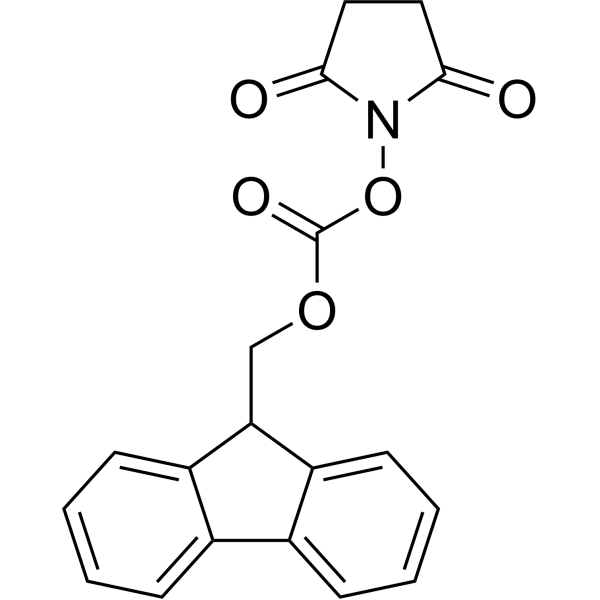
Fmoc-OSu (N-(Fmoc-oxy)succinimide) is an acylating agent that targets amino groups (-NH2). It can selectively protect the amino groups of amino acids by covalently binding with primary or secondary amines through nucleophilic substitution reactions. Fmoc-OSu forms a stable amide bond with the amino group to avoid side reactions of the amino group in peptide synthesis. It can also be used as a fluorescent labeling reagent to react with glycosylamines for efficient labeling of N-sugar chains. Fmoc-OSu can be used as an Fmoc protection strategy in peptide synthesis, and as a fluorescent labeling and analysis method for N-sugar chains .
|
-
- HY-Y1169S1
-
|
|
Isotope-Labeled Compounds
|
Others
|
|
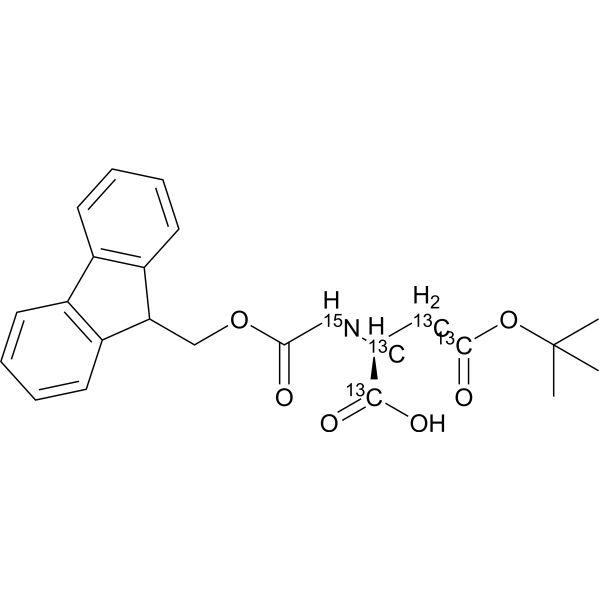
Fmoc-Asp(OtBu)-OH- 13C4, 15N is the 13C and 15N labeled Fmoc-Asp(OtBu)-OH . Fmoc-Asp(OtBu)-OH (4-tert-Butyl N-(fluoren-9-ylmethoxycarbonyl)-L-aspartate) is a aspartate derivative containing amine protecting group Fmoc. Fmoc-Asp(OtBu)-OH can be used for peptide synthesis .
|
-
- HY-135233
-
|
SATA
|
Biochemical Assay Reagents
|
Others
|
|
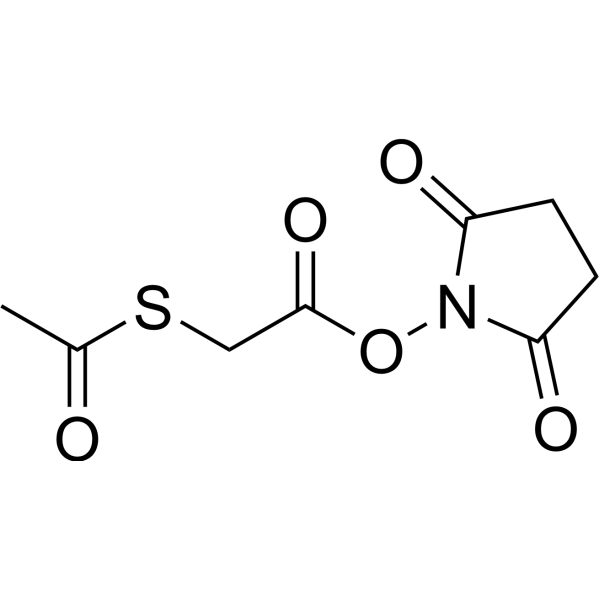
N-Succinimidyl S-acetylthioacetate (SATA) is a protein modifying agent. N-Succinimidyl S-acetylthioacetate adds sulfhydryl groups to proteins and other amine-containing molecules in a protected form. N-Succinimidyl-S-acetylthioacetate can thiolate antibodies, thereby promoting efficient attachment of antibodies to other molecules and exerting conjugation activity. N-Succinimidyl-S-acetylthioacetate can be used in immunoassays such as ELISA studies .
|
-
- HY-151824
-
|
|
ADC Linker
|
Others
|
|
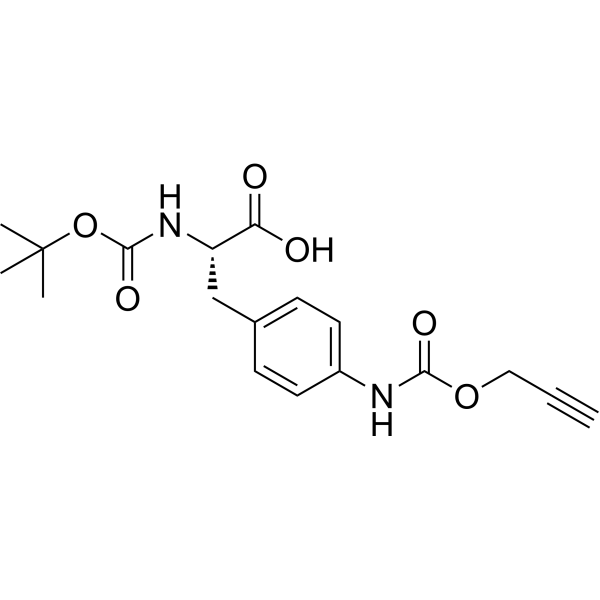
Boc-L-Phe(4-NH-Poc)-OH is a click chemistry reagent containing an azide group. Used as an orthogonally protected building block in peptide synthesis. Propargyloxycarbonyl, commonly abbreviated as Poc or Pryoc, can either be used as alkyne component for standard Click conjugation or in combination with tetrazine linkers in copper-free Diels-Alder type Click reactions. It also has applications as unusual protecting group for amines, hydroxy functions and as esters. All 3 are stable to neat TFA, but can be cleaved at ambient temperature with Co2(CO)8 in TFA:DCM. Deprotection with other transition metals like palladium have also been reported . Boc-L-Phe(4-NH-Poc)-OH is a click chemistry reagent, it contains an Alkyne group and can undergo copper-catalyzed azide-alkyne cycloaddition (CuAAc) with molecules containing Azide groups.
|
-
- HY-Y1636S
-
-

- HY-Y1169S2
-
|
4-tert-Butyl N-(fluoren-9-ylmethoxycarbonyl)-L-aspartate-d3; Fmoc-L-Asp(OtBu)-OH-d3
|
Isotope-Labeled Compounds
Amino Acid Derivatives
|
Others
|
|
Fmoc-Asp(OtBu)-OH-d3 (4-tert-Butyl N-(fluoren-9-ylmethoxycarbonyl)-L-aspartate-d3) is deuterium labeled Fmoc-Asp(OtBu)-OH. Fmoc-Asp(OtBu)-OH (4-tert-Butyl N-(fluoren-9-ylmethoxycarbonyl)-L-aspartate) is a aspartate derivative containing amine protecting group Fmoc. Fmoc-Asp(OtBu)-OH can be used for peptide synthesis .
|
-

- HY-151837
-
|
|
ADC Linker
|
Others
|
|
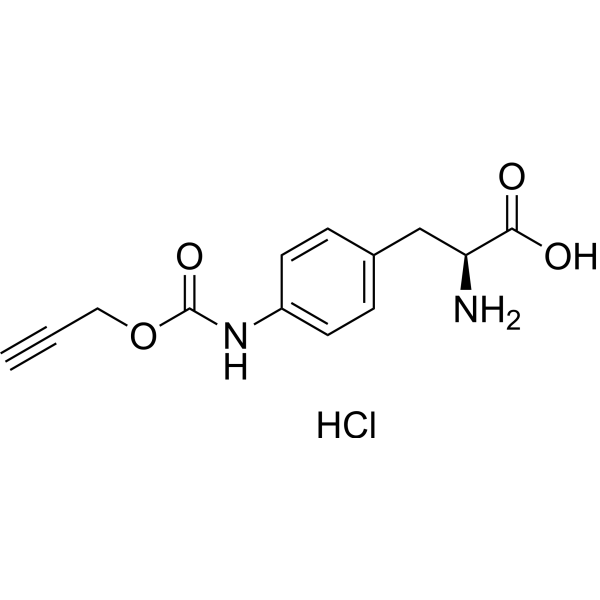
H-L-Phe(4-NH-Poc)-OH (hydrochloride) is a click chemistry reagent containing an azide group. Used as a modified Phe or Tyr analogue in protein and peptide biosynthesis. Propargyloxycarbonyl, commonly abbreviated as Poc or Pryoc, can either be used as alkyne component for standard Click conjugation or in combination with tetrazine linkers in copper-free Diels-Alder type Click reactions. It also has applications as unusual protecting group for amines, hydroxy functions and as esters. All 3 are stable to neat TFA, but can be cleaved at ambient temperature with Co2(CO)8 in TFA:DCM. Deprotection with other transition metals like palladium have also been reported . H-L-Phe(4-NH-Poc)-OH (hydrochloride) is a click chemistry reagent, it contains an Alkyne group and can undergo copper-catalyzed azide-alkyne cycloaddition (CuAAc) with molecules containing Azide groups.
|
-
| Cat. No. |
Product Name |
Type |
-
- HY-135233
-
|
SATA
|
Biochemical Assay Reagents
|
|
N-Succinimidyl S-acetylthioacetate (SATA) is a protein modifying agent. N-Succinimidyl S-acetylthioacetate adds sulfhydryl groups to proteins and other amine-containing molecules in a protected form. N-Succinimidyl-S-acetylthioacetate can thiolate antibodies, thereby promoting efficient attachment of antibodies to other molecules and exerting conjugation activity. N-Succinimidyl-S-acetylthioacetate can be used in immunoassays such as ELISA studies .
|
-
- HY-79647
-
|
N-(Fmoc-oxy)succinimide
|
Biochemical Assay Reagents
|
|
Fmoc-OSu (N-(Fmoc-oxy)succinimide) is an acylating agent that targets amino groups (-NH2). It can selectively protect the amino groups of amino acids by covalently binding with primary or secondary amines through nucleophilic substitution reactions. Fmoc-OSu forms a stable amide bond with the amino group to avoid side reactions of the amino group in peptide synthesis. It can also be used as a fluorescent labeling reagent to react with glycosylamines for efficient labeling of N-sugar chains. Fmoc-OSu can be used as an Fmoc protection strategy in peptide synthesis, and as a fluorescent labeling and analysis method for N-sugar chains .
|
-
- HY-W013081
-
|
|
Biochemical Assay Reagents
|
|
Fmoc-Gln(Trt)-OH is a glutamine derivative containing amine protecting group Fmoc. Fmoc-Gln(Trt)-OH can be used in solid-phase peptide synthesis .
|
-
- HY-W440823A
-
|
DSPE-PEG1000-NH2 ammonium
|
Biochemical Assay Reagents
|
|
DSPE-PEG1000-Amine (DSPE-PEG1000-NH2) ammonium is a 1,2-distearoyl-sn-glycero-3-phosphoethanolamine-polyethylene glycol conjugate with a terminal amino group. DSPE-PEG1000-Amine ammonium can functionalize the surface of PLGA-lecithin-PEG core-shell nanoparticles to introduce positive surface charges. The amino group of DSPE-PEG1000-Amine ammonium can be converted into an aromatic aldehyde to react with the acetone-protected aromatic hydrazide on the surface of bovine carbonic anhydrase (BCA) molecules .
|
-
- HY-155908
-
|
DSPE-PEG10000-NH2 ammonium
|
Biochemical Assay Reagents
|
|
DSPE-PEG10000-Amine ammonium is a phosphoethanolamine involved in the synthesis of liposomes for delivery systems. The amino group of DSPE-PEG10000-Amine ammonium can be converted into aromatic aldehydes by reacting with acetone-protected aromatic hydrazines on the surface of bovine carbonic anhydrase (BCA) molecules. Liposomes form a liposome-BAH-BCA conjugate by forming a bisarylhydrazone (BAH) with the target enzyme molecule. The conjugate catalyzes the hydration of carbon dioxide to bicarbonate.
|
-
- HY-155907
-
|
DSPE-PEG5000-NH2 ammonium
|
Biochemical Assay Reagents
|
|
DSPE-PEG5000-Amine ammonium is a phosphoethanolamine involved in the synthesis of liposomes for delivery systems. DSPE-PEG5000-Amine ammonium amino group can be converted to aromatic aldehydes that react with acetone-protected aromatic hydrazides on the surface of the bovine carbonic anhydrase (BCA) molecule. Liposomes produce liposome-Bah-BCA conjugates by forming diaryl hydrazone (BAH) with target enzyme molecules. The conjugate catalyzes the hydration of carbon dioxide to bicarbonate.
|
-
- HY-W1049061
-
|
|
Biochemical Assay Reagents
|
|
Boc-NH-PEG2000-COOH is a linear hetero-bifunctional PEG product with one Boc-protected amine and one carboxyl group. Boc-NH-PEG2000-COOH is an important cross-linker with PEG chains .
|
-
- HY-140232B
-
|
|
Biochemical Assay Reagents
|
|
BOC-NH-PEG2000-NH2 is a linear hetero-bifunctional PEG product with one Boc-protected amine and one amino group. BOC-NH-PEG2000-NH2 is an important cross-linker with PEG chains .
|
-
- HY-140232D
-
|
|
Biochemical Assay Reagents
|
|
BOC-NH-PEG5000-NH2 is a linear hetero-bifunctional PEG product with one Boc-protected amine and one amino group. BOC-NH-PEG5000-NH2 is an important cross-linker with PEG chains .
|
-
- HY-140232A
-
|
Boc-NH-PEG1000-amine
|
Biochemical Assay Reagents
|
|
BOC-NH-PEG1000-NH2 (Boc-NH-PEG1000-Amine) is a linear hetero-bifunctional PEG product with one Boc-protected amine and one amino group. BOC-NH-PEG1000-NH2 is an important cross-linker with PEG chains .
|
-
- HY-140232H
-
|
Boc-NH-PEG20000-amine
|
Biochemical Assay Reagents
|
|
BOC-NH-PEG20000-NH2 (Boc-NH-PEG20000-Amine) is a linear hetero-bifunctional PEG product with one Boc-protected amine and one amino group. BOC-NH-PEG20000-NH2 is an important cross-linker with PEG chains .
|
-
- HY-140232E
-
|
Boc-NH-PEG10000-amine
|
Biochemical Assay Reagents
|
|
BOC-NH-PEG10000-NH2 (Boc-NH-PEG10000-Amine) is a linear hetero-bifunctional PEG product with one Boc-protected amine and one amino group. BOC-NH-PEG10000-NH2 is an important cross-linker with PEG chains .
|
-
- HY-140232I
-
|
Boc-NH-PEG40000-amine
|
Biochemical Assay Reagents
|
|
BOC-NH-PEG40000-NH2 (Boc-NH-PEG40000-Amine) is a linear hetero-bifunctional PEG product with one Boc-protected amine and one amino group. BOC-NH-PEG40000-NH2 is an important cross-linker with PEG chains .
|
-
- HY-W1049061E
-
|
|
Biochemical Assay Reagents
|
|
Boc-NH-PEG1000-COOH is a linear hetero-bifunctional PEG product with one Boc-protected amine and one carboxyl group. Boc-NH-PEG1000-COOH is an important cross-linker with PEG chains .
|
-
- HY-W1049061D
-
|
|
Biochemical Assay Reagents
|
|
Boc-NH-PEG40000-COOH is a linear hetero-bifunctional PEG product with one Boc-protected amine and one carboxyl group. Boc-NH-PEG40000-COOH is an important cross-linker with PEG chains .
|
-
- HY-W1049061A
-
|
|
Biochemical Assay Reagents
|
|
Boc-NH-PEG5000-COOH is a linear hetero-bifunctional PEG product with one Boc-protected amine and one carboxyl group. Boc-NH-PEG5000-COOH is an important cross-linker with PEG chains .
|
-
- HY-W1049061H
-
|
|
Biochemical Assay Reagents
|
|
Boc-NH-PEG3400-COOH is a linear hetero-bifunctional PEG product with one Boc-protected amine and one carboxyl group. Boc-NH-PEG3400-COOH is an important cross-linker with PEG chains .
|
-
- HY-140232C
-
|
|
Biochemical Assay Reagents
|
|
BOC-NH-PEG3400-NH2 is a linear hetero-bifunctional PEG product with one Boc-protected amine and one amino group. BOC-NH-PEG3400-NH2 is an important cross-linker with PEG chains .
|
-
- HY-W1049061B
-
|
|
Biochemical Assay Reagents
|
|
Boc-NH-PEG10000-COOH is a linear hetero-bifunctional PEG product with one Boc-protected amine and one carboxyl group. Boc-NH-PEG10000-COOH is an important cross-linker with PEG chains .
|
-
- HY-W1049061C
-
|
|
Biochemical Assay Reagents
|
|
Boc-NH-PEG20000-COOH is a linear hetero-bifunctional PEG product with one Boc-protected amine and one carboxyl group. Boc-NH-PEG20000-COOH is an important cross-linker with PEG chains .
|
| Cat. No. |
Product Name |
Target |
Research Area |
-
- HY-Y1636
-
-
- HY-Y1169
-
|
4-tert-Butyl N-(fluoren-9-ylmethoxycarbonyl)-L-aspartate; Fmoc-L-Asp(OtBu)-OH
|
Amino Acid Derivatives
|
Others
|
|
Fmoc-Asp(OtBu)-OH (4-tert-Butyl N-(fluoren-9-ylmethoxycarbonyl)-L-aspartate) is an aspartate derivative containing amine protecting group Fmoc. Fmoc-Asp(OtBu)-OH can be used for peptide synthesis .
|
| Cat. No. |
Product Name |
Chemical Structure |
-
- HY-Y1636S
-
|
|
|
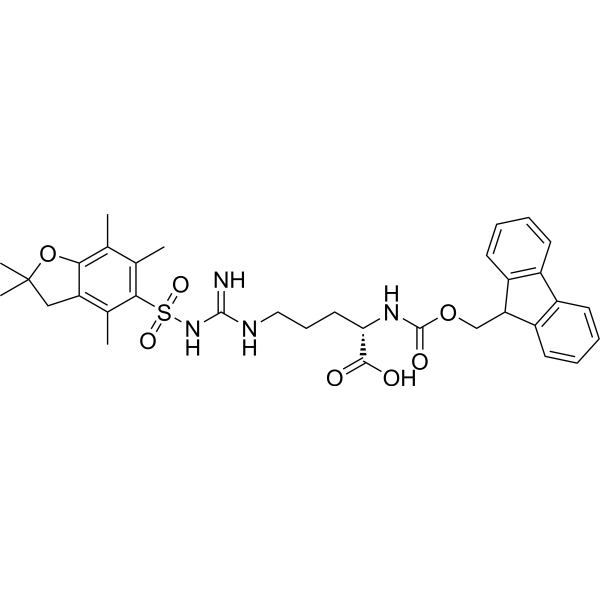
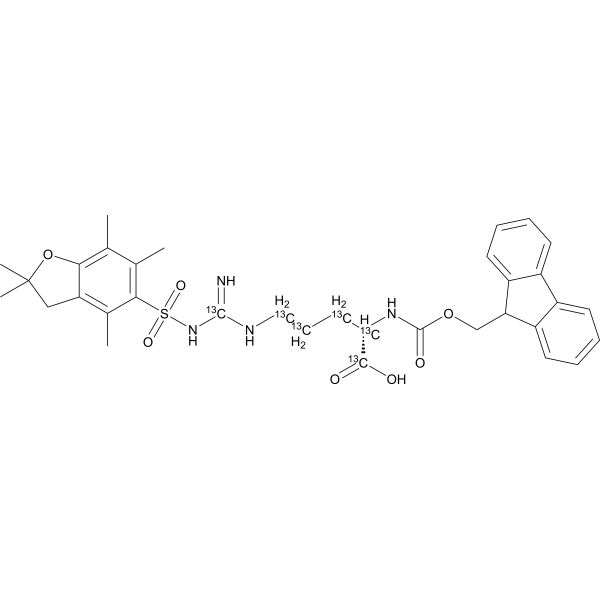
Fmoc-Arg(Pbf)-OH- 13C6, 15N4 is the 13C-labeled and 15N-labeled Fmoc-Arg(Pbf)-OH (HY-Y1636). Fmoc-Arg(Pbf)-OH is an arginine derivative containing amine protecting group Fmoc. Fmoc-Arg(Pbf)-OH is a building block for the introduction of Arg into SPPS (Solid-Phase Peptide Synthesis) .
|
-
-
- HY-W013081S
-
|
|
|
Fmoc-Gln(Trt)-OH- 13C5, 15N2 is the 13C-labeled and 15N-labeled Fmoc-Gln(Trt)-OH (HY-W013081). Fmoc-Gln(Trt)-OH is a glutamine derivative containing amine protecting group Fmoc. Fmoc-Gln(Trt)-OH can be used in solid-phase peptide synthesis .
|
-
-
- HY-Y1636S1
-
|
|
|
Fmoc-Arg(Pbf)-OH- 13C6 is the 13C labeled Fmoc-Arg(Pbf)-OH . Fmoc-Arg(Pbf)-OH is an arginine derivative containing amine protecting group Fmoc. Fmoc-Arg(Pbf)-OH is a building block for the introduction of Arg into SPPS (Solid-Phase Peptide Synthesis) .
|
-
-
- HY-Y1169S1
-
|
|
|
Fmoc-Asp(OtBu)-OH- 13C4, 15N is the 13C and 15N labeled Fmoc-Asp(OtBu)-OH . Fmoc-Asp(OtBu)-OH (4-tert-Butyl N-(fluoren-9-ylmethoxycarbonyl)-L-aspartate) is a aspartate derivative containing amine protecting group Fmoc. Fmoc-Asp(OtBu)-OH can be used for peptide synthesis .
|
-
-
- HY-Y1169S2
-
|
|
|
Fmoc-Asp(OtBu)-OH-d3 (4-tert-Butyl N-(fluoren-9-ylmethoxycarbonyl)-L-aspartate-d3) is deuterium labeled Fmoc-Asp(OtBu)-OH. Fmoc-Asp(OtBu)-OH (4-tert-Butyl N-(fluoren-9-ylmethoxycarbonyl)-L-aspartate) is a aspartate derivative containing amine protecting group Fmoc. Fmoc-Asp(OtBu)-OH can be used for peptide synthesis .
|
-
-
- HY-Y1169S
-
|
|
|
Fmoc-Asp(OtBu)-OH- 15N is the 15N-labeled Fmoc-Asp(OtBu)-OH (HY-Y1169). Fmoc-Asp(OtBu)-OH (4-tert-Butyl N-(fluoren-9-ylmethoxycarbonyl)-L-aspartate) is an aspartate derivative containing amine protecting group Fmoc. Fmoc-Asp(OtBu)-OH can be used for peptide synthesis .
|
-
| Cat. No. |
Product Name |
|
Classification |
-
- HY-151824
-
|
|
|
Alkynes
|
|
Boc-L-Phe(4-NH-Poc)-OH is a click chemistry reagent containing an azide group. Used as an orthogonally protected building block in peptide synthesis. Propargyloxycarbonyl, commonly abbreviated as Poc or Pryoc, can either be used as alkyne component for standard Click conjugation or in combination with tetrazine linkers in copper-free Diels-Alder type Click reactions. It also has applications as unusual protecting group for amines, hydroxy functions and as esters. All 3 are stable to neat TFA, but can be cleaved at ambient temperature with Co2(CO)8 in TFA:DCM. Deprotection with other transition metals like palladium have also been reported . Boc-L-Phe(4-NH-Poc)-OH is a click chemistry reagent, it contains an Alkyne group and can undergo copper-catalyzed azide-alkyne cycloaddition (CuAAc) with molecules containing Azide groups.
|
-
- HY-151837
-
|
|
|
Alkynes
|
|
H-L-Phe(4-NH-Poc)-OH (hydrochloride) is a click chemistry reagent containing an azide group. Used as a modified Phe or Tyr analogue in protein and peptide biosynthesis. Propargyloxycarbonyl, commonly abbreviated as Poc or Pryoc, can either be used as alkyne component for standard Click conjugation or in combination with tetrazine linkers in copper-free Diels-Alder type Click reactions. It also has applications as unusual protecting group for amines, hydroxy functions and as esters. All 3 are stable to neat TFA, but can be cleaved at ambient temperature with Co2(CO)8 in TFA:DCM. Deprotection with other transition metals like palladium have also been reported . H-L-Phe(4-NH-Poc)-OH (hydrochloride) is a click chemistry reagent, it contains an Alkyne group and can undergo copper-catalyzed azide-alkyne cycloaddition (CuAAc) with molecules containing Azide groups.
|
-
- HY-W800658
-
|
|
|
DBCO
|
|
DBCO-PEG6-NH-Boc is a click chemistry reagent with a DBCO group and a Boc-protected amine. The DBCO can undergo copper-free Click Chemistry reactions with azides. The Boc protecting group can be removed under acidic conditions. The hydrophilic PEG linker increases the water solubility of the compound.
|
-
- HY-W457953
-
|
|
|
Azide
|
|
tert-Butyl N-(4-azidobutyl)carbamate is N-Boc protected crosslinker. tert-Butyl N-(4-azidobutyl)carbamate can react with alkyne, BCN, DBCO via Click Chemistry to yield a stable triazole linkage. The Boc group can be deprotected under mild acidic conditions to form the free amine.
|
| Cat. No. |
Product Name |
|
Classification |
-
- HY-W440823A
-
|
DSPE-PEG1000-NH2 ammonium
|
|
Pegylated Lipids
|
|
DSPE-PEG1000-Amine (DSPE-PEG1000-NH2) ammonium is a 1,2-distearoyl-sn-glycero-3-phosphoethanolamine-polyethylene glycol conjugate with a terminal amino group. DSPE-PEG1000-Amine ammonium can functionalize the surface of PLGA-lecithin-PEG core-shell nanoparticles to introduce positive surface charges. The amino group of DSPE-PEG1000-Amine ammonium can be converted into an aromatic aldehyde to react with the acetone-protected aromatic hydrazide on the surface of bovine carbonic anhydrase (BCA) molecules .
|
-
- HY-155908
-
|
DSPE-PEG10000-NH2 ammonium
|
|
Pegylated Lipids
|
|
DSPE-PEG10000-Amine ammonium is a phosphoethanolamine involved in the synthesis of liposomes for delivery systems. The amino group of DSPE-PEG10000-Amine ammonium can be converted into aromatic aldehydes by reacting with acetone-protected aromatic hydrazines on the surface of bovine carbonic anhydrase (BCA) molecules. Liposomes form a liposome-BAH-BCA conjugate by forming a bisarylhydrazone (BAH) with the target enzyme molecule. The conjugate catalyzes the hydration of carbon dioxide to bicarbonate.
|
-
- HY-155907
-
|
DSPE-PEG5000-NH2 ammonium
|
|
Pegylated Lipids
|
|
DSPE-PEG5000-Amine ammonium is a phosphoethanolamine involved in the synthesis of liposomes for delivery systems. DSPE-PEG5000-Amine ammonium amino group can be converted to aromatic aldehydes that react with acetone-protected aromatic hydrazides on the surface of the bovine carbonic anhydrase (BCA) molecule. Liposomes produce liposome-Bah-BCA conjugates by forming diaryl hydrazone (BAH) with target enzyme molecules. The conjugate catalyzes the hydration of carbon dioxide to bicarbonate.
|
Your information is safe with us. * Required Fields.
Inquiry Information
- Product Name:
- Cat. No.:
- Quantity:
- MCE Japan Authorized Agent:





![Benzyl N-[2-(prop-2-enamido)ethyl]carbamate](http://file.medchemexpress.com/product_pic/hy-w800833.gif)





