



FGFR
Fibroblast growth factor receptor
FGFR (Fibroblast growth factor receptors) are the receptors that bind to members of the fibroblast growth factor family of proteins. Some of these receptors are involved in pathological conditions. A point mutation in FGFR3 can lead to achondroplasia. Five distinct membrane FGFR have been identified in vertebrates and all of them belong to the tyrosine kinase superfamily (FGFR1, FGFR2, FGFR3, FGFR4, FGFR6). The fibroblast growth factor family constitutes one of the most important groups of paracrine factors that act during development. They are responsible for determining certain cells to become mesoderm, for the production of blood vessels, for limb outgrowth, and for the growth and differentiation of numerous cell types.
All Product Categories
-
FGFR Inhibitors
(322)
View all products
-
FGFR Agonists
(4)
View all products
-
FGFR Antagonist
(1)
View all products
-
FGFR Activators
(6)
View all products
-
FGFR Modulators
(3)
View all products
-
FGFR Degraders
(11)
View all products
-
FGFR Control
(1)
View all products
-
FGFR Ligands
(2)
View all products
-
FGFR Proteins
(97)
View all products
-
FGFR-1 Proteins
(20)
View all products
-
FGFR-2 Proteins
(31)
View all products
-
FGFR-3 Proteins
(26)
View all products
-
FGFR-4 Proteins
(18)
View all products
-
FGFR Related Products (391)
Related Products (391)

-
Recombinant Proteins (97)
-
Antibodies (11)
-
IONIS-FGFR4Rx sodium scrambled negative control
 0 ImagesCat. No.: HY-159691BIONIS-FGFR4Rx sodium scrambled negative control is the sequence scrambled negative control of IONIS-FGFR4Rx sodium.
-
Pep1-DNP conjugate 9
 0 ImagesCat. No.: HY-P10870Pep1-DNP conjugate 9 is a functionalized peptide which is composed of the DNP-Hapten and the FGFR1 binding peptide. Pep1-DNP conjugate 9 exhibits good affinity to FGFR1 with KD of 5.01 μM. Pep1-DNP conjugate 9 recruits anti-DNP antibodies to the surface of FGFR1-positive cells, inhibits the FGF2-induced proliferation in rat skeletal myoblast cells, and induces apoptosis. Pep1-DNP conjugate 9 exhibits antitumor efficacy in mouse models.
-
FGFR-IN-9
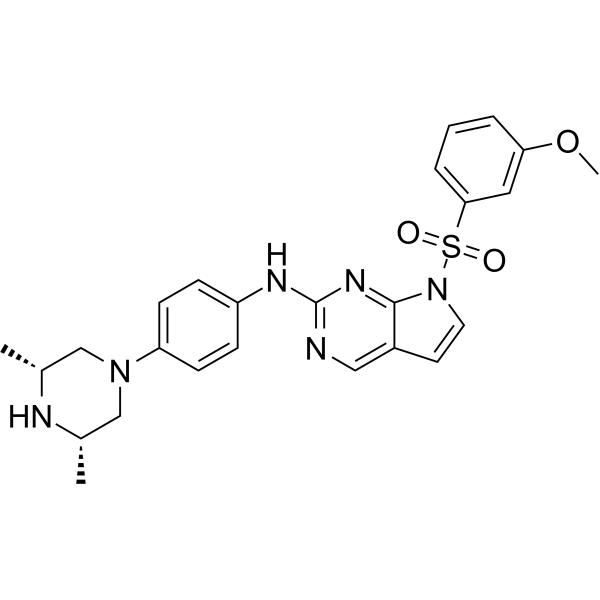 0 ImagesCat. No.: HY-152104CAS No.: 3024090-08-9FGFR-IN-9 (Compound 19) is a potent, reversible and orally active FGFR inhibitor with an IC50 of 17.1, 29.6, 30.7, 46.7 and 64.3 nM against FGFR4WT, FGFR3, FGFR4V550L, FGFR2 and FGFR1, respectively.
-
FGFR-IN-3
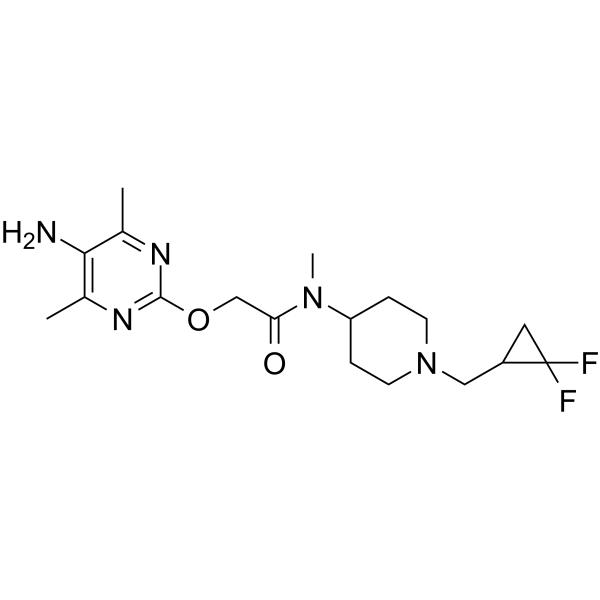 0 ImagesCat. No.: HY-147683CAS No.: 2488762-63-4FGFR-IN-3 (compound 6) is an orally active, potent and BBB-penetrated FGFR (fibroblast growth factor receptor) modulator. FGFR-IN-3 shows neuroprotective activity. FGFR-IN-3 can be used for neurodegenerative diseases research.
-
BMS-645737
 0 ImagesCat. No.: HY-10335CAS No.: 651744-16-0
-
FGFR-IN-8
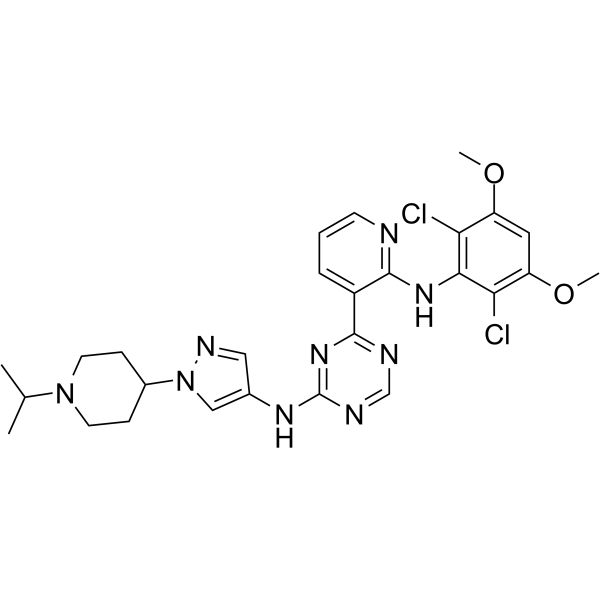 0 ImagesCat. No.: HY-150652CAS No.: 2640217-64-5FGFR-IN-8 (Compound 17a) is a highly potent and orally active panFGFR inhibitor against wild-type and mutant FGFRs. FGFR-IN-8 shows inhibition with IC50 values of <0.5, 189.1, <0.5, 22.6, <0.5 and 7.30 nM against FGFR1, V564F-FGFR2, N549H-FGFR2, V555M-FGFR3, FGFR3 and FGFR4, respectively. GFR-IN-8 induces cancer cell apoptosis and shows anticancer activities.
-
(S)-N-trans-feruloyloctopamine
 0 ImagesCat. No.: HY-N11517CAS No.: 640235-67-2(S)-N-trans-feruloyloctopamine is an isomer of N-trans-feruloyloctopamine (HY-N2232). N-trans-feruloyloctopamine is a natural hydroxycinnamic acid amide compound derived from garlic husk, possessing tyrosinase inhibitory, FGF2 inhibitory, anti-melanogenic, and anti-tumor activities, and is used in research related to hepatocellular carcinoma, pigmentation disorders, and UVB-induced skin damage.
-
FGFR4-IN-24
 0 ImagesCat. No.: HY-179381CAS No.: 3053546-73-6FGFR4-IN-24 is a selective irreversible covalent FGFR4 inhibitor (IC50 = 1.2 nM). FGFR4-IN-24 shows much weaker activity against the other three FGFR family kinases (FGFR1-3). FGFR4-IN-24 inhibits the FGF19/FGFR4 signaling pathway, effectively suppressing the proliferation of the HuH-7 HCC cell line (GI50 = 17 nM). FGFR4-IN-24 exhibits significant antitumor activity in a HuH-7 mouse xenograft model. FGFR4-IN-24 can be used for the research of hepatocellular carcinoma.
-
PROTAC FGFR3 Degrader-1
 0 ImagesCat. No.: HY-181153PROTAC FGFR3 Degrader-1 is a fibroblast growth factor receptor 3 (FGFR3) PROTAC degrader, promotes FGFR3 degradation via the ubiquitin-proteasome pathway, and inhibits the downstream FGFR3/PI3K/AKT signaling pathway. PROTAC FGFR3 Degrader-1 can be used for the research of hepatocellular carcinoma.
-
FGFRs-IN-1
 0 ImagesCat. No.: HY-170846FGFRs-IN-1 (Compound A16) is the orally active inhibitor for FGFR, that inhibits FGFR1/2/3/4 with IC50s of 2.3, 7, 11, and 163 nM, respectively. FGFRs-IN-1 also inhibits VEGFR1/2/3, Abl, and Flt3 with IC50s of 61, 176, 112, 26, and 353 nM, respectively. FGFRs-IN-1 exhibits weak inhibitory efficacy against CYP enzymes. FGFRs-IN-1 reduces the expression of α-SMA and collagen I, and inhibits epithelial-mesenchymal transition (EMT) in TGF-β1 stimulated A549 cell. FGFRs-IN-1 exhibits anti-inflammatory activity in Bleomycin (HY-17565)-induced mouse pulmonary fibrosis model and CCl4 (HY-Y0298)-induced mouse liver fibrosis model.
-
Surfen
 0 ImagesSurfen is a potent heparan sulfate antagonist. Surfen inhibits FGF2 binding and signal transduction. Surfen binds to glycosaminoglycans and reduces tau hyperphosphorylation. Surfen inhibits the activity of recombinant uronyl 2-O-sulfotransferase with an IC50 of approximately 2 μM. Surfen inhibits HSV-1 viral infection. Surfen inhibits neural differentiation, delays remyelination, and alleviates EAE.

-
FGFR3-IN-2
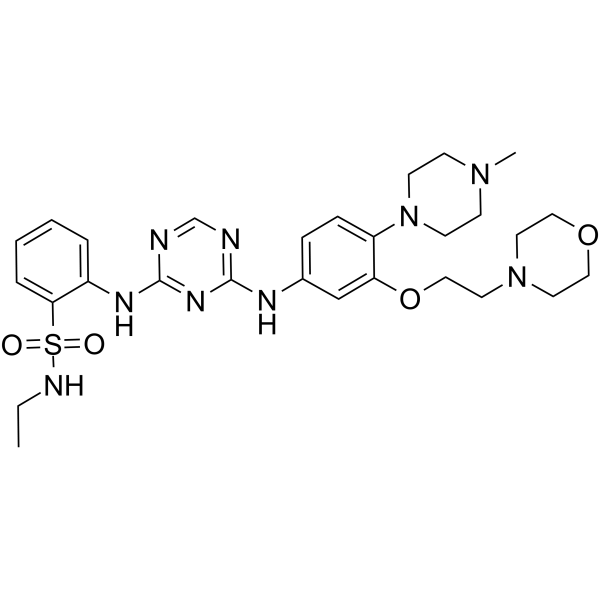 0 ImagesCat. No.: HY-147714CAS No.: 2428742-58-7FGFR3-IN-2 (compound 18b) is a potent and selective FGFR3 inhibitor, with IC50s of 4.1 nM and 570 nM for FGFR3 and VEGFR2, respectively. FGFR3-IN-2 can be used for the research of bladder cancer.
-
Pazopanib-13C,d3
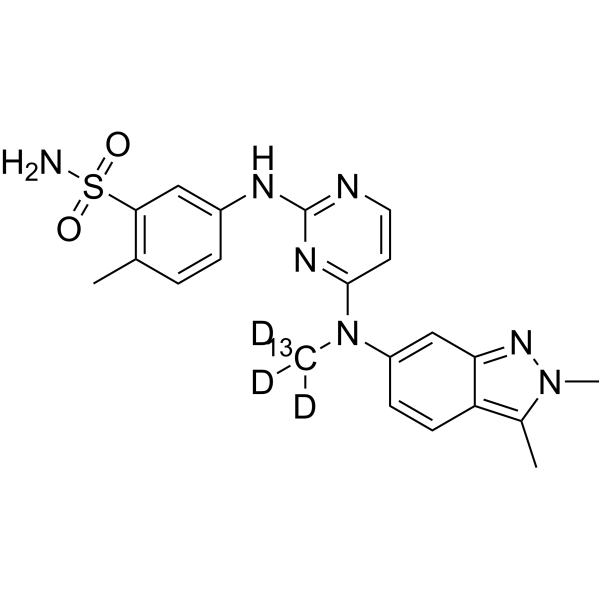 0 ImagesCat. No.: HY-10208S1CAS No.: 1261734-88-6Synonyms: GW786034-13C,d3
-
Tec-IN-6
 0 ImagesCat. No.: HY-123541CAS No.: 923762-87-2
-
FGFR-IN-10
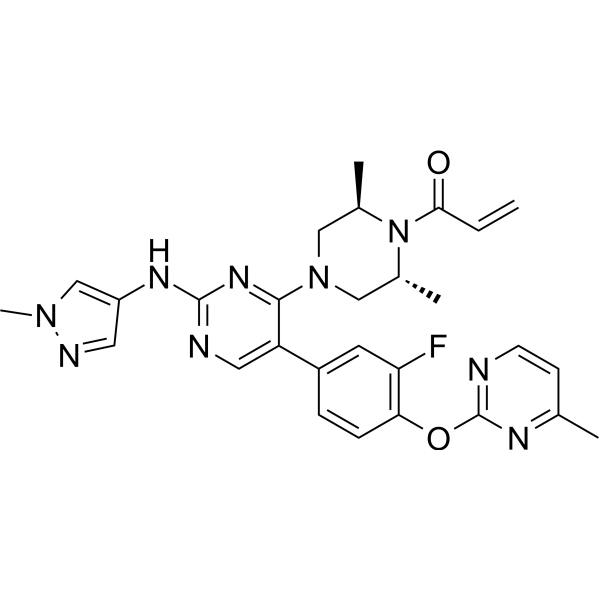 0 ImagesCat. No.: HY-148597CAS No.: 2847092-41-3FGFR-IN-10 is an orally active inhibitor of FGFR and Cytochrome P450 (CYPs). FGFR-IN-10 inhibits wide type and V564F mutant FGFR2 with IC50s of 104.1 nM and 43.6 nM, respectively. FGFR-IN-10 also inhibits CYPs with IC50s of 3.33 μM (CYP2C9), 18.75 μM (CYP2C19), 4.34 μM (CYP2CD6), and 0.69 μM (CYP3A4), respectively.
-
BRD4-IN-41
 0 ImagesCat. No.: HY-115541CAS No.: 1877286-69-5BRD4-IN-41 is a BRD4 inhibitor with an IC50 of 34 nM. BRD4-IN-41 also inhibits JAK2, FLT3, RET, ROS1, NTRK3, PDGFRb, and FGFR1 kinases with IC50 values ranging from 0.9 nM to 43 nM. BRD4-IN-41 inhibits acetyl-lysine binding site of BRD4, downregulates c-MYC, reduces phosphorylated STAT3 levels, induces G1 cell cycle arrest and apoptosis, thereby inhibiting cancer cells growth. BRD4-IN-41 can be used for the research of cancer, such as multiple myeloma and acute myeloid leukemia.

-
FGFR-IN-27
 0 ImagesCat. No.: HY-183780FGFR-IN-27 is an orally active, broad-spectrum FGFR inhibitor, with an IC50 of 0.24 nM against human FGFR1, 0.71 nM against FGFR2, 0.87 nM against FGFR3, and 6.50 nM against FGFR4. FGFR-IN-27 inhibits cancer cell proliferation and blocks tumor growth. FGFR-IN-27 reduces the phosphorylation levels of AKT and ERK, induces apoptosis and ferroptosis, increases ROS levels, and decreases GSH levels. FGFR-IN-27 can be used in the research of hepatocellular carcinoma.




