



Topoisomerase
Topoisomerases are enzymes that regulate the overwinding or underwinding of DNA. The winding problem of DNA arises due to the intertwined nature of its double-helical structure. Topoisomerases are isomerase enzymes that act on the topology of DNA. Type I topoisomerase cuts one strand of a DNA double helix, relaxation occurs, and then the cut strand is reannealed. Type I topoisomerases are subdivided into two subclasses: type IA topoisomerases, which share many structural and mechanistic features with the type II topoisomerases, and type IB topoisomerases, which utilize a controlled rotary mechanism. Type II topoisomerase cuts both strands of one DNA double helix, pass another unbroken DNA helix through it, and then reanneal the cut strands. This class is also split into two subclasses: type IIA and type IIB topoisomerases, which possess similar structure and mechanisms.
Topoisomerase Isoform Specific Products
All Product Categories
-
Topoisomerase Inhibitors
(753)
View all products
-
Topoisomerase Agonists
(2)
View all products
-
Topoisomerase Modulator
(1)
View all products
-
Topoisomerase Inducer
(1)
View all products
-
Topoisomerase Degraders
(3)
View all products
-
Topoisomerase Controls
(3)
View all products
-
Topoisomerase Ligands
(2)
View all products
-
Topoisomerase Proteins
(1)
View all products
-
DNA topoisomerase II Proteins
(1)
View all products
-
Topoisomerase Related Products (830)
Related Products (830)

-
Recombinant Proteins (1)
-
Antibodies (4)
-
Topoisomerase Isoform Comparison
-
BE-10988
 0 ImagesCat. No.: HY-167671CAS No.: 135261-89-1BE-10988 is a DNA topoisomerase inhibitor. BE-10988 inhibits the growth of Doxorubicin (HY-15142A)-resistant and vincristine-resistant P388 mouse leukemia cell lines by increasing the formation of DNA topoisomerase complexes.
-
Top/HDAC-IN-3
 0 ImagesCat. No.: HY-159966CAS No.: 3059615-90-3Top/HDAC-IN-3 (Compound 31) is an orally active dual inhibitor of Topoisomerase and HDAC. Top/HDAC-IN-3 increases reactive oxygen species (ROS) levels, leading to DNA damage, thereby inhibiting cancer cell colony formation and migration, inducing cancer cell Apoptosis, and causing cell cycle arrest. In the NSCLC model, Top/HDAC-IN-3 exhibited significant antitumor effects, with a tumor growth inhibition (TGI) of 77.5% at 100 mg/kg, surpassing the efficacy of the HDAC inhibitor SAHA (HY-10221) and the combination of SAHA (HY-10221) with the topoisomerase inhibitor Irinotecan (HY-16562).
-
Topoisomerase IIα-IN-3
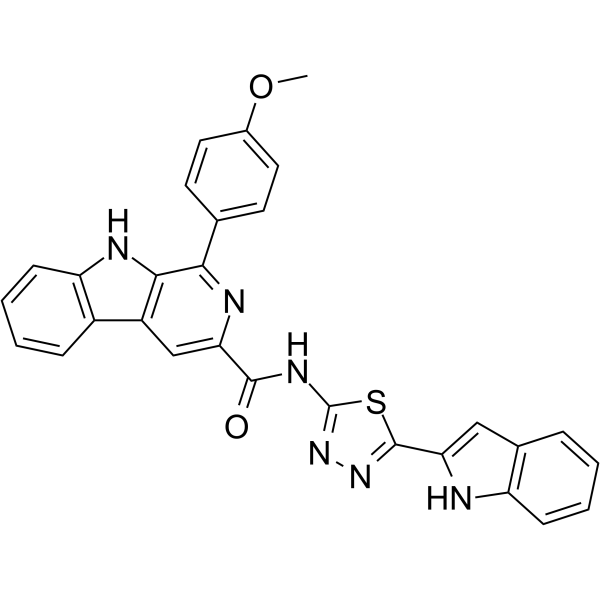 0 ImagesCat. No.: HY-147801CAS No.: 2538528-11-7Topoisomerase IIα-IN-3 (Compound 12c) is a DNA intercalative topoisomerase-IIα inhibitor. Topoisomerase IIα-IN-3 arrests cell cycle at the G0/G1 phase and induces apoptosis.
-
Topoisomerase I/II inhibitor 4
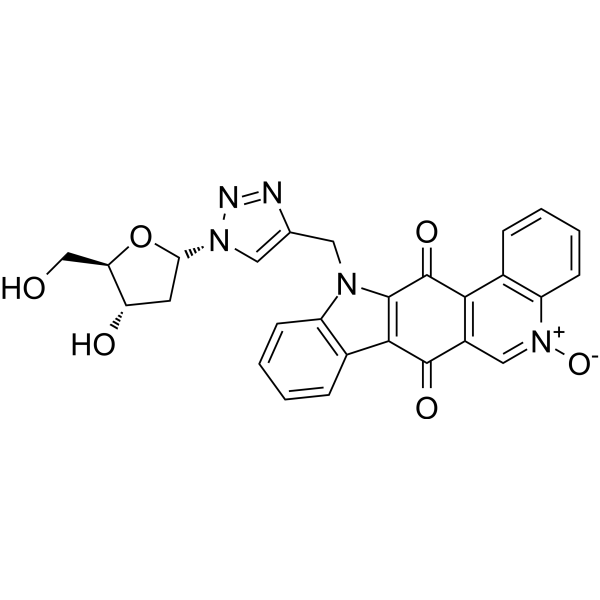 0 ImagesCat. No.: HY-149002CAS No.: 3031403-77-4Topoisomerase I/II inhibitor 4 (compound F16) is a potent topoisomerase I (Topo I) and II (Topo II) dual inhibitor. Topoisomerase I/II inhibitor 4 inhibits cell proliferation, invasion and migration and induces apoptosis. Topoisomerase I/II inhibitor 4 can be used for liver cancer research.
-
GI-149893
 0 ImagesCat. No.: HY-131438CAS No.: 149809-18-7GI-149893 is a selective topoisomerase I (TopoI) inhibitor. GI-149893 prevents DNA religation and induces irreversible DNA damage in tumor cells. GI-149893 is promising for research of cancers (e.g., colon carcinoma HT-29/SW-48, breast MX-1, prostate PC-3 xenografts).
-
Topoisomerase II, Yeast
 0 ImagesCat. No.: HY-E70902Topoisomerase II, Yeast (EC 5.99.1.3) is a nuclear enzyme that play essential roles in DNA replication, transcription, chromosome segregation, and recombination. All cells have two major forms of topoisomerases: type I, which makes single-stranded cuts in DNA, and type II enzymes, which cut and pass double-stranded DNA.
-
TopBP1-IN-4
 0 ImagesCat. No.: HY-189210ATopBP1-IN-4 is a TopBP1 inhibitor, with an IC50 value of 2.47 to 3.8 nM against the TopBP1 BRCT7/8 domain. TopBP1-IN-4 selectively disrupts BRCT7/8-dependent oncogenic protein-protein interactions, does not interfere with other BRCT domain-mediated functions of TopBP1, and has no effect on DNA replication. TopBP1-IN-4 restores E2F1-mediated Apoptosis in cells. TopBP1-IN-4 induces mitotic catastrophe in cells. TopBP1-IN-4 overcomes Osimertinib (HY-15772) resistance in EGFR-mutant non-small cell lung cancer models. TopBP1-IN-4 can be used in studies related to triple-negative breast cancer, ovarian cancer, non-small cell lung cancer, and acute myeloid leukemia.
-
Camsirubicin
 0 ImagesCat. No.: HY-109113CAS No.: 236095-26-4Synonyms: GPX-150Camsirubicin (GPX-150) is a non-cardiotoxic Doxorubicin (HY-15142) analog that selectively targets topoisomerase IIβ. Camsirubicin reduces cell viability and clone formation of MDA-MB-468 breast cancer cells. Camsirubicin increases the exposure of CALR and HSP90 on the cell surface. Camsirubicin can be used for the study of breast cancer.
-
XK469 sodium
 0 ImagesCat. No.: HY-120679ACAS No.: 157434-99-6Synonyms: NSC 697887 sodiumXK469 (NSC 697887) sodium is a quinoxaline-based topoisomerase II inhibitor. XK469 sodium exhibits antiproliferative activity against neuroblastoma cells. XK469 sodium can be used in the research of neuroblastoma.
-
OSu-Val-Cit-PAB-Exa
 0 ImagesCat. No.: HY-186185CAS No.: 3091519-75-1OSu-Val-Cit-PAB-Exa (compound D) is a cleavable linker-payload conjugate (usable for ADC synthesis). OSu-Val-Cit-PAB-Exa bears an N-terminal N-hydroxysuccinimide (OSu) ester group, and comprises Val-Cit, p-aminobenzyl alcohol (PAB) and Exatecan (HY-13631). OSu-Val-Cit-PAB-Exa serves as a payload-linker intermediate for polypeptide conjugation.
-
Mal-PEG8-Phe-Lys-PAB-Exatecan
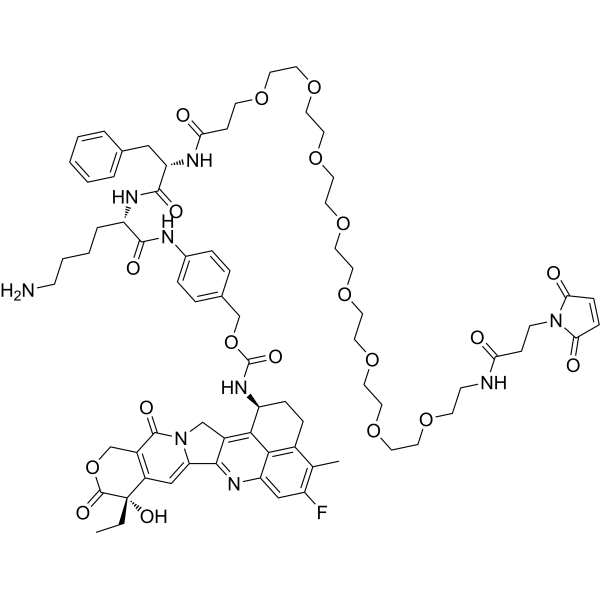 0 ImagesCat. No.: HY-148380CAS No.: 2679821-44-2

-
Topo I/DDX5-IN-1
 0 ImagesCat. No.: HY-181018CAS No.: 3040940-61-9Topo I/DDX5-IN-1 (Compound A10) is a Topo I and DDX5 inhibitor. Topo I/DDX5-IN-1 inhibits Topo I activity, binds to DDX5, and suppresses DDX5 function. Topo I/DDX5-IN-1 increases expression of γ-H2AX and p21, suppresses the expression of antiapoptotic proteins (Bcl-2 and XIAP), stimulates ROS generation, and triggers Apoptosis. Topo I/DDX5-IN-1 exhibits anticancer activity against pancreatic cancer, non-small cell lung cancer, skin cancer, and colorectal cancer.
-
Albaconol
 0 ImagesCat. No.: HY-N20661CAS No.: 338405-64-4Albaconol is a prenylresorcinol compound. Albaconol is isolated from the mushroom A. confluens. Albaconol inhibits NF-κB and DNA topoisomerase II, and induces Apoptosis. Albaconol inhibits IκB-α phosphorylation and p65 nuclear translocation, enhances SOCS1 expression, reduces the production of proinflammatory cytokines and NO, and suppresses the expression of iNOS, MHC-II and co-stimulatory molecules. Albaconol acts as a weak antagonist of hVR1 and rVR1, with IC50 values of 17 µM and 5.5 µM, respectively. Albaconol induces tracheal contraction and desensitization. Albaconol inhibits the growth of tumor cells. Albaconol can be used in pain-related research.
-
Garenoxacin Mesylate hydrate (Standard)
 0 ImagesSynonyms: BMS284756 Mesylate hydrate (Standard)ACHE-IN-38 (hydrochloride) (Standard) is the analytical standard of ACHE-IN-38 (hydrochloride). This product is intended for research and analytical applications. ACHE-IN-38 hydrochloride (Compound 13b) inhibits the metabolic breakdown of the neurotransmitter acetylcholine (ACh) by the enzyme acetylcholinesterase (AChE) and hence alleviates memory deficits in patients with Alzheimer’s Disease by potentiating cholinergic transmission.
-
Exatecan analog 38
 0 ImagesCat. No.: HY-178315CAS No.: 2766214-00-8Exatecan analog 38 is a camptothecin derivative with potent topoisomerase I inhibitory activity. Exatecan analog 38 can be connected to monoclonal antibodies via linkers to form antibody-drug conjugate (ADC) molecules. Exatecan analog 38 can be used for cancer research.
-
MYCMI-7 hydrobromide
 0 ImagesCat. No.: HY-187521CAS No.: 102537-38-2MYCMI-7 hydrobromide is a potent and selective MYC/MYCN inhibitor, with a Kd of 4 μM for MYC and an IC50 of 10 μM for topoisomerase IIα (Topoisomerase IIα). MYCMI-7 hydrobromide binds directly to MYC, selectively inhibits the interactions of MYC:MAX and MYCN:MAX, reduces MYC-driven transcription levels, induces MYC/MYCN protein degradation, and blocks the binding of MYC to chromatin, thereby inducing tumor cell growth arrest, apoptosis and reducing cell viability, while only inducing G1 phase growth arrest in normal cells. MYCMI-7 hydrobromide can be used in research related to MYC-driven acute myeloid leukemia and breast cancer, MYCN-amplified neuroblastoma, glioblastoma, Burkitt's lymphoma, melanoma, colon cancer, osteosarcoma, cervical cancer and histiocytic lymphoma.
-
Hsp90-IN-48
 0 ImagesCat. No.: HY-184245CAS No.: 3117528-53-4Hsp90-IN-48 is an orally active Hsp90 inhibitor with an IC50 of 19.4 nM. Hsp90-IN-48 improves tumor-cell uptake and intracellular active-component release, and suppresses tumor metastasis. Hsp90-IN-48 induces G2/M phase cell cycle arrest and tumor cell apoptosis whlie simultaneously inhibits Top1/Top2 activity. Hsp90-IN-48 inhibits tumor growth and can be used for colon cancer research.
-
Topoisomerase II/EGFR-IN-1
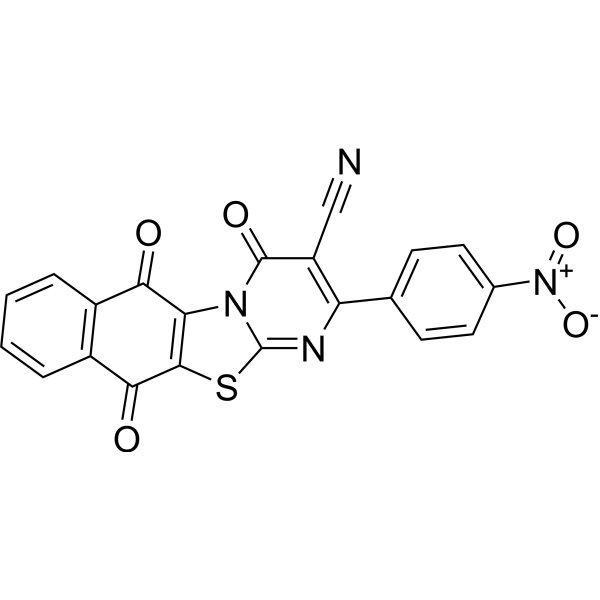 0 ImagesCat. No.: HY-157402Topoisomerase II/EGFR-IN-1 is topoisomerase II/EGFR dual inhibitor. Topoisomerase II/EGFR-IN-1 has superior cytotoxic activity to MCF-7, A549 and HCT-116 cell lines, displays strong apoptotic activity and can be used for the research of cancer.
-
F-14512 hydrochloride
 0 ImagesCat. No.: HY-106031ACAS No.: 866874-39-7F-14512 hydrochloride is an anticancer agent that utilizes the polyamine transport system (PTS) to selectively deliver polyamine-containing drugs to cancer cells. F-14512 hydrochloride enhances the affinity of polyamines for DNA, thereby inhibiting topoisomerase II and achieving selective cellular uptake. F-14512 hydrochloride exhibits significant cytotoxicity against cells with high PTS activity and induces DNA damage. F-14512 hydrochloride demonstrates potent antitumor activity in the MX1 breast tumor xenograft model. F-14512 hydrochloride could be used to study breast cancer.




