



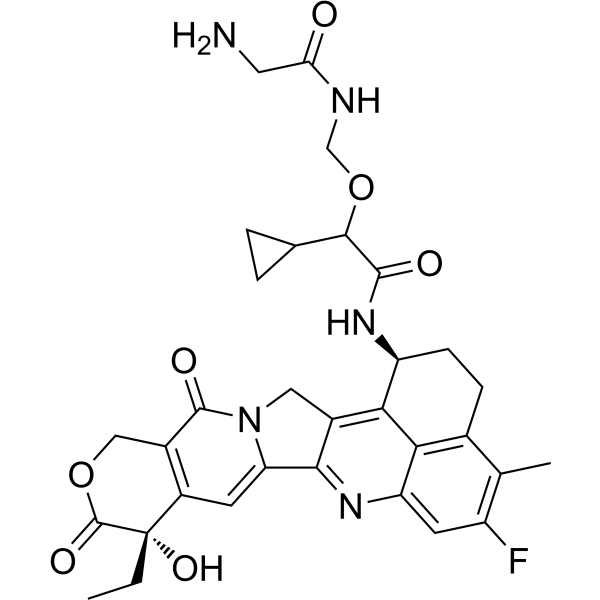
Gly-Cyclopropane-Exatecan
Gly-Cyclopropane-Exatecan involves in the synthesis of anti-B7-H4 ADC, containing Exatecan (HY-13631), a DNA Topoisomerase I inhibitor. Gly-Cyclopropane-Exatecan participated in the formation of the ADC hu2F7-Exatecan (compound 34), which showed antitumor activity in vivo and in vitro.
Nur für Forschungszwecke. Wir verkaufen nicht an Patienten.
- CAS. Nr.: 2414254-49-0
- Formel: C32H34FN5O7
- Molecular Weight:619.64
-
Speicherung:
Please store the product under the recommended conditions in the Certificate of Analysis.

To place orders, for customer services and technical support, please contact: MedChemExpress USA
Tel: 609-228-6898 E-mail: [email protected] [email protected]


-
 Biologische Aktivität
-
Chemical Information
- Protokoll
- Reinheit & Dokumentation
- Verweise
-
 Help & FAQs


Alle ADC Payloads Isoform-spezifische Produkte anzeigen
MoreAlle Topoisomerase Isoform-spezifische Produkte anzeigen
More

Biologische Aktivität
Beschreibung
IC50 & Target
[1]|
Camptothecins |
In Vitro
ADCs are comprised of an antibody to which is attached an ADC cytotoxin through an ADC linker.
MedChemExpress (MCE) has not independently confirmed the accuracy of these methods. They are for reference only. Further protocols information, click here.


Chemical Information
-
CAS. Nr. 2414254-49-0
-
Molecular Weight 619.64
-
Formel C32H34FN5O7
-
SMILES
NCC(NCOC(C1CC1)C(N[C@@H]2C3=C4C(C(N5C4)=CC([C@](O)(C(OC6)=O)CC)=C6C5=O)=NC7=CC(F)=C(C)C(CC2)=C73)=O)=O
-
Versand
Room temperature in continental US; may vary elsewhere.
-
Speicherung
Please store the product under the recommended conditions in the Certificate of Analysis.

Protokoll
-
Subcutaneous Cell-Line-Derived Xenograft
Subcutaneous cell-line-derived xenograft (CDX) models are established by implanting cultured human cancer cell lines into immunodeficient mice, where the injected cells form localized tumors that can be monitored in vivo as a measure of tumorigenic potential, growth kinetics, and treatment response. These models are widely used in oncology research because they allow reproducible tumor formation and enable comparative assessment of tumor growth between different cell lines or genetic manipulations in a controlled in vivo microenvironment. Subcutaneous implantation of cancer cells in immunodeficient mice is a standard approach for evaluating tumor growth behavior and therapeutic response across multiple cancer types, including prostate, esophageal, pancreatic, and colon cancer models.


Reinheit & Dokumentation
Verweise

Calculators
Konzentration (Stammlösung) × Volumen (Stammlösung) = Konzentration (Ziellösung) × Volumen (Ziellösung)


Gly-Cyclopropane-Exatecan Related Classifications
HY-148696A Related Classifications
 Powered by Bioz