



Antibiotic
Antibiotics are a class of secondary metabolites produced from microorganisms, animals or plants. Some of them exhibit anti-bacterial, anti-fungal, anthelmintic, anti-tumor or immunosuppressive activities with a wealth of structural classes such as β-lactams, macrolide and polyether. As major sources of antibiotics, streptomycetes, penicillium and marine organisms produce a wide variety of commercially important polyketide compounds including the well-known macrolide, polyene and polyether antibiotics with wide range of activities. Antibiotics such as penicillin, cephalosporin, streptomycin, and tetracycline can be used in the treatment of human and veterinary diseases. However, antibiotic resistance is also a growing threat to global public health.
Antibiotic Isoform Specific Products
-
Antibiotic
(2767)
View all products
-
Aminoglycoside
(47)
View all products
-
Glycopeptide
(20)
View all products
-
Lipopeptide
(6)
View all products
-
Macrolide
(76)
View all products
-
Oxazolidinone
(16)
View all products
-
Quinolone
(101)
View all products
-
Tetracycline
(42)
View all products
-
β-lactam
(200)
View all products
All Product Categories
-
Antibiotic Related Products (3529)
Related Products (3529)

-
Related Compound Screening Libraries (1)
-
Antibiotic Isoform Comparison
-
Depsidomycin
 0 ImagesCat. No.: HY-N15028CAS No.: 131956-33-7Depsidomycin is an immunomodulatory antibiotic with immunosuppressive activity that can be isolated from the culture broth of Streptomyces lavendofoliae MI951-62F2. Depsidomycin primarily exhibits antibacterial activity against Gram-positive bacteria.
-
Aurein 2.1
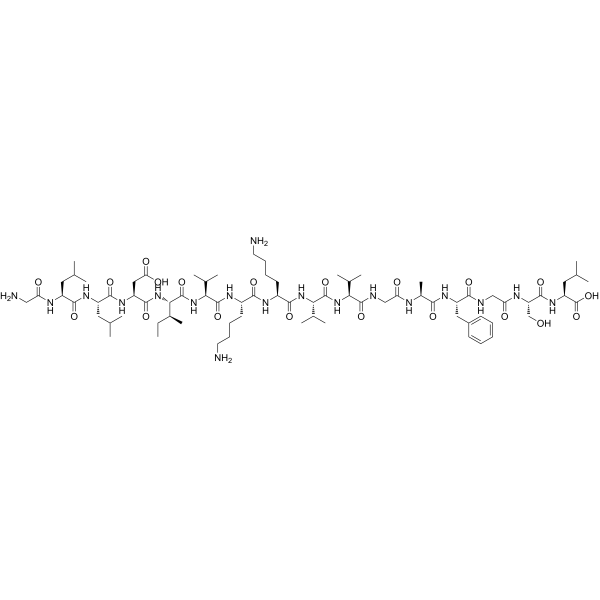 0 ImagesCat. No.: HY-P5725CAS No.: 1240116-47-5Aurein 2.1 is an antibiotic peptide that can be found in the Australian Bell Frogs Litoria aurea and Litoria raniformis.
-
Cytosaminomycin A
 0 ImagesCat. No.: HY-N14067CAS No.: 157878-02-9Cytosaminomycin A is an antibiotic with anticoccidial and antibacterial activities.
-
Kirromycin
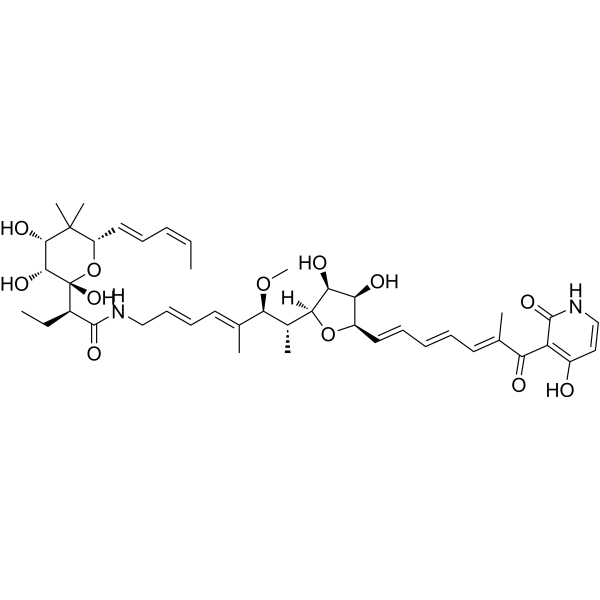 0 ImagesCat. No.: HY-122386CAS No.: 50935-71-2Synonyms: Mocimycin; DelvomycinKirromycin (Mocimycin; Delvomycin) is an elongation factor Tu (EF-Tu) inhibitor targeting protein biosynthesis. As an antibiotic, Kirromycin exerts antibacterial activity against Gram-negative bacteria by acting on EF-Tu to interfere with the peptidyl transfer reaction. Kirromycin is applicable to studies on bacterial infections.
-
Linogliride
 0 ImagesCat. No.: HY-126198CAS No.: 75358-37-1Synonyms: McN-3935Linogliride (MCN-3935) is an antidiabetic agent. Linogliride (100 μM) does not affect insulin secretion in the absence of glucose, but has a significant insulinotropic effect in the presence of 5.5 mM glucose.
-
Epoxyquinomicin A
 0 ImagesCat. No.: HY-N14237CAS No.: 175448-31-4Epoxyquinomicin A is an antibiotic that can be isolated from Amycolatopsis sp. Epoxyquinomicin A exhibits inhibitory activity against Micrococcus luteus, Bacillus subtilis, Pasteurella piscicida and Staphylococcus aureus with a MIC of 3-12.5 µg/mL. Epoxyquinomicin A exhibits cytotoxicity in cancer cell L1210, B16 and S180 with IC50 of 2-8 µg/mL. Epoxyquinomicin A exhibits anti-inflammatory effects against collagen-induced arthritis.
-
Mycinamicin VII
 0 ImagesCat. No.: HY-N14507CAS No.: 77704-58-6Mycinamicin VII is a macrolide antibiotic. Mycinamicin VII shows activity against Gram-positive bacteria.
-
Bactobolin hydrochloride
 0 ImagesCat. No.: HY-121104ACAS No.: 73543-68-7Bactobolin hydrochloride (Compound 1) is an antibiotic, which inhibits Escherichia coli, Salmonella, Shigella, Staphylococcus and Bacillus subtilis, with MICs of 0.3-6.25 μg/mL. Bactobolin hydrochloride exhibits antitumor efficacy against leukemia, with a LD50 value of 6.25-12.5 mg/kg.
-
Clopidol (Standard)
 0 ImagesClopidol (Standard) is the analytical standard of Clopidol. This product is intended for research and analytical applications. Clopidol (WR-61112) is an anticoccidial agent which is used as feed additive to control coccidiosis in chickens. Clopidol inhibits the sporulation of Eimeria tenella oocysts.
-
(R)-Ofloxacin (Standard)
 0 ImagesCat. No.: HY-B0330DRCAS No.: 100986-86-5Synonyms: Dextrofloxacin (Standard)(R)-Ofloxacin (Standard) is the analytical standard of (R)-Ofloxacin (HY-B0330D). (R)-Ofloxacin is the dextrorotatory enantiomer of Ofloxacin (HY-B0125) and is an orally effective fluoroquinolone antibiotic. (R)-Ofloxacin can inhibit the activity of bacterial DNA topoisomerase II, interfere with bacterial DNA replication and repair, and exert a bactericidal effect. (R)-Ofloxacin has a broad-spectrum antibacterial activity and has inhibitory effects on both Gram-negative and Gram-positive bacteria.
-
Clavamycin F
 0 ImagesCat. No.: HY-N14004CAS No.: 103059-97-8Clavamycin F is a clavam antibiotic.
-
3-O-α-D-Forosaminyl-(+)-griseusin
 0 ImagesCat. No.: HY-N14955CAS No.: 158268-23-63-O-α-D-Forosaminyl-(+)-griseusin is a memberof naphthoquinone antibiotic. 3-O-α-D-Forosaminyl-(+)-griseusin is active against Gram-positive bacteria including methicillin-resistant strain of Staphylococcus aureus (MRSA).

-
Griseusin B
 0 ImagesCat. No.: HY-N14684CAS No.: 59554-12-0Griseusin B is a quinone antibiotic. Griseusin B mainly has anti-Gram-positive bacterial activity.
-
L-threo-β-Hydroxyaspartic acid
 0 ImagesCat. No.: HY-W441968CAS No.: 7298-98-8L-threo-β-Hydroxyaspartic acid is an amino acid antibiotic. L-threo-β-Hydroxyaspartic acid has the activity of inhibiting Bacillus subtilis, Xanthomonas oryzae, Mycobacterium phlei and Botrytis cinerea.
-
Argimicin A
 0 ImagesCat. No.: HY-N5167CAS No.: 321846-46-2Argimicin A is an antibiotic that can be isolated from Sphingomonas sp.. Argimicin A exhibits algicidal activity against toxic cyanobacteria, inhibits M. viridis and M. aeruginosa with IC50s of 12 ng/mL and 100 ng/mL.
-
Amythiamicin B
 0 ImagesCat. No.: HY-125419CAS No.: 156620-48-3Amythiamicin B is a trisubstituted pyridine thiopeptide with antibiotic properties against Gram-positive bacteria and activity against Plasmodium falciparum.
-
Olivanic acid
 0 ImagesCat. No.: HY-N14919CAS No.: 64761-66-6Olivanic acid is a β -lactam antibiotic. Olivanic acid has the effect of anti -Gram-positive bacteria and anti-Gram-negative bacteria. Olivanic acid inhibits β-lactamase.
-
Sitafloxacin-d4
 0 ImagesCat. No.: HY-B0395SSynonyms: DU6859a-d4Sitafloxacin-d4 (DU6859a-d4) is deuterium labeled Sitafloxacin. Sitafloxacin (DU6859a) is a potent, orally active fluoroquinolone antibiotic. Sitafloxacin shows antichlamydial activity and antibacterial activities against a broad range of gram-positive and gram-negative bacteria, including anaerobic bacteria, as well as against atypical pathogens. Sitafloxacin can be used for the research of respiratory tract infection and urinary tract infection.
-
Macquarimicin C
 0 ImagesCat. No.: HY-N14836CAS No.: 165561-12-6Macquarimicin C is an antibiotic.



