



iGluR
Ionotropic glutamate receptors
iGluR (ionotropic glutamate receptor) is a ligand-gated ion channel that is activated by the neurotransmitter glutamate. iGluR are integral membrane proteins compose of four large subunits that form a central ion channel pore. Sequence similarity among all known glutamate receptor subunits, including the AMPA, kainate, NMDA, and δ receptors.
AMPA receptors are the main charge carriers during basal transmission, permitting influx of sodium ions to depolarise the postsynaptic membrane. NMDA receptors are blocked by magnesium ions and therefore only permit ion flux following prior depolarisation. This enables them to act as coincidence detectors for synaptic plasticity. Calcium influx through NMDA receptors leads to persistent modifications in the strength of synaptic transmission.
iGluR Isoform Specific Products
All Product Categories
-
iGluR Inhibitors
(131)
View all products
-
iGluR Agonists
(131)
View all products
-
iGluR Antagonists
(348)
View all products
-
iGluR Activators
(35)
View all products
-
iGluR Modulators
(93)
View all products
-
iGluR MDM2 Inhibitor
(1)
View all products
-
iGluR Controls
(5)
View all products
-
iGluR Ligands
(3)
View all products
-
iGluR Related Products (830)
Related Products (830)

-
Antibodies (11)
-
iGluR Isoform Comparison

-
PF-04701475
 0 ImagesCat. No.: HY-120811CAS No.: 1488407-52-8PF-04701475 is a potent AMPA receptor potentiator with an EC50 of 123 nM. PF-04701475 can be used for the study of neurological disorders.
-
NMDAR antagonist 3 (Standard)
 0 ImagesCat. No.: HY-W008038RCAS No.: 39512-49-7NMDAR antagonist 3 (Standard) is the analytical standard of NMDAR antagonist 3. This product is intended for research and analytical applications. NMDAR antagonist 3 (Compound 2) is an antagonist of the NMDA receptor. NMDAR antagonist 3 has a certain but weak inhibitory activity against the NR1A/2B subtype of the NMDA receptor.
-
DL-Willardiine
 0 ImagesCat. No.: HY-W922811CAS No.: 19772-76-0DL-Willardiine is an AMPA antagonist with an IC50 of 2 μM. DL-Willardiine can be utilized in psychotropic cccccc research.
-
NMDA receptor modulator 8
 0 ImagesCat. No.: HY-160931CAS No.: 1629853-49-1NMDA receptor modulator 8 (Compound 3-6) is a modulator for NMDA receptor, with 50%-100% potentiation of NMDA receptor at 10 μM.
-
Philanthotoxin 74 diTFA
 0 ImagesCat. No.: HY-104020BCAS No.: 401601-12-5Synonyms: PhTx 74 diTFAPhilanthotoxin 74 (PhTx 74) diTFA is an AMPAR antagonist; inhibits GluR3 and GluR1 with IC50s of 263 and 296 nM, respectively.
-
Tulrampator (Standard)
 0 ImagesCat. No.: HY-109046RCAS No.: 1038984-31-4Synonyms: CX-1632 (Standard); S-47445 (Standard)Tulrampator (Standard) is the analytical standard of Tulrampator (HY-109046). This product is intended for research and analytical applications. Tulrampator (S-47445) is an orally active selective AMPA receptor modulator. Tulrampator possesses procognitive, enhancing synaptic plasticity, anti-depressant-anxiolytic-like, procognitive and potential neuroprotective properties. Tulrampator can be used for research of alzheimer’s disease and in major depressive disorder.
-
Mephenesin-d3
 0 ImagesCat. No.: HY-B1283SMephenesin-d3 is deuterium labeled Mephenesin. Mephenesin is an NMDA receptor antagonist. Mephenesin is also a central muscle relaxant with antianxiety, muscle-paralyzing and anticonvulsant effects. Mephenesin acts directly on the skeletal muscle fibres to produce skeletal muscle relaxation. Mephenesin is promising for research of spasticity or painful muscle spasm.
-
(Rac)-Lanicemine (Standard)
 0 ImagesCat. No.: HY-108235BRCAS No.: 61890-25-3Synonyms: (Rac)-AZD6765 (Standard)(Rac)-Lanicemine (Standard) is the analytical standard of (Rac)-Lanicemine. This product is intended for research and analytical applications. (Rac)-Lanicemine ((Rac)-AZD6765) is the racemate of Lanicemine. Lanicemine (AZD6765) is a low-trapping NMDA channel blocker (Ki of 0.56-2.1 μM for NMDA receptor; IC50s of 4-7 μM and 6.4 μM in CHO and Xenopus oocyte cells, respectively). Antidepressant effects.
-
Gacyclidine hydrochloride
 0 ImagesCat. No.: HY-15410ACAS No.: 131774-33-9Gacyclidine hydrochloride, a non competitive N-methyl-D-aspartate (NMDA) antagonist, can be used in the study of spinal cord injuries.
-
ZL006 (Standard)
 0 ImagesCat. No.: HY-100456RCAS No.: 1181226-02-7
-
Omberacetam (Standard)
 0 ImagesSynonyms: GVS-111 (Standard); SGS-111 (Standard)Omberacetam (Standard) is the analytical standard of Omberacetam. This product is intended for research and analytical applications. Omberacetam (GVS-111) is a medication promoted and prescribed in Russia and neighbouring countries as a nootropic.
-
Kynurenic acid sodium (Standard)
 0 ImagesKynurenic acid (sodium) (Standard) is the analytical standard of Kynurenic acid (sodium). This product is intended for research and analytical applications. Kynurenic acid sodium, an endogenous tryptophan metabolite, is a broad-spectrum antagonist targeting NMDA, glutamate, α7 nicotinic acetylcholine receptor. Kynurenic acid sodium is also an agonist of GPR35/CXCR8.
-
Piracetam-d8
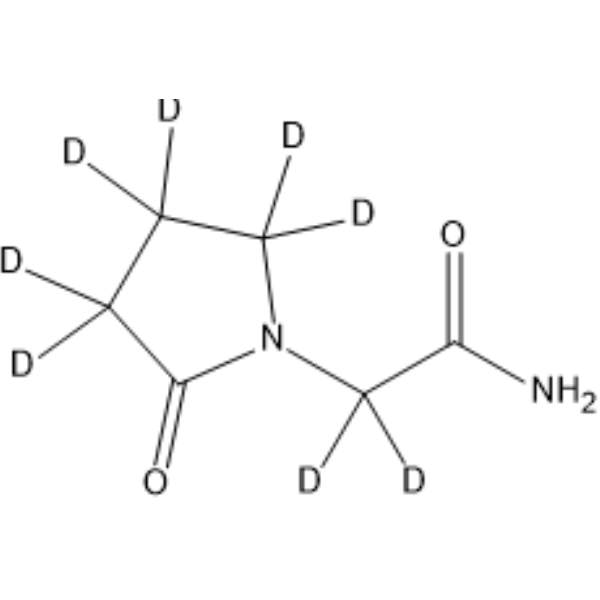 0 ImagesCat. No.: HY-B0585SCAS No.: 1329799-64-5Piracetam-d8 (UCB-6215-d8) is the deuterium labeled Piracetam. Piracetam (UCB-6215) is a cyclic derivative of the neurotransmitter gamma-aminobutyric acid (GABA), used in treatment of a wide range of cognitive disorders.
-
Mephenesin (Standard)
 0 ImagesMephenesin (Standard) is the analytical standard of Mephenesin. This product is intended for research and analytical applications. Mephenesin is an NMDA receptor antagonist and Mephenesin is a central muscle relaxant.
-
Apimostinel (Standard)
 0 ImagesCat. No.: HY-102053RCAS No.: 1421866-48-9Synonyms: NRX-1074 (Standard); AGN-241660 (Standard)Apimostinel (Standard) is the analytical standard of Apimostinel (HY-102053). This product is intended for research and analytical applications. Apimostinel (NRX-1074; AGN-241660) is an orally active NMDA receptor partial agonist.
-
Topiramate-13C6-1
 0 ImagesCat. No.: HY-B0122SS1Synonyms: McN 4853-13C6-1; RWJ 17021-13C6-1
-
7-Chlorokynurenic acid (Standard)
 0 ImagesSynonyms: 7-CKA (Standard)7-Chlorokynurenic acid (Standard) is the analytical standard of 7-Chlorokynurenic acid. This product is intended for research and analytical applications. 7-Chlorokynurenic acid (7-CKA) is a potent and selective antagonist of the glycine B coagonist site of the N-methyl-D-aspartate (NMDA) receptor (IC50=0.56 μM). 7-Chlorokynurenic acid is also a potent inhibitor of the reuptake of glutamate into synaptic vesicles with a Ki of 0.59 μM. 7-Chlorokynurenic acid has potent antinociceptive actions after neuraxial delivery.
-
O-Phosphono-L-homoserine
 0 ImagesCat. No.: HY-W051199CAS No.: 4210-66-6Synonyms: o-PhosphohomoserineO-Phosphono-L-homoserine (o-Phosphohomoserine) is an intermediate in threonine synthesis in bacteria and plants, and can also be hijacked by MetM in some Streptomyces species to enter a novel methionine synthesis pathway. O-Phosphono-L-homoserine acts as a weak antagonist of the NMDA receptor. O-Phosphono-L-homoserine can be used as a substrate for studies on amino acid metabolism of the aspartate family, a control for mechanism studies of PLP enzymes, and a reference for structure-activity relationship studies of NMDA receptor ligands.
-
DL-AP5 (Standard)
 0 ImagesCat. No.: HY-100714RCAS No.: 76326-31-3Synonyms: 2-APV (Standard); DL-2-Amino-5-phosphonovaleric acid (Standard)DL-AP5 (Standard) is the analytical standard of DL-AP5. This product is intended for research and analytical applications. DL-AP5 (2-APV) is a competitive NMDA (N-methyl-D-aspartate) receptor antagonist. DL-AP5 shows significantly antinociceptive activity. DL-AP5 specifically blocks on channels in the rabbit retina.




