



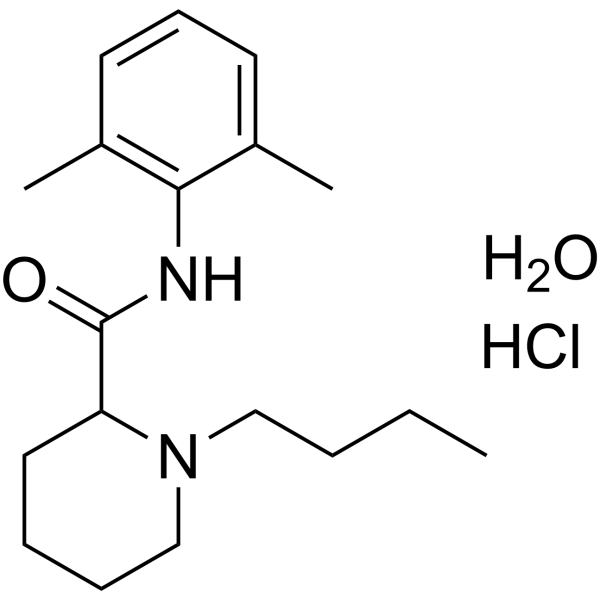
Bupivacaine hydrochloride monohydrate
Based on 4 publication(s) in Google Scholar
Bupivacaine hydrochloride monohydrate is a NMDA receptor inhibitor. Bupivacaine hydrochloride monohydrate can block sodium, L-calcium, and potassium channels. Bupivacaine hydrochloride monohydrate potently blocks SCN5A channels with the IC50 of 69.5 μM. Bupivacaine hydrochloride monohydrate can be used for the research of chronic pain.
For research use only. We do not sell to patients.
- CAS No.: 73360-54-0
- Formula: C18H31ClN2O2
- Molecular Weight:342.90
-
Storage:
Please store the product under the recommended conditions in the Certificate of Analysis.

To place orders, for customer services and technical support, please contact: MedChemExpress USA
Tel: 609-228-6898 E-mail: [email protected] [email protected]


-
 Biological Activity
-
Chemical Information
- Purity & Documentation
- References
-
 Help & FAQs


Publications Citing Use of MedChemExpress (MCE) Bupivacaine hydrochloride monohydrate
MoreAll iGluR Isoforms
MoreAll Calcium Channel Isoforms
More

Biological Activity
Description
IC50 & Target
|
NMDA Receptor |
In Vitro
Bupivacaine inhibits NMDA receptor-mediated synaptic transmission in the dorsal horn of the spinal cord, an area critically involved in central sensitization[1].
Bupivacaine influences the voltage dependency of channel activation and steady-state inactivation by shifting the membrane potential of half-maximal activation/inactivation toward somewhat more negative membrane potentials. In their inactivated state, SCN5A channels are slightly sensitive toward Bupivacaine IC50=2.18±0.16 μM[2].
Bupivacaine reversibly inhibits the SK2 channel in a dose-dependent manner with the IC 50 of 16.5 μM[3].
MedChemExpress (MCE) has not independently confirmed the accuracy of these methods. They are for reference only.


Chemical Information
-
CAS No. 73360-54-0
-
Molecular Weight 342.90
-
Formula C18H31ClN2O2
-
SMILES
CCCCN1CCCCC1C(=O)NC2=C(C=CC=C2C)C.O.Cl
-
Shipping
Room temperature in continental US; may vary elsewhere.
-
Storage
Please store the product under the recommended conditions in the Certificate of Analysis.


Publications (4)
-
Journal Impact Factor
-
Most Recent
-
Cell
2025 Nov 26;188(24):6754-6773.e29. PMID: 41138728 -
Nat Commun
2023 Jun 3;14(1):3224. PMID: 37270609 -
Sci Adv
EphB1-NR2B receptor signaling in glutamatergic neurons of the ventroposteromedial thalamic nucleus regulates emergence from anesthesia. [Abstract]2025 Dec 5;11(49):eadw7972. PMID: 41348875 -
Stem Cell Res Ther
Local anesthetics impair the growth and self-renewal of glioblastoma stem cells by inhibiting ZDHHC15-mediated GP130 palmitoylation. [Abstract]2021 Feb 4;12(1):107. PMID: 33541421


Purity & Documentation
References
[1]. Meaghan A Paganelli, et al. Actions of Bupivacaine, a widely used local anesthetic, on NMDA receptor responses. J Neurosci. 2015 Jan 14;35(2):831-42. [Content Brief]
[2]. Alexander P Schwoerer, et al. A Comparative Analysis of Bupivacaine and Ropivacaine Effects on Human Cardiac SCN5A Channels. Anesth Analg. 2015 Jun;120(6):1226-34. [Content Brief]
[3]. Carsten Stoetzer, et al. Inhibition of Voltage-Gated Na+ Channels by Bupivacaine Is Enhanced by the Adjuvants Buprenorphine, Ketamine, and Clonidine. Reg Anesth Pain Med.Jul/Aug 2017;42(4):462-468. [Content Brief]

Calculators
Concentration (start) × Volume (start) = Concentration (final) × Volume (final)


Bupivacaine hydrochloride monohydrate Related Classifications
HY-W415121 Related Classifications
 Powered by Bioz