



Nav1.9
Naᵥ1.9, encoded by SCN11A, is preferentially expressed in peripheral nociceptive neurons and visceral afferents, where it acts as a threshold channel[1]. Mechanistically, Naᵥ1.9 produces persistent tetrodotoxin-resistant current that modulates resting potential and amplifies small depolarizations[2]. In inflammatory pain models, Naᵥ1.9 contributes to persistent thermal hypersensitivity and spontaneous pain behavior after peripheral inflammation[3]. Human disease evidence links SCN11A gain-of-function variants to familial episodic pain and painful peripheral neuropathy[4][1]. Compared with Naᵥ1.7 and Naᵥ1.8, Naᵥ1.9 shows unique gating and pharmacology, including hyperpolarized activation, slow inactivation, and limited recombinant-channel pharmacology before stable HEK-293 expression systems[5]. For experimental applications, stable human, mouse, and rat Naᵥ1.9 HEK-293 cell lines support biophysical analysis and inhibitor characterization[5].- Naᵥ1.9 research should prioritize nociceptor excitability, inflammatory pain, and SCN11A channelopathy models. - Stable recombinant systems enable controlled testing of Naᵥ1.9 gating, species differences, and inhibitor responses.
References:
- [1]. Huang J, et al. Gain-of-function mutations in sodium channel Na(v)1.9 in painful neuropathy. Brain. 2014 Jun;137(Pt 6):1627-42. [Content Brief]
- [2]. Dib-Hajj S, et al. NaN/Nav1.9: a sodium channel with unique properties. Trends Neurosci. 2002 May;25(5):253-9. [Content Brief]
- [3]. Priest BT, et al. Contribution of the tetrodotoxin-resistant voltage-gated sodium channel NaV1.9 to sensory transmission and nociceptive behavior. Proc Natl Acad Sci U S A. 2005 Jun 28;102(26):9382-7. [Content Brief]
- [4]. Zhang XY, et al. Gain-of-function mutations in SCN11A cause familial episodic pain. Am J Hum Genet. 2013 Nov 7;93(5):957-66. [Content Brief]
- [5]. Lin Z, et al. Biophysical and Pharmacological Characterization of Nav1.9 Voltage Dependent Sodium Channels Stably Expressed in HEK-293 Cells. PLoS One. 2016 Aug 24;11(8):e0161450. [Content Brief]
All Product Categories
-
Nav1.9 Related Products (3)
Related Products (3)

-
DSP-2230
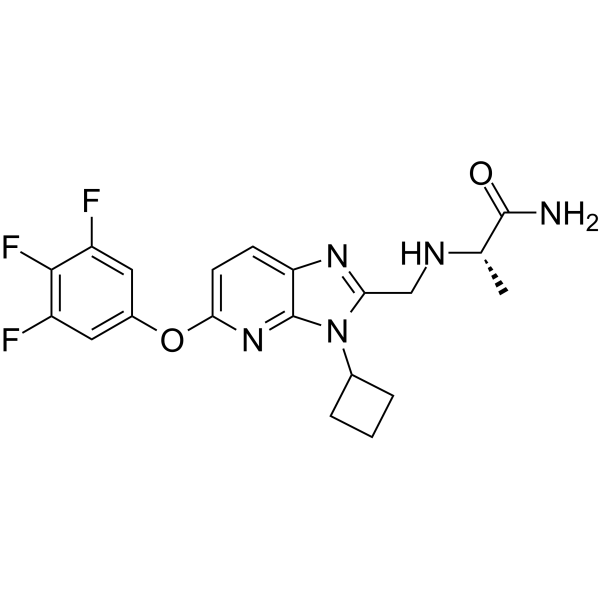 0 ImagesSynonyms: ANP-230DSP-2230 is the orally active inhibitor for voltage-gated sodium channel that inhibits Nav1.7-, Nav1.8-, and Nav1.9-derived sodium currents with IC50s of 7.1 μM, 11.4 μM and 6.7 μM, respectively. DSP-2230 can be used to improve neuropathic pain.
-
E0199
 0 ImagesE0199 is a novel potent dual-target KV7/NaV modulator that activates the KV7 channel (KV7.2/7.3 (EC50 = 12.78 nM), KV7.2 (EC50 = 0.50 μM), and KV7.5 (EC50 = 27.14 nM) channels) while simultaneously blocks the NaV1.7 (IC50 = 0.52 μM), NaV1.8 (IC50 = 0.24 μM), and NaV1.9 (IC50 = 0.16 μM) channels. E0199 shows a potent analgesic effect without affecting heart and skeletal muscle ion channels critically in a chronic constriction injury (CCI) mouse model. E0199 can be used for Neuropathic pain (NP) research.
-
ICA604025
 0 ImagesCat. No.: HY-186318ICA604025 is a state-dependent inhibitor of human Nav1.9 voltage-gated sodium channel. ICA604025 exerts stronger inhibitory effects on activated/inactivated Nav1.9 than on resting closed Nav1.9, and serves as a tool for investigating the physiological functions of Nav1.9. ICA604025 is applicable to pain-related research.



