



Salmonella Infection
-
Salmonella Infection (25)

- 1
- 2

- Molecular Weight: 150 kDa
Anti-Mouse CD172a Antibody (P84) is a rat-derived anti-mouse CD172a IgG1 κ type antibody inhibitor. Anti-Mouse CD172a Antibody (P84) blocks CD47-SIRPα interaction and thereby augments cell phagocytosis. Anti-Mouse CD172a Antibody (P84) can be used for the researches of infection and immunology, such as salmonella typhimurium infection.
- Formula: C112H189N15O70
- Molecular Weight: 2865.76
Sialylglycopeptide is an orally active glycopeptide found in egg yolk. Sialylglycopeptide inhibits the binding of Salmonella enteritidis and Escherichia coli to intestinal cells, and protects mice from Salmonella infection. Sialylglycopeptide can be used in the research of Salmonella infection.

- Formula: H6N2O4S
- Molecular Weight: 130.12
Hydrazine sulfate is an orally active PEPCK inhibitor. Hydrazine sulfate inhibits PEPCK and low-Km ALDH. Hydrazine sulfate impairs gluconeogenesis and enhances the protective effect of energy substrates against MPP+ toxicity. Hydrazine sulfate exacerbates liver damage in rats when combined with Ethanol. Hydrazine sulfate can be used in the research of shock, non-small cell lung cancer, colorectal cancer and Parkinson's disease.
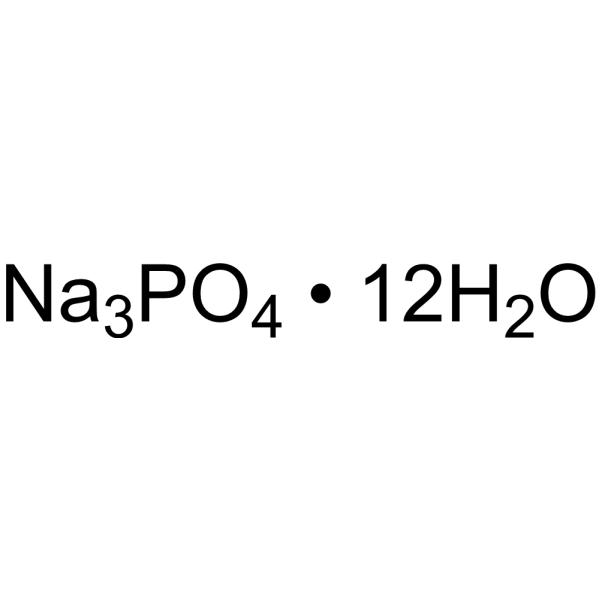
- Formula: Na3PO4·12H2O
- Molecular Weight: 380.12
Trisodium phosphate dodecahydrate is an Antibacterial agent. Trisodium phosphate dodecahydrate reduces the counts of Escherichia coli O157:H7 and Salmonella typhimurium attached to the surfaces of beef fat and fascia. Trisodium phosphate dodecahydrate modulates the growth parameters of Listeria monocytogenes in vitro: low concentrations shorten the lag phase and increase the maximum growth rate, while high concentrations prolong the lag phase and decrease the maximum growth rate. Trisodium phosphate dodecahydrate is used in poultry processing.

- Formula: C13H16N4O
- Molecular Weight: 244.29
VKT-17-P4-23 is a blood-brain barrier-permeable DksA inhibitor. DksA is a highly conserved transcriptional regulator in Gram-negative bacteria, with a Kd of 124 μM. Through the DksA-regulated, SPI-2-dependent survival pathway, VKT-17-P4-23 exhibits antibacterial activity against both planktonic and intracellular pathogens such as Salmonella, and also effectively combats persistent bacteria that are difficult to eliminate. VKT-17-P4-23 can be used in studies of Salmonella infection.

- Formula: C24H35D5N7O17P3S
- Molecular Weight: 828.63
Propionyl CoA-d5 is the deuterium labeled Propionyl CoA (HY-141467). Propionyl CoA serves as a common intermediate in the catabolic pathways of 1,2-propanediol and propionate in Salmonella enterica serovar Typhimurium LT2, and also functions as a precursor for 2-methylcitrate. Propionyl CoA is utilized as a substrate for the 2-methylcitrate synthase (PrpC) enzyme to synthesize 2-methylcitrate.

- Formula: C24H34D5N7NaO17P3S
- Molecular Weight: 850.61
Propionyl CoA-d5 sodium is the deuterium labeled Propionyl CoA. Propionyl CoA serves as a common intermediate in the catabolic pathways of 1,2-propanediol and propionate in Salmonella enterica serovar Typhimurium LT2, and also functions as a precursor for 2-methylcitrate. Propionyl CoA is utilized as a substrate for the 2-methylcitrate synthase (PrpC) enzyme to synthesize 2-methylcitrate.

- Formula: C12H11NO4
- Molecular Weight: 233.22
Casimiroin is a QR2 and Aromatase inhibitor, with an IC50 of 54.1 μM against QR2 and an IC50 of 3.92 μM against aromatase. Casimiroin exhibits antimutagenic activity and inhibits DMBA (HY-W011845)-induced mutations in Salmonella typhimurium. Casimiroin suppresses DMBA-induced precancerous lesions in mouse mammary organ cultures. Casimiroin can be used in breast cancer-related research.

- Formula: C27H45FeN6O9
- Molecular Weight: 653.53
Ferrioxamine E is a siderophore and bacterial growth regulator. Ferrioxamine E can chelate ferric iron, and promote the growth, morphological differentiation and antibiotic synthesis of Streptomyces tanashiensis.
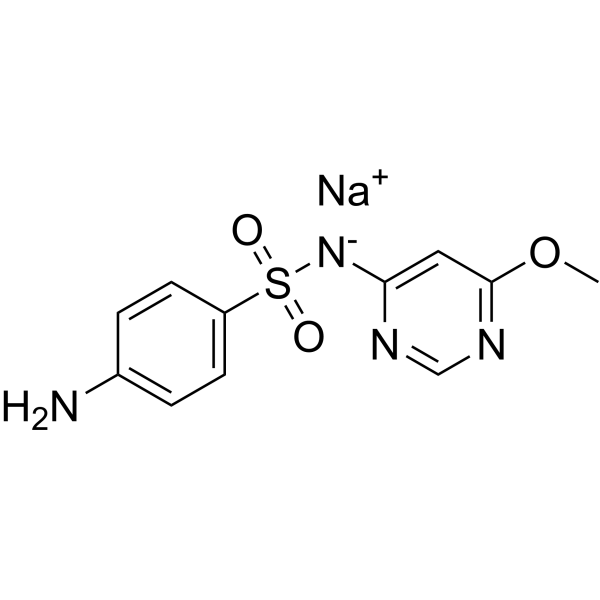
- Formula: C11H11N4NaO3S
- Molecular Weight: 302.29
Sulfamonomethoxine sodium is an orally active broad-spectrum synthetic sulfonamide antibiotic that inhibits dihydropteroate synthetase. Sulfamonomethoxine sodium increases blood glucose levels, induces anxiety-related activities and impairs spatial learning and memory. Sulfamonomethoxine sodium can be used for the research of anxiety, spatial memory impairment, colisepticemia, salmonellosis, and staphylococcus infection.

- Formula: C22H34O2
- Molecular Weight: 330.50
3,4-Seco-mansumbinoic acid (Compound 2) is an Antibacterial agent. 3,4-Seco-mansumbinoic acid can be isolated from the oleo-resin of Commiphora molmol. 3,4-Seco-mansumbinoic acid exhibits in vitro anti-staphylococcal activity, with the strongest activity against the multidrug-resistant Staphylococcus aureus strain SA-1199B (MIC 4 μg/mL) 3,4-Seco-mansumbinoic acid displays weak potentiation of Ciprofloxacin (HY-B0356) and Tetracycline (HY-A0107) activity against strains of Salmonella enterica serovar Typhimurium SL1344 and L10. 3,4-Seco-mansumbinoic acid can be used for the research of multidrug-resistant bacterial infection (Staphylococcus aureus, Salmonella enterica serovar Typhimurium).

- Formula: C19H17NO3
- Molecular Weight: 307.34
N-Demethyl-N-formyldehydronuciferine is a dehydroaporphine alkaloid. N-Demethyl-N-formyldehydronuciferine induces mutations in Salmonella typhimurium TA98 and TA100.

- Formula: C169H253N51O44
- Molecular Weight: 3703.13
Plantaricin F is an antibacterial peptide. Plantaricin F strongly inhibits several gram-negative bacteria including the foodbome pathogens Salmonella enteritidis and Pseudomonas aeruginosa. Plantaricin F inhibits several Lactobacillus, Pediococcus and Leuconostoc species.
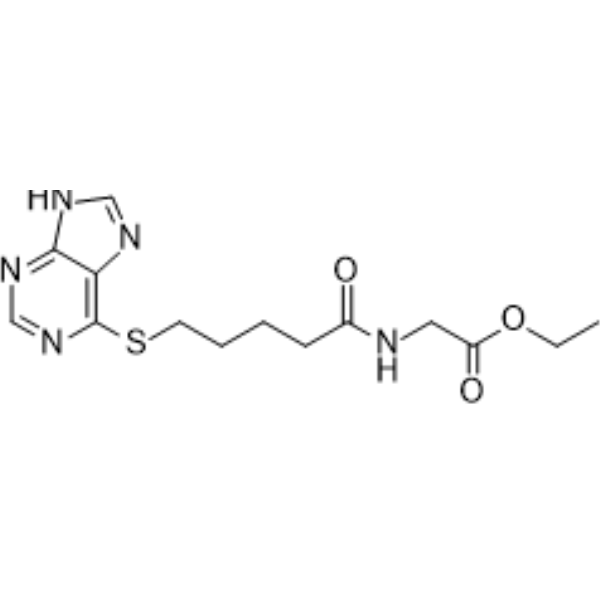
- Formula: C14H19N5O3S
- Molecular Weight: 337.40
Benin is a potent cytostatic agent that can be used for the treatment of generalized carcinoma of the breast.

- Formula: C49H65N3O15
- Molecular Weight: 936.05
CGP 4832 is a Rifamycin S (HY-125365) derivative and Antibacterial agent. CGP 4832 inhibits DNA-dependent transcription through DNA-dependent RNA polymerase. CGP 4832 exhibits activity against Gram-positive bacteria comparable to Rifampicin (HY-B0272), but is more potent against certain Gram-negative bacterial species, such as Escherichia coli ETH 2018 (MIC 0.01 µg/mL) and Salmonella AX 5 (MIC 0.5 µg/mL). CGP 4832 can be used for research on Gram-negative bacterial infections.

- Formula: C30H22O10
- Molecular Weight: 542.49
Rhusflavanone is a biflavonoid found in the stamens of Mesua ferrea. Rhusflavanone IC50 values against elastase and tyrosinase are 10.6 and 14.3 μg/mL, respectively. Rhusflavanone inhibits the replication of influenza B virus, SARS-CoV-2, Measles virus and HSV-2, and suppresses the secretion of Salmonella T3SS effector proteins. Rhusflavanone inhibits the production of pro-inflammatory mediators and exerts cytotoxic effects on cancer cells. Rhusflavanone can be used in research related to colon cancer, breast cancer, cervical cancer, COVID-19, influenza B, measles, HSV-2 infection and Salmonella infection.

- Formula: C6H3N5O3S2
- Molecular Weight: 257.25
Antimicrobial agent-46 is a inhibitor of Salmonella typhimurium serine acetyltransferase (StSAT) with an IC50 of 48.6 μM. Antimicrobial agent-46 inhibits bacterial growth in minimal medium lacking cysteine (LB 20%). Antimicrobial agent-46 exerts its effect by targeting the cysteine biosynthesis pathway, which is crucial for bacterial persistence and adaptability. Antimicrobial agent-46 exhibits antibacterial activity against the Gram-negative bacterium Escherichia coli. Antimicrobial agent-46 can be used in infection-related research .

- Formula: C12H13N5
- Molecular Weight: 227.27
4,8-DiMeIQx is an orally active mutagen, selective dopaminergic neurotoxicant, and DNA damaging agent. 4,8-DiMeIQx can be isolated from cooked beef, sausage, pork, and chicken. 4,8-DiMeIQx induces reverse mutations in *Salmonella typhimurium* TA98 in the presence or absence of S9 mix, and forms DNA adducts in vivo in rat liver. 4,8-DiMeIQx exhibits selective neurotoxicity toward dopaminergic neurons. 4,8-DiMeIQx shows no activity against non-dopaminergic neurons. 4,8-DiMeIQx can be used in studies related to Parkinson's disease and colorectal cancer.

- Formula: C16H23N5O5S
- Molecular Weight: 397.45
2-Methylthio-cis-zeatin riboside (ms2io6A) , a hypermodified adenosine derivative, is present in the transfer RNA of Salmonella ryphimurium.
- 1
- 2



