



Hydrazine sulfate (99%)

Based on 1 Customer Validation
Hydrazine sulfate is an orally active PEPCK inhibitor. Hydrazine sulfate inhibits PEPCK and low-Km ALDH. Hydrazine sulfate impairs gluconeogenesis and enhances the protective effect of energy substrates against MPP+ toxicity. Hydrazine sulfate exacerbates liver damage in rats when combined with Ethanol. Hydrazine sulfate can be used in the research of shock, non-small cell lung cancer, colorectal cancer and Parkinson's disease.
For research use only. We do not sell to patients.
- Purity : 99.16%
- CAS No.: 10034-93-2
- Formula: H6N2O4S
- Molecular Weight:130.12
-
Storage:
4°C, sealed storage, away from moisture
* In solvent : -80°C, 6 months; -20°C, 1 month (sealed storage, away from moisture)


To place orders, for customer services and technical support, please contact: MedChemExpress USA
Tel: 609-228-6898 E-mail: [email protected] [email protected]


-
 Biological Activity
-
Chemical Information
-
Solvent & Solubility
- Protocols
- Purity & Documentation
- References
-
 Help & FAQs


-
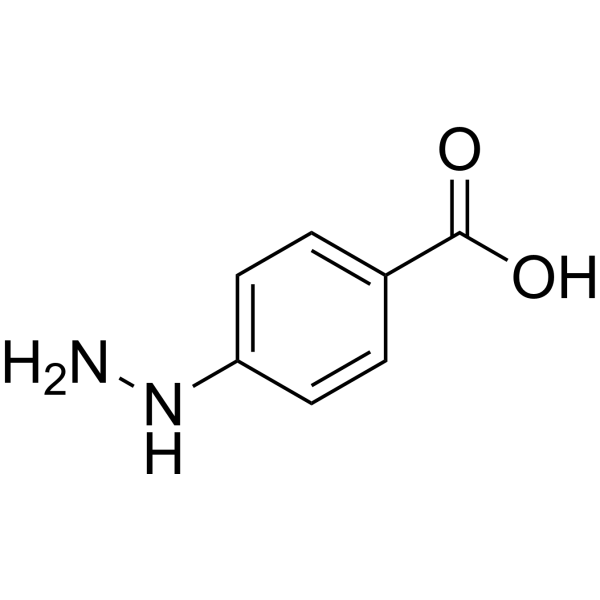
HY-W017382
4-Hydrazinobenzoic acidDNA Damaging Agent -
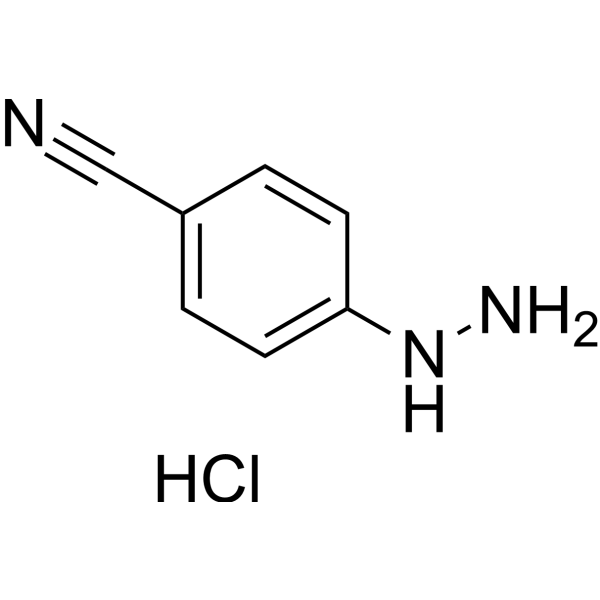
HY-41677
4-Cyanophenylhydrazine hydrochlorideBiochemical Reagent -

HY-W094747A
BenzalazineAnti-Ulcerative Colitis Agent -

HY-I0777
1,2-DiacetylhydrazineDrug Impurity -

HY-W012890
PentanehydrazideBiochemical Assay Reagents -

HY-W001874
2-CyanoethylhydrazineDrug Intermediate -

HY-W017382R
4-Hydrazinobenzoic acid (Standard)Reference Standard -

HY-I0777R
1,2-Diacetylhydrazine (Standard)


Biological Activity
Description
In Vitro
Hydrazine sulfate (500 μM; 2 h) impairs gluconeogenesis by inhibiting PEPCK, and enhances the protective effects of energy substrates against MPP+ toxicity in murine brain Neuro-2A (N2A) neuroblastoma cells[1].
MedChemExpress (MCE) has not independently confirmed the accuracy of these methods. They are for reference only. Further protocols information, click here.
In Vivo
Hydrazine sulfate (50-80 mg/kg; i.p.) protects D-galactosamine (HY-42682)-sensitized CF1 female mice against endotoxin and tumor necrosis factor/Cachectin lethality[5].
Hydrazine sulfate (30 ppm; p.o. via liquid diet; 4 weeks) exacerbates hepatic injury in Sprague-Dawley male rats when co-administered with 4% (w/v) Ethanol[6].
MedChemExpress (MCE) has not independently confirmed the accuracy of these methods. They are for reference only.
-
Animal Model:Male Sprague-Dawley rats (initial weight approximately 290 g)[6]
-
Dosage:30 mg/kg per day
-
Administration:Oral administration via liquid diet, for 4 weeks
-
Result:Increased the liver weight.
Caused significantly elevated plasma levels of AST, ALT, LDH, and prolyl hydroxylase (PH) compared to the control group when administered concurrently with 4% (w/v) ethanol.
Revealed diffuse large fatty droplets, pericellular fibrosis extending from portal and central veins when administered concurrently with 4% (w/v) ethanol.


Chemical Information
-
CAS No. 10034-93-2
-
Appearance Solid
-
Molecular Weight 130.12
-
Formula H6N2O4S
-
Color White to off-white
-
SMILES
NN.OS(=O)(O)=O
-
Synonyms
Diamine sulfate (99%)
-
Shipping
Room temperature in continental US; may vary elsewhere.
-
Storage
4°C, sealed storage, away from moisture
* In solvent : -80°C, 6 months; -20°C, 1 month (sealed storage, away from moisture)


Solvent & Solubility
In Vitro:
DMSO : 6.67 mg/mL (51.26 mM; ultrasonic and warming and heat to 60°C; Hygroscopic DMSO has a significant impact on the solubility of product, please use newly opened DMSO)
Please refer to the solubility information to select the appropriate solvent. Once prepared, please aliquot and store the solution to prevent product inactivation from repeated freeze-thaw cycles.
Storage method and period of stock solution: -80°C, 6 months; -20°C, 1 month (sealed storage, away from moisture). When stored at -80°C, please use it within 6 months. When stored at -20°C, please use it within 1 month.
Please refer to the solubility information to select the appropriate solvent. Once prepared, please aliquot and store the solution to prevent product inactivation from repeated freeze-thaw cycles.
Storage method and period of stock solution: -80°C, 6 months; -20°C, 1 month (sealed storage, away from moisture). When stored at -80°C, please use it within 6 months. When stored at -20°C, please use it within 1 month.
Concentration (start) × Volume (start) = Concentration (final) × Volume (final)
In Vivo:
Select the appropriate dissolution method based on your experimental animal and administration route.
- For the following dissolution methods, please ensure to first prepare a clear stock solution using an In Vitro approach and then sequentially add co-solvents:
- To ensure reliable experimental results, the clarified stock solution can be appropriately stored based on storage conditions. As for the working solution for In Vivo experiments, it is recommended to prepare freshly and use it on the same day.
- The percentages shown for the solvents indicate their volumetric ratio in the final prepared solution. If precipitation or phase separation occurs during preparation, heat and/or sonication can be used to aid dissolution.
Add each solvent one by one: 10% DMSO 40% PEG300 5% Tween-80 45% Saline
Solubility: ≥ 0.67 mg/mL (5.15 mM); Clear solution
This protocol yields a clear solution of ≥ 0.67 mg/mL (saturation unknown).
Taking 1 mL working solution as an example, add 100 μL DMSO stock solution (6.7 mg/mL) to 400 μL PEG300, and mix evenly; then add 50 μL Tween-80 and mix evenly; then add 450 μL Saline to adjust the volume to 1 mL.
Preparation of Saline: Dissolve 0.9 g sodium chloride in ddH₂O and dilute to 100 mL to obtain a clear Saline solution.
Add each solvent one by one: 10% DMSO 90% (20% SBE-β-CD in Saline)
Solubility: ≥ 0.67 mg/mL (5.15 mM); Clear solution
This protocol yields a clear solution of ≥ 0.67 mg/mL (saturation unknown).
Taking 1 mL working solution as an example, add 100 μL DMSO stock solution (6.7 mg/mL) to 900 μL 20% SBE-β-CD in Saline, and mix evenly.
Preparation of 20% SBE-β-CD in Saline (4°C, storage for one week): 2 g SBE-β-CD powder is dissolved in 10 mL Saline, completely dissolve until clear.
In Vivo Dissolution Calculator
Please enter the basic information of animal experiments:
-
-
-
-
Recommended: Prepare an additional quantity of animals to account for potential losses during experiments.
Please enter your animal formula composition:
-
%DMSO +
Recommended: Keep the proportion of DMSO in working solution below 2% if your animal is weak.
-
%+
-
+%Tween-80 + +
-
%Saline +
The co-solvents required include: DMSO, . All of co-solvents are available by MedChemExpress (MCE). , Tween 80. All of co-solvents are available by MedChemExpress (MCE).
Working solution concentration: 0.22 mg/mL
Method for preparing stock solution: mg drug dissolved in μL DMSO. Stock solution concentration: mg/mL. * In solvent : -80°C, 6 months; -20°C, 1 month (sealed storage, away from moisture)
1. Take μL DMSO stock solution;
2. Add μL .
μL , mix evenly;
3. Then add μL Tween 80, mix evenly;
4. Then add μL
Please ensure that the stock solution in the first step is dissolved to a clear state, and add co-solvents in sequence. You can use ultrasonic heating (ultrasonic cleaner, recommended frequency 20-40 kHz), vortexing, etc. to assist dissolution.

Protocols
-
Human pluripotent stem cell midbrain dopaminergic neuron differentiation
Human pluripotent stem cells are directed toward midbrain dopaminergic neurons by first inducing a neural floor-plate-like progenitor state, then patterning cells with ventralizing SHH signaling and midbrain/WNT-FGF cues, and finally maturing progenitors into neurons expressing dopaminergic markers such as TH, NURR1/NR4A2, PITX3, DAT/SLC6A3, VMAT2/SLC18A2, GIRK2/KCNJ6, FOXA2, LMX1A, and EN1. The main readouts are loss of pluripotency, acquisition of FOXA2+/LMX1A+ midbrain floor-plate progenitors, emergence of βIII-tubulin+/MAP2+ neurons, and production of TH+ dopaminergic neurons with molecular, dopamine-release, and electrophysiological features of midbrain dopaminergic identity.
-
Hepatotoxicity Study
This protocol evaluates hepatotoxicity using complementary in vivo mouse APAP acute liver injury and in vitro hepatocyte-based cytotoxicity readouts. In vivo APAP injury is assessed by serum ALT/AST, liver histology, hepatic glutathione, protein adducts, necrosis, inflammation, and regeneration-related endpoints. In vitro hepatotoxicity is assessed by loss of viability, leakage of ALT/AST/LDH, oxidative-stress markers, mitochondrial function, nuclear morphology, intracellular calcium, and high-content imaging endpoints.


Purity & Documentation
-
Data Sheet (272 KB)
-
SDS (950 KB)
- English - EN (950 KB)
- Français - FR (950 KB)
- Deutsch - DE (950 KB)
- Norwegian - NO (950 KB)
- Español - ES (950 KB)
- Swedish - SV (950 KB)
- Italian - IT (950 KB)
- Korean - KR (950 KB)
- Portuguese - PT (950 KB)
-
Handling Instructions (2659 KB)
References
[1]. Mazzio E, et al. The role of glycolysis and gluconeogenesis in the cytoprotection of neuroblastoma cells against 1-methyl 4-phenylpyridinium ion toxicity. Neurotoxicology. 2003 Jan;24(1):137-47. [Content Brief]
[2]. Chlebowski RT, et al. Hydrazine sulfate influence on nutritional status and survival in non-small-cell lung cancer. J Clin Oncol. 1990 Jan;8(1):9-15. [Content Brief]
[3]. Loprinzi CL, et al. Randomized placebo-controlled evaluation of hydrazine sulfate in patients with advanced colorectal cancer. J Clin Oncol. 1994 Jun;12(6):1121-5. [Content Brief]
[4]. Silverstein R, et al. Modulation of endotoxin lethality in mice by hydrazine sulfate. Infect Immun. 1989 Jul;57(7):2072-8. [Content Brief]
[5]. Silverstein R, et al. Hydrazine sulfate protects D-galactosamine-sensitized mice against endotoxin and tumor necrosis factor/cachectin lethality: evidence of a role for the pituitary. J Exp Med. 1991 Feb 1;173(2):357-65. [Content Brief]
[6]. Suzuki H, et al. Ethanol and hydrazine sulfate induced chronic hepatic injury in rats: the curative effect of administration of glucogenic amino acids. Alcohol Alcohol Suppl. 1993;1A:111-7. [Content Brief]


Complete Stock Solution Preparation Table
Please refer to the solubility information to select the appropriate solvent. Once prepared, please aliquot and store the solution to prevent product inactivation from repeated freeze-thaw cycles.
Storage method and period of stock solution: -80°C, 6 months; -20°C, 1 month (sealed storage, away from moisture). When stored at -80°C, please use it within 6 months. When stored at -20°C, please use it within 1 month.
| Optional Solvent | Concentration Solvent Mass | 1 mg | 5 mg | 10 mg | 25 mg |
|---|---|---|---|---|---|
| DMSO | 1 mM | 7.6852 mL | 38.4261 mL | 76.8521 mL | 192.1303 mL |
| 5 mM | 1.5370 mL | 7.6852 mL | 15.3704 mL | 38.4261 mL | |
| 10 mM | 0.7685 mL | 3.8426 mL | 7.6852 mL | 19.2130 mL | |
| 15 mM | 0.5123 mL | 2.5617 mL | 5.1235 mL | 12.8087 mL | |
| 20 mM | 0.3843 mL | 1.9213 mL | 3.8426 mL | 9.6065 mL | |
| 25 mM | 0.3074 mL | 1.5370 mL | 3.0741 mL | 7.6852 mL | |
| 30 mM | 0.2562 mL | 1.2809 mL | 2.5617 mL | 6.4043 mL | |
| 40 mM | 0.1921 mL | 0.9607 mL | 1.9213 mL | 4.8033 mL | |
| 50 mM | 0.1537 mL | 0.7685 mL | 1.5370 mL | 3.8426 mL |


Hydrazine sulfate (99%) Related Classifications
HY-W115752 Related Classifications
 Powered by Bioz