



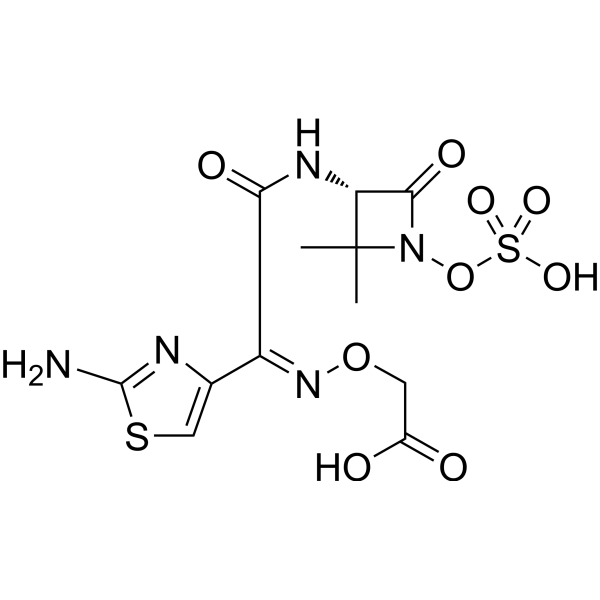
Tigemonam
Tigemonam is an orally active monobactam antibiotic with a Ki of 0.86 μM against Enterobacter cloacae P99 β-lactamase and 50.8 μM against Escherichia coli TEM-1 β-lactamase. Tigemonam binds to penicillin-binding proteins 1a, 3, and 4, inhibits bacterial cell wall synthesis, and exhibits bactericidal activity against aerobic gram-negative bacteria including Enterobacteriaceae, Haemophilus influenzae, and Neisseria gonorrhoeae. Tigemonam resists hydrolysis by multiple β-lactamase enzymes, reduces bacterial load in systemic, pyelonephritic, lung, and thigh muscle infections in rodents, and shows minimal difference between minimum inhibitory and bactericidal concentrations. Tigemonam can be used for the research of gram-negative bacterial infections, acute pyelonephritis, lung infection, and thigh muscle infection.
For research use only. We do not sell to patients.
- CAS No.: 102507-71-1
- Formula: C12H15N5O9S2
- Molecular Weight:437.41
-
Storage:
Please store the product under the recommended conditions in the Certificate of Analysis.

To place orders, for customer services and technical support, please contact: MedChemExpress USA
Tel: 609-228-6898 E-mail: [email protected] [email protected]


-
 Biological Activity
-
Chemical Information
- Protocols
- Purity & Documentation
- References
-
 Help & FAQs




Biological Activity
Description
In Vitro
Tigemonam (24 h) potently inhibits the in vitro growth of a broad range of gram-negative bacteria, including specific strains of Escherichia coli, Salmonella schottmulleri, Proteus mirabilis, Providencia rettgeri, Klebsiella pneumoniae, Serratia marcescens, Enterobacter cloacae, Haemophilus influenzae, and Proteus vulgaris, with MIC values ranging from <0.05 to 3.1 μg/mL[1].
Tigemonam (≤0.015-128 μg/mL; 18-20 h) inhibits most tested aerobic gram-negative bacteria at concentrations ≤1 μg/mL, with MIC90 values ranging from 0.03 μg/mL (for Proteus mirabilis) to 8 μg/mL (for Enterobacter cloacae), but does not inhibit Pseudomonas spp. or Acinetobacter spp[2].
Tigemonam (1-128 μg/mL; 18-20 h) inhibits hemolytic streptococci, Streptococcus pneumoniae, and Clostridium perfringens at concentrations up to 16 μg/mL, but has no activity against Staphylococcus spp., Enterococcus faecalis, viridans group streptococci, Listeria monocytogenes, or Bacteroides fragilis[2].
Tigemonam (0.1 mM) is highly stable against most common plasmid and chromosomal β-lactamases, with minimal hydrolysis by only a small subset of β-lactamases[2].
Tigemonam (equimolar to cephaloridine; 10 min) effectively inhibits chromosomal β-lactamases from Enterobacter cloacae and Pseudomonas aeruginosa, has moderate inhibition of plasmid TEM-1 and SHV-1 β-lactamases, and does not inhibit Proteus vulgaris β-lactamase[2].
Tigemonam (18-20 h) exhibits increased activity (two- to eightfold lower MICs) against Escherichia coli outer membrane permeability mutants compared to the parent E. coli UB1005 strain[2].
Tigemonam (0.07-0.2 μg/mL; 3 h) inhibits the growth of Escherichia coli (serotype O:90) in vitro with an EC50 of 0.122 μg/mL[3].
Tigemonam (0.05-0.25 μg/mL; 3 h) inhibits the growth of Klebsiella pneumoniae (ATCC 43816) in vitro with an EC50 of 0.135 μg/mL[3].
Tigemonam potently inhibits Enterobacteriaceae (97.7% susceptible at ≤8.0 μg/mL) and Aeromonas hydrophila, but shows minimal to no activity against pseudomonads, enterococci, staphylococci, and most streptococcal species tested[4].
Tigemonam potently inhibits pathogenic Neisseria spp., B. catarrhalis, and H. influenzae (all susceptible at ≤0.25 μg/mL), shows moderate activity against serogroups A, C, and G streptococci, and has minimal to no activity against L. monocytogenes, enterococci, staphylococci, and most pseudomonad species tested[4].
Tigemonam (0.13-1.0 μg/mL; duration of incubation required for bacterial growth) has a proposed MIC quality-control range against Escherichia coli ATCC 25922 of 0.13 to 0.5 μg/mL, encompassing 95% of test endpoints across six laboratories[4].
Tigemonam (<0.25 μg/mL) shows that fecal gram-negative bacteria (predominantly E. coli, Proteus mirabilis, Morganella morganii) exhibit in vitro susceptibility to Tigemonam with an MIC50 of <0.25 μg/mL, with no change in susceptibility during the study[5].
Tigemonam inhibits growth of Escherichia coli SC8294 (104 CFU) with an MIC of 0.40 μg/mL in yeast-beef agar[6].
MedChemExpress (MCE) has not independently confirmed the accuracy of these methods. They are for reference only.
Parmacokinetics
In Vivo
Tigemonam (p.o.; 3 doses per day; 2 consecutive days) is highly efficacious in reducing kidney bacterial loads in mice with acute pyelonephritis caused by both β-lactamase-negative and β-lactamase-positive gram-negative bacteria, with ED50 values ranging from 0.5 to 3.2 mg/kg[1].
Tigemonam (p.o.; 3 doses per day; 2 consecutive days) is efficacious in reducing lung bacterial loads in rats with K. pneumoniae lung infections, with an ED50 of 46.2 mg/kg[1].
Tigemonam (1.6-100 mg/kg; p.o.; single dose) exhibits potent in vivo antibacterial activity against E. coli and K. pneumoniae in granulocytopenic mice, with ED50 values of 2.7 mg/kg and 2.1 mg/kg, respectively[3].
Tigemonam (6.25-100 mg/kg; p.o.; single daily dose; up to 10 days) causes a dose-dependent reduction in fecal aerobic gram-negative rods in mice, with a 100 mg/kg daily dose increasing fecal Candida albicans counts but not altering relative cecal weight or total cecal bacterial counts[5].
MedChemExpress (MCE) has not independently confirmed the accuracy of these methods. They are for reference only.
-
Animal Model:CD-1 (female, 20-22 g); Swiss-Webster (female, 18-20 g)[1]
-
Dosage:0.2-3.9 mg/kg
-
Administration:p.o.; 2 doses (1 and 5 hours post-infection)
-
Result:Exhibited ED50 of 1.4 mg/kg against Escherichia coli SC 8294.
Exhibited ED50 of 1.5 mg/kg against E.
coli SC 12199.
Exhibited ED50 of 0.7 mg/kg against Salmonella schottmulleri SC 3850.
Exhibited ED50 of 0.3 mg/kg against Proteus mirabilis SC 9575.
Exhibited ED50 of 0.2 mg/kg against Providencia rettgeri SC 8217.
Exhibited ED50 of 0.9 mg/kg against Klebsiella pneumoniae SC 12216.
Exhibited ED50 of 0.5 mg/kg against Serratia marcescens SC 9782.
Exhibited ED50 of 3.9 mg/kg against Enterobacter cloacae SC 11078.
Exhibited ED50 of 1.8 mg/kg against Haemophilus influenzae SC 10556.
-
Animal Model:Swiss mice (female, specific-pathogen-free, granulocytopenic via 6 Gy total body irradiation)[3]
-
Dosage:1.6 mg/kg; 12.5 mg/kg; 100 mg/kg
-
Administration:p.o.; single dose
-
Result:Reduced viable bacterial counts in infected thigh muscles compared to untreated controls.
Approached maximum antibacterial effect at a dose of 12.5 mg/kg.
-
Animal Model:Swiss mice (female, specific-pathogen-free)[4]
-
Dosage:6.25 mg/kg; 25 mg/kg; 100 mg/kg
-
Administration:p.o.; single daily dose; up to 10 days
-
Result:Caused a dose-dependent decrease in the number of aerobic gram-negative rods in feces, but did not lead to complete eradication of these bacteria.
Resulted in a statistically significant increase in fecal Candida albicans counts compared to controls at 100 mg/kg per day.
Did not produce a significant change in relative cecal weight or total microscopically detectable cecal bacterial counts compared to controls.


Chemical Information
-
CAS No. 102507-71-1
-
Molecular Weight 437.41
-
Formula C12H15N5O9S2
-
SMILES
OC(CO/N=C(C1=CSC(N)=N1)\C(N[C@H]2C(C)(N(OS(=O)(O)=O)C2=O)C)=O)=O
-
Shipping
Room temperature in continental US; may vary elsewhere.
-
Storage
Please store the product under the recommended conditions in the Certificate of Analysis.


Purity & Documentation
References
[1]. Clark JM, et al. In vivo evaluation of tigemonam, a novel oral monobactam. Antimicrob Agents Chemother. 1987;31(2):226-229. [Content Brief]
[2]. Chin NX, et al. Tigemonam, an oral monobactam. Antimicrob Agents Chemother. 1988;32(1):84-91. [Content Brief]
[3]. van Ogtrop ML, et al. Comparison of the effects of aztreonam and tigemonam against Escherichia coli and Klebsiella pneumoniae in vitro and in vivo. Antimicrob Agents Chemother. 1991;35(3):417-422. [Content Brief]
[4]. Fuchs PC, et al. In vitro antimicrobial activity of tigemonam, a new orally administered monobactam. Antimicrob Agents Chemother. 1988;32(3):346-349. [Content Brief]
[5]. van Ogtrop ML, et al. Modulation of the intestinal flora of mice by treatment with aztreonam and tigemonam. Antimicrob Agents Chemother. 1991;35(5):983-985. [Content Brief]
[6]. Bush K, et al. Improved sensitivity in assays for binding of novel beta-lactam antibiotics to penicillin-binding proteins of Escherichia coli. Antimicrob Agents Chemother. 1987;31(8):1271-1273. [Content Brief]

Calculators
Concentration (start) × Volume (start) = Concentration (final) × Volume (final)


Tigemonam Related Classifications
HY-U00380 Related Classifications
 Powered by Bioz
Keywords
- Tigemonam
- 102507-71-1
- Antibiotic
- Beta-lactamase
- Bacterial
- penicillin-binding proteins 1a
- Escherichia coli TEM-1 β-lactamase
- Enterobacteriaceae
- Neisseria gonorrhoeae
- Klebsiella pneumoniae
- Haemophilus influenzae
- penicillin-binding proteins 3
- Escherichia coli
- penicillin-binding proteins 4
- Enterobacter cloacae P99 β-lactamase
- Inhibitor
- inhibitor
- inhibit