



Metallo-β-lactamase (MBL)
Metallo-β-lactamases (MBLs) are Zn(II)-containing, zinc-dependent hydrolases that inactivate broad ranges of β-lactam antibiotics, including carbapenems, penicillins, and cephalosporins[1][2]. Mechanistically, MBL activity depends on metal binding in the bacterial periplasm, where zinc availability controls enzyme activity, stability, and resistance profiles during infection-relevant metal starvation[2]. In Gram-negative bacteria, MBL expression severely limits therapeutic options because these enzymes hydrolyze nearly all clinically available β-lactam antibiotics and drive carbapenem resistance[2][3]. Compared with serine-β-lactamases, MBLs show distinct folds, active sites, catalytic features, and zinc-dependent mechanisms, which complicate broad-spectrum inhibitor development[1][4]. Within MBLs, B1 enzymes such as NDM-1, IMP-1, and VIM-2 are clinically significant, whereas B1, B2, and B3 subclasses differ in sequence identity, zinc dependence, active-site architecture, zinc ligands, and catalytic mechanisms[5]. For experimental applications, inhibitor studies use zinc chelation, metal displacement, covalent active-site targeting, and substrate-site affinity labeling to evaluate MBL inhibition and resistance liabilities[2][6][7]. TACN-based compounds restored meropenem activity against carbapenemase-producing bacteria in vitro, supporting MBL inhibitor screening as a practical research model[8].
References:
- [1]. Bahr G, et al. Metallo-β-lactamases in the Age of Multidrug Resistance: From Structure and Mechanism to Evolution, Dissemination, and Inhibitor Design. Chem Rev. 2021 Jul 14;121(13):7957-8094. [Content Brief]
- [2]. Bahr G, et al. Metallo-β-lactamases and a tug-of-war for the available zinc at the host-pathogen interface. Curr Opin Chem Biol. 2022 Feb;66:102103. [Content Brief]
- [3]. Zakhour J, et al. Metallo-beta-lactamases: mechanisms, treatment challenges, and future prospects. Expert Rev Anti Infect Ther. 2024 Apr;22(4):189-201. [Content Brief]
- [4]. King DT, et al. Targeting metallo-β-lactamase enzymes in antibiotic resistance. Future Med Chem. 2013 Jul;5(11):1243-63. [Content Brief]
- [5]. Mojica MF, et al. B1-Metallo-β-Lactamases: Where Do We Stand? Curr Drug Targets. 2016;17(9):1029-50. [Content Brief]
- [6]. Thomas PW, et al. An altered zinc-binding site confers resistance to a covalent inactivator of New Delhi metallo-beta-lactamase-1 (NDM-1) discovered by high-throughput screening. Bioorg Med Chem. 2013 Jun 1;21(11):3138-46. [Content Brief]
- [7]. Thomas PW, et al. A Lysine-Targeted Affinity Label for Serine-β-Lactamase Also Covalently Modifies New Delhi Metallo-β-lactamase-1 (NDM-1). Biochemistry. 2019 Jun 25;58(25):2834-2843. [Content Brief]
- [8]. Somboro AM, et al. 1,4,7-Triazacyclononane Restores the Activity of β-Lactam Antibiotics against Metallo-β-Lactamase-Producing Enterobacteriaceae: Exploration of Potential Metallo-β-Lactamase Inhibitors. Appl Environ Microbiol. 2019 Jan 23;85(3):e02077-18. [Content Brief]
All Product Categories
-
Metallo-β-lactamase (MBL) Related Products (10)
Related Products (10)

-
NDM-1-IN-11
 0 ImagesCat. No.: HY-179618NDM-1-IN-11 is a potent covalent NDM-1 inhibitor with an IC50 of 1.12 μM, which acts by forming a Se-S bond with the enzyme. NDM-1-IN-11 effectively suppresses the growth of NDM-1-producing E. coli in both in vivo and in vitro models when combined with Meropenem (HY-13678). NDM-1-IN-11 can be used for addressing NDM-1 driven bacterial resistance.
-
Metallo-β-lactamase-IN-15
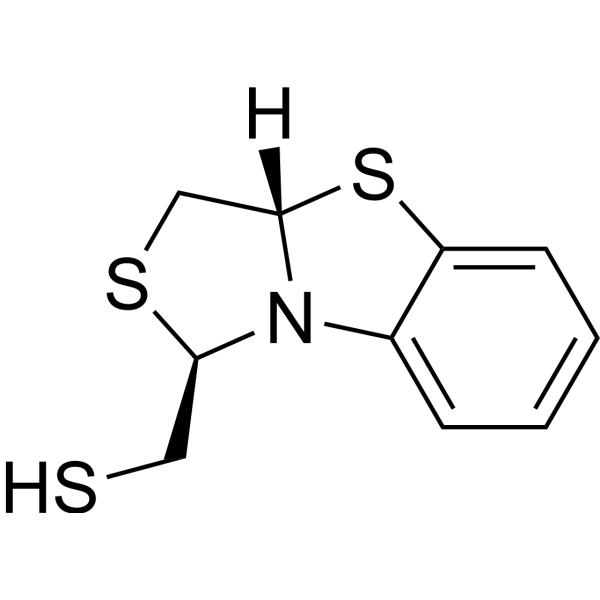 0 ImagesCat. No.: HY-161310CAS No.: 1804934-57-3Metallo-β-lactamase-IN-15 (Compound ±13) is a potent MBL inhibitor, the IC50 values for NDM-1、IMP-1 and VIM-2 were 0.29 μM, 0.088 μM and 0.063 μM, respectively.
-
β-Lactamase/Ferroptosis-IN-1
 0 ImagesCat. No.: HY-184667CAS No.: 3115648-56-8β-Lactamase/Ferroptosis-IN-1 is a dual inhibitor of β-Lactamase and ferroptosis, β-Lactamase/Ferroptosis-IN-1 inhibits NDM-1 (metallo-β-lactamase, MBLs, IC50 = 1.8 μM) and KPC-2 (serine-β-lactamase, SBLs, IC50 = 2.6 μM). β-Lactamase/Ferroptosis-IN-1 exerts synergistic antibacterial effects with antibiotics against multidrug-resistant Gram-negative bacteria (MDR-GNB), and alleviates LPS (HY-D1056)-induced acute lung injury by inhibiting ferroptosis via upregulating FTH1 and GPX4 expression and reducing MDA levels. β-Lactamase/Ferroptosis-IN-1 can be used for the study of MDR-GNB infections and acute lung injury.
-
YL6113
 0 ImagesCat. No.: HY-178976YL6113 is a potent and selective dual inhibitor of metallo-β-lactamases (MBLs) and serine-β-lactamases (SBLs). YL6113 shows inhibitory effect to MBLs, such as NDm-1, VIM-2, IMP-1, with IC50 values of 0.25, 27.16 and 3.55 μM. YL6113 shows inhibitory effect to SBLs, such as KPC-2, AmpC, OXA-48, with IC50 values of 0.2, 34.1 and 1.31 μM. YL6113 enhances the antibacterial efficacy of Meropenem (HY-13678) against carbapenem-resistant Gram-negative bacteria. YL6113 can be used for the research of infection.
-
ML121
 0 ImagesCat. No.: HY-128049CAS No.: 1212185-26-6ML121 is a selective and potent VIM-2 inhibitor with an IC50 of 54 nM and a Ki of 148 nM. ML121 shows inactive in IMP-1 and TEM-1 beta-lactamase assays. ML121 can potentiate the antibiotic activity of Imipenem (HY-B1369A) in VIM-2 transformed E.coli.
-
Aspergillomarasmine A
 0 ImagesAspergillomarasmine A is a fungal secondary metabolite derived from natural amino acids, with inhibitory activity against metallo-β-lactamases. Aspergillomarasmine A selectively inhibits the metallo-β-lactamases NDM-1 and VIM-2, but shows weak inhibitory activity against IMP-7. Aspergillomarasmine A exhibits metal ion selectivity, which enables it to capture spontaneously dissociated Zn2+ from NDM-1, inducing the monozincation and inactivation of the enzyme; the inactivated metallo-β-lactamase undergoes protein degradation in the bacterial periplasm, thereby restoring the bacteriostatic efficacy of carbapenem antibiotics. Aspergillomarasmine A can be used in studies related to bacterial infections.
-
MBL-IN-5
 0 ImagesCat. No.: HY-173472CAS No.: 2876921-34-3MBL-IN-5 is a metallo-β-lactamase (MBL) inhibitor. MBL-IN-5 inhibits three clinically relevant B1 subfamily MBLs (NDM-1, VIM-1, and IMP-1) with IC50s of 0.05 nM, 14 nM and 21 nM respectively. MBL-IN-5 remarkably enhances carbapenems’ effectiveness against MBL-producing clinical strains and significantly reduces the bacterial load in a neutropenic murine thigh infection model combined with the IPM antibiotic.
-
D-Captopril
 0 ImagesCat. No.: HY-B0368BCAS No.: 119238-52-7D-Captopril is a NDM-1 inhibitor and a competitive BlaB inhibitor, with an IC50 value of 21.8 µM against NDM-1 and a Ki of 70-100 µM against BlaB. D-Captopril synergistically reduces the minimum inhibitory concentration of Meropenem (HY-13678) against NDM-1-expressing bacteria. D-Captopril binds to BcII via its thiolate sulfur atom and carboxylate group, altering metal ion occupancy and modulating Cd2+ binding affinity. D-Captopril can be used in the research of neonatal meningitis, sepsis and bacterial infections.
-
3-Cyanochromone
 0 ImagesCat. No.: HY-122711CAS No.: 50743-17-43-Cyanochromone (Compound fragment 1) is a dual NDM-1 and VIM-2 inhibitor with KD values of 181 μM and 999 μM, respectively. 3-Cyanochromone is promising for research of antibiotics.
-
NDM-1-IN-10
 0 ImagesCat. No.: HY-178019CAS No.: 3044733-61-8NDM-1-IN-10 (Compound CS-23) is an irreversible and covalent New Delhi metallo-β-lactamase-1 (NDM-1) inhibitor with an IC50 of 36 nM. NDM-1-IN-10 shows a synergistic effect with Meropenem (HY-13678) against NDM-1-expressing E. coli ( MIC of 0.25 μg/mL for E. coli BL21/pET15b-blaNDM-1). NDM-1-IN-10 can be used for bacterial infections research.



